
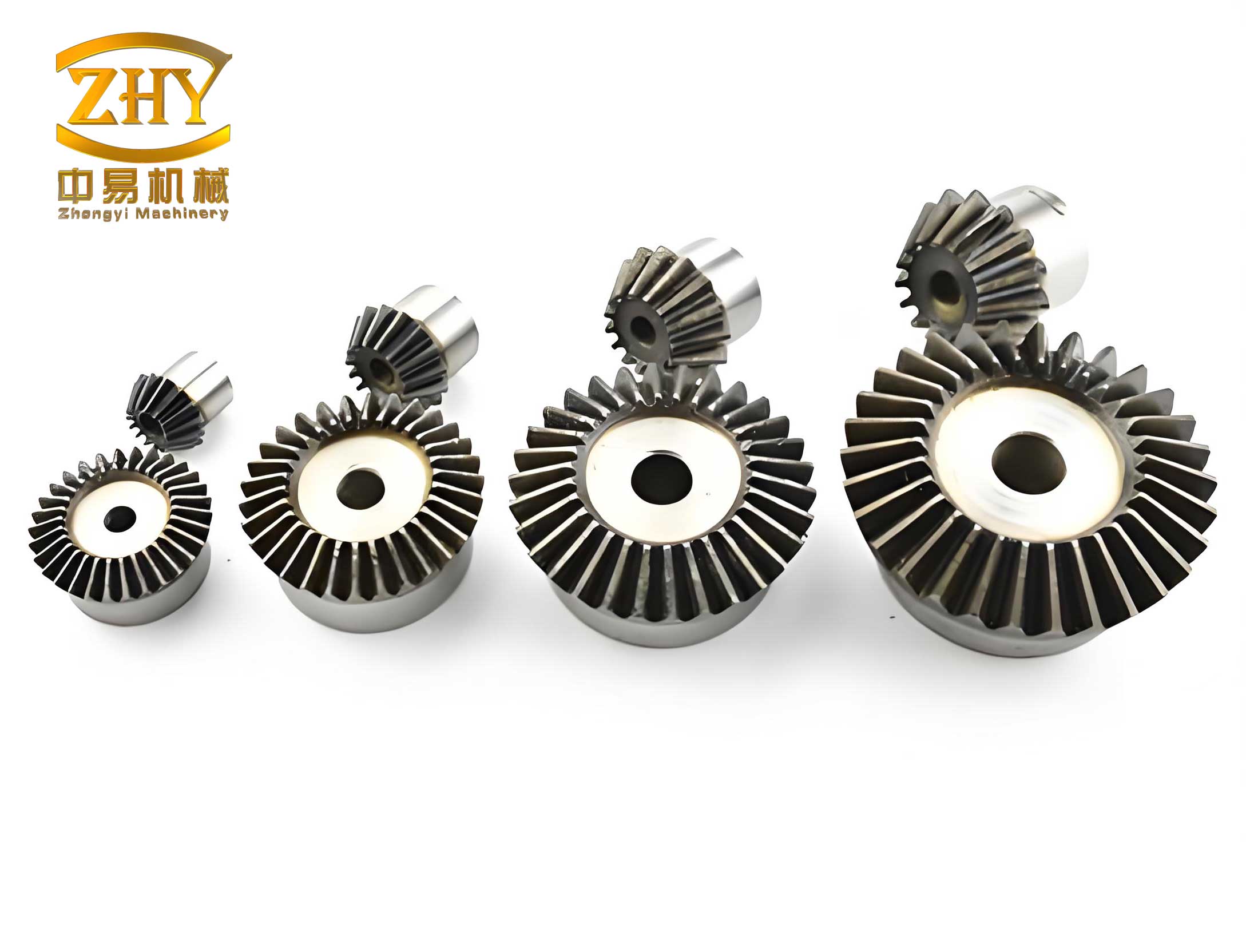
In my experience as an engineer focused on mechanical dynamics and structural integrity, the analysis of vibrational characteristics is paramount for ensuring the reliability and longevity of power transmission components. Among these, bevel gears hold a particularly significant position due to their essential role in transferring motion and power between intersecting axes, commonly found in differentials, industrial gearboxes, and auxiliary transportation systems. The dynamic behavior of bevel gears under operational loads is complex, and unforeseen resonant vibrations can lead to premature failure, increased noise, and catastrophic system breakdowns. Therefore, employing advanced simulation techniques like Finite Element Analysis (FEA) for modal investigation is not just an academic exercise but a critical engineering practice. This article delves deeply into the theoretical foundations, methodological steps, and practical implications of conducting a modal analysis on bevel gears, drawing from established principles and presenting a comprehensive case study.
The fundamental theory governing the linear vibration of a structural component like a gear begins with the equation of motion. For a multi-degree-of-freedom system, this is expressed as:
$$ M \ddot{\delta} + C \dot{\delta} + K \delta = F(t) $$
Where:
- $M$ is the mass matrix of the system.
- $C$ is the damping matrix.
- $K$ is the stiffness matrix.
- $\ddot{\delta}$, $\dot{\delta}$, and $\delta$ are the acceleration, velocity, and displacement vectors, respectively.
- $F(t)$ is the vector of externally applied forces.
Modal analysis specifically deals with the inherent dynamic properties of the structure, independent of external loads. Consequently, we set the force vector $F(t)$ to zero. Furthermore, for the purpose of extracting natural frequencies and mode shapes—the core objectives of a basic modal analysis—damping is often neglected ($C = 0$). This simplifies the equation to the form of undamped free vibration:
$$ M \ddot{\delta} + K \delta = 0 $$
Assuming a harmonic solution of the form $\delta = \phi e^{i \omega t}$, where $\phi$ is the mode shape vector and $\omega$ is the natural frequency in radians per second, we derive the classic eigenvalue problem:
$$ (K – \omega^2 M) \phi = 0 $$
For non-trivial solutions ($\phi \neq 0$), the determinant must vanish:
$$ |K – \omega^2 M| = 0 $$
Solving this eigenvalue problem yields the squared natural frequencies $\omega_i^2$ (the eigenvalues) and their corresponding mode shapes $\phi_i$ (the eigenvectors). The natural frequency in Hertz is $f_i = \omega_i / (2\pi)$. These natural frequencies and mode shapes are intrinsic properties of the structure, dictated solely by its mass distribution, material properties, and geometric stiffness. The primary goal is to ensure that the excitation frequencies encountered during operation, such as gear meshing frequencies, do not coincide with these natural frequencies to avoid resonance.
The accurate construction of a finite element model is the most crucial step that underpins the fidelity of the entire modal analysis for bevel gears. This process involves several meticulous stages, from geometry handling to material definition.
Firstly, the three-dimensional geometry of the bevel gear must be created or imported. While modern CAD software like Siemens NX, SolidWorks, or CATIA can generate highly detailed models, it is often necessary to simplify the geometry for computational efficiency. Small features such as minor fillets, chamfers, or non-critical threads that have negligible impact on the global stiffness and mass distribution can be suppressed. The focus should remain on accurately capturing the macro-geometry: the tooth profile (based on Gleason or Klingelnberg systems), the back cone, the hub, the keyway, and the mounting surfaces. The model is then typically exported in a neutral format like IGES or STEP for seamless integration into FEA pre-processors.
Next, the continuous geometry is discretized into a finite number of small, simple-shaped elements interconnected at nodes—a process known as meshing. For the complex, irregular shape of bevel gears, tetrahedral (tet) elements are highly suitable due to their ability to conform to intricate contours. The choice between linear (first-order) and quadratic (second-order) tetrahedral elements is important. Quadratic elements, with mid-side nodes, provide much better accuracy for stress and dynamic analysis, especially in capturing bending modes, albeit at a higher computational cost. The mesh density must be carefully controlled; a mesh that is too coarse will yield inaccurate results, while an excessively fine mesh will demand unnecessary computational resources. A convergence study, where results are compared across progressively finer meshes until they stabilize, is the recommended practice to establish mesh adequacy. A well-constructed mesh for a medium-sized bevel gear might contain anywhere from 50,000 to 200,000 nodes, ensuring no highly skewed or distorted elements are present.
The material properties assigned to the model directly influence the calculated natural frequencies. For high-performance bevel gears, alloy steels such as 40Cr (AISI 5140), 20CrMnTi (AISI 8620), or 42CrMo (AISI 4140) are common. Their properties must be defined accurately in the FEA software. The key properties for modal analysis are density ($\rho$), Young’s Modulus ($E$), and Poisson’s ratio ($\nu$). Damping properties, while often omitted in basic modal analysis, can be included for more advanced harmonic or transient analyses. The table below summarizes typical material parameters for a common gear steel.
| Material Designation | Density, $\rho$ (kg/m³) | Young’s Modulus, $E$ (GPa) | Poisson’s Ratio, $\nu$ |
|---|---|---|---|
| 40Cr (AISI 5140) | 7,850 | 206 | 0.28 |
| 20CrMnTi (AISI 8620) | 7,850 | 207 | 0.29 |
| 42CrMo (AISI 4140) | 7,850 | 210 | 0.28 |
The final step in model preparation is applying boundary conditions that reflect the gear’s actual mounting constraints. An unconstrained model will have six rigid body modes (zero frequency modes corresponding to three translations and three rotations). To obtain the “free-free” modes, minimal soft supports might be used. However, for a more realistic scenario, the constraints from the shaft, key, and adjacent components must be simulated. This often involves:
- Applying “Cylindrical Support” or “Frictionless Support” on the inner bore surface to represent the shaft connection, restricting radial displacement.
- Applying “Fixed Support” on the axial face(s) where the gear is pressed against a shoulder or spacer, restricting axial movement.
- Applying constraints on the keyway surfaces to simulate the connection with the key.
It is critical that these constraints are applied judiciously, as over-constraining the model will artificially increase its natural frequencies, while under-constraining will lower them.
The dynamic analysis of bevel gears extends beyond simple modal analysis. The meshing action itself provides a time-varying excitation. The fundamental meshing frequency is given by:
$$ f_m = \frac{N \times n}{60} $$
Where $N$ is the number of teeth on the gear in question, and $n$ is its rotational speed in revolutions per minute (RPM). For a pinion with $N_p = 20$ teeth rotating at $n = 980$ RPM, the meshing frequency is:
$$ f_m = \frac{20 \times 980}{60} = 326.67 \text{ Hz} $$
This excitation frequency, along with its harmonics ($2f_m$, $3f_m$, etc.), acts as a forcing function on the gear structure. The core principle of anti-resonance design is to ensure that none of these excitation frequencies coincides with a natural frequency $f_i$ of the gear body. A common safety rule is to maintain a separation margin, for instance:
$$ |f_m – f_i| > 0.2 \times f_i \quad \text{for all significant modes } i $$
Furthermore, the dynamic transmission error—the deviation from perfect conjugate motion between meshing teeth—is a primary source of vibration and noise in gear systems. The stiffness of bevel gears varies periodically as the number of tooth pairs in contact changes (from one to two and back). This parametric excitation can be modeled as a time-varying stiffness $k(t)$ in a simplified single-degree-of-freedom model of the meshing teeth:
$$ m_{eq} \ddot{x} + c \dot{x} + k(t) x = F_{ext} $$
where $m_{eq}$ is the equivalent mass, $c$ is damping, $x$ is the transmission error, and $F_{ext}$ is the external load. Analyzing the response to this type of excitation requires advanced transient or harmonic analysis, for which the modal analysis provides the essential foundation (modal frequencies and shapes can be used in a modal superposition analysis).
To illustrate the practical outcomes, let us consider the results from a modal analysis performed on a spiral bevel gear designed for a heavy-duty application. The gear was constrained as described earlier, and the Block Lanczos eigenvalue solver was used to extract the first six elastic modes (excluding rigid body modes). The results are tabulated below.
| Mode Order | Natural Frequency, $f_i$ (Hz) | Primary Mode Shape Description | Critical Stress Location |
|---|---|---|---|
| 1 | 1,253.5 | Torsional vibration about the gear axis. | Outer rim, diametrically opposite the keyway. |
| 2 | 2,533.1 | Two-node diameter bending (in-plane). Vibration plane parallel to keyway axis. | Outer rim, near the keyway region. |
| 3 | 2,605.5 | Two-node diameter bending (in-plane). Vibration plane perpendicular to keyway axis. | Outer rim, symmetric points perpendicular to keyway. |
| 4 | 2,680.8 | Umbrella (breathing) mode. Whole rim expands/contracts radially. | Entire outer rim circumference. |
| 5 | 2,890.2 | Four-node diameter bending. | Four symmetric lobes on the outer rim. |
| 6 | 2,919.8 | Four-node diameter bending with a phase shift relative to Mode 5. | Four symmetric lobes, shifted 45° from Mode 5. |
The progression of mode shapes reveals critical design insights. Lower-order modes like torsion (Mode 1) and two-node bending (Modes 2 & 3) involve large sections of the gear body moving coherently. These are typically the most critical as they can be more easily excited and involve higher strain energy. Higher-order modes, such as the four-node bending modes (Modes 5 & 6), involve more localized deformation with nodal lines dividing the gear into multiple vibrating sectors. The maximum deformation (antinode) consistently occurs at the outermost points of the gear rim or teeth, identifying these as the most vulnerable areas for dynamic stress concentration.
Comparing the lowest natural frequency (1,253.5 Hz) with the calculated meshing frequency (326.67 Hz) shows a significant separation, with the lowest natural frequency being nearly four times higher. This indicates a low risk of resonance at the fundamental meshing frequency. However, the third harmonic of the meshing frequency ($3f_m = 980$ Hz) approaches the first natural frequency more closely. While still separated by about 28%, this highlights the importance of checking not just the fundamental, but also several harmonics against the modal frequency spectrum, especially in systems with potential for tooth defect excitations which can generate broad-frequency content.
The results of a modal analysis directly feed into several key aspects of gear design and system engineering for bevel gears.
Firstly, it informs resonance avoidance. By knowing the natural frequencies, engineers can tailor the operational speed range of the machinery to ensure that persistent excitation frequencies (meshing frequency and its harmonics, rotational frequency of other components) avoid these critical zones. If an unavoidable conflict exists, design modifications become necessary.
Secondly, it guides structural optimization. The mode shapes visually pinpoint areas of high dynamic flexibility. For instance, if the first bending mode shows excessive rim deflection, potential design changes include:
- Increasing the web thickness or adding ribs to enhance bending stiffness.
- Modifying the rim profile or adding a stiffening ring.
- Using a material with a higher specific stiffness (higher $E/\rho$ ratio).
The objective function in such an optimization could be to maximize the fundamental natural frequency, thereby pushing it farther away from excitation bands, subject to constraints on weight and geometric envelope.
Thirdly, modal analysis is the prerequisite for more complex dynamic response analyses. The extracted mode shapes and frequencies can be used in a Modal Superposition method to efficiently calculate the forced vibration response of the bevel gear to time-varying meshing loads. This response analysis yields dynamic stresses, which are crucial for a modern fatigue life prediction. The dynamic load factor, which accounts for load increases due to vibration, can be more accurately estimated from such an analysis than from empirical charts. The dynamic stress $\sigma_{dyn}$ can be related to the static stress $\sigma_{stat}$ via a dynamic factor $K_v$:
$$ \sigma_{dyn} = K_v \cdot \sigma_{stat} $$
where $K_v$ is a function of the proximity of the excitation frequency to the natural frequency and the system damping. A modal analysis provides the natural frequency component of this relationship.
The performance and results of a modal analysis are sensitive to several parameters. Understanding this sensitivity is key to interpreting results and guiding design.
| Design Parameter | Effect on Natural Frequencies | Governing Relationship |
|---|---|---|
| Young’s Modulus ($E$) | Increase in $E$ increases stiffness ($K$), raising all natural frequencies proportionally to $\sqrt{E}$. | $ f \propto \sqrt{\frac{K}{M}} \propto \sqrt{E} $ |
| Density ($\rho$) | Increase in $\rho$ increases mass ($M$), lowering all natural frequencies proportionally to $1/\sqrt{\rho}$. | $ f \propto \sqrt{\frac{1}{M}} \propto \sqrt{\frac{1}{\rho}} $ |
| Gear Size (Scale Factor) | Geometrically scaling up the gear increases mass faster than stiffness. Natural frequencies decrease with size. | For geometric similarity, $ f \propto \frac{1}{\text{Characteristic Length}} $ |
| Rim/Web Thickness | Increasing thickness significantly boosts bending stiffness, raising bending-mode frequencies more than torsional modes. | Bending stiffness $ \propto $ (Thickness)$^3$ |
| Boundary Conditions | Stiffer constraints (e.g., from a larger/interference-fit shaft) increase effective stiffness, raising frequencies. | Must be modeled as accurately as possible. |
For the bevel gears in question, which operate under demanding conditions with frequent starts/stops and shock loads, the modal analysis confirms the structural design’s adequacy in avoiding resonance with the primary meshing frequency. However, the analysis also reveals the mode shapes where the gear is most compliant. This information is invaluable for planning inspection and monitoring regimes. For instance, vibration sensors could be strategically placed at the antinode locations identified in the first few bending modes (e.g., on the gearbox housing adjacent to the rim near the keyway and opposite it) to best capture incipient dynamic problems.
In conclusion, the modal analysis of bevel gears transcends being a mere validation step; it is a proactive design tool that illuminates the intrinsic dynamic personality of these critical components. From the initial eigenvalue extraction governed by $(K – \omega^2 M)\phi = 0$ to the practical evaluation of resonance risks by comparing $f_m$ with $f_i$, the process provides a scientific basis for decisions that impact safety, noise, vibration, and fatigue life. The case study presented, with natural frequencies spanning 1.2 to 2.9 kHz and distinct torsional and bending mode shapes, is emblematic of the rich dynamic behavior present in even a single bevel gear. Integrating this analysis into the standard design workflow for bevel gears—from automotive differentials to industrial conveyor drives—enables engineers to move beyond static strength calculations and design systems that are robust, quiet, and durable throughout their dynamic operational life. The ultimate goal is to ensure that the powerful and efficient motion transmission facilitated by bevel gears is performed with unwavering reliability.