
The operational efficiency and longevity of rotary hydraulic actuators are fundamentally governed by the lubrication state within their transmission core—the multi-stage helical gear pair. This gear pair translates linear piston motion into high-torque rotary output, a function critical in applications demanding compact power density, such as construction machinery and aerospace systems. The lubrication is achieved via a pressurized oil film residing in the micron-level clearance between the meshing helical surfaces. The characteristics of this oil film—its pressure distribution, flow dynamics, and load-bearing stiffness—directly dictate mechanical efficiency, leakage rates, and overall actuator performance. This analysis delves into the fluid-structure interaction within this confined spiral passage, establishing a framework to model its behavior, simulate its flow field under various clearances, and optimize its design parameters for peak operational efficacy.
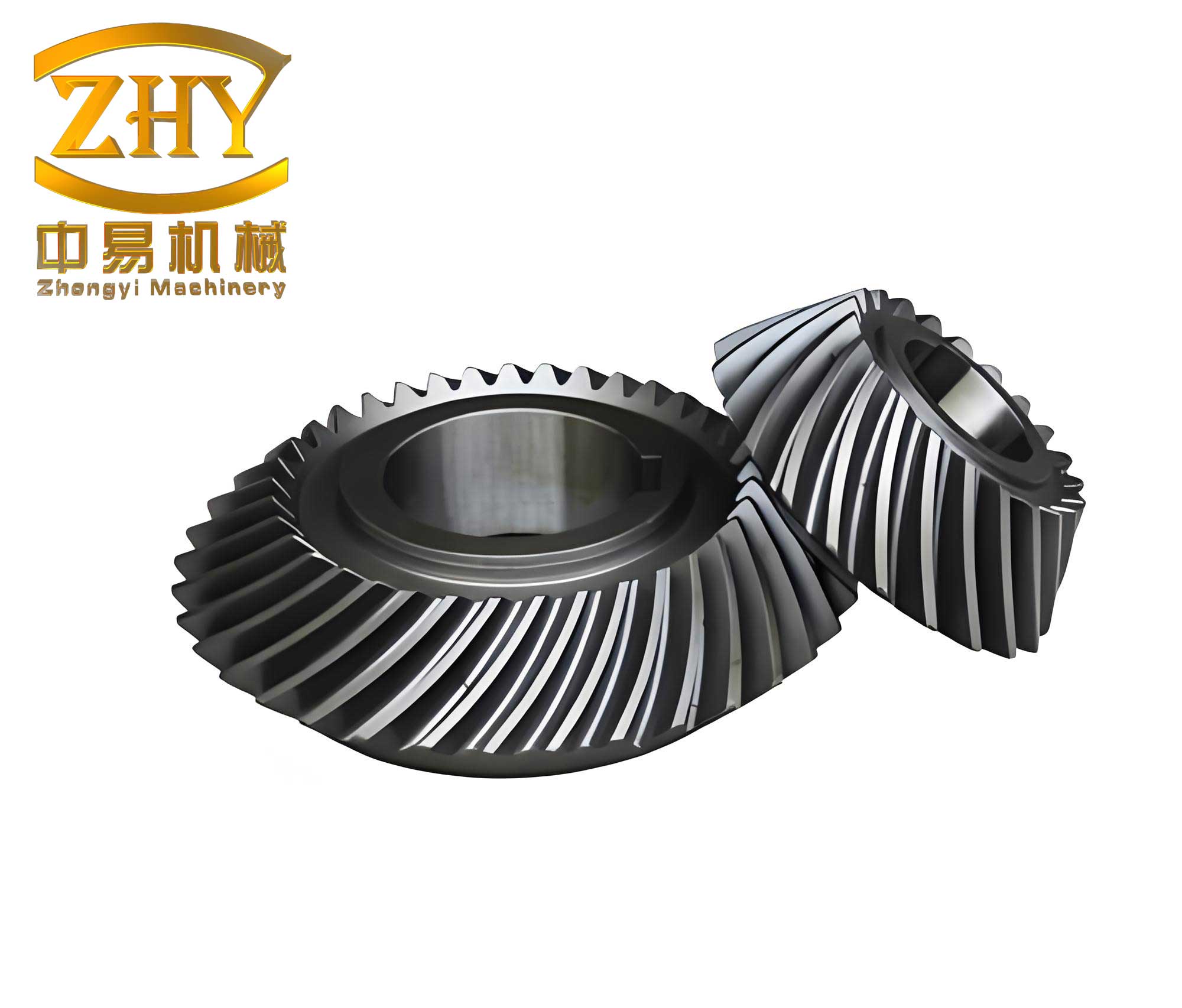
Structural Configuration and Operational Principles
The actuator’s torque generation relies on a two-stage planetary helical gear system. The primary stage consists of a hollow screw, which functions as the nut, engaging with internal threads of a stationary sleeve. The secondary stage is formed between the internal threads of this hollow screw and the external threads of the central output shaft. Critically, the hand of the helix on these two stages is opposite. The hollow screw divides the actuator cylinder into two pressure chambers. Pressurizing one chamber imparts axial and rotational motion to the hollow screw via the first-stage helical gear pair. This motion is then transmitted and converted into a pure, amplified rotation of the output shaft via the second-stage pair. The entire kinematic chain operates within a bath of hydraulic fluid, which is forced into the clearances, forming a critical load-bearing and lubricating film. The geometry of this spiral gear interface is thus the primary determinant of the system’s fluid dynamics.
Mathematical Foundation for Spiral Gear Oil Film Analysis
To quantitatively analyze the oil film within the spiral gear clearance, the flow is governed by the fundamental laws of fluid mechanics: conservation of mass, momentum, and energy. For an incompressible, viscous fluid (hydraulic oil), these can be expressed as follows.
The continuity equation ensures mass conservation:
$$ \frac{\partial u_x}{\partial x} + \frac{\partial u_y}{\partial y} + \frac{\partial u_z}{\partial z} = 0 $$
where $u_x$, $u_y$, and $u_z$ are the velocity components in the Cartesian coordinate directions.
The Navier-Stokes equations describe momentum conservation. For a Newtonian fluid, they are:
$$ \rho \left( \frac{\partial \mathbf{v}}{\partial t} + \mathbf{v} \cdot \nabla \mathbf{v} \right) = -\nabla p + \mu \nabla^2 \mathbf{v} + \mathbf{F} $$
where $\rho$ is the fluid density, $\mathbf{v}$ is the velocity vector, $p$ is the pressure, $\mu$ is the dynamic viscosity, and $\mathbf{F}$ represents body forces. In the context of the thin, spiraling oil film, these equations simplify but remain essential for resolving pressure gradients and shear stresses.
The energy equation, relevant for assessing thermal effects, is:
$$ \rho c_p \left( \frac{\partial T}{\partial t} + \mathbf{v} \cdot \nabla T \right) = \nabla \cdot (k \nabla T) + \Phi $$
where $T$ is temperature, $c_p$ is specific heat, $k$ is thermal conductivity, and $\Phi$ is the viscous dissipation function. For the initial structural optimization focused on mechanical performance, an isothermal analysis is often sufficient, making the momentum equation primary.
Computational Fluid Dynamics Model Setup
A three-dimensional model of the oil film domain was created, representing the fluid volume trapped between the engaged threads of the spiral gear pair. The model simplification assumes a uniform circumferential clearance, $h$, and perfect concentricity. Six distinct models were generated with clearances of 0.05, 0.10, 0.15, 0.20, 0.25, and 0.30 mm to investigate the sensitivity of performance to this critical gap. The fluid domain was discretized using a structured, swept meshing technique with localized refinement in the narrow clearance region to capture steep velocity gradients accurately. A summary of the mesh independence study and final mesh quality is presented below.
| Model Parameter | Value / Description |
|---|---|
| Mesh Type | Structured Hexahedral (Swept) |
| Total Element Count | ~2.4 – 2.5 million (per model) |
| Near-Wall Refinement | 5-10 layers with growth factor 1.2 |
| Mesh Quality (Skewness) | < 0.85 |
| Solver & Algorithm | Fluent, Pressure-Based Coupled |
| Turbulence Model | Realizable k-ε with Enhanced Wall Treatment |
The boundary conditions were defined to mimic operational conditions. The inner wall (output shaft thread surface) was set as a rotating wall with a tangential speed corresponding to 60 RPM. The outer wall (hollow screw thread surface) was stationary. The spiral ends of the fluid domain were defined as pressure inlet (21 MPa gauge) and pressure outlet (1.5 MPa gauge), representing the working and return line pressures, respectively. Hydraulic oil ISO VG 32 was used as the working fluid with density $\rho = 889\ kg/m^3$ and kinematic viscosity $\nu = 32\ cSt$.
Flow Field Characteristics and Clearance-Dependent Performance
The simulation results provide a detailed view of the pressure and velocity fields within the complex spiral gear oil film. The pressure distribution exhibits a clear gradient from the high-pressure inlet to the low-pressure outlet, as dictated by the Poiseuille flow component. Importantly, the pressure contours remain relatively consistent across the tooth profile for a given clearance, indicating that the helical shape’s primary effect is to guide and constrain the flow path rather than create localized extreme pressure zones under these conditions.
The velocity field is more illustrative of the clearance’s impact. The flow is a superposition of pressure-driven flow (Poiseuille) and shear-driven Couette flow due to the relative rotation. The maximum axial velocity within the film shows a non-linear relationship with clearance, $h$, as plotted below.
The performance metrics of torque transmission, leakage flow rate ($Q$), and oil film stiffness ($K$) are critical for actuator design. The stiffness, defined as the change in load-bearing force per unit change in film thickness ($K = \Delta F / \Delta h$), is a direct indicator of the film’s ability to maintain separation under load. The following table synthesizes the key performance indicators extracted from the simulations for the six clearance values.
| Clearance, h (mm) | Max Axial Velocity (m/s) | Flow Rate, Q (L/min) | Transmitted Torque (N·m) | Estimated Film Stiffness, K (N/µm) |
|---|---|---|---|---|
| 0.05 | 12.4 | 0.85 | 1520 | 8.45 |
| 0.10 | 14.3 | 2.15 | 1680 | 5.60 |
| 0.15 | 15.1 | 3.98 | 1780 | 3.92 |
| 0.20 | 15.5 | 6.35 | 1850 | 2.95 |
| 0.25 | 14.8 | 9.12 | 1865 | 2.31 |
| 0.30 | 13.9 | 12.45 | 1870 | 1.87 |
The data reveals clear trade-offs. As clearance increases, the flow rate rises significantly due to reduced flow resistance, which directly increases volumetric leakage and reduces volumetric efficiency. Concurrently, the transmitted torque increases but plateaus after approximately $h = 0.20$ mm. The oil film stiffness, however, decreases monotonically with increasing clearance, implying a reduced capacity to resist load-induced thinning of the film. The optimal clearance is therefore a compromise: sufficient to allow lubricant flow and avoid solid contact, but minimal to maximize stiffness and minimize leakage. The analysis identifies $h = 0.20$ mm as a balanced optimum for this specific spiral gear geometry, where torque is near its peak while stiffness remains reasonably high and the leakage flow, though present, is controlled.
Influence of Hydraulic Oil Viscosity on Spiral Gear Film Performance
The properties of the hydraulic fluid itself are a vital design variable. The dynamic performance of the spiral gear oil film was investigated for four common ISO viscosity grades (VG): 22, 32, 46, and 68, keeping the optimal clearance of 0.20 mm constant. The primary variable is the dynamic viscosity, $\mu = \rho \nu$.
The results demonstrate predictable yet important trends. Higher viscosity oil experiences greater shear and flow resistance within the confined spiral gear clearance. This leads to a reduction in the maximum flow velocity and a significant decrease in the volumetric flow rate (leakage), enhancing volumetric efficiency. The relationship between leakage flow $Q$ and viscosity $\mu$ for a given pressure drop $\Delta P$ and clearance $h$ in a narrow gap can be approximated by a modified form of the flow between parallel plates, scaled by the spiral length $L$:
$$ Q \propto \frac{h^3 \Delta P}{\mu L} $$
This inverse relationship is clearly observed in the simulation data.
However, the effect on oil film stiffness is more complex. Stiffness initially increases with viscosity due to stronger hydrodynamic pressure generation (higher damping). Beyond an optimum point, excessive viscous resistance can hinder the rapid establishment of pressure across the film, potentially reducing its dynamic responsiveness and effective stiffness. The simulated data for the 0.20 mm clearance case is summarized below.
| Oil Grade (ISO VG) | Kinematic Viscosity, ν @40°C (cSt) | Flow Rate, Q (L/min) | Film Stiffness, K (N/µm) |
|---|---|---|---|
| 22 | 22 | 7.85 | 2.70 |
| 32 | 32 | 6.35 | 2.95 |
| 46 | 46 | 5.10 | 2.80 |
| 68 | 68 | 3.92 | 2.55 |
For the high-pressure, low-speed, and high-load conditions typical of these rotary actuators, a lower viscosity oil like VG 32 provides the best compromise. It offers lower internal friction (higher mechanical efficiency), adequate film stiffness as seen in the table, and sufficient lubricity while maintaining acceptable leakage levels. Very low viscosity oil (VG 22) may lead to excessive leakage and potential boundary lubrication issues under extreme loads, whereas higher viscosity oils (VG 46, 68) increase power losses and may not significantly improve, and can even degrade, the dynamic stiffness of the spiral gear interface.
Conclusion and Optimization Guidelines
The performance of a helical-gear-based rotary hydraulic actuator is intrinsically linked to the fluid dynamics of the oil film within its spiral gear pair clearance. Through detailed computational fluid dynamics modeling, this analysis has quantified the interplay between geometric design and fluid properties. The circumferential clearance of the gear pair is a pivotal parameter. An optimum value exists that balances the competing demands of torque capacity, oil film stiffness, and volumetric efficiency. For the studied actuator geometry, a clearance of 0.20 mm was identified as optimal, providing near-maximum torque transmission while maintaining film stiffness and controlling leakage.
Furthermore, the choice of hydraulic oil viscosity is not arbitrary. While higher viscosity reduces leakage, it also increases friction losses and may not optimize the load-bearing stiffness of the film. For robust performance in demanding low-speed, high-torque applications, a medium viscosity grade oil, such as ISO VG 32, is recommended. It effectively supports the hybrid hydrostatic/hydrodynamic lubrication regime in the spiral gear interface, ensuring high mechanical efficiency, reliable load support, and sustained actuator longevity. This systematic approach to analyzing and optimizing the micro-scale oil film provides a powerful methodology for enhancing the macro-scale performance and reliability of critical rotary hydraulic drive systems.