
In the realm of power transmission systems, bevel gears play a pivotal role in transferring motion between intersecting shafts, particularly in automotive, aerospace, and industrial machinery. The precision of bevel gears directly influences the efficiency, noise, vibration, and overall performance of these systems. However, the measurement of bevel gears has long been a challenging endeavor due to their complex geometry and the limitations of traditional contact-based inspection methods. Conventional techniques often involve intricate setups, manual interventions, and time-consuming processes, leading to inefficiencies and potential inaccuracies. This article presents a comprehensive exploration of a novel non-contact measurement methodology for bevel gears, leveraging a laser displacement sensor to assess critical parameters such as pitch deviation and tooth ring radial run-out. We will delve into the underlying principles, mathematical formulations, experimental procedures, and analytical techniques, aiming to provide a robust framework for the high-precision evaluation of bevel gears.
The impetus for this research stems from the observed gap in accessible, efficient, and precise measurement solutions for bevel gears, especially among small to medium-sized manufacturers. While advanced coordinate measuring machines (CMMs) and dedicated gear measurement centers exist, their high cost, operational complexity, and reliance on physical probe contact often render them impractical for widespread use. Our approach seeks to democratize precision metrology for bevel gears by employing a non-contact laser sensor, which eliminates issues related to probe radius compensation, surface deformation, and complex path planning. This method not only simplifies the measurement process but also enhances speed and repeatability. Throughout this discourse, we will consistently emphasize the application to bevel gears, underscoring the adaptability of our technique to various configurations of bevel gears, including straight, spiral, and zerol types, though the primary focus here is on straight bevel gears for illustrative clarity.
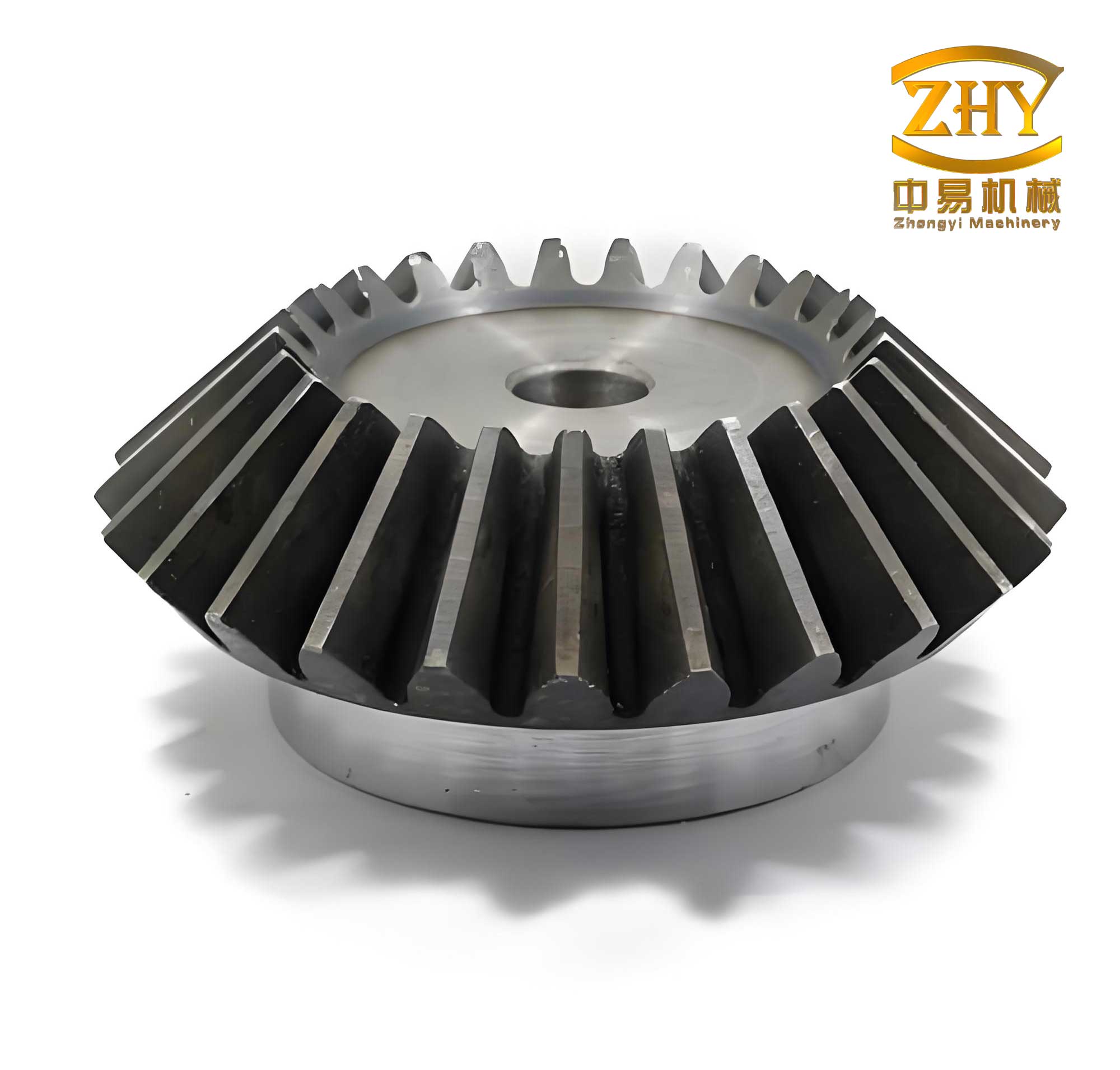
The core of our measurement system is a custom-built apparatus designed to capture the tooth profile of bevel gears with high fidelity. The device comprises several key components: a precision rotary stage to hold and rotate the bevel gear, a three-axis linear motion system (X, Y, Z) for positioning, and a high-resolution laser displacement sensor mounted on the Z-axis. The rotary stage incorporates a high-accuracy angular encoder, while each linear axis is equipped with linear encoders, ensuring precise feedback for position control. The laser displacement sensor operates on the principle of optical triangulation, emitting a focused beam onto the gear tooth surface and detecting the reflected light to calculate the distance to the surface. This non-contact method allows for rapid data acquisition without mechanical interaction, preserving the integrity of the gear surface and enabling measurements on delicate or finished components. The entire system is orchestrated by a dedicated motion controller and custom software, which synchronizes sensor data collection with positional data from the encoders.
The fundamental measurement principle is based on coordinate metrology. The bevel gear is mounted on the rotary stage such that its axis of rotation is aligned with the system’s reference axis. The laser sensor is then positioned to interrogate the tooth profile at a specific location, typically the mid-face width point, which is a conventional reference for bevel gear inspection. As the gear undergoes controlled rotation, the laser spot traverses the tooth flank, and the sensor continuously records the distance from its reference plane to the tooth surface. Simultaneously, the angular position of the gear from the rotary encoder is recorded. This process yields a dense set of data points, each consisting of an angular coordinate and a corresponding radial distance value. This raw data represents the actual tooth profile in a polar-like coordinate system relative to the sensor’s frame. The challenge and innovation lie in transforming this raw data into a geometrically meaningful model that allows for the extraction of standard gear error parameters.
To analyze the bevel gear errors, we must first construct a mathematical model of the ideal tooth profile and then map the measured data onto this model. For a straight bevel gear, the tooth profile at the mid-face width can be approximated as an involute curve on a back-cone developed surface. The key parameters of the bevel gear are: number of teeth $z$, module at the large end $m_e$, face width $b$, pitch cone angle $\delta$, and gear ratio. From these, we derive the mid-face width parameters. The mid-face width radius $r_m$ and the mid-face width cone distance $R_m$ are calculated as:
$$ r_m = \frac{m_e z}{2} (1 – 0.5 \phi_R) $$
$$ R_m = R_e (1 – 0.5 \phi_R) $$
where $R_e$ is the outer cone distance ($R_e = \frac{m_e z}{2 \sin \delta}$) and $\phi_R$ is the face width factor ($\phi_R = b / R_e$, typically 0.3). The equivalent number of teeth for the developed profile is $z_v = z / \cos \delta$. The theoretical tooth profile at the mid-face width is essentially an involute of a base circle with radius $r_{bm} = r_m \cos \alpha$, where $\alpha$ is the pressure angle (usually 20°). However, for error calculation, we often work with the coordinate representation directly.
The raw measurement data consists of pairs $(\theta_i, d_i)$, where $\theta_i$ is the angular position from the rotary encoder and $d_i$ is the distance measured by the laser sensor. This distance is relative to the sensor’s zero point. To convert this into gear-centric coordinates, we perform a series of transformations. First, we establish a reference. The laser sensor is positioned so that when it measures the theoretical pitch cone surface at the mid-face width, the distance reading corresponds to a nominal value $D_0$. The deviation $H_i$ of the actual surface from this theoretical pitch cone is then:
$$ H_i = d_i – D_0 $$
A positive $H_i$ indicates a point outside the theoretical pitch cone (towards the tooth tip), and negative indicates inside (towards the root). To visualize and analyze the profile in a Cartesian plane, we “develop” the conical surface onto a plane. The development involves mapping a point on the cone to a point in a plane sector. The radius from the cone apex to the mid-face width point is $L = R_m / \sin \delta = R_m \csc \delta$. In the developed plane, this corresponds to a radial coordinate. The corresponding developed angle for the entire gear is $\alpha_d = 2\pi r_m / L$. Therefore, each measured angular position $\theta_i$ (relative to a starting tooth) maps to a developed angle $\beta_i$:
$$ \beta_i = \frac{\theta_i}{\theta_{\text{total}}} \alpha_d $$
where $\theta_{\text{total}}$ is the total angular rotation for one complete gear revolution. The Cartesian coordinates $(x_i, y_i)$ of the measured point in the developed plane are then:
$$ x_i = (L + H_i) \sin \beta_i $$
$$ y_i = (L + H_i) \cos \beta_i $$
This transformation converts the measured data into a set of points that represent the tooth profile as if it were laid out flat. This planar representation is crucial for applying standard gear analysis algorithms. The following table summarizes the key coordinate transformation parameters for a sample bevel gear:
| Parameter | Symbol | Value | Unit |
|---|---|---|---|
| Number of Teeth | $z$ | 36 | – |
| Large End Module | $m_e$ | 2.5 | mm |
| Pitch Cone Angle | $\delta$ | 45° | degree |
| Face Width | $b$ | 20 | mm |
| Mid-face Radius | $r_m$ | 42.5 | mm |
| Cone Distance (Mid) | $R_m$ | 60.1 | mm |
| Development Radius | $L$ | 85.0 | mm |
| Developed Angle | $\alpha_d$ | 3.142 rad | rad |
With the tooth profile represented in Cartesian coordinates, we can proceed to calculate specific error metrics for the bevel gear. The first major parameter is the single pitch deviation $\Delta f_{pt}$. According to gear standards, this is the difference between the actual pitch and the theoretical pitch at the pitch circle. In our planar model, the pitch circle corresponds to the circle with radius $L$ (since $H_i=0$ theoretically). We first need to locate the actual intersection points of the tooth flanks with this reference circle. For each tooth space, we identify data points near $H_i \approx 0$. Using interpolation (e.g., cubic spline or polynomial fitting) on a small set of points around this region, we can accurately solve for the point where the profile intersects the circle of radius $L$. Let these intersection points for two adjacent tooth flanks be $P_k(x_k, y_k)$ and $P_{k+1}(x_{k+1}, y_{k+1})$. The actual arc length between them along the pitch circle is the chord length corrected by the arc geometry. The chord length $C_k$ is:
$$ C_k = \sqrt{(x_{k+1} – x_k)^2 + (y_{k+1} – y_k)^2} $$
The corresponding central angle $\gamma_k$ subtended by this chord on the circle of radius $L$ is:
$$ \gamma_k = 2 \arcsin\left( \frac{C_k}{2L} \right) $$
The actual pitch $p_{a,k}$ is then the arc length:
$$ p_{a,k} = L \cdot \gamma_k $$
The theoretical pitch at the mid-face width is:
$$ p_t = \pi m_m = \pi m_e (1 – 0.5 \phi_R) $$
Thus, the single pitch deviation for the k-th pitch is:
$$ \Delta f_{pt,k} = p_{a,k} – p_t $$
The cumulative pitch error $\Delta F_{p,k}$ over k pitches is the sum of deviations:
$$ \Delta F_{p,k} = \sum_{i=1}^{k} \Delta f_{pt,i} $$
And the total cumulative pitch error $\Delta F_p$ is the maximum range of $\Delta F_{p,k}$ over all teeth. These calculations are performed algorithmically for all teeth of the bevel gear. The process is summarized in the following formula sequence for clarity:
$$ \text{Find } P_k: \text{Solve } \sqrt{x_i^2 + y_i^2} = L \text{ using interpolated profile data.} $$
$$ \text{Compute chord: } C_k = ||P_{k+1} – P_k|| $$
$$ \text{Compute angle: } \gamma_k = 2 \sin^{-1}\left( \frac{C_k}{2L} \right) $$
$$ \text{Actual pitch: } p_{a,k} = L \gamma_k $$
$$ \text{Deviation: } \Delta f_{pt,k} = p_{a,k} – \pi m_e (1 – 0.5 \phi_R) $$
The second critical parameter is the tooth ring radial run-out $F_r$. This is defined as the maximum variation in the position of a reference point (like a ball seated in the tooth space) relative to the gear axis during one complete revolution. Traditional methods use a master ball or probe, but we simulate this computationally. For each tooth space, we consider the two flank points $P_{k,L}$ and $P_{k,R}$ on the pitch circle (left and right flanks). At these points, we construct lines normal to the tooth profile. For an involute, the normal at a point on the pitch circle passes through the base circle. In our discrete coordinate model, we approximate the normal by calculating the tangent. For a point $(x, y)$, the slope of the tangent can be derived from the derivative of the interpolated profile function. However, a more geometric approach is to use the fact that for a point on the pitch circle, the normal makes an angle equal to the pressure angle $\alpha$ with the radial line. The radial line from the origin (apex of developed cone) to the point $P_k$ has an angle $\psi_k = \arctan(y_k / x_k)$ (adjusted for quadrant). Therefore, the normal direction for the left flank point $P_{k,L}$ has an angle $\psi_{k,L} + \alpha$, and for the right flank point $P_{k,R}$, it is $\psi_{k,R} – \alpha$. The equations of the two normal lines are:
$$ \text{Left normal: } y – y_{k,L} = \tan(\psi_{k,L} + \alpha)(x – x_{k,L}) $$
$$ \text{Right normal: } y – y_{k,R} = \tan(\psi_{k,R} – \alpha)(x – x_{k,R}) $$
The intersection point $Q_k(x_{Q,k}, y_{Q,k})$ of these two lines represents the center of a virtual master ball that would simultaneously contact both flanks at the pitch circle. Solving these two linear equations gives the coordinates of $Q_k$. The distance from the origin $O(0,0)$ (which corresponds to the cone apex in the developed plane, but in the measurement context, it aligns with the gear axis projection) to $Q_k$ is:
$$ R_{Q,k} = \sqrt{x_{Q,k}^2 + y_{Q,k}^2} $$
For a perfect bevel gear, all $R_{Q,k}$ would be equal. The variation in $R_{Q,k}$ over one revolution indicates the radial run-out. We typically reference the first tooth space, so the run-out for the k-th space is:
$$ \Delta f_{r,k} = R_{Q,k} – R_{Q,1} $$
The tooth ring radial run-out $F_r$ is then:
$$ F_r = \max(\Delta f_{r,k}) – \min(\Delta f_{r,k}) $$
This computational simulation of the master ball method eliminates the need for physical balls of different sizes and avoids contact errors, providing a precise and consistent measure for bevel gears.
To validate our methodology, we conducted a series of experiments on various bevel gears. One representative test involved a straight bevel gear with parameters: $z=36$, $m_e=2.5\,\text{mm}$, $\delta=45^\circ$, $b=20\,\text{mm}$, pressure angle $\alpha=20^\circ$. The gear was mounted on the rotary stage, and the laser sensor was aligned to the mid-face width. The gear was rotated continuously at a slow speed (0.5 RPM) while data was acquired at a sampling rate of 10 kHz, resulting in over 100,000 data points per revolution. The raw data was processed using the algorithms described above. The following table presents a subset of the calculated pitch deviations for the first 10 teeth:
| Tooth Index (k) | Actual Pitch $p_{a,k}$ (mm) | Theoretical Pitch $p_t$ (mm) | Single Pitch Deviation $\Delta f_{pt,k}$ (mm) | Cumulative Error $\Delta F_{p,k}$ (mm) |
|---|---|---|---|---|
| 1 | 7.854 | 7.854 | 0.000 | 0.000 |
| 2 | 7.851 | 7.854 | -0.003 | -0.003 |
| 3 | 7.860 | 7.854 | +0.006 | +0.003 |
| 4 | 7.848 | 7.854 | -0.006 | -0.003 |
| 5 | 7.857 | 7.854 | +0.003 | 0.000 |
| 6 | 7.852 | 7.854 | -0.002 | -0.002 |
| 7 | 7.859 | 7.854 | +0.005 | +0.003 |
| 8 | 7.850 | 7.854 | -0.004 | -0.001 |
| 9 | 7.862 | 7.854 | +0.008 | +0.007 |
| 10 | 7.846 | 7.854 | -0.008 | -0.001 |
From the full data set, the maximum single pitch deviation was found to be $\Delta f_{pt,\text{max}} = +0.012\,\text{mm}$ and the minimum was $\Delta f_{pt,\text{min}} = -0.010\,\text{mm}$. The total cumulative pitch error $\Delta F_p$ was $0.045\,\text{mm}$. For the tooth ring run-out, the computed distances $R_{Q,k}$ varied between a minimum of $85.002\,\text{mm}$ and a maximum of $85.085\,\text{mm}$, yielding a radial run-out $F_r = 0.083\,\text{mm}$. These values can be compared against tolerance grades specified in standards like ISO 17485 or AGMA 2005. For this gear, the results correspond approximately to a quality grade of 8-9 according to ISO standards, indicating acceptable but not excellent precision, which is typical for mass-produced bevel gears used in general machinery.
The advantages of our laser-based non-contact method for measuring bevel gears are manifold. First, the speed of data acquisition is significantly higher than contact methods; a full 360-degree scan can be completed in under two minutes, including setup. Second, the absence of physical contact eliminates probe wear, measurement force deformation, and the need for probe radius compensation, which is particularly complex for bevel gears due to their varying curvature. Third, the method captures a dense point cloud of the entire tooth flank, enabling not only the calculation of pitch and run-out but also potential future analysis of profile error, lead error, and surface topography. The mathematical framework we developed is robust and can be adapted to different types of bevel gears by adjusting the coordinate transformation parameters. For instance, for spiral bevel gears, the development process would involve accounting for the curved tooth trace, but the core principle of non-contact data acquisition and coordinate-based analysis remains applicable.
Potential sources of error in our system include alignment inaccuracies, thermal effects on the sensor and stages, and environmental vibrations. The laser sensor itself has a specified linearity error (e.g., ±0.05% of full scale) and resolution (e.g., 0.5 µm). The rotary and linear encoders contribute angular and positional uncertainties. To mitigate these, we employ careful calibration procedures using master artifacts, such as a precision sphere or reference gear, and conduct measurements in a controlled environment. The software includes filters to remove noise and outliers from the data, as mentioned in the initial data processing step where points with abrupt changes are smoothed. Additionally, the interpolation and curve-fitting algorithms introduce numerical errors, but these are minimized by using high-order interpolation and ensuring sufficient data density. For critical applications, uncertainty analysis can be performed by propagating the individual error sources through the mathematical model.
In conclusion, the integration of a laser displacement sensor into a coordinate measurement framework provides a powerful, efficient, and precise solution for the inspection of bevel gears. This non-contact approach simplifies the measurement process, reduces cycle times, and enhances repeatability. By transforming measured data into a developed planar coordinate system, we enable the computation of standard gear errors such as pitch deviation and tooth ring radial run-out using straightforward geometric and trigonometric relationships. The method is scalable and can be implemented with relatively modest hardware compared to full-fledged gear measurement centers. Future work could focus on extending the analysis to more complex bevel gear geometries, such as hypoid gears, and integrating real-time feedback for adaptive manufacturing processes. As the demand for high-performance bevel gears continues to grow in industries like electric vehicles and robotics, advanced metrology techniques like the one described here will play an increasingly vital role in ensuring quality and reliability. Ultimately, this methodology contributes to the broader goal of making precision measurement of bevel gears more accessible, accurate, and efficient for manufacturers worldwide.
Throughout this exploration, the centrality of bevel gears in mechanical systems has been underscored, and the need for precise measurement of bevel gears is clear. Our laser-based system offers a viable path forward. The mathematical models and algorithms presented are general and can be applied to a wide range of bevel gears, from small instrument gears to large industrial ones. By continuing to refine these techniques, we can help bridge the gap between design intent and manufactured reality for bevel gears, ensuring smoother transmissions, quieter operation, and longer service life. The journey towards perfect bevel gears is iterative, and precise measurement is the compass that guides each step.