
In the realm of pure electric passenger vehicles, the differential stands as a pivotal component within the powertrain system. Its primary function is to manage speed differences between the left and right wheels during turns, ensuring smooth power transmission and vehicle stability. The quality and precision of the differential, particularly the bevel gears—comprising the side gears (半轴齿轮) and planet gears (行星齿轮)—directly influence overall vehicle efficiency, noise levels, and driving comfort. As the automotive industry shifts toward electrification, optimizing differential assembly processes has become crucial. In this article, I will delve into the structural nuances of differentials, compare passenger car and commercial vehicle designs, outline assembly workflows, and propose an automated solution for controlling axial clearance in bevel gears. This approach aims to enhance production efficiency and product reliability in high-volume manufacturing settings.
The differential in a pure electric passenger car is typically compact and integrated into the reducer assembly. Power from the electric motor is transmitted through the reducer to the differential case, which then drives the side gears. These bevel gears, in turn, rotate the left and right axle shafts to propel the wheels. During straight-line driving, the planet gears and side gears rotate uniformly, but during turns, speed differentials occur, allowing the wheels to rotate at different rates. The fundamental kinematic relationship governing differential operation is expressed as:
$$N_{\text{left}} + N_{\text{right}} = 2 \times N_{\text{carrier}}$$
where \(N_{\text{left}}\) and \(N_{\text{right}}\) denote the rotational speeds of the left and right wheels, respectively, and \(N_{\text{carrier}}\) represents the speed of the planet gear carrier. This equation ensures proper torque distribution and wheel synchronization.
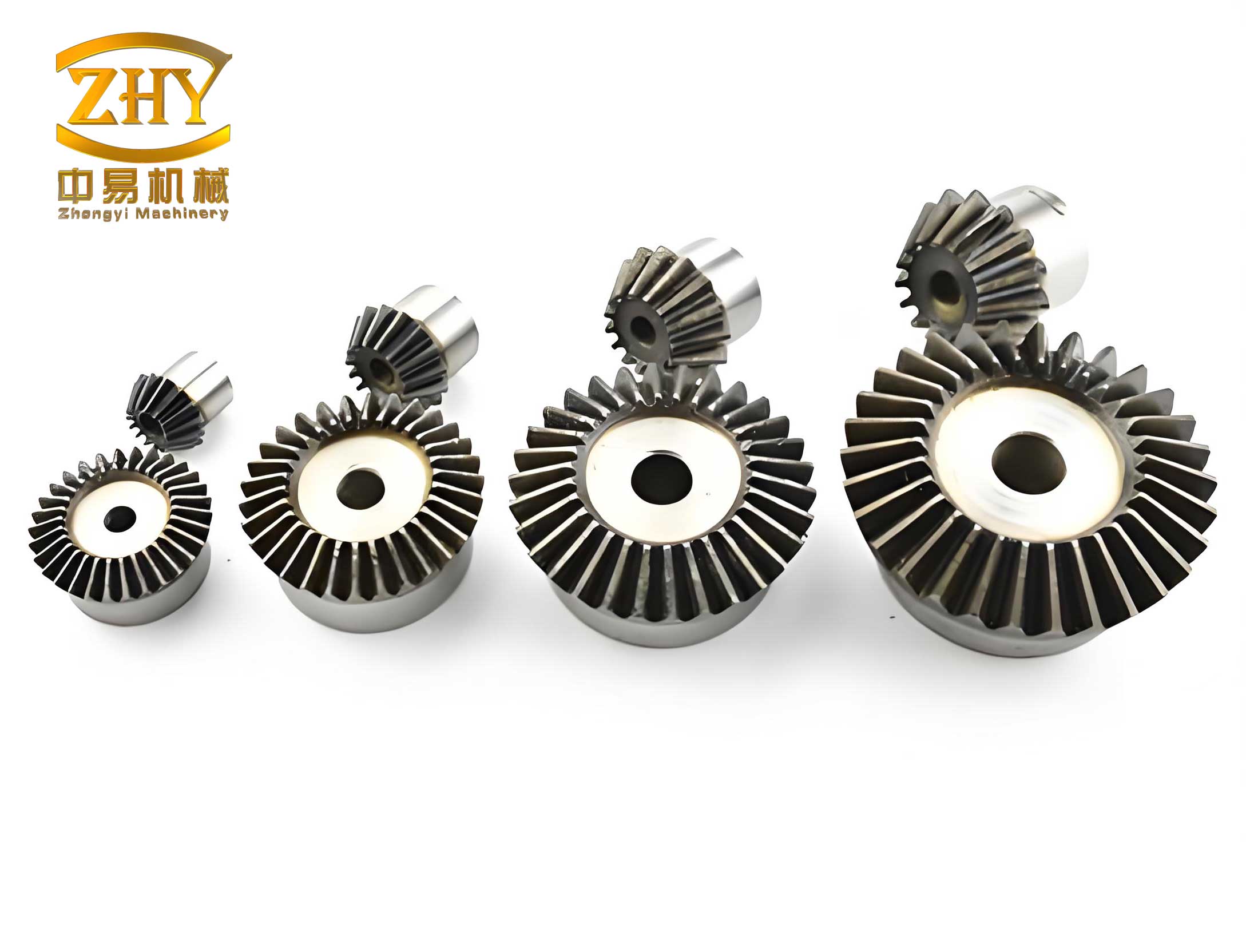
Structurally, pure electric passenger car differentials differ significantly from their commercial vehicle counterparts. Commercial vehicle differentials often feature a split-case design, which facilitates assembly and allows for direct measurement of gear backlash. In contrast, passenger car differentials utilize a one-piece case, making internal inspections challenging. Additionally, commercial vehicles typically employ four planet bevel gears arranged in a cross-pin configuration, forming a stable plane that minimizes冲击 during gear engagement. Passenger cars, however, commonly use only two planet bevel gears, which can lead to greater摆动 and noise if precision is not maintained. This necessitates higher manufacturing tolerances for passenger car bevel gears to ensure smooth operation. The following table summarizes key distinctions:
| Aspect | Pure Electric Passenger Car Differential | Commercial Vehicle Differential |
|---|---|---|
| Case Design | One-piece, integrated | Split-case, modular |
| Planet Gear Count | Typically 2 bevel gears | Typically 4 bevel gears |
| Assembly Complexity | High due to limited access | Lower, allowing easier measurement |
| Gear Precision Requirement | Higher to reduce noise and vibration | Moderate due to robust design |
The performance of bevel gears in differentials profoundly impacts vehicle noise, vibration, and harshness (NVH). In pure electric vehicles, the absence of internal combustion engine noise makes gear whine and rattling more perceptible. Improper axial clearance in bevel gears can lead to excessive backlash, causing冲击 during torque transmission and elevating noise levels. Moreover, inadequate clearance may result in premature wear or binding, compromising differential reliability. Thus, controlling axial clearance is not merely an assembly step but a critical quality assurance measure to ensure longevity and driver comfort.
In mass production, differential assembly follows a streamlined workflow to maintain consistency and throughput. For pure electric passenger cars, the typical sequence involves: installing side gears and their thrust washers, placing planet gears and washers, inserting the planet gear shaft, and finally measuring axial clearance. This process is often automated on assembly lines to handle high volumes. However, the one-piece case design complicates direct inspection of gear meshing parameters like contact pattern and backlash. Consequently, manufacturers rely on indirect control via axial clearance measurements, which correlate with gear backlash. The axial clearance, denoted as \(\Delta L\), is defined as the distance the side gear can move axially between its uppermost position (contacting the case) and its lowest point (engaging with the planet gears). Mathematically, it is expressed as:
$$\Delta L = |M_2 – M_1|$$
where \(M_1\) is the position when the side gear face contacts the case, and \(M_2\) is the position when the gear fully engages the planet bevel gears. Ensuring this clearance within specified limits is vital for optimal gear function.
Traditional manual measurement methods for axial clearance are fraught with inefficiencies. Operators must manually rotate gears, apply pressure, and use dial indicators, leading to slow throughput and inconsistent readings due to human error. For instance, different technicians might record varying values, and even repeated measurements by the same person can diverge. This unreliability is unacceptable in high-precision applications involving bevel gears. To address this, I propose an automated control system that integrates sensing, actuation, and data processing for real-time clearance verification. The system employs expanding mandrels inserted into the side gear splines to secure the gears, followed by controlled axial movement and rotation to capture precise positional data. The setup includes detection shafts (C and F) connected to主轴, with expanding sleeves (D and E) that grip the gear internally. The differential is fixed on a platform via surface G, and the shafts rotate at 20–30 rpm while moving axially to record \(M_1\) and \(M_2\). To account for manufacturing variations in bevel gears, the shafts must rotate sufficiently to capture the maximum \(M_2\) value across multiple gear engagements. The minimum required rotations, \(N_{\text{min}}\), depend on the tooth counts of the side gear (\(Z_1\)) and planet gear (\(Z_2\)):
$$N_{\text{min}} = \frac{Z_1 Z_2}{2}$$
This ensures comprehensive sampling of gear positions, enhancing measurement accuracy.
The relationship between axial clearance and gear backlash is nonlinear due to factors like tooth profile modifications, heat treatment distortions, and assembly tolerances. For straight bevel gears, theoretical conversions can be derived, but practical deviations necessitate empirical calibration. On a gear rolling tester, backlash \(L_n\) is measured by shifting the side gear until zero clearance is achieved, noting position \(L_{i1}\), then moving it to achieve designed backlash, recording \(L_{i2}\). The theoretical axial clearance \(\Delta L_i\) is:
$$\Delta L_i = |L_{i2} – L_{i1}|$$
In production, acceptable axial clearance must fall within a defined range to accommodate dimensional variations and thermal effects. If \(L_{n,\text{min}}\) and \(L_{n,\text{max}}\) represent the minimum and maximum allowable backlash, then the measured axial clearance \(\Delta L\) should satisfy:
$$L_{n,\text{min}} < \Delta L < L_{n,\text{max}}$$
This criterion ensures that the bevel gears operate with sufficient lubrication and minimal noise. The table below outlines typical clearance and backlash specifications for pure electric passenger car differentials:
| Parameter | Typical Range | Measurement Method |
|---|---|---|
| Axial Clearance (\(\Delta L\)) | 0.05–0.20 mm | Automated mandrel system |
| Gear Backlash (\(L_n\)) | 0.05–0.20 mm | Gear rolling tester |
| Contact Pattern Location | Central on tooth height, 10% from toe on length | Visual inspection with dye |
Implementing automated axial clearance control offers multifaceted benefits. First, it drastically reduces measurement time—from minutes per unit to seconds—enabling inline inspection without bottlenecking production. Second, it enhances repeatability, with standard deviations in clearance readings often below 0.01 mm, compared to 0.05 mm or more with manual methods. Third, the system can be integrated with data analytics platforms to monitor trends, predict tool wear, and trigger adjustments in real time. For instance, if consecutive measurements show drifting clearance values, the system can alert operators to check mandrel wear or gear quality. This proactive approach minimizes scrap and rework, contributing to overall equipment effectiveness (OEE).
From a design perspective, the geometry of bevel gears plays a crucial role in clearance management. Tooth flank modifications, such as crowning or bias, are applied to mitigate edge loading and noise. These modifications, however, alter the effective contact area and influence axial movement. Therefore, the automated system must be calibrated for specific gear designs. Finite element analysis (FEA) simulations can model gear deflections under load, providing insights into optimal clearance ranges. The stress distribution on bevel gear teeth, \(\sigma\), can be approximated using the Lewis formula for bending stress:
$$\sigma = \frac{W_t}{F m Y} K_v K_o K_m$$
where \(W_t\) is the tangential load, \(F\) is the face width, \(m\) is the module, \(Y\) is the Lewis form factor, and \(K_v\), \(K_o\), and \(K_m\) are velocity, overload, and mounting factors, respectively. Maintaining proper axial clearance helps distribute loads evenly, reducing peak stresses and extending gear life.
In practice, the automated control system comprises mechanical, electronic, and software modules. The mechanical setup includes precision linear actuators and rotary drives to manipulate the detection shafts. Sensors, such as linear encoders or LVDTs, capture positional data with micron-level resolution. The electronic interface processes signals and communicates with a programmable logic controller (PLC) that orchestrates the measurement cycle. Software algorithms filter noise, compute statistical metrics, and classify parts as pass or fail. Additionally, the system can store measurement histories for traceability, a key requirement in automotive quality management systems like IATF 16949.
Challenges in deploying such systems include handling part-to-part variability in gear splines and case dimensions. The expanding mandrels must accommodate slight irregularities without damaging the bevel gears. Using compliant materials or adaptive clamping mechanisms can mitigate this. Furthermore, temperature fluctuations in the production environment can affect material dimensions; thus, thermal compensation algorithms may be necessary. Regular calibration against master differentials ensures long-term accuracy.
Looking ahead, the integration of machine learning could further refine axial clearance control. By analyzing historical data from thousands of differentials, predictive models could correlate clearance values with field performance indicators like noise complaints or warranty claims. This would enable dynamic adjustment of clearance tolerances, optimizing for both manufacturability and customer satisfaction. The continued evolution of bevel gear technology—such as the adoption of powder metallurgy or advanced coatings—will also influence clearance requirements, necessitating adaptable automation solutions.
In conclusion, the automatic control of axial clearance for bevel gears in pure electric passenger car differentials represents a significant advancement in automotive manufacturing. By replacing error-prone manual methods with a robust, data-driven system, producers can achieve higher consistency, faster throughput, and improved product quality. As electric vehicles become mainstream, such innovations will be pivotal in meeting stringent NVH standards and ensuring driver comfort. The interplay between gear design, assembly precision, and automated inspection underscores the importance of a holistic approach to differential engineering. Through continuous improvement and adoption of smart technologies, the industry can propel the reliability and performance of bevel gears to new heights, supporting the sustainable mobility landscape.