
In my extensive experience with mechanical systems, fatigue failures represent one of the most prevalent and critical issues, particularly in high-stress components like bevel gears. The catastrophic failure of a single tooth in a bevel gear can lead to complete system shutdown, as was the case in an engine I recently examined. This article details my first-person investigation into the fracture of an active bevel gear, focusing on the root causes through meticulous metallurgical analysis, dimensional inspection, and advanced computational simulation. The study underscores the paramount importance of manufacturing precision in bevel gears, where deviations in geometry can precipitate severe stress concentrations and premature fatigue failure.
The importance of bevel gears in transmitting power between intersecting shafts, especially in aerospace and automotive applications, cannot be overstated. These components are routinely subjected to complex loading conditions, making them susceptible to various failure modes, with fatigue being predominant. My analysis begins with the initial discovery: during a routine engine inspection, a single tooth on an active bevel gear was found to have fractured after approximately 362 hours of operation. The gear, manufactured from 18Cr2Ni4WA steel with case-hardened teeth, is integral to the engine’s start-up and power transfer system. Its failure demanded a thorough forensic examination to prevent recurrence.
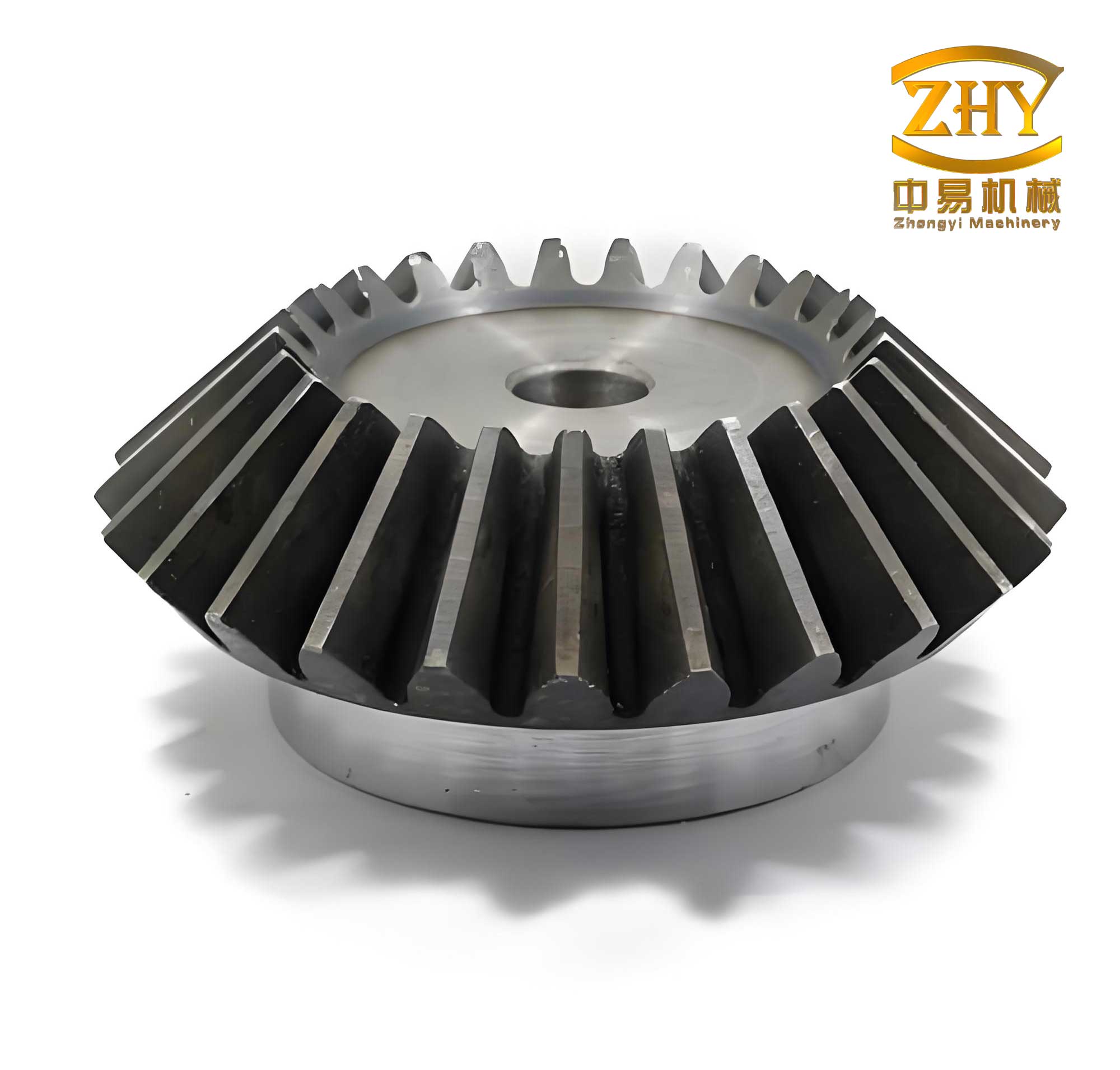
My investigation commenced with a macroscopic visual examination of the failed bevel gear. The overall gear exhibited no signs of overheating or discoloration. The fractured tooth, however, presented a distinct “spoon-shaped” or undercut profile at the root on both the drive and coast sides of the tooth. Closer inspection of the tooth flanks revealed critical clues. The contact patterns on both the working and start-up faces of all teeth, including the fractured one and its neighbors, were not centered. They were biased consistently towards the toe (smaller end) of the gear and towards the tip of the tooth. This abnormal contact pattern immediately suggested a misalignment in meshing, which would alter the load distribution and potentially increase bending stress at the tooth root. This observation was pivotal in guiding the subsequent phases of my analysis.
The core of any failure analysis lies in the fractographic examination. The fracture surface was divided into two distinct regions. Approximately 80% of the area was relatively flat and exhibited clear beach marks and progression lines radiating from a specific origin. This is the hallmark of fatigue crack growth. The remaining area was rougher and more textured, characteristic of final overload fracture. The convergence of the beach marks pointed unequivocally to the fatigue origin: a region on the tooth root surface, approximately 1-3 mm from the toe end. Scanning Electron Microscopy (SEM) examination confirmed this. The origin was a linear feature about 2 mm long, and no intrinsic material defects like inclusions or voids were found at this site. The fatigue propagation region displayed fine, microscopic fatigue striations, conclusively identifying the failure mechanism as bending fatigue. The crack initiated on the root surface and propagated through the tooth, leading to the final separation.
To rule out material deficiency as a contributing factor, I conducted a series of material property tests. Metallographic examination of the case-hardened layer revealed a normal, acceptable microstructure of fine martensite with a rating of 2. The core microstructure consisted of low-carbon martensite, which is standard for this grade of steel. Hardness measurements were taken both at the surface and in the core. The results are summarized in the table below:
| Measurement Location | Hardness Value | Technical Requirement |
|---|---|---|
| Case (Subsurface) | 744 – 756 HV | ≥ 648 HV |
| Core | 45 HRC | 35 – 45 HRC |
| Case Depth | 0.8 mm | 0.5 – 0.8 mm |
The data confirmed that the material’s heat treatment was within specification. The case depth and hardness were adequate, and the core hardness was at the upper limit but acceptable. Therefore, I could confidently eliminate inferior material quality or improper heat treatment as direct causes of the premature failure. The focus then shifted decisively to geometrical and mechanical factors influencing stress.
A critical step was the precise dimensional inspection of the failed bevel gear. I measured two key parameters: the tooth thickness and the root fillet radius. The tooth thickness was compared against the drawing specification and against a service-proven gear and a reference sample. The results were revealing:
| Gear Sample | Measured Tooth Thickness (mm) | Drawing Requirement (mm) |
|---|---|---|
| Failed Bevel Gear | 3.30 | 3.10 -0.06 / 0 |
| 1000-Hour Service Gear | 3.108 | 3.10 -0.06 / 0 |
| Reference Design Sample | 3.04 – 3.05 | 3.10 -0.06 / 0 |
The failed bevel gear exhibited a significant positive deviation in tooth thickness—it was approximately 0.2 mm thicker than the maximum allowable dimension. This is a substantial error in gear manufacturing. Such an error directly affects the gear meshing conditions. If the mating gear has correct tooth thickness, a thicker tooth will force an increase in the center distance or, in the case of bevel gears, cause an axial shift during assembly to achieve the specified backlash. This misalignment perfectly explains the observed contact pattern bias towards the toe and tip.
Next, I meticulously measured the root fillet radii at both the toe and heel ends of several teeth, including the fractured one. The fillet radius is crucial as it is the site of maximum bending stress concentration. The specifications called for a radius between 0.3 mm and 0.4 mm at both ends.
| Tooth Location | Fillet Radius at Toe (mm) | Fillet Radius at Heel (mm) |
|---|---|---|
| Fractured Tooth | 0.44 | 0.67 |
| Adjacent Tooth 1 | 0.52 | 0.69 |
| Adjacent Tooth 2 | 0.58 | 0.72 |
The measurements showed a clear trend: the fillet radius at the toe end was consistently smaller than at the heel end. More importantly, visual inspection under a microscope revealed poor transitional blending at the root fillet on several teeth, including the toe region of the failed tooth. There were noticeable sharp edges or “tool marks” where the machining process for the tooth flank and the root fillet did not blend smoothly. This creates a local stress riser, a point of intensified stress concentration.
The evidence so far pointed to two manufacturing defects in the bevel gear: tooth thickness oversize and poor root fillet geometry. To quantitatively understand how these defects synergistically led to failure, I employed Finite Element Analysis (FEA). My goal was to simulate the stress state in the tooth root under load, comparing the nominal design condition with the as-manufactured defective condition.
First, I analyzed the impact of the poor root fillet. Using a simplified 2D plane-strain model of an equivalent spur gear tooth, I applied a bending load via the 30° tangent method. The nominal root fillet radius was varied, and the effect of a sharp “tool mark” discontinuity was modeled as a small notch at the root. The maximum principal stress at the root was calculated for each case. The bending stress at the root of a gear tooth can be conceptually represented by the Lewis formula:
$$ \sigma_b = \frac{F_t}{b m_n Y} $$
where $\sigma_b$ is the bending stress, $F_t$ is the tangential load, $b$ is the face width, $m_n$ is the normal module, and $Y$ is the Lewis form factor which depends on tooth geometry and load application point. However, this formula does not account for local stress concentrators like sharp notches. The FEA provides a more accurate stress concentration factor $K_t$. My simulation results for the root stress are summarized below:
| Nominal Fillet Radius (mm) | Tool Mark Height (mm) | Max. Root Bending Stress (MPa) | Stress Increase vs. Nominal |
|---|---|---|---|
| 0.3 | 0 (Ideal) | 300 | Baseline |
| 0.12 | 375 | 25% | |
| 0.4 | 0 (Ideal) | 265 | Baseline |
| 0.16 | 365 | 38% | |
| 0.5 | 0 (Ideal) | 250 | Baseline |
| 0.2 | 310 | 24% |
The FEA clearly demonstrated that the presence of a machining-induced sharp edge at the root fillet could increase the maximum bending stress by 25% to 40%. This significant elevation in stress drastically reduces the fatigue strength of the component. For high-strength steels like 18Cr2Ni4WA, the fatigue limit $\sigma_f$ is often related to the ultimate tensile strength $\sigma_u$, but stress concentrators can reduce it dramatically according to the relationship:
$$ \sigma_{f,notched} = \frac{\sigma_f}{K_f} $$
where $K_f$ is the fatigue notch factor, typically close to the theoretical stress concentration factor $K_t$ for sharp notches. Therefore, even a well-hardened bevel gear can fail prematurely if such stress risers are present.
Second, I modeled the effect of the tooth thickness error. A full 3D model of the bevel gear pair was constructed. The nominal correct mesh was simulated first. Then, to replicate the assembly condition forced by the oversized tooth, I introduced an axial misalignment. Two scenarios were analyzed: axial outward shift of the pinion (the failed active bevel gear) by 0.2 mm, and axial outward shift of the mating gear by 0.2 mm. The contact analysis revealed profound changes. In both misalignment cases, the contact pattern shifted from the central region to a biased location—towards the root for one scenario and towards the tip for the other, matching my physical observations. Most critically, the maximum bending stress at the tooth root increased substantially.
| Mesh Condition | Contact Pattern Location | Approx. Max. Root Bending Stress Increase |
|---|---|---|
| Nominal (Correct) | Centered on tooth flank | Baseline |
| Pinion shifted 0.2 mm axially | Biased towards pinion root | ~50% higher |
| Mating gear shifted 0.2 mm axially | Biased towards pinion tip | ~60% higher |
The combination of these factors created a perfect storm for fatigue failure. The tooth thickness error caused a misalignment during assembly, shifting the load application point. This alone raised the nominal bending stress by 50-60%. Concurrently, the poor machining of the root fillet, particularly at the toe end where the stress was already higher due to the misalignment, introduced a severe local stress concentrator. This further amplified the stress by another 30-40%. The multiplicative effect of these factors pushed the local stress at the toe-end root fillet well beyond the endurance limit of the material.
The fatigue process in bevel gears under such conditions can be described by Paris’ law for crack growth:
$$ \frac{da}{dN} = C (\Delta K)^m $$
where $da/dN$ is the crack growth rate per cycle, $\Delta K$ is the stress intensity factor range, and $C$ and $m$ are material constants. The elevated stress $\Delta \sigma$ leads to a higher $\Delta K$, accelerating crack initiation and propagation from the stress concentration site. In this case, the crack initiated at the toe-end root surface, propagated through the tooth, and final fracture occurred when the remaining ligament could no longer support the load.
My investigation into the fracture of these bevel gears highlights several critical control points in manufacturing. First, tooth thickness must be held to very tight tolerances. For bevel gears, this is not just about the tooth itself but about ensuring correct conjugate action and load distribution with the mating gear. Second, the finishing of the root fillet is not a minor detail but a critical stress-critical feature. Grinding or machining processes must ensure a smooth, continuous transition with the specified radius, free of sharp tool marks or discontinuities. Any deviation acts as a built-in fatigue crack starter.
Based on this analysis, I recommended and oversaw the implementation of specific corrective actions. The machining process for the tooth flank and root fillet was revised. A more controlled finishing operation was introduced to guarantee the root fillet geometry. The inspection protocol was strengthened, mandating 100% verification of tooth thickness and a visual/dimensional check of the root fillet transition using profilometry or high-magnification optical methods on all critical bevel gears. Subsequent production batches and field returns have been monitored, and no recurrence of this specific failure mode has been observed, validating the root cause analysis and corrective measures.
In conclusion, the fracture of the active bevel gear was a definitive bending fatigue failure. The primary root cause was excessive bending stress at the tooth root, originating from two synergistic manufacturing defects: a tooth thickness oversize leading to gear misalignment and a poorly machined root fillet with a sharp transitional edge causing severe stress concentration. This case study powerfully illustrates that for high-performance components like bevel gears, fatigue life is not solely determined by material strength but is exquisitely sensitive to geometrical precision. Strict adherence to dimensional tolerances and surface finish specifications is non-negotiable for ensuring the reliability and durability of bevel gears in demanding mechanical systems. The methodologies employed—combining traditional fractography, metrology, and modern FEA—provide a robust framework for diagnosing and preventing similar failures in a wide array of mechanical components, especially complex geometries like bevel gears.