
The pursuit of efficient and high-quality manufacturing for mechanical transmission components is a constant driver of innovation. Among these components, bevel gears hold a critical position due to their ability to transmit power between intersecting axes. While traditional machining methods like milling and hobbing are common, they involve significant material removal, leading to waste and sometimes failing to meet the structural or cost constraints of mass production, particularly for specialized bevel gears. In this context, cold extrusion, a near-net-shape forming process, emerges as a compelling alternative. This technology offers high production rates, superior mechanical properties in the finished part due to work hardening, and minimal material waste, making it extensively applicable in automotive and motorcycle industries.
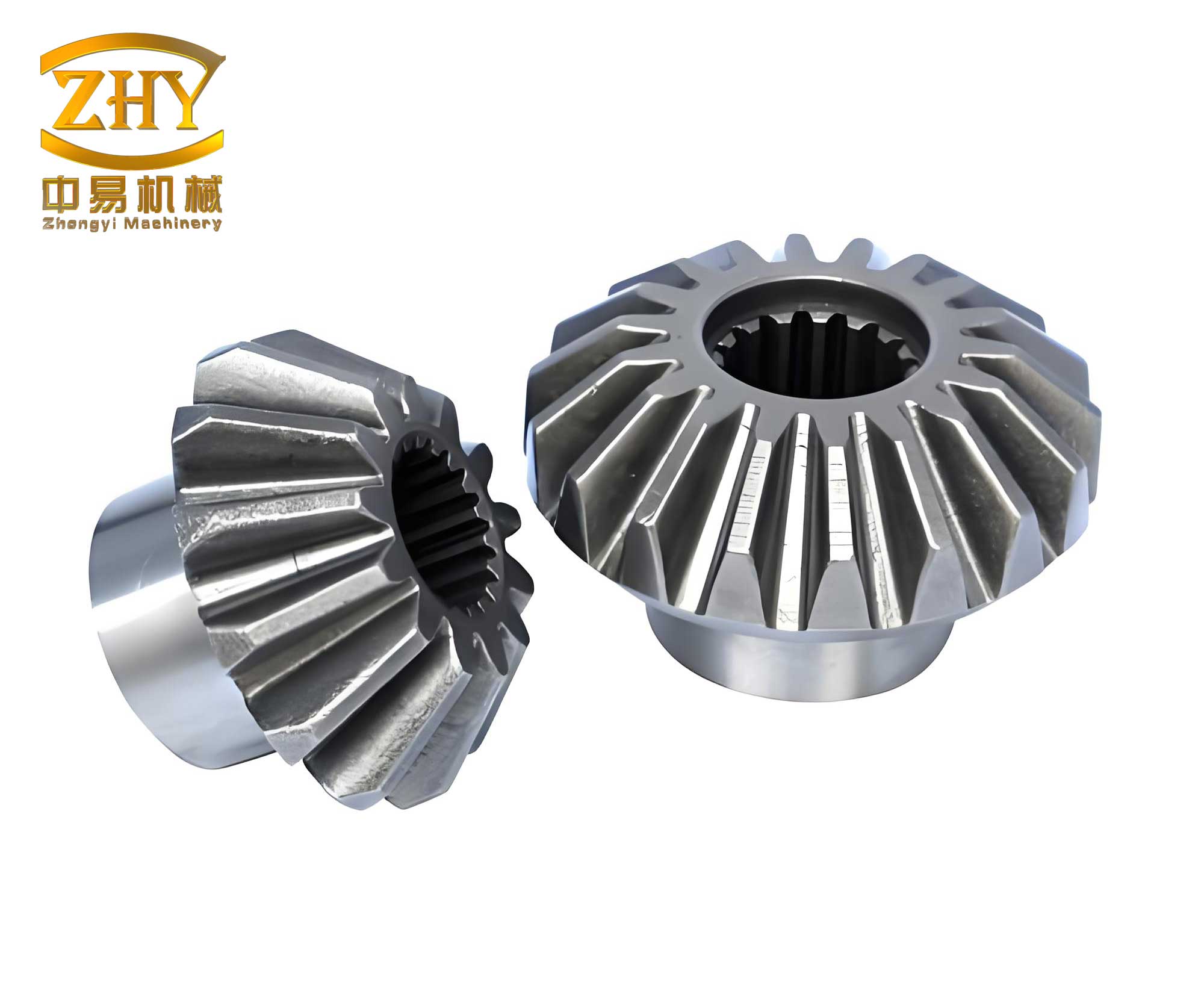
However, the cold extrusion of complex shapes like bevel gears presents formidable challenges. A primary issue is the incomplete filling of the die cavity, especially at the tooth tips, resulting in unsatisfactory gear profiles. To overcome this, higher forming forces are typically required to increase plastic deformation. This, unfortunately, leads to a cascade of problems: a significant rise in metal forming resistance, exacerbated by continuous work hardening and deteriorating lubrication conditions during the process. The consequence is accelerated tool wear, potential tooth chipping or cracking in the die, and a drastic reduction in mold lifespan. Furthermore, cold extrusion performed at room temperature demands presses with substantial tonnage, high strength, and rigidity to withstand these immense forces.
To address these intrinsic disadvantages of conventional cold extrusion for bevel gears, this analysis explores the integration of vibration-assisted forming technology. The core hypothesis is that applying a controlled, periodic vibration to the die during the extrusion process can fundamentally alter the metal flow behavior and deformation mechanics. This study employs a computational approach using finite element analysis (FEA) to systematically investigate and compare the extrusion process under two distinct conditions: with a stationary die and with a die subjected to periodic vibration. The goal is to quantify the impact of die vibration on key performance metrics such as metal flow velocity, stress distribution, forming load, and the final quality of the extruded bevel gears.
Finite Element Modeling and Simulation Setup
A robust finite element model is essential for simulating the complex three-dimensional plastic deformation involved in extruding bevel gears. The model focuses on a straight bevel gear shaft. To reduce computational cost while maintaining accuracy, symmetry is exploited. Only one-eighth of the full three-dimensional model is analyzed, assuming symmetrical geometry and loading conditions.
The model consists of three primary components: the punch (upper die), the billet (workpiece), and the die (lower die cavity containing the gear profile). The billet material is specified as 20Cr steel, a commonly used carburizing steel for gears. It is modeled as a plastic, deformable body. For the simulation, the material is assumed to be in a softened state following preliminary heat treatment, with its flow stress behavior defined by a suitable plastic constitutive model. Both the punch and die are modeled as rigid bodies, made from tool steel Cr12MoV, representing their significantly higher stiffness compared to the workpiece. The key parameters for the two simulation scenarios are summarized in the table below.
| Parameter | Stationary Die Simulation | Vibrating Die Simulation |
|---|---|---|
| Billet Material | 20Cr (Plastic Body) | |
| Tool Material (Punch & Die) | Cr12MoV (Rigid Body) | |
| Mesh Type | Tetrahedral Elements | |
| Number of Elements (Billet) | ~8,000 (Absolute Mesh Generation) | |
| Friction Model | Constant Shear, Coefficient μ = 0.12 | |
| Temperature | 20°C (Room Temperature) | |
| Punch Velocity | 10 mm/s (Constant) | |
| Total Punch Stroke | Approximately 8 mm | |
| Simulation Time Increment | 0.001 s | |
| Total Simulation Steps | 800 steps | |
| Die Motion | Fixed (Velocity = 0) | Periodic Vibration |
| Vibration Function | N/A | Simple Harmonic Motion |
The vibration applied to the die is defined as a simple harmonic motion. If the punch moves in the +X direction, the die’s periodic displacement \( D(t) \) is given by:
$$ D(t) = A \cdot \sin(2\pi f t) $$
where \( A \) is the vibration amplitude and \( f \) is the vibration frequency. For this simulation, \( A = 0.02 \) mm and \( f = 100 \) Hz. The corresponding velocity function \( V_d(t) \) of the die is the time derivative of displacement:
$$ V_d(t) = \frac{dD}{dt} = 2\pi f A \cdot \cos(2\pi f t) $$
This results in a maximum die vibration velocity of \( 2\pi f A \approx 12.57 \) mm/s. This periodic kinematic condition is applied as a boundary condition to the die in the FEA model for the second scenario.
Analysis of Simulation Results: A Comparative Study
The post-processing of the finite element simulations provides detailed insights into the metal forming process. The comparison between the stationary and vibrating die scenarios reveals significant differences across multiple metrics critical for successful extrusion of bevel gears.
Metal Flow Pattern and Grid Distortion
The flow net or grid pattern visualization illustrates the internal deformation of the material. In the conventional process with a stationary die, the mesh lines exhibit severe distortion, particularly in regions where metal flows into the complex tooth cavities of the bevel gear profile. This indicates non-uniform, turbulent flow and high shear strains.
In contrast, when periodic vibration is applied to the die, the flow lines remain noticeably more regular and orderly. The grid distortion is reduced, suggesting a smoother, more guided metal flow. This beneficial effect can be attributed to the periodic alteration of friction conditions at the die-billet interface and the additional shear stresses imparted by the vibrating die, which help overcome local flow resistance and facilitate filling of intricate features like the tooth tips of the bevel gears.
Metal Flow Velocity Enhancement
The velocity field within the deforming billet is profoundly affected by die vibration. The results can be summarized as follows:
| Simulation Condition | Step of Maximum Velocity | Maximum Velocity Magnitude | Velocity Increase Factor |
|---|---|---|---|
| Stationary Die | Step 799 | 37.8 mm/s | 1.0 (Baseline) |
| Vibrating Die (100 Hz, 0.02 mm) | Step 796 | 85.6 mm/s | ≈ 2.26 |
The mechanism behind this dramatic increase is synergistic. In the standard process, flow is driven solely by the pressure from the punch. With die vibration, the material experiences a combined action: the steady pressure from the punch and a cyclic shearing/impact from the die walls. When the die vibrates opposite to the punch motion, it creates a momentary “hammering” effect, directly pushing material into cavities. When it moves with the punch, it reduces the relative velocity and may momentarily lower friction. This cyclic action effectively “fluidizes” the metal flow, breaking down friction locks and promoting faster, more complete filling of the die cavity for the bevel gears. The effective flow velocity \( V_{eff} \) can be conceptually related to the punch velocity \( V_p \) and die vibration velocity \( V_d(t) \) by a complex function:
$$ V_{eff} = f(V_p, V_d(t), \mu, \sigma) $$
where \( \mu \) is the friction coefficient and \( \sigma \) is the material flow stress. The simulation confirms that the superposition of vibration significantly boosts \( V_{eff} \).
Stress Distribution and Uniformity
The effective (von Mises) stress distribution is a key indicator of deformation homogeneity and part quality. In both cases, the maximum stress concentration occurs at the inner corner of the die exit, a typical shear zone in extrusion.
However, the extent and gradient of this high-stress region differ markedly. With a stationary die, a large volume of material experiences very high stress levels, with a sharp gradient between the highly stressed surface layers and the less-stressed core. This indicates localized, severe plastic deformation.
Applying vibration to the die leads to a more uniform stress distribution. The zone of maximum stress is reduced in volume, and the transition from high to low stress is more gradual. This uniformity is highly advantageous for bevel gears, as it suggests a more consistent work-hardening profile throughout the teeth, potentially leading to better and more predictable mechanical performance and reduced risk of internal defects.
Forming Force Reduction
The load-stroke curve for the punch is a direct measure of forming resistance. The comparison yields a critical finding: the periodic vibration of the die leads to a substantial reduction in the required forming force.
The force reduction is dynamic and cyclical, corresponding to the die’s motion. When the die vibrates in the opposite direction to the punch travel, the instantaneous force on the punch may be slightly higher due to direct opposition. Crucially, when the die vibrates in the same direction as the punch, the relative speed between the tool and workpiece decreases, friction drops momentarily, and the force on the punch plunges, sometimes nearly to zero. Over a full cycle, the time-averaged forming force is significantly lower than in the stationary die case. This can be expressed conceptually by examining the work done. The external work \( W \) required for deformation is related to the integral of force over displacement:
$$ W = \int F \, dx $$
Vibration assists the process, meaning for the same final geometry of the bevel gears, the average force \( \bar{F} \) is lower, thus reducing \( W \) or allowing the same work to be done with less press tonnage. This force reduction directly addresses one of the major drawbacks of cold extrusion, lowering energy consumption, press requirements, and tool stresses.
Discussion on Mechanisms and Implications for Bevel Gear Production
The finite element results clearly demonstrate that superimposing periodic vibration onto the cold extrusion process for bevel gears creates a superior forming mode. The underlying physical mechanisms can be attributed to several interrelated phenomena:
1. Interfacial Friction Modulation: The cyclic motion of the die relative to the billet constantly changes the shear direction at the interface. This can break down stable friction layers, prevent lubricant breakdown, and effectively lower the average frictional resistance. Lower friction directly reduces the force needed for metal flow and improves die filling for complex geometries like bevel gears.
2. Superimposed Stress States & “Stress Superposition Principle”: The vibration introduces cyclic shear stresses into the deformation zone. According to plasticity theory, a vibratory shear stress can lower the yield threshold of the material under a concurrent compressive stress (the punch pressure). This is sometimes explained by a localized, transient reduction in the material’s flow stress. The combined stress state promotes plastic flow at lower overall punch pressure. The yield criterion under vibration-assisted forming could be conceptually modified from the standard von Mises criterion \( \sigma_{eff} = \bar{\sigma} \) to a form accounting for the cyclic component:
$$ \sigma_{eff} + \alpha \cdot \sigma_{vib} \approx \bar{\sigma} $$
where \( \sigma_{vib} \) is the vibratory stress amplitude and \( \alpha \) is a factor. This implies effective yielding occurs at a lower steady-state \( \sigma_{eff} \).
3. Enhanced Material Mobility: The high-frequency micro-impacts impart energy to the metal grains, increasing their mobility and making it easier for dislocations to move and for the material to conform to the die shape. This is particularly beneficial for filling the sharp corners and deep profiles of bevel gear teeth.
The implications for manufacturing bevel gears are significant:
- Improved Geometric Accuracy: Enhanced flow ensures complete filling of the tooth profile, producing bevel gears with full, sharp teeth and minimal flash.
- Extended Tool Life: Lower forming forces and more uniform stress distribution reduce wear, chipping, and fatigue on expensive precision dies used for bevel gears.
- Energy and Equipment Efficiency: The reduction in required press tonnage allows for the use of smaller machines or the extrusion of larger bevel gears on existing presses.
- Potential for More Complex Designs: The improved flow capability may enable the cold extrusion of bevel gears with more challenging geometries or higher precision grades that were previously not feasible with conventional methods.
Conclusion
This computational investigation establishes a compelling case for the application of die vibration in the cold extrusion process of bevel gears. The comparative finite element analysis between stationary and vibratory die conditions reveals transformative improvements across all critical process metrics.
The introduction of low-amplitude, high-frequency periodic vibration to the die fundamentally alters the metal flow dynamics. It transforms the flow pattern from turbulent and distorted to smooth and streamlined, significantly enhancing the metallurgical quality of the part. Most strikingly, it more than doubles the maximum metal flow velocity, directly tackling the problem of incomplete die filling that plagues the forming of intricate bevel gear teeth. Furthermore, the process fosters a more homogeneous distribution of stress within the workpiece, which is paramount for achieving consistent mechanical properties in the final bevel gears. Perhaps the most practical benefit is the substantial reduction in the time-averaged forming force, which alleviates the demands on press capacity and dramatically reduces tooling stresses, promising extended die life.
In summary, vibration-assisted cold extrusion presents itself not merely as an incremental improvement but as a fundamentally enhanced forming mode for bevel gears. It effectively mitigates the key disadvantages of conventional cold extrusion—high force, poor filling, and rapid tool wear—by harnessing dynamic effects to promote material flow. This technology holds strong potential for advancing the efficient, high-quality, and economical mass production of bevel gears and other complex precision components in the automotive and general manufacturing sectors.