
In my extensive experience analyzing mechanical failures, the integrity of bevel gears is paramount for power transmission systems, especially in demanding applications like forklifts. These bevel gears are critical components, and their sudden fracture can lead to catastrophic operational failures. This article details a first-person investigative journey into the root cause of a premature fracture in a driving bevel gear from a forklift. The failure occurred during an unloading operation, and through systematic analysis, I identified hydrogen embrittlement as the primary culprit. The focus will remain squarely on bevel gears, their material behavior, and the mechanisms that lead to such failures. I will employ numerous tables and mathematical formulations to encapsulate the data and theories involved.
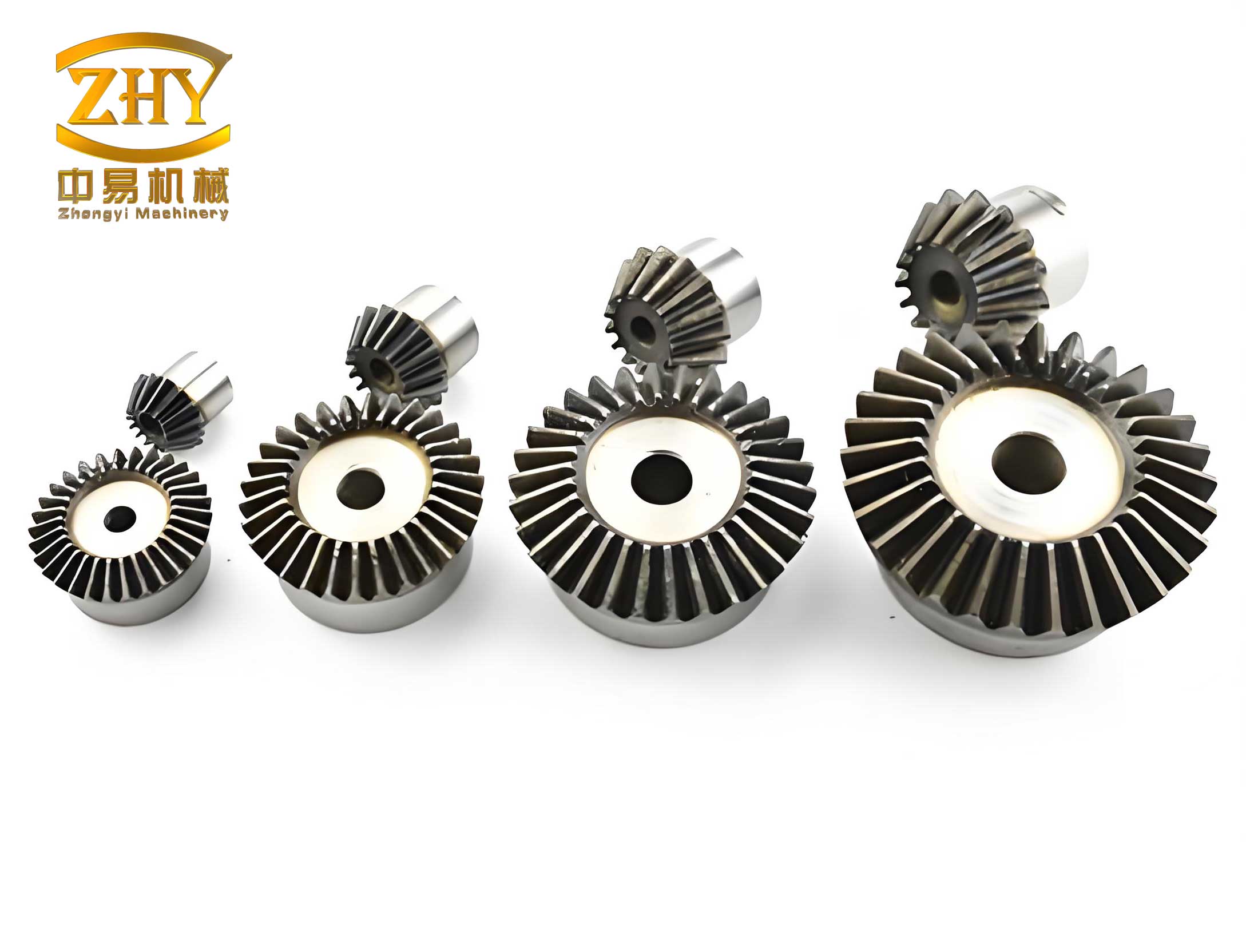
The specific bevel gear under investigation fractured at the transition step between shaft diameters of 45 mm and 40 mm. The material was specified as 20CrMnTi steel, a common alloy for carburized bevel gears due to its good hardenability and core toughness. The manufacturing process involved forging, isothermal normalizing, machining, gear cutting, followed by carburizing, quenching, and tempering. The carburizing was conducted in a pit furnace at approximately 910°C using methanol and kerosene as enriching agents, followed by direct quenching in N32 oil and tempering at 180°C. My investigation protocol encompassed macro-fractography, chemical analysis, metallography, hardness testing, and scanning electron microscopy (SEM) of the fracture surface. The consistent theme throughout this analysis is the vulnerability of bevel gears to specific failure modes when processing conditions are not optimal.
My initial macro-examination revealed a brittle, crystalline fracture surface that was relatively flat and clean, exhibiting a bright gray appearance. The fracture origin was at the surface of the transition step, with a relatively smooth propagation zone and a final rough, radial-patterned instantaneous fracture zone. This morphology immediately suggested a brittle fracture mechanism, inconsistent with classic fatigue failure often seen in cyclically loaded bevel gears. The absence of beach marks or significant plastic deformation pointed towards an environmentally assisted cracking process.
To rule out material composition as a contributing factor, I performed spectroscopic chemical analysis. The results, compared against the standard GB/T 3077-2015 for 20CrMnTi steel, are summarized in Table 1. The composition was well within specification limits, indicating that the base material was not intrinsically faulty. This directed the focus towards processing and microstructural factors.
| Element | C | Si | Mn | P | S | Cr | Ti |
|---|---|---|---|---|---|---|---|
| Measured Value | 0.20 | 0.26 | 1.10 | 0.017 | 0.010 | 1.28 | 0.07 |
| Standard Range | 0.17-0.23 | 0.17-0.37 | 0.80-1.10 | ≤0.035 | ≤0.035 | 1.00-1.30 | 0.04-0.10 |
Metallographic examination was pivotal. Prior to etching, non-metallic inclusion assessment per GB/T 10561-2005 revealed very low levels: Sulfide (A0), Alumina (B0.5), Silicate (C1.5), Globular Oxide (D1.5), and Single-particle Spherical (DS0). This confirmed the steel’s cleanliness. Upon etching with 4% nital, the microstructure was revealed. The surface carburized layer consisted of martensite and retained austenite, rated as carbide level 2 and martensite/austenite level 5 according to QC/T 262-1999. More critically, I observed cracking, predominantly intergranular in nature, emanating from the transition step and also present as secondary cracks beneath the main fracture surface. These cracks showed no evidence of decarburization at their faces. The core microstructure comprised low-carbon martensite, tempered bainite, and a small amount of ferrite, within which microcracks were also present. This widespread cracking, especially its intergranular character, is a classic hallmark of hydrogen embrittlement in high-strength steels like those used for hardened bevel gears.
Hardness measurements further illuminated the problem. As shown in Table 2, both surface and core hardness values were significantly below the technical requirements specified for these bevel gears. The effective case depth was also slightly below the required range. This sub-par hardening reduces the load-bearing capacity and, crucially, for hydrogen embrittlement susceptibility, surfaces with hardness above approximately 38 HRC are at risk. The measured surface hardness, though lower than specified, was still in a range susceptible to hydrogen-assisted cracking.
| Property | Surface Hardness (HRC) | Core Hardness (HRC) | Case Depth (mm) |
|---|---|---|---|
| Measured Values | 53.5, 55.0, 54.5 | 34.5, 34.5, 34.0 | 1.45 |
| Technical Requirement | 58 – 63 | 35 – 45 | 1.50 – 1.80 |
Scanning Electron Microscopy of the fracture surface provided conclusive evidence. The crack initiation zone at the transition step exhibited multiple terraces, micro-voids, and intergranular secondary cracks. At higher magnification, small, flat facets with tear ridges and fine “chicken-track” or “hair-line” markings were visible, characteristics synonymous with mixed intergranular and quasi-cleavage fracture modes induced by hydrogen. These features, shown in the propagation and final rupture zones as well, are diagnostic of hydrogen embrittlement. The fracture mode was not ductile microvoid coalescence but a brittle separation facilitated by the presence of hydrogen atoms within the metal lattice.
The core of the discussion revolves around the mechanism of hydrogen embrittlement in these bevel gears. During the gas carburizing process, the atmosphere—comprising hydrocarbons like kerosene and methanol—decomposes at high temperature to produce a mixture rich in carbon monoxide, carbon dioxide, water vapor, and hydrogen. Atomic hydrogen (H) is readily absorbed into the steel surface at these elevated temperatures. The diffusion coefficient of hydrogen in steel is high, governed by Fick’s laws. The diffusion equation can be expressed as:
$$ \frac{\partial C_H}{\partial t} = D_H \nabla^2 C_H $$
where $C_H$ is the concentration of hydrogen, $t$ is time, and $D_H$ is the diffusion coefficient of hydrogen in austenite or ferrite/martensite. During carburizing, hydrogen ingress is significant. Subsequent quenching traps the hydrogen within the martensitic structure, as its solubility drops dramatically at lower temperatures. The trapped hydrogen atoms reside in interstitial sites, dislocations, and grain boundaries.
The microstructure of the bevel gear plays a defining role. The susceptibility of different microstructures to hydrogen embrittlement increases in the following order: ferrite/pearlite → bainite → low-carbon martensite → mixed martensite/bainite → twinned martensite. The case of these bevel gears consisted of high-carbon martensite and retained austenite, while the core was low-carbon martensite and bainite. Both martensitic structures are highly susceptible to hydrogen embrittlement. Hydrogen reduces the cohesive strength of grain boundaries and interfaces, promoting intergranular fracture. The critical stress for hydrogen-induced cracking, $\sigma_c$, can be modeled as:
$$ \sigma_c = \sigma_0 – \alpha \sqrt{C_H} $$
Here, $\sigma_0$ is the inherent fracture strength of the material in the absence of hydrogen, $\alpha$ is a material constant, and $C_H$ is the local hydrogen concentration. Under an applied stress, even below the nominal yield strength, hydrogen atoms diffuse and segregate to regions of high triaxial stress. This is where the geometry of bevel gears becomes critical. The shaft transition step, where the fracture originated, is a classic stress concentrator. The theoretical stress concentration factor $K_t$ for a shoulder fillet can be approximated by empirical formulas. For a stepped shaft under bending or torsion, the factor depends on the ratio of the step dimensions. The local stress $\sigma_{local}$ is amplified:
$$ \sigma_{local} = K_t \cdot \sigma_{nominal} $$
For the bevel gear in question, the nominal stress during operation was the torsional and bending load from transmitting torque. The hydrogen atoms, mobile under stress, migrated to this high-stress zone at the transition. Once the local hydrogen concentration reached a critical level at these vulnerable grain boundaries, crack initiation occurred. The crack then propagated in a brittle, often delayed, manner. This explains the sudden failure during a routine operation—the stress intensity at the crack tip, assisted by hydrogen, reached the critical value for catastrophic fracture. The sub-optimal hardness further reduced the fracture toughness, accelerating the process.
To quantify the relative susceptibility of different microstructures common in bevel gears, I have constructed Table 3 based on empirical data and literature. This highlights why the chosen heat treatment path for high-performance bevel gears must be carefully controlled to minimize hydrogen uptake and embrittlement risk.
| Microstructure | Typical Hardness (HRC) | Relative HE Susceptibility Index (1=Low, 10=High) | Common Formation Condition in Bevel Gears |
|---|---|---|---|
| Spheroidized Carbide in Ferrite | < 25 | 1 | Annealed state |
| Fine Pearlite | 25-35 | 2-3 | Normalized |
| Upper Bainite | 35-45 | 4-5 | Moderate cooling rate |
| Lower Bainite | 45-55 | 5-6 | Alloyed steels, controlled cooling |
| Low-Carbon Lath Martensite | 40-50 | 7-8 | Core of carburized gears |
| High-Carbon Plate Martensite | 58-65 | 9-10 | Case of carburized gears |
| Mixed Martensite-Bainite | Varies | 8-9 | Incomplete transformation |
The kinetics of hydrogen diffusion and trapping are also essential. Hydrogen atoms can be trapped at various sites with different binding energies $E_b$. The effective diffusion coefficient $D_{eff}$ is reduced by trapping:
$$ D_{eff} = \frac{D_L}{1 + \frac{N_T}{N_L} \exp\left(\frac{E_b}{RT}\right)} $$
where $D_L$ is the lattice diffusion coefficient, $N_T$ and $N_L$ are trap and lattice site densities, $R$ is the gas constant, and $T$ is temperature. In the tempered martensite of bevel gears, dislocations and carbide interfaces act as potent traps, influencing the distribution and availability of hydrogen for embrittlement.
Furthermore, the role of residual stresses from quenching cannot be ignored. Quenching introduces significant tensile stresses in the core and compressive stresses on the surface. However, at a geometrical discontinuity like a sharp transition, the residual stress field can become complex and superimpose on the service stresses, further elevating the local stress state. The combined stress $\sigma_{total}$ driving hydrogen-assisted cracking is a superposition of applied, residual, and microstructural stresses:
$$ \sigma_{total} = \sigma_{applied} + \sigma_{residual} + \sigma_{microstructural} $$
For bevel gears, ensuring a generous fillet radius at diameter transitions is a fundamental design rule to reduce $K_t$. The relationship between the stress concentration factor $K_t$, the smaller diameter $d$, the larger diameter $D$, and the fillet radius $r$ for a shaft in bending can be approximated using Peterson’s formula:
$$ K_t \approx 1 + \frac{A}{\sqrt{\frac{r}{d} + B}} $$
where $A$ and $B$ are constants depending on the $D/d$ ratio. A small or absent fillet radius, as might occur from aggressive grinding or poor design, dramatically increases $K_t$, making bevel gears extremely prone to failure initiation, especially when hydrogen is present.
Based on my findings, the failure sequence for these specific bevel gears is reconstructed as follows: 1) During carburizing, a substantial amount of atomic hydrogen was introduced into the steel. 2) Quenching trapped this hydrogen in the susceptible martensitic microstructure. 3) During service, the applied load created a stress concentration at the 45mm to 40mm transition step. 4) Hydrogen diffused and accumulated at these high-stress grain boundaries. 5) The local hydrogen concentration lowered the cohesive energy, leading to intergranular crack initiation. 6) The crack propagated in a brittle manner, assisted by continuous hydrogen supply to the crack tip, culminating in sudden fracture under normal operating load.
To mitigate such failures in bevel gears, specific recommendations must be implemented. Firstly, the heat treatment process should be modified to minimize hydrogen intake. This can involve using alternative carburizing atmospheres with lower hydrogen potential, such as nitrogen-methanol blends with precise carbon potential control, or employing vacuum carburizing, which virtually eliminates hydrogen as a by-product. Secondly, a mandatory post-heat treatment dehydrogenation step must be introduced. This typically involves holding the bevel gears at a temperature between 150°C and 250°C for an extended period (e.g., 4 to 8 hours or more) immediately after quenching and before tempering. This allows the trapped hydrogen to diffuse out of the steel before it can cause damage. The required time $t_{bake}$ for effective baking can be estimated from diffusion theory:
$$ t_{bake} \propto \frac{x^2}{D_H(T_{bake})} $$
where $x$ is a characteristic diffusion distance (e.g., case depth or part thickness) and $D_H(T_{bake})$ is the hydrogen diffusion coefficient at the baking temperature. Thirdly, the hardness and case depth must be strictly controlled to meet specifications, ensuring adequate strength and fatigue resistance. Finally, design optimization for bevel gears should mandate adequate fillet radii at all section changes to minimize stress concentration factors. Implementing Statistical Process Control (SPC) for hardness and case depth can preemptively flag batches of bevel gears at risk.
In conclusion, through a detailed first-person investigation combining multiple analytical techniques, I have unequivocally demonstrated that the fracture of the subject forklift bevel gear was caused by hydrogen embrittlement. The hydrogen was introduced during the carburizing heat treatment and, in conjunction with a microstructurally susceptible state and a geometric stress concentrator, led to a low-stress, brittle fracture. This case underscores a critical reliability challenge in the manufacturing of high-performance bevel gears. A profound understanding of the interaction between hydrogen, microstructure, and stress is essential for preventing such failures. Future production of bevel gears must integrate hydrogen management strategies into the heat treatment protocol and enforce rigorous design and quality control standards to ensure their durability and safe operation in power transmission systems. The lessons learned are directly applicable to all carburized and hardened bevel gears across various industries, from automotive to heavy machinery.