
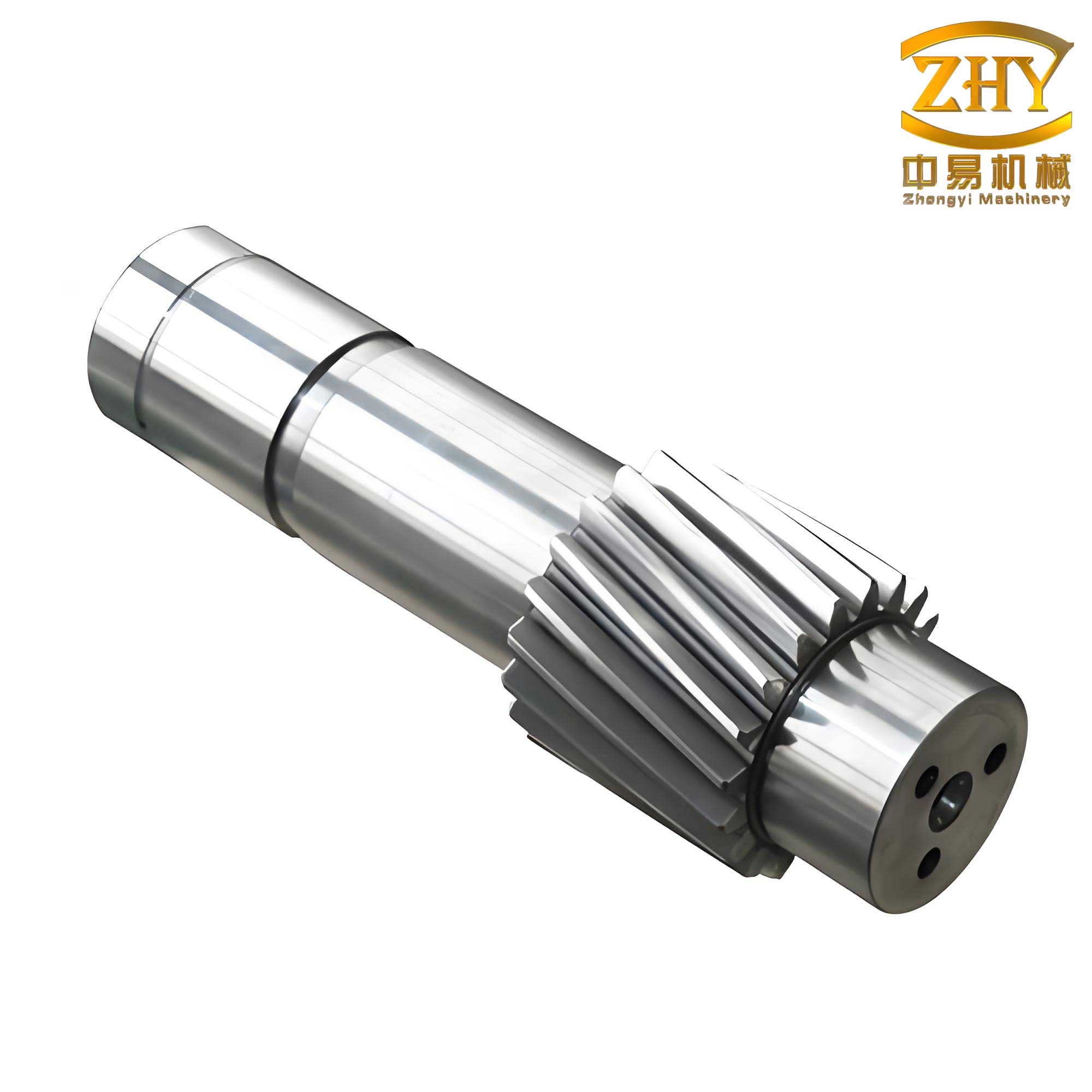
The grinding process for automotive gear shafts traditionally demands significant manual intervention, including loading/unloading parts, operating machine tools, and engaging the gear teeth with the driving mechanism. This approach presents several challenges: a demanding work environment, high labor intensity, fluctuating production quality, and management complexity due to high worker turnover. While some modern grinding machines incorporate basic linear mechanisms for part handling, they often remain expensive, inflexible, and still require manual setup. This paper details the design and implementation of a comprehensive, flexible automation system built around an industrial robot to fully automate the grinding process for specific automotive gear shaft components.
The target gear shaft requires grinding on three specific external cylindrical surfaces, labeled Positions 1, 2, and 3. The established process uses two CNC cylindrical grinding machines. The first machine grinds Positions 2 and 3, after which the batch of gear shafts is transferred to the second machine for grinding Position 1. Our objective was to replace all manual operations in this sequence with an integrated robotic cell.
The proposed system layout positions the two CNC grinders facing each other. A 6-axis articulated industrial robot (Stäubli TX90 model) is stationed between them, responsible for all part manipulation. A custom-designed feeding machine is placed on one side to manage the flow of raw and finished gear shaft batches. The system’s master controller is a Siemens S7-1200 PLC. Communication is facilitated via an industrial network; the PLC communicates with the robot controller using the Modbus/TCP protocol over PROFINET and interacts with the grinding machines via discrete I/O signals. A human-machine interface (HMI) touch panel provides system monitoring and control.
1. Mechanical and Electrical System Design
1.1 Feeding Machine Design
The feeding machine was designed to automate the storage and presentation of gear shafts. Gear shafts are stored vertically in pallets, with each pallet holding 50 units. The machine’s core functions include automatic pallet transfer, precise positioning, locking at the robot pick-up station, and providing a safe, ergonomic interface for manual pallet exchange on the opposite side.
The machine consists of three main sections: a manual-side lift mechanism, a central transfer conveyor, and a robot-side lift mechanism. Both lift mechanisms utilize chains driven by DC motors and are actuated vertically by pneumatic cylinders to interface between different conveyor levels. The central transfer conveyor has two levels (upper and lower) for moving pallets to and from the robot station. Proximity sensors detect pallet presence, a pneumatic stop cylinder halts the pallet, and a pneumatic claw mechanism clamps onto a metal block on the pallet base for precise location and locking at the robot pick-up station.
Key Component Sizing Calculations:
Lift Cylinder Sizing: The total load (pallet with 50 gear shafts) is approximately 30 kg. Accounting for additional mechanical elements and friction, the design load (F) is set to 40 kg. With a required lifting speed and a cylinder load factor (β) of 40% at an operating pressure (p) of 0.6 MPa, the required cylinder bore (D) is calculated. Assuming a piston rod diameter (d) of 0.3D, the theoretical output force (F0) is:
$$ F_0 = \frac{\pi}{4} (D^2 – d^2) p $$
The load factor is defined as:
$$ \beta = \frac{F}{F_0} \times 100\% $$
Solving for D yields approximately 47.8 mm. A standard 50 mm bore cylinder (e.g., SMC model SC-50×350-S-FA) was selected.
Conveyor Motor Power Calculation: The power required for the central transfer conveyor motor (P1) accounts for moving up to 7 pallets simultaneously, while the lift conveyor motor (P2) moves only one pallet. With conveyor speed v = 0.6 m/s, rolling friction coefficient μ = 0.05, and respective mechanical efficiencies (η for chain, worm gear, belt drive), the required power is:
$$ P_1 = \frac{7 \mu m g v S}{\eta_{chain} \cdot \eta_{worm}} $$
$$ P_2 = \frac{\mu m g v S}{\eta_{chain} \cdot \eta_{belt}} $$
where m is the mass of one pallet assembly (30 kg), g is gravity, and S is a safety factor (1.2). Calculations resulted in P1 ≈ 111.4 W and P2 ≈ 12.4 W. Motors rated at 120 W and 15 W were chosen, respectively.
1.2 Machine Tool Fixturing Modification
Both grinding machines traditionally use a two-center fixturing method with a driving plate (“driver”) that has a claw to engage the helical teeth of the gear shaft. Manual loading required an operator to rotationally align (or “clock”) the gear shaft teeth with the driver’s claw—a step incompatible with automation.
To enable robotic loading, two modifications were implemented:
1. Driver Positioning: A proximity sensor was mounted on the machine headstock, and a trigger was attached to the driver. The CNC program was modified to stop the spindle at a precise angular position where the driver claw is at the bottom, providing a consistent target for the robot.
2. Active Driver Claw: The fixed driver claw was replaced with a pivoting claw, spring-loaded against the driver face. During the robotic load sequence, the gear shaft is placed between centers. The initial rotation of the spindle, driven by the grinding wheel’s friction, causes the pivoting claw to self-locate and engage with the gear shaft teeth autonomously, eliminating the need for pre-alignment.
1.3 Robot End-Effector and Transfer Station Design
A custom multi-gripper end-effector was designed to handle all required manipulations of the gear shaft efficiently. It integrates three distinct grippers on a common base plate:
– Gripper 1 & 2: Two parallel two-finger grippers used for directly loading/unloading the gear shaft to/from the grinding machines. They grip the central Ø20 mm cylindrical surface.
– Gripper 3: A three-finger centering gripper used to extract the vertically-oriented gear shaft from the pallet in the feeding machine. It grips the top Ø12 mm journal.
Since the vertical orientation in the pallet interferes with the machine tailstock during loading, an intermediate transfer station was designed. The robot uses Gripper 3 to pick a gear shaft from the pallet and place it horizontally on this station. Subsequently, Gripper 1 or 2 picks it up from the station for machine loading. This allows a single robot to perform the complete “unload finished part / load new part” cycle on a grinder in one visit.
Gripping Force Analysis for Gripper 3: The chosen three-finger gripper (e.g., SCHUNK MPZ 38) must provide sufficient force. The holding force F must satisfy the condition that the total frictional force counteracts the weight of the gear shaft, considering dynamic forces during robot acceleration. With a safety factor α=4 and coefficient of friction μ=0.15, the condition is:
$$ 3 \mu F \ge \alpha m g $$
For a gear shaft mass m=0.35 kg, the required minimum gripping force F is ≥ 31 N. The selected gripper provides 75 N at 0.6 MPa, which is adequate.
1.4 Pneumatic System Design
The system’s pneumatic circuit powers eight cylinders: two lift cylinders, two stop cylinders, one pallet clamp cylinder, and the three robot gripper cylinders. The robot grippers use 5/3-way solenoid valves to control open/close functions, while the other actuators use 5/2-way valves. Magnetic sensors on each cylinder provide positional feedback to the PLC. A central compressed air supply with appropriate regulation and filtration serves the entire cell.
2. Automated Control System Design
2.1 Feeding Machine Control Logic
The PLC manages the feeding machine’s sequential logic based on sensor inputs and commands from the HMI or overall system state. The control program, written in Ladder Logic, coordinates the following:
– Manual-side operation for safe pallet exchange.
– Automatic transfer of an empty/finished pallet from the robot station back to the manual side via the lower conveyor.
– Simultaneous advancement of a new pallet from a buffer position to the robot pick-up station on the upper conveyor.
– Precise positioning and clamping at the robot station.
Inputs include button signals, pallet sensors, and cylinder position sensors. Outputs control the motors, solenoid valves for cylinders, and indicator lights.
A subset of the I/O signals for the feeding machine is summarized in the table below:
| Category | Input Signals (Examples) | Output Signals (Examples) |
|---|---|---|
| Manual Station | Pallet Exchange Button, Emergency Stop, Lift Cylinder Up/Down Sensors | Lift Cylinder, Manual-side Conveyor Motor Forward/Reverse |
| Conveyors & Positioning | Pallet Sensors (Upper/Lower, Manual/Robot side), Stop Cylinder Position Sensors, Clamp Sensor | Stop Cylinders, Clamp Cylinder, Upper/Lower Conveyor Motors |
| Robot Station | Robot-side Lift Cylinder Up/Down Sensors, Pallet Sensor | Robot-side Lift Cylinder, Robot-side Conveyor Motor Forward/Reverse |
2.2 PLC-Robot Communication
The PLC (Modbus/TCP client) and the robot controller (server) exchange a set of boolean flags to synchronize their actions. Two independent Modbus/TCP connections are established using dedicated function blocks in the TIA Portal software—one for the PLC to read robot status, another for the PLC to write commands to the robot. Data is mapped to specific holding registers in both devices. The table below lists a sample of the exchanged signals critical for coordinating the gear shaft transfer workflow.
| PLC Reads from Robot (Status) | PLC Writes to Robot (Command) |
|---|---|
| Ready for “Home to Feeder” move | Pneumatic Low Pressure Alarm |
| Ready for “Feeder to Grinder 1” move | “Home to Feeder” move completed |
| Ready to place part on transfer station | “Feeder to Grinder 1” move completed |
| Ready to pick part from transfer station | Part placed on transfer station |
| Grinder 1 requests load/unload cycle | Activate Gripper 1 / 2 / 3 |
2.3 PLC-Machine Tool Communication
Direct communication between the robot and the legacy grinding machines is not feasible. The PLC acts as an intermediary, exchanging discrete I/O signals with each grinder. The machines signal events like “Grinding Complete – Request Unload”, “Tailstock Advanced/Retracted”. The PLC signals actions like “Part Loaded in Position”, “Unload Cycle Complete”. This simple but robust handshake protocol ensures safe and coordinated operation.
2.4 Robot Motion Programming
The robot’s task sequence is programmed in VAL3 language. The program is structured into modular subroutines for each distinct motion (e.g., pick from pallet, place on transfer station, load Grinder 1, unload Grinder 1). The core logic involves nested loops: an outer loop for each pallet of 50 gear shafts, and an inner loop handling the specific sequence for each individual gear shaft. Robot positions for picking from the pallet are defined using offsets from a master “pallet home” position, calculated within the program using composite and approximate move instructions to account for the row and column of each gear shaft. The program continuously monitors the status flags from the PLC to decide its next action.
2.5 System HMI and Supervision Interface
The HMI, configured using Siemens TIA Portal, provides the operator interface. It displays real-time system status, allows manual jogging for maintenance, and shows alarm messages. The interface is organized into several screens for clarity, as summarized below:
| Screen / Tab | Purpose and Key Elements |
|---|---|
| Start Conditions | Displays a checklist (e.g., “E-Stop Reset”, “No Machine Alarms”, “Robot at Home”, “Air Pressure OK”) that must be satisfied before auto-cycle start. |
| Signal Monitoring | Divided into sub-tabs showing live status of hardware I/O, Modbus signals from the robot, and commands sent to the robot. Essential for debugging. |
| Manual Jog / Debug | Allows manual triggering of machine signals (e.g., simulate “Request Load”) for testing. Central display for active alarm messages from machines or the cell. |
| Production Data | Optional screen for displaying counters (parts produced, pallets cycled) and cycle time information. |
3. Conclusion
The designed and implemented automation system successfully addresses the challenges of manual gear shaft grinding. By integrating an industrial robot with custom-designed peripheral equipment (feeding machine, transfer station, multi-gripper end-effector) and implementing a robust control architecture centered on a PLC, the system achieves full automation of the loading, unloading, and fixturing processes. Key innovations include the modification of the grinding machine’s driver mechanism to enable automatic gear shaft engagement and the design of a three-gripper end-effector that maximizes robotic efficiency. The system significantly reduces labor requirements, minimizes operator skill dependency, improves consistency in the grinding of every gear shaft, and enhances overall production line safety and manageability. This approach provides a flexible and scalable model for automating similar turning and grinding processes for precision shaft-type components.