
As a process design engineer specializing in aviation power transmission components, I view the gear milling operation for spiral bevel gears as a critical subsystem within the larger manufacturing system. This process, performed on semi-finished gear blanks prior to heat treatment, lays the essential foundation for the final gear tooth geometry achieved through grinding. To move beyond traditional resource-oriented planning and establish a robust, forward-looking design methodology, I employ a systems engineering approach, structured around a development V-model. This framework decomposes the seemingly continuous gear milling process into distinct, verifiable phases: Requirement Analysis, Preliminary Design, and Detailed Design. Each phase defines the necessary process solutions—encompassing not just the process sheet but also specifications, operating procedures, software models, and machine programs—and mandates corresponding validation activities. This structured approach is vital for developing a complete, verifiable gear milling solution that balances quality, cost, and efficiency, and forms a solid basis for digital transformation initiatives within manufacturing.
The core objective of the gear milling process is to generate a pre-heat-treatment tooth form that reliably and efficiently leads to the final specified gear geometry after subsequent grinding. The design must fulfill a hierarchy of needs, starting with the fundamental requirements of the finishing grind operation and extending to production logistics.
Primary Functional Requirements:
- Grinding Stock Allowance: The milled tooth surface must leave a precisely controlled and uniform stock material for the final grinding operation. This allowance is critical for achieving the final hardness profile, surface finish, and geometric accuracy. The stock must be sufficient to remove heat treatment distortions but minimal enough to maintain grinding efficiency and wheel life.
- Tooth Flank & Root Geometry: The milled geometry must correctly pre-form the active tooth flanks (both convex and concave), the root fillet, and the tooth root land. The relationship between the cutter path and the final desired root fillet is particularly important, as the heat treatment case depth varies along the tooth length due to the gear’s spiral angle.
- Contact Pattern Precursor: The milled gear pair should produce an initial contact pattern that, while not final, exhibits the correct basic trend, location, and size. This is typically verified using a setup (checking) gear or the mating production gear with adjusted mounting distances. A stable and predictable starting pattern is essential for efficient grinding process setup.
Interface & Secondary Requirements:
- Blanking & Fixturing: The process must interface cleanly with the preceding blank machining operations. Calculated blank dimensions (e.g., pitch cone distance, face width, whole depth) must account for grinding allowances on outer diameters and functional surfaces. The blank design must also provide reliable and accessible datums for both gear milling and subsequent grinding fixture/clamping.
- Burr & Transition Management: The gear milling process must be designed to minimize burrs and sharp edges at all tooth transitions (tip, root, ends). This is crucial because subsequent operations like grinding or manual deburring can damage the brittle hardened case layer if large burrs are present.
- Production Efficiency: The process should be designed for stability and minimal adjustment time. This involves selecting appropriate cutter specifications, machining parameters, and sequences that balance metal removal rate with tool life and surface integrity.
| Requirement Category | Key Parameters/Concerns | Typical Validation Method |
|---|---|---|
| Grinding Stock | Uniformity, thickness (flank, root, fillet) | Gear measuring machine analysis, cross-sectioning |
| Basic Tooth Geometry | Slot width, chordal tooth thickness, chordal height, fillet profile | Gear measuring machine, functional gages, master samples |
| Contact Pattern (Preliminary) | Location, length, width, general shape | Roll test with setup/master gear on testing machine |
| Blank Interface | Clearance for cutter/fixture, datum consistency | 3D model interference check, first-article inspection |
| Edge Condition | Burr size at tip, root, and ends | Visual inspection, tactile check with gauge wires |
In the preliminary design phase, I define the static technical states of all primary elements involved in the gear milling system: the workpiece, the cutter, and the machine tool. This involves detailed geometric calculations and initial selections.
Workpiece Geometry Calculation:
The first step is to calculate all necessary blank and tooth geometry parameters that are not fully defined on the part drawing. Using standard gear handbooks and based on fundamental data (number of teeth, module, pitch angle, spiral angle, etc.), I compute parameters critical for setup and cutter selection.
- Blank Dimensions: Dimensions like the outer cone distance ($R_e$), mean cone distance ($R_m$), face width ($F$), and blank angles (root angle, face angle) are calculated. Crucially, these must be calculated considering the tolerances specified on the drawing to determine worst-case scenarios for setup and potential interference. For example, the actual root angle ($\delta_f$) variation affects the machine setup.
$$ \text{Outer Cone Distance: } R_e = \frac{m_t \cdot z}{2 \sin \delta} $$
$$ \text{Mean Cone Distance: } R_m = R_e – 0.5F $$
Where $m_t$ is the transverse module, $z$ is the number of teeth, and $\delta$ is the pitch angle.
- Tooth Geometry at Reference Section: Key parameters for machining and inspection are calculated, such as the normal chordal tooth thickness ($\bar{s}_n$) and the corresponding chordal height ($\bar{h}_a$) at the mean point. These are essential for post-milling inspection.
$$ \bar{s}_n = m_n \cdot z \cdot \sin \left( \frac{90^\circ}{z} + \frac{2 x_t \tan \alpha_n}{z} + \text{inv} \alpha_n – \text{inv} \alpha_{et} \right) \cdot \cos \beta_m $$
$$ \bar{h}_a = h_a + \frac{m_n z}{2} \left[ 1 – \cos \left( \frac{90^\circ}{z} + \frac{2 x_t \tan \alpha_n}{z} + \text{inv} \alpha_n – \text{inv} \alpha_{et} \right) \right] $$
Where $m_n$ is the normal module, $x_t$ is the tangential correction coefficient, $\alpha_n$ is the normal pressure angle, $\alpha_{et}$ is the transverse pressure angle at the reference circle, and $\beta_m$ is the spiral angle at the mean point.
Cutter & Machine Selection:
The preliminary selection of the cutter head (diameter, number of groups, blade profile) and the specific gear milling machine is based on the gear geometry, production volume, and required quality. The selection ensures compatibility: the cutter must be able to generate the required tooth length and depth, and the machine must accommodate the gear size and provide the necessary degrees of motion control. The traditional “five-cut” method (roughing and finishing of the gear member, followed by generating the pinion member) is the baseline, but alternative strategies like single-indexing or continuous indexing may be considered based on gear size and lot quantity.
Tooth Form Modification Consideration:
At this stage, I also consider the type of tooth taper. The choice between standard (convergent) tooth, dual-tapered (Duplex) tooth, and uniform-depth tooth influences the stress distribution and contact pattern. For example, the uniform-depth design, often used in high-performance aviation gears, aims for a more constant case depth after carburizing. This choice directly affects the cutter blade profile design and the machine kinematics required during gear milling.
| Element | Key Parameters to Define | Preliminary Verification Method |
|---|---|---|
| Workpiece (Gear Blank) | Calculated cone distances, angles, reference chordal dimensions | Manual calculation check, 3D CAD model verification |
| Cutter Head | Diameter, point width, blade profile radius, hook/rake angles | Interference check with gear blank model, software simulation of cut |
| Machine Tool | Workpiece size capacity, axis travel, CNC capabilities | Check against machine specification sheets |
| Tooth Form | Selected taper type (convergent, duplex, uniform-depth) | Consultation with product design, stress analysis review |
The detailed design phase is where the static parameters from preliminary design are woven into the dynamic relationships that define the actual gear milling process. This involves creating the specific machine setup instructions, cutter paths, and machining parameters.
Machine Setup Calculation (Kinematics):
Using the established “Gear Milling Data Sheet” or dedicated software, I calculate all machine settings that define the spatial relationship between the workpiece and the cutter. This transforms geometric parameters into actionable machine coordinates and angles. For a generated spiral bevel gear, key settings include:
- Machine Center to Back (McB): The horizontal distance from the machine centerline to the gear blank reference face.
- Sliding Base (Sb): The radial distance setting.
- Machine Root Angle (MRA): The tilt of the work head to establish the root angle.
- Cradle Angle (CrA) & Roll Ratios: The angular position and the ratio linking the cradle rotation to the workpiece rotation during generation.
- Tool Offsets (ToF, ToS): The vertical and horizontal offsets of the cutter center relative to the machine center, which control the depth and profile of the cut.
These calculations are performed for both the roughing and finishing cuts of each member. The formulas are embedded within specialized calculation sheets or software algorithms. For instance, the basic relationship for the generating roll connects the workpiece rotation ($\phi_w$) to the cradle rotation ($\phi_c$) via the ratio of their numbers of teeth (or a designated ratio $R_g$):
$$ \phi_w = R_g \cdot \phi_c $$
Process Optimization with Software:
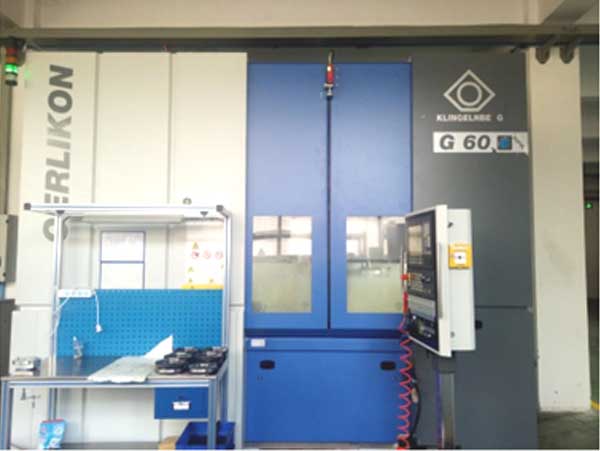
Modern gear design software (e.g., Gleason GEMS, Klingelnberg KIMOS) is indispensable here. I import the gear design, cutter, and machine models to perform a virtual Tooth Contact Analysis (TCA) and simulation of the gear milling process. TCA mathematically predicts the contact pattern and transmission error under load, allowing for optimization of machine settings (both basic and higher-order corrections like modified roll) before any metal is cut. The software can output optimized CNC programs for both the gear milling machine and the subsequent gear inspection machine. This virtual validation significantly reduces the trial-and-error time on the shop floor.
Machining Parameter Definition:
With the kinematics defined, I establish the cutting conditions:
- Cutting Speed ($v_c$): Based on cutter material (carbide, HSS) and workpiece material (typically high-strength alloy steel like AISI 9310 or Pyrowear 53).
- Feed Rate: This includes the generating feed (cradle roll rate) and the indexing feed. It is a critical parameter for surface finish and tool life.
- Depth of Cut: Separated into roughing and finishing depths.
These parameters are often summarized in a table for the operator:
| Operation | Cutting Speed $v_c$ [m/min] | Generating Feed [mm/rev of work] | Depth of Cut [mm] | Coolant |
|---|---|---|---|---|
| Roughing | 80 – 100 | 0.8 – 1.2 | Full slot depth in 2-3 passes | High-performance EP oil |
| Finishing | 100 – 120 | 0.4 – 0.6 | 0.2 – 0.5 (stock for grind) | High-performance EP oil |
The validation of these parameters is empirical and ongoing, based on tool wear patterns, surface roughness measurements, and the absence of detrimental white layer or excessive burr formation on the workpiece.
The final and most critical phase is the physical execution and validation of the gear milling process design. This is a multi-stage verification loop.
First-Article Validation:
The initial gears are machined using the calculated settings. A meticulous inspection sequence follows:
- Dimensional Check: Key parameters like chordal tooth thickness, hole location, and runout are measured using CMMs or functional gages.
- Geometry Check: The tooth flank form, lead, and profile are measured on a gear inspection machine. The data is compared against the theoretical model from the design software. Deviations are analyzed to determine if they are within the pre-grind tolerance band.
- Contact Pattern Check: The milled gear is rolled against its master or mating gear on a gear rolling tester, with mounting distances adjusted to a nominal position. The resulting contact pattern (using marking compound) is evaluated for location, shape, and size. It does not need to match the final grind specification perfectly but must show a stable, centrally-tending pattern of appropriate dimensions.
Process Adjustment & Optimization:
Based on the first-article results, fine-tuning is almost always required. Adjustments follow a logical hierarchy: first, correct basic machine settings (e.g., machine root angle, offset) to reposition the contact pattern. Second, if needed, apply higher-order corrections (modified roll, tilt) to adjust the pattern shape or transmission error. Each adjustment is made intentionally, and its effect is re-verified. Once a stable and acceptable process is achieved, the final “as-cut” data sheet is frozen for production.
Production Monitoring & Control:
For sustained production, the process control plan for gear milling includes:
- Tool Life Management: Monitoring cutter wear and establishing preventive blade change intervals based on surface finish or a predefined part count.
- In-Process Checks: Periodic checks of chordal tooth thickness and visual inspection for burrs on sample parts from the batch.
- System Stability Checks: Regular verification of machine alignment (e.g., head squareness, cutter spindle runout) and fixture condition.
| Validation Stage | Activity | Acceptance Criteria | Corrective Action (if needed) |
|---|---|---|---|
| First-Article Dimensional | Measure chordal thickness, runout, blank features. | Conformance to pre-grind drawing tolerances. | Adjust depth-of-cut or machine center settings. |
| First-Article Geometric | Gear inspection machine flank measurement. | Form/lead profile within pre-grind tolerance band; correct root fillet. | Adjust cutter profile offsets or machine kinematic coefficients. |
| First-Article Functional | Roll test for contact pattern. | Pattern is central, has correct length/width trend, is stable. | Hierarchical adjustment of machine settings (basic then modified). |
| Production Control | Statistical process control (SPC) on key dimensions. | Process capability (Cpk) meets requirement. | Review tool wear, machine maintenance, material batch. |
In conclusion, a systematic, V-model-based approach to gear milling process design transforms it from a tacit, experience-based skill into a rigorous engineering discipline. By explicitly defining requirements, performing detailed static and dynamic design with the aid of modern software, and establishing a closed-loop physical validation process, we can ensure the gear milling operation reliably produces optimal pre-forms for final grinding. This methodology not only improves first-time quality and reduces lead time but also creates the structured data and clear process boundaries essential for successful digitalization. The future lies in embedding these standardized calculations, validations, and best practices into integrated manufacturing execution systems, creating a seamless digital thread from gear design to the finished, high-performance aerospace component.