
In my extensive experience with industrial machinery, gear shaft failures represent a critical concern, often leading to costly downtime and safety hazards. This article delves into the root causes of such fractures, drawing from firsthand investigations and analytical approaches. I will explore common failure mechanisms, emphasizing the importance of material properties, heat treatment, and stress analysis in ensuring gear shaft reliability. The gear shaft, as a core transmission component, must withstand complex loads, and its failure can stem from various factors, including fatigue, improper manufacturing, or design flaws.
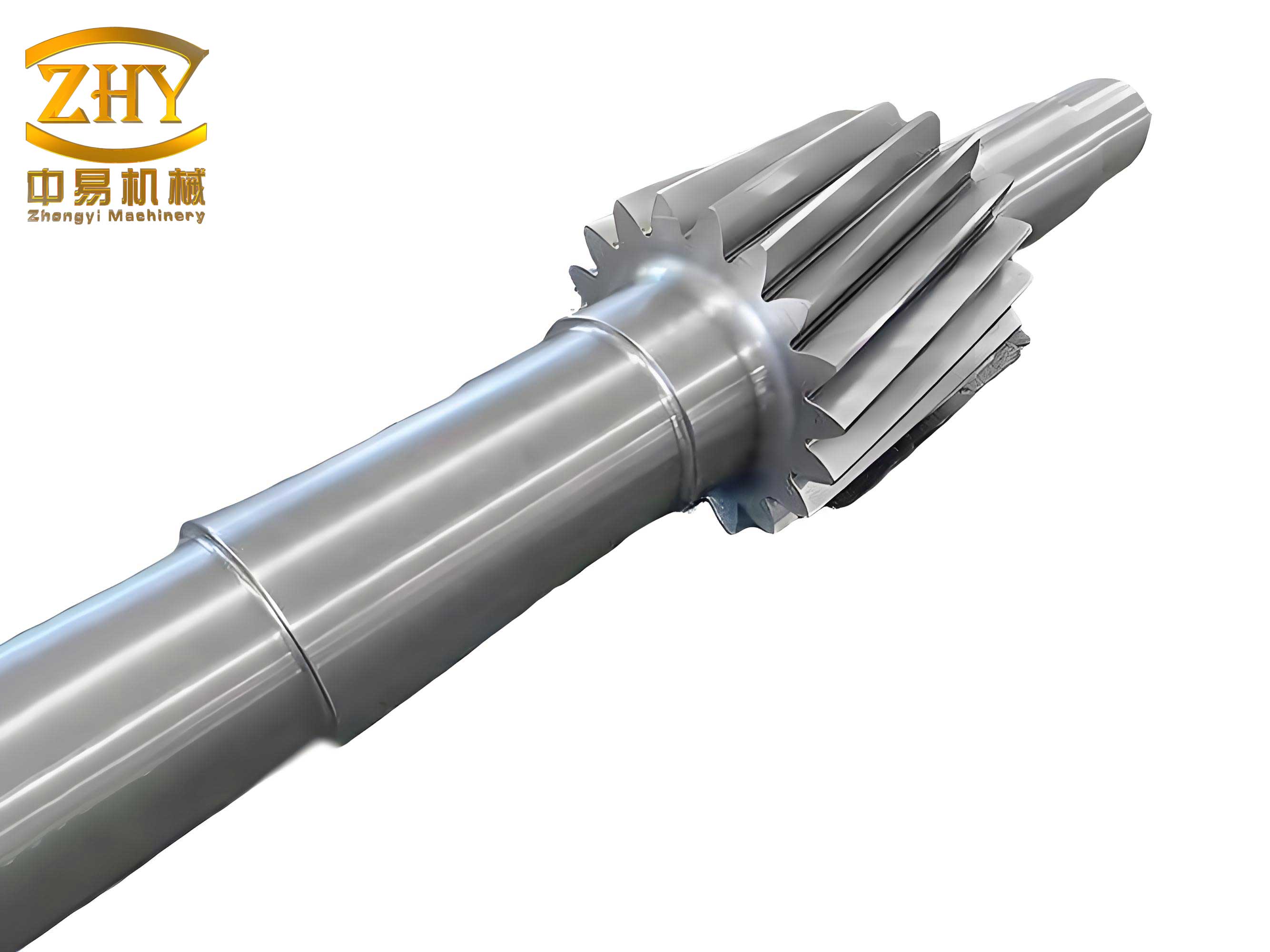
My investigation often begins with a visual examination of the fractured gear shaft. For instance, in a case involving a coal mine hoist reducer, the high-speed helical gear shaft broke at the transition between a thread relief groove and a shaft shoulder. The fracture surface exhibited distinct smooth and rough zones, indicative of fatigue failure. This observation prompted a deeper analysis using numerical simulations and material science techniques to confirm the hypothesis. The gear shaft in question was subjected to cyclic stresses, and understanding its behavior under load is paramount.
To systematically evaluate gear shaft integrity, I employ a multi-faceted approach. Mechanical performance testing, metallographic examination, and finite element analysis (FEA) are integral parts of my methodology. For example, in another case study involving a pin shaft from hydraulic support equipment, longitudinal tensile tests revealed substandard properties. The data, summarized in Table 1, showed that the tensile strength was approximately half the standard value, and hardness was below the required specification. This immediately raised flags about the heat treatment process applied to the gear shaft.
| Property | Test Value | Standard Value | Process Requirement |
|---|---|---|---|
| Tensile Strength, Rm (MPa) | 745 | 1470 | – |
| Elongation, A (%) | 22.5 | 9 | – |
| Reduction of Area, Z (%) | 60 | 40 | – |
| Hardness (HRC) | 28 | – | 35-42 |
Further hardness measurements around the circumference of the gear shaft, as shown in Table 2, indicated non-uniform surface hardness, with some areas failing to meet specifications. This inconsistency often points to uneven quenching or cooling during heat treatment, which can create residual stresses and weak zones within the gear shaft.
| Measured Values (HRC) | Average HRC | |||||||||||
|---|---|---|---|---|---|---|---|---|---|---|---|---|
| 39.5 | 45.0 | 43.0 | 31.0 | 38.0 | 46.5 | 34.0 | 33.0 | 32.5 | 38.0 | 36.0 | 37.86 | |
Metallographic analysis provides crucial insights into the microstructural conditions of the gear shaft. In the pin shaft case, samples from the core revealed a microstructure of pearlite and ferrite, which is relatively soft. In contrast, the subsurface region near the fracture origin showed a fully hardened layer of 4–5 mm with a tempered martensite structure. The transition between this hardened case and the soft core was abrupt, with a narrow zone containing a mixture of tempered martensite, bainite, and ferrite. This rapid change in microstructure, without a gradual gradient, creates a weakened region prone to crack initiation under stress. The relationship between hardness (H) and ultimate tensile strength (σ_u) for steel can often be approximated by empirical formulas such as:
$$ \sigma_u \approx k \cdot H $$
where k is a material constant. For many alloy steels, a rough correlation exists where higher hardness generally corresponds to higher strength. The sharp drop in hardness over a short radial distance implies a similar drop in local strength, creating a stress concentration effect beyond the geometric ones.
To understand the stress state in a gear shaft under operational loads, I frequently resort to finite element analysis. For the helical gear shaft, I created a 3D model, simplified by omitting minor features like threads and small fillets to focus on global stress distribution. The material was defined as 20CrNiMo alloy steel with an elastic modulus E = 208 GPa, Poisson’s ratio ν = 0.295, and density ρ = 7870 kg/m³. The boundary conditions were applied based on the actual loading: a torque converted into a uniform normal pressure on the keyway side for the input, and the gear tooth forces simplified as a normal distributed load on the tooth surface. The forces involved are derived from the transmitted torque and gear geometry.
The tangential force on the gear tooth is given by:
$$ F_t = \frac{2T}{d} $$
where T is the torque and d is the pitch diameter. The normal force on the tooth surface, which accounts for the helical angle β and normal pressure angle α_n, is:
$$ F_n = \frac{F_t}{\cos \beta \cos \alpha_n} $$
For the specific case analyzed, using the provided data, the normal force was calculated to be approximately 49.8 kN. The distributed pressure on the tooth contact area A_tooth is then:
$$ p’ = \frac{F_n}{A_{tooth}} $$
Similarly, the pressure on the keyway side from the input torque was calculated. The FEA mesh, using SOLID45 elements, consisted of over 500,000 elements to ensure accuracy. The static stress analysis results revealed that the maximum equivalent stress, calculated using the von Mises criterion, was located precisely at the thread relief groove transition—the actual fracture site. The stress value at this critical gear shaft location was found to be 561.2 MPa. While this is below the material’s yield strength of 785 MPa, it is significantly above its fatigue limit of 460 MPa. This is a key finding. The fatigue life N under cyclic stress amplitude σ_a can be estimated using the Basquin equation:
$$ \sigma_a = \sigma_f’ (2N)^b $$
where σ_f’ is the fatigue strength coefficient and b is the fatigue strength exponent. The presence of stress concentrations at geometric discontinuities, combined with stresses above the fatigue limit, leads to cumulative damage according to Miner’s rule:
$$ D = \sum_{i=1}^{k} \frac{n_i}{N_i} $$
where D is the total damage, n_i is the number of cycles at stress level i, and N_i is the number of cycles to failure at that level. When D reaches 1, failure occurs. The stress concentration factor K_t at the groove further amplifies the nominal stress. For a shaft with a shoulder fillet, K_t can be estimated from empirical charts based on the ratio of fillet radius to shaft diameter. The actual stress range becomes:
$$ \sigma_{max} = K_t \cdot \sigma_{nominal} $$
In my analysis, the combination of this localized high stress, a weakened microstructural transition zone, and cyclic loading unequivocally points to fatigue failure. The fracture initiated at the surface stress concentration, propagated through the region of microstructural weakness, and led to final rupture. This pattern is classic for fatigue failures in rotating components like gear shafts.
The importance of proper heat treatment for a gear shaft cannot be overstated. In the first case, the insufficient and non-uniform hardening led to a soft core and a brittle, shallow case, creating an unfavorable stress distribution. The theoretical and actual stress distribution curves across the radius of the gear shaft would show a mismatch. Ideally, a smooth gradient in properties is desired to avoid abrupt changes in stress capacity. The core strength σ_core and case strength σ_case should be balanced to support the applied bending and torsional moments. The bending stress in a gear shaft is given by:
$$ \sigma_b = \frac{32 M}{\pi d^3} $$
and the torsional shear stress by:
$$ \tau = \frac{16 T}{\pi d^3} $$
The von Mises equivalent stress in the gear shaft under combined loading is:
$$ \sigma_{vm} = \sqrt{\sigma_b^2 + 3\tau^2} $$
This must be less than the allowable stress at every point, which is a function of the local material strength. A summary of key material properties for common gear shaft steels is provided in Table 3.
| Material Grade | Yield Strength σ_s (MPa) | Ultimate Tensile Strength σ_u (MPa) | Fatigue Limit σ_{-1} (MPa) | Recommended Hardness (HRC) |
|---|---|---|---|---|
| 20CrNiMo | 785 | 980 | ~460 | 30-40 |
| 42CrMo | 930 | 1080 | ~550 | 35-45 |
| SAE 4340 | 470 | 745 | ~330 | 28-36 |
Based on my findings, I consistently recommend stringent control over heat treatment processes for gear shafts. This includes precise control of quenching temperature, time, and cooling media to achieve a desired case depth and a gradual transition zone. Implementing process control records and regular metallographic and mechanical testing per batch is essential. For design, fillet radii at transitions should be maximized within space constraints to reduce stress concentration factors. The relationship between stress concentration factor K_t and the geometry for a stepped shaft is complex, but simplified formulas exist. For a shaft with diameter D and a smaller diameter d, with a fillet radius r, the factor for bending can be approximated using curves or empirical relations.
Furthermore, for gear shafts operating under cyclic loads, a detailed fatigue analysis should be conducted. This involves defining the load spectrum, calculating stress ranges at critical locations, and applying appropriate fatigue life prediction models. The modified Goodman diagram is often used to account for mean stress effects:
$$ \frac{\sigma_a}{S_e} + \frac{\sigma_m}{S_u} = 1 $$
where σ_a is the stress amplitude, σ_m is the mean stress, S_e is the corrected endurance limit, and S_u is the ultimate tensile strength. For the gear shaft analyzed, with a mean stress in the tensile region, this interaction further reduces the allowable stress amplitude, accelerating fatigue damage.
In conclusion, the failure of a gear shaft is rarely due to a single cause. It is typically the result of an interplay between material deficiencies, manufacturing imperfections, and operational stresses. My analyses underscore that fatigue, driven by stress concentrations and inadequate material strength gradients, is a predominant failure mode. Regular inspection, proper material selection, optimized heat treatment, and thorough engineering analysis using tools like FEA are vital to prevent such failures. The gear shaft, while a seemingly simple component, demands meticulous attention to detail throughout its lifecycle to ensure the reliability and safety of the entire mechanical system.