
In my extensive experience within industrial operations, I have consistently observed the critical role of speed reducers, or gearboxes, across numerous sectors such as coal processing, material handling, and general mechanical engineering. These devices are fundamental for torque multiplication and speed reduction, directly enhancing productivity. However, a persistent and significant challenge I have encountered is the premature failure, specifically fracture, of the high-speed gear shaft. Such failures lead to unplanned downtime, costly repairs, and can pose serious safety risks. The fracture of this central rotating component is a complex issue rarely attributable to a single cause. In this analysis, I will systematically deconstruct the primary factors leading to the failure of the high-speed gear shaft and provide detailed, actionable strategies for prevention, incorporating quantitative models and structured data where applicable.
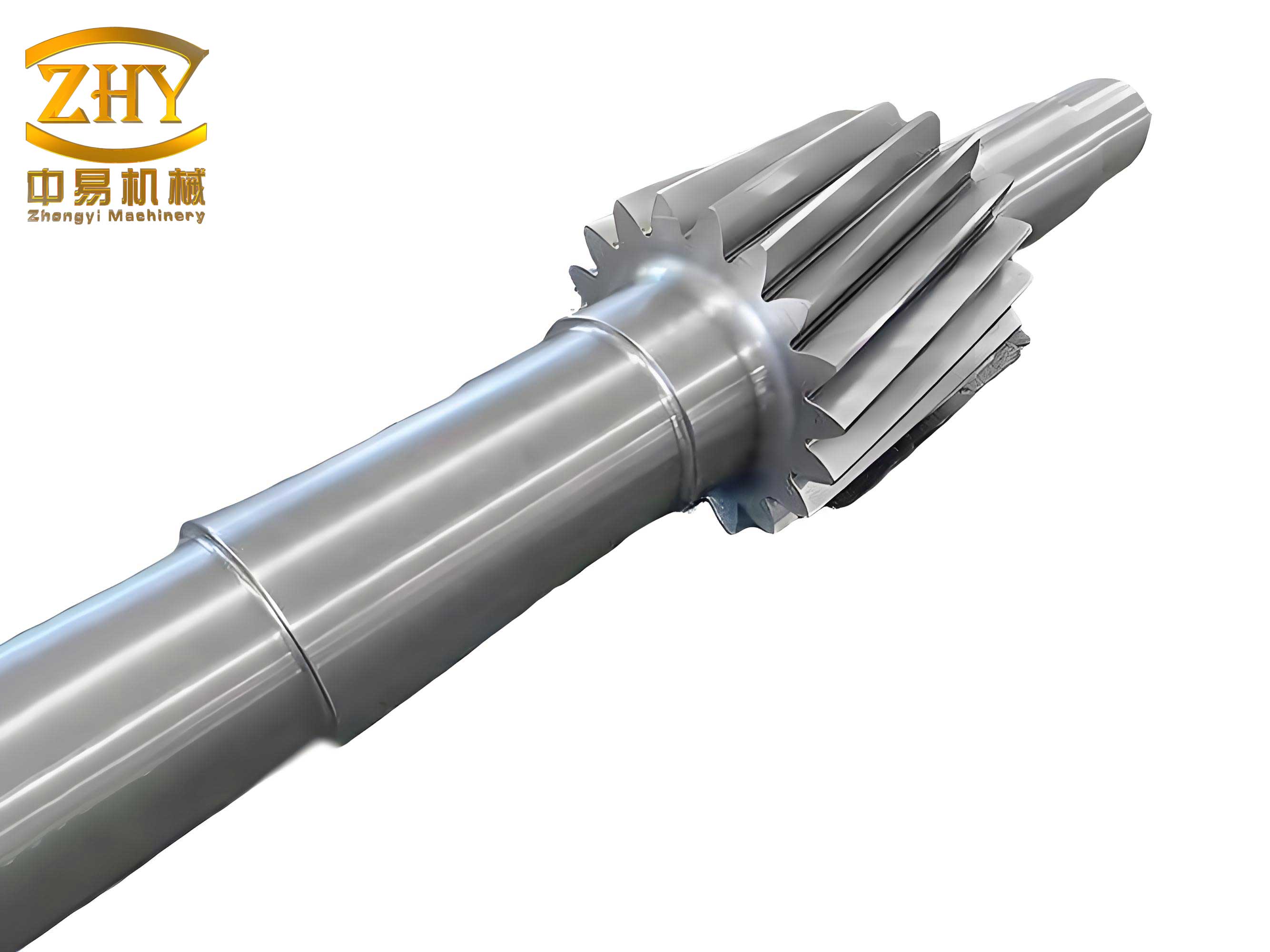
The high-speed gear shaft operates under demanding conditions, transmitting power while subject to fluctuating torsional, bending, and shear stresses. Its integrity is paramount for system reliability. My investigation into numerous failure cases reveals a pattern rooted in four interconnected domains: material science, manufacturing quality, assembly precision, and operational management. Understanding the interplay between these domains is key to developing a robust failure prevention program.
Root Cause Analysis of High-Speed Gear Shaft Fracture
1. Material Properties and Metallurgical Factors
The choice and quality of material for the gear shaft are foundational. During operation, the shaft is subjected to significant cyclic torque, leading to stress states that can induce both elastic and plastic deformation. While design often accounts for a controlled plastic zone under extreme overload, the shaft’s long-term resistance to fatigue is dictated by its material properties. The vast majority of industrial-grade gear shafts are manufactured from alloy steels containing elements like Chromium (Cr), Molybdenum (Mo), Manganese (Mn), and Silicon (Si) to enhance hardenability, strength, and toughness. The precise composition and the subsequent heat treatment (quenching and tempering) determine the final microstructure—typically a tempered martensite—which governs the fatigue limit.
In my assessments, material-related failures often stem from two issues: improper alloy composition and inadequate heat treatment. Deviations in the concentration of key elements, particularly carbon (C), can drastically alter mechanical properties. Excess carbon, while increasing hardness, can lead to embrittlement, reducing impact toughness and promoting sudden, catastrophic brittle fracture with little plastic deformation. Conversely, insufficient carbon or incorrect alloy ratios may fail to achieve the necessary core strength, leading to accelerated plastic deformation and low-cycle fatigue failure.
A critical parameter is the endurance limit (Se), the stress level below which the material can theoretically endure an infinite number of cycles. For steel, a rough estimation is often given as a fraction of the ultimate tensile strength (Sut):
$$ S_e’ = 0.5 \cdot S_{ut} \quad \text{(for } S_{ut} \leq 1400 \text{ MPa)} $$
This corrected value (Se) must then be adjusted for factors like surface finish, size, loading, and temperature. A shaft failing below its calculated Se often points to material defects or unaccounted stress concentrations.
| Element | Primary Effect | Consequence for Gear Shaft Performance |
|---|---|---|
| Carbon (C) | Increases hardness & tensile strength. | Critical for wear resistance; excess leads to brittleness and increased risk of brittle fracture. |
| Chromium (Cr) | Improves hardenability, corrosion & wear resistance. | Enhances core strength and surface durability, extending fatigue life. |
| Molybdenum (Mo) | Enhances hardenability and high-temperature strength. | Reduces risk of temper embrittlement, stabilizes microstructure under thermal cycling. |
| Manganese (Mn) | Increases hardenability and strength. | Improves response to heat treatment; helps deoxidize the steel melt. |
| Silicon (Si) | Main deoxidizer; increases strength. | Improves yield strength but can promote brittleness if too high. |
| Sulfur (S) | Typically an impurity, but added for machinability. | Forms manganese sulfide inclusions which can act as stress raisers and initiate fatigue cracks, weakening the gear shaft. |
2. Internal Inclusions and Manufacturing Defects
Even with optimal chemistry, the internal soundness of the gear shaft forging or bar stock is crucial. Non-metallic inclusions—oxides, sulfides, or silicates entrapped during the steelmaking process—act as internal stress concentrators. Under cyclic loading, a fatigue crack can initiate at such an inclusion well before the nominal stress on the component reaches critical levels. The fracture surface from an inclusion-initiated failure is often distinct: it may originate at an internal point and propagate radially, sometimes showing a “fish-eye” pattern around the inclusion site. While modern steelmaking practices like vacuum arc remelting (VAR) have significantly reduced inclusion content, they remain a potential threat, especially in highly stressed components like the high-speed gear shaft.
The stress intensity factor (K) at the tip of a crack-like inclusion governs crack propagation. For a small, embedded, elliptical flaw, it can be approximated by:
$$ K_I \approx \sigma \sqrt{\pi a} $$
where \(\sigma\) is the remote tensile stress and \(a\) is the flaw size. This demonstrates why controlling the size and frequency of inclusions is paramount; a small reduction in maximum inclusion size can lead to a disproportionate increase in fatigue life.
3. Assembly and Alignment Errors
This is perhaps the most common and preventable cause of gear shaft failure I encounter in the field. A perfectly manufactured shaft can be doomed by poor installation. The central issue is the introduction of unintended bending moments and shear forces due to misalignment. A gear shaft is primarily designed to transmit torque (T). Its diameter is calculated based on torsional shear stress (\(\tau\)):
$$ \tau_{max} = \frac{16T}{\pi d^3} $$
However, when the connected components (e.g., motor and reducer input flanges) are misaligned—either in parallel offset (Δy) or angular misalignment (Δθ)—the shaft is forced to bend with each rotation. This superimposes a fully reversed bending stress (\(\sigma_b\)) on the torsional stress. The combined stress state becomes far more damaging. The alternating bending stress can be estimated if the misalignment-induced force (F) is known:
$$ \sigma_b = \frac{32 M}{\pi d^3}, \quad \text{where } M = F \cdot L $$
Here, \(M\) is the bending moment and \(L\) is a relevant moment arm. This bending stress, acting at the same frequency as rotation, dramatically accelerates high-cycle fatigue. Furthermore, improper bearing fits, excessive preload, or incorrect gear meshing during assembly create local stress concentrations that become nucleation sites for cracks. The use of force during assembly, such as hammering components onto the shaft, can cause immediate micro-damage or distort bearings, guaranteeing premature failure.
4. Inadequate Operational Management and Maintenance
The gear shaft operates in a dynamic environment. Fatigue damage is cumulative, governed by Miner’s rule:
$$ \sum_{i=1}^{k} \frac{n_i}{N_i} = D $$
where \(n_i\) is the number of cycles at a given stress level \(\sigma_i\), \(N_i\) is the number of cycles to failure at that stress level, and \(D\) is the accumulated damage (failure is predicted when D ≈ 1). Without proper management, several factors accelerate this damage accumulation: overloads from process upsets, improper lubrication leading to wear and pitting on the gear teeth (which then transmits shock loads to the gear shaft), and contamination ingress. The absence of a proactive condition monitoring program means that warning signs—increased vibration spectra indicating misalignment, wear, or shaft crack development; rising oil temperature; or audible noise changes—are missed. The shaft is run to complete failure, resulting in a more destructive and costly event.
Comprehensive Strategies to Prevent Gear Shaft Fracture
Based on the root cause analysis, a multi-layered defense strategy is essential. The goal is to create a system that ensures shaft integrity from specification through to decommissioning.
1. Strategic Selection and Specification of the Gear Shaft
Procurement is the first line of defense. A price-focused approach is invariably costly in the long term. I advocate for a performance-based specification:
- Material Certification: Require mill certificates for the raw material, verifying chemical composition and mechanical properties against standards like AISI 4140, 4340, or similar. Specify maximum allowable inclusion ratings per standards like ASTM E45 or ISO 4967.
- Non-Destructive Testing (NDT): Mandate 100% ultrasonic testing (UT) of the shaft forgings to detect internal flaws. Magnetic particle inspection (MPI) or liquid penetrant testing (PT) of finished machined surfaces, especially in fillet radii and keyway areas, is non-negotiable.
- Lifecycle Data Analysis: Maintain a detailed failure and performance database for all critical gear shafts. Track mean time between failures (MTBF) by manufacturer, material grade, and application. This data-driven approach informs future purchases and identifies systemic issues.
2. Precision Installation and Alignment Protocols
This phase requires treating the gear shaft and its housing as a precision system. The old methods of using straight edges and feeler gauges are insufficient for high-speed equipment.
- Laser Alignment: Implement laser shaft alignment tools as the standard. They provide real-time, precise measurement of offset and angular misalignment in two planes, guiding corrections to within thousandths of an inch or hundredths of a millimeter. The target should be alignment tolerances stricter than the manufacturer’s general recommendations.
- Dimensional Pre-Check: Before any assembly, verify all mating dimensions: shaft diameters, bearing fits, gear hub bores, keyway dimensions, and coupling specs. Interference fits must be correct; clearances must be within specification. Use proper tools (induction heaters for bearings, hydraulic nuts) for assembly—never brute force.
- Procedure Adherence: Develop and follow a detailed, step-by-step assembly procedure (SOP) for each reducer model. This includes bolt torque sequences, lubrication procedures for bearings and gears, and final alignment verification after the system is bolted down to its baseplate.
3. Proactive and Predictive Maintenance Regime
Prevention is more economical than reaction. A shift from time-based to condition-based maintenance is critical for the gear shaft.
- Scheduled Condition Monitoring:
Table 2: Key Condition Monitoring Techniques for Gear Shaft Health Technique Parameter Measured What it Detects Related to Gear Shaft Vibration Analysis Acceleration, velocity, displacement spectra Imbalance, misalignment, bearing defects, gear mesh issues, shaft cracks (changes in natural frequency). Oil Analysis Wear metal concentration, viscosity, particle count Active wear from gears/bearings (Fe, Cr, Pb particles), contamination ingress, lubricant degradation. Thermography Surface temperature Hot spots indicating misalignment, overloading, or inadequate lubrication at bearings or couplings connected to the shaft. Ultrasonic Monitoring High-frequency sound emissions Early-stage bearing fatigue, cavitation, and the sound of a propagating crack in the gear shaft. - Strategic Replacement: Based on vibration trends, oil analysis history, and operating hours, plan for the replacement of the high-speed gear shaft during scheduled shutdowns before failure occurs. This is particularly important for shafts in critical, high-availability applications.
- Root Cause Failure Analysis (RCFA): When a failure does occur, conduct a thorough RCFA. Examine the fracture surface (often requiring electron microscopy), review alignment records, and analyze operating data. The goal is not just to replace the broken gear shaft, but to identify and eliminate the root cause to prevent recurrence.
Conclusion
The fracture of the high-speed gear shaft in reducers is a multifaceted problem that bridges design, manufacturing, installation, and operational disciplines. In my professional judgment, there is no single “silver bullet” solution. A holistic approach is required, beginning with the specification of a high-integrity gear shaft characterized by optimal material properties and verified through rigorous NDT. This must be followed by a precision installation process that eliminates parasitic bending stresses through laser-perfect alignment and correct assembly techniques. Finally, the life of the gear shaft must be actively managed through a predictive maintenance program that monitors its condition, anticipates wear, and schedules intervention before catastrophic failure. By implementing this integrated strategy, plant reliability engineers and maintenance managers can significantly reduce the incidence of costly and disruptive gear shaft failures, ensuring safer and more productive industrial operations.