
In the realm of mechanical engineering, the gear shaft serves as a critical transmission component, integral to the efficient operation of various machinery. From automotive systems to industrial equipment, the gear shaft facilitates torque transfer and motion control, making its manufacturing precision paramount. As an engineer deeply involved in mechanical design and production, I have observed that even minor deviations in gear shaft processing can lead to significant performance degradation, increased wear, and premature failure. Therefore, a thorough investigation into the manufacturing processes and optimization strategies for gear shafts is essential to enhance reliability, durability, and overall efficiency. This article delves into the intricate details of gear shaft processing, from material selection to final finishing, incorporating analytical models, empirical data, and advanced techniques to propose actionable improvements. Through this first-person perspective, I aim to share insights gained from both theoretical studies and practical applications, emphasizing the multifaceted nature of gear shaft production.
The structure of a gear shaft is inherently complex, comprising multiple geometric features such as gears, splines, keyways, shoulders, and grooves. Each element must be meticulously crafted to ensure seamless integration with other components. For instance, the gear teeth require precise tooth profile accuracy to minimize noise and vibration, while the splines must maintain strict tolerances for effective torque transmission. Understanding these structural nuances is the foundation for developing a robust manufacturing plan. In this context, the gear shaft’s design specifications, including dimensions, load capacities, and operational environments, dictate the selection of materials and processing methods. A holistic analysis of the gear shaft’s architecture reveals that challenges often arise from balancing strength, weight, and manufacturability, necessitating a systematic approach to process planning.
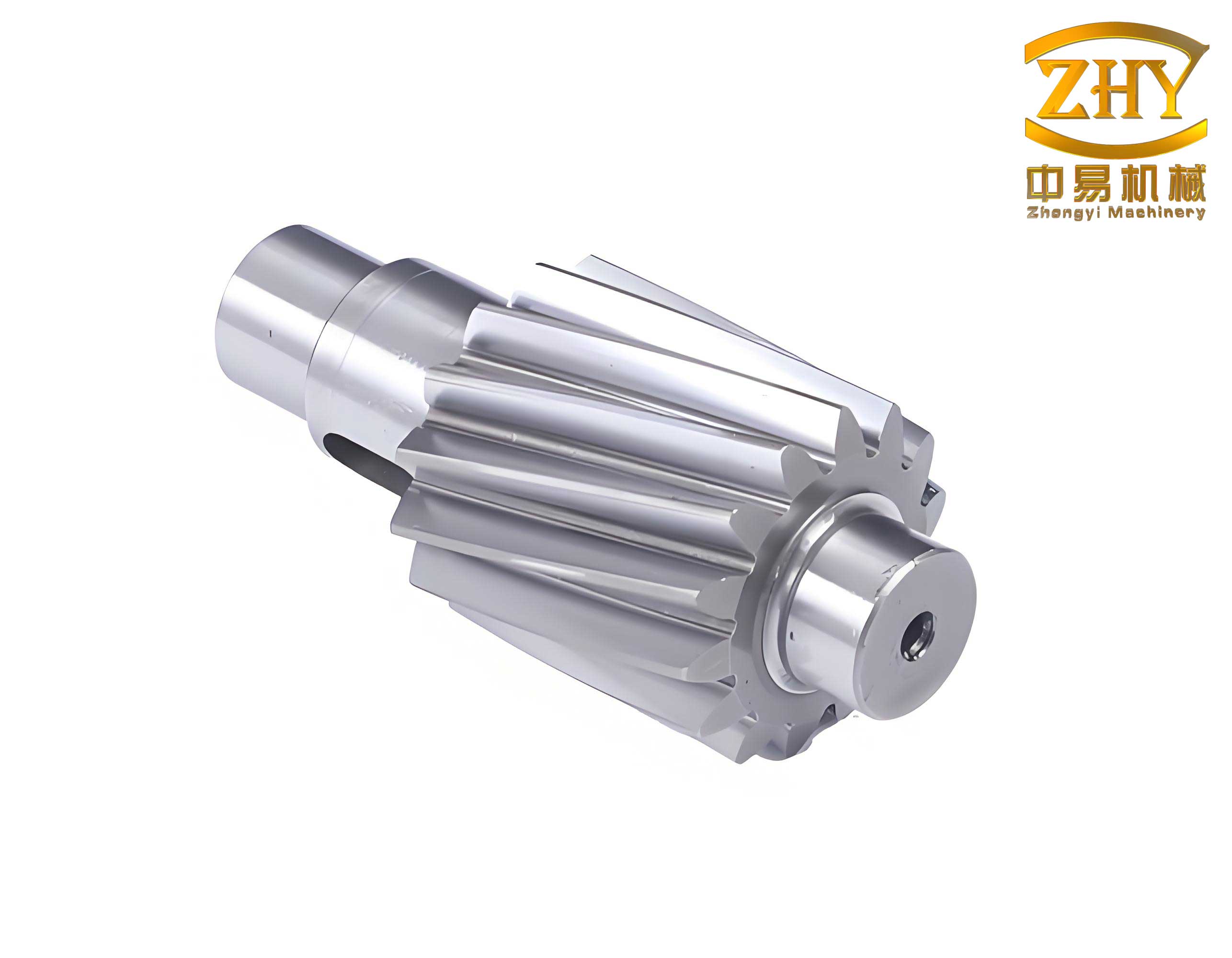
Material selection forms the bedrock of gear shaft manufacturing, directly influencing mechanical properties such as hardness, toughness, and fatigue resistance. Commonly used materials for gear shafts include medium-carbon steels like AISI 1045 (45 steel) and low-alloy steels such as AISI 8620 or 20MnCr5. These materials offer a favorable balance of strength and machinability, but their suitability depends on specific application demands. For high-stress environments, alloy steels with chromium, nickel, or molybdenum additions are preferred to enhance core toughness and surface hardness after heat treatment. To illustrate, consider the following table summarizing key materials for gear shafts, their compositions, and typical applications:
| Material Type | Standard Designation | Key Alloying Elements | Typical Applications | Advantages for Gear Shaft |
|---|---|---|---|---|
| Medium-Carbon Steel | AISI 1045 | C: 0.45%, Mn: 0.75% | General machinery, agricultural equipment | Good machinability, moderate strength |
| Low-Alloy Steel | AISI 8620 | C: 0.20%, Ni: 0.55%, Cr: 0.50%, Mo: 0.20% | Automotive transmissions, heavy-duty gearboxes | Excellent case hardenability, core toughness |
| Carburizing Steel | 20MnCr5 | C: 0.20%, Mn: 1.25%, Cr: 1.15% | High-performance gear shafts, aerospace components | Superior surface hardness after carburizing |
| Alloy Steel | AISI 4140 | C: 0.40%, Cr: 0.95%, Mo: 0.20% | Industrial machinery, mining equipment | High tensile strength, good wear resistance |
The selection process often involves evaluating material properties through empirical formulas. For example, the ideal hardness for a gear shaft surface can be estimated based on the applied load and desired service life. A simplified model relates surface hardness \( H \) to the contact stress \( \sigma_c \) and safety factor \( S \): $$ H = k \cdot \sigma_c \cdot S $$ where \( k \) is a material constant derived from experimental data. This equation underscores the importance of material choice in meeting performance criteria for the gear shaft.
Once the material is chosen, the next step involves selecting an appropriate blank. For gear shafts, forging is widely adopted due to its ability to produce near-net shapes with enhanced grain flow and mechanical integrity. The forging process aligns the metal’s grain structure with the gear shaft’s contours, reducing material waste and improving fatigue resistance. However, the size and complexity of the gear shaft influence whether open-die or closed-die forging is employed. Larger gear shafts with diameters exceeding 200 mm may require open-die forging, followed by machining, while smaller ones benefit from precision closed-die forging to minimize subsequent processing. The economic and technical trade-offs in blank selection can be analyzed using cost functions that account for material usage, forging energy, and machining time. For instance, the total cost \( C_{total} \) for producing a gear shaft blank can be expressed as: $$ C_{total} = C_{material} \cdot V + C_{forging} \cdot E + C_{machining} \cdot T $$ where \( V \) is the volume of material, \( E \) is the forging energy, and \( T \) is the machining time. Optimization algorithms can then determine the most cost-effective blank geometry for the gear shaft.
Prior to machining, thermal treatments are applied to refine the microstructure and relieve internal stresses. For low-carbon and alloy steels commonly used in gear shafts, normalizing is a prevalent pre-treatment. Normalizing involves heating the steel to approximately 50°C above its upper critical temperature, followed by air cooling. This process homogenizes the structure, refines grain size, and eliminates forging stresses, thereby improving machinability by preventing issues like “gumminess” during cutting. The effectiveness of normalizing can be quantified through hardness measurements and microstructural analysis. For a gear shaft made of AISI 1045, the normalizing temperature \( T_n \) is typically around 850°C to 900°C, with a holding time \( t_n \) calculated based on the section thickness \( d \): $$ t_n = \alpha \cdot d^{2} $$ where \( \alpha \) is a constant dependent on the furnace type and steel composition. This pre-treatment sets the stage for subsequent machining operations by ensuring consistent material properties throughout the gear shaft.
Rough turning is the initial machining phase, where excess material is removed to approximate the final dimensions of the gear shaft. The choice of cutting parameters—such as speed, feed, and depth of cut—directly impacts tool life, surface finish, and dimensional accuracy. For gear shafts, it is crucial to establish a reliable datum system to maintain positional accuracy between features. Commonly, the centerline or specific diameters serve as datums, with tolerances tightly controlled to within one-fifth to one-third of the overall tolerance band. During rough turning, the focus is on material removal rate (MRR), which can be maximized subject to constraints like tool wear and machine power. The MRR for turning is given by: $$ MRR = v \cdot f \cdot a_p $$ where \( v \) is the cutting speed in m/min, \( f \) is the feed rate in mm/rev, and \( a_p \) is the depth of cut in mm. Optimizing these parameters for the gear shaft involves balancing productivity with surface integrity, as excessive heat generation can induce thermal distortions that affect later stages.
Following rough turning, finish turning achieves the precise dimensions and surface qualities required for the gear shaft. With the advent of computer numerical control (CNC) technology, finish turning can be executed with high repeatability and efficiency. CNC programming allows for complex contours and tight tolerances, often achieving surface roughness values below 1.6 μm. For batch production of gear shafts, CNC turning centers equipped with automatic tool changers and in-process measurement systems reduce cycle times and enhance quality control. The relationship between surface roughness \( R_a \) and cutting parameters can be modeled as: $$ R_a = \frac{f^{2}}{32 \cdot r_e} $$ where \( r_e \) is the tool nose radius. This equation highlights the importance of fine feeds and sharp tools in obtaining smooth surfaces on the gear shaft. After finish turning, a stress-relief operation such as tempering may be performed if subsequent heat treatments are planned, to minimize distortions during quenching.
The gear teeth and splines represent the most critical features of the gear shaft, demanding high precision to ensure proper meshing and torque transmission. Gear teeth are typically machined via hobbing or shaping, with hobbing being preferred for its higher productivity and accuracy for gears up to quality grade 9 (according to ISO 1328). The hobbing process involves a rotating hob that progressively generates the tooth profile on the gear shaft. The kinematic relationship between the hob and workpiece is complex, governed by parameters like module, pressure angle, and helix angle. For a spur gear shaft, the basic tooth geometry is defined by the module \( m \) and number of teeth \( z \), with the pitch diameter \( d_p \) calculated as: $$ d_p = m \cdot z $$ Hobbing accuracy depends on factors such as hob wear, machine rigidity, and cutting fluid application. To optimize hobbing for gear shafts, statistical process control (SPC) can monitor key variables like tooth thickness error and profile deviation.
For higher precision gear shafts requiring quality grades better than 7, additional finishing processes like grinding or honing are employed after heat treatment. The sequence often involves hobbing, shaving (if applicable), carburizing, quenching, and then grinding. This approach compensates for distortions induced by thermal treatments, ensuring final tooth accuracy. Spline machining, particularly for involute splines commonly used in gear shafts, is performed via dedicated spline milling or broaching machines. The geometry of an involute spline is defined by parameters such as pitch, pressure angle, and fit class. The manufacturing tolerance for spline teeth is critical to avoid backlash and ensure smooth engagement. A comparison of gear and spline machining methods for gear shafts is presented in the table below:
| Feature | Machining Method | Typical Accuracy | Advantages | Limitations |
|---|---|---|---|---|
| Gear Teeth (Spur/Helical) | Hobbing | ISO 6-9 Grade | High productivity, good accuracy | Requires dedicated hobbing machine |
| Gear Teeth (Internal) | Shaping | ISO 7-10 Grade | Suitable for internal gears | Slower than hobbing |
| Gear Finishing | Grinding | ISO 3-6 Grade | Excellent precision, corrects heat treat distortions | High cost, thermal damage risk |
| Involute Splines | Spline Milling | Class 5-7 Fit | Flexible for various sizes | Setup complexity for batch production |
| Involute Splines | Broaching | Class 4-6 Fit | High accuracy, fast for mass production | Expensive tooling, limited to through holes |
Surface hardening through carburizing and quenching is essential to impart wear resistance and fatigue strength to the gear shaft. Carburizing involves diffusing carbon into the surface layer at temperatures around 900°C to 950°C, creating a high-carbon case with depths typically ranging from 1.1 to 1.7 mm for medium-sized gear shafts. The carbon concentration profile \( C(x,t) \) as a function of depth \( x \) and time \( t \) can be described by Fick’s second law: $$ \frac{\partial C}{\partial t} = D \frac{\partial^{2} C}{\partial x^{2}} $$ where \( D \) is the diffusion coefficient, which depends on temperature and steel composition. After carburizing, quenching rapidly cools the gear shaft to form a hard martensitic structure in the case, while the core remains tough. However, quenching introduces residual stresses and distortions, which must be managed through techniques like press quenching or austempering. Areas such as spline teeth or grooves that do not require hardening are often protected with anti-carburizing coatings, such as copper plating or ceramic paints, prior to carburizing. The optimization of carburizing parameters—time, temperature, and atmosphere composition—aims to achieve a desired case depth with minimal distortion, often using response surface methodology (RSM) experiments.
After heat treatment, the gear shaft undergoes final precision machining to correct any distortions and meet exact dimensional specifications. The center holes at both ends are ground to serve as precise datums for subsequent operations. This grinding process ensures concentricity and alignment of all features on the gear shaft. Following this, critical surfaces like journals and shoulders are finish-ground to achieve tight tolerances and low roughness. The grinding parameters, such as wheel speed \( v_s \), workpiece speed \( v_w \), and depth of cut \( a_g \), influence the material removal rate and surface integrity. A model for grinding force \( F_g \) can be expressed as: $$ F_g = K_g \cdot a_g \cdot b \cdot v_w / v_s $$ where \( K_g \) is a grinding constant and \( b \) is the width of cut. Excessive grinding forces can induce thermal damage, so coolants and optimized cycles are vital for the gear shaft’s final quality.
The gear teeth themselves may require finishing via grinding or honing, especially for high-precision applications. Gear grinding can be performed using form grinding or generating grinding methods, with the latter offering higher flexibility. The process corrects tooth profile errors introduced during heat treatment, ensuring smooth operation and noise reduction. The final inspection of the gear shaft encompasses comprehensive measurements of dimensions, hardness, surface finish, and geometric tolerances. Advanced metrology tools like coordinate measuring machines (CMMs) and gear analyzers provide data for statistical quality control, ensuring each gear shaft conforms to design specifications.
The entire manufacturing route for a typical gear shaft can be summarized as a sequence of operations, as shown in the table below. This sequence represents a conventional approach, but it is subject to optimization based on specific requirements and technological advancements.
| Step No. | Process Operation | Key Parameters | Objectives | Potential Optimizations |
|---|---|---|---|---|
| 1 | Material Procurement & Cutting | Bar stock diameter, length | Obtain raw material of correct grade and size | Just-in-time inventory to reduce waste |
| 2 | Forging | Temperature, strain rate, die design | Form near-net shape with improved grain flow | Finite element simulation to predict defects |
| 3 | Normalizing | Temperature: 850-900°C, air cool | Refine microstructure, relieve stresses | Controlled atmosphere to prevent decarburization |
| 4 | Rough Turning | v = 150-200 m/min, f = 0.3 mm/rev, a_p = 2-4 mm | Remove bulk material, establish datums | Adaptive control to adjust parameters based on tool wear |
| 5 | Finish Turning | v = 250-300 m/min, f = 0.1 mm/rev, a_p = 0.5 mm | Achieve precise diameters and surfaces | CNC programming with trochoidal turning for hard materials |
| 6 | Gear Hobbing | Hob speed, feed, coolant flow | Generate gear teeth to pre-heat treat accuracy | Use of powder metallurgy hobs for longer life |
| 7 | Spline Milling | Cutter geometry, axial feed | Machine involute splines with proper fit | Multi-axis CNC milling for complex splines |
| 8 | Carburizing | Temperature: 920°C, time: 4-8 h, carbon potential | Create high-carbon case for hardness | Vacuum carburizing for uniform depth and clean surfaces |
| 9 | Quenching | Quenchant type (oil, polymer), agitation | Harden case while maintaining core toughness | High-pressure gas quenching to minimize distortion |
| 10 | Tempering | Temperature: 150-200°C, time: 2 h | Relieve quenching stresses, improve toughness | Multiple tempering cycles for stability |
| 11 | Center Hole Grinding | Grinding wheel grit, feed rate | Create precise datums for final grinding | In-process gaging to automatically compensate for wear |
| 12 | Surface Grinding | v_s = 35 m/s, v_w = 20 m/min, a_g = 0.02 mm | Finish critical diameters and shoulders | CBN wheels for higher material removal rates |
| 13 | Gear Grinding | Wheel profile, generating motion | Correct tooth geometry after heat treat | Continuous generating grinding for efficiency |
| 14 | Final Inspection & Cleaning | CMM, hardness tester, surface profilometer | Verify all specifications, remove contaminants | Automated optical inspection for 100% quality check |
Optimizing the manufacturing process for gear shafts involves a multi-objective approach, aiming to minimize cost, maximize quality, and reduce environmental impact. One powerful tool is the use of design of experiments (DOE) to identify critical factors influencing key responses such as surface roughness, hardness gradient, and distortion. For instance, a factorial experiment can evaluate the effects of carburizing time, temperature, and quench rate on the case depth and distortion of a gear shaft. The results can be modeled using regression equations, enabling the prediction of optimal settings. Additionally, advanced simulation software, such as finite element analysis (FEA), can predict thermal and mechanical behaviors during machining and heat treatment, allowing for virtual prototyping of the gear shaft. This reduces the need for physical trials, saving time and resources.
Another optimization avenue lies in sustainable manufacturing practices. The gear shaft industry can adopt green techniques like dry machining or minimum quantity lubrication (MQL) to reduce coolant usage and waste. Moreover, material recycling and energy-efficient furnaces contribute to a lower carbon footprint. The life cycle assessment (LCA) of a gear shaft can quantify environmental impacts from raw material extraction to end-of-life disposal, guiding eco-friendly decisions. For example, the total energy consumption \( E_{total} \) for producing a gear shaft can be approximated as: $$ E_{total} = E_{material} + E_{forging} + E_{machining} + E_{heat treatment} $$ where each term is derived from process-specific data. Minimizing \( E_{total} \) while maintaining performance is a key optimization goal.
In conclusion, the manufacturing of gear shafts is a sophisticated interplay of material science, mechanical processing, and thermal treatment. Each stage, from blank formation to final inspection, demands careful consideration to achieve the desired balance of strength, precision, and durability. Through continuous research and the integration of advanced technologies like CNC, simulation, and sustainable practices, the processes for producing gear shafts can be steadily refined. As an engineer, I advocate for a holistic view that not only focuses on technical excellence but also embraces economic and environmental sustainability. The gear shaft, though a single component, epitomizes the challenges and opportunities in modern manufacturing, and its optimization will undoubtedly contribute to more reliable and efficient machinery across industries. Future directions may include additive manufacturing for complex gear shaft geometries, smart sensors for real-time process monitoring, and AI-driven optimization algorithms, further pushing the boundaries of what is possible in gear shaft production.