
In recent years, the wind power industry has seen rapid growth, with key components like gearboxes playing a critical role in energy conversion. Among these, the high-speed gear shaft is a vital element, often subjected to extreme operational stresses. During trial runs after assembly, multiple instances of tooth breakage were observed in high-speed gear shafts made of 17Cr2Ni2MoA steel, leading to significant downtime and financial losses. This analysis aims to investigate the root causes of this failure, focusing on material properties,热处理 processes, and structural integrity. As an engineer specializing in failure analysis, I will delve into the detailed examination using various techniques to unravel the underlying issues.
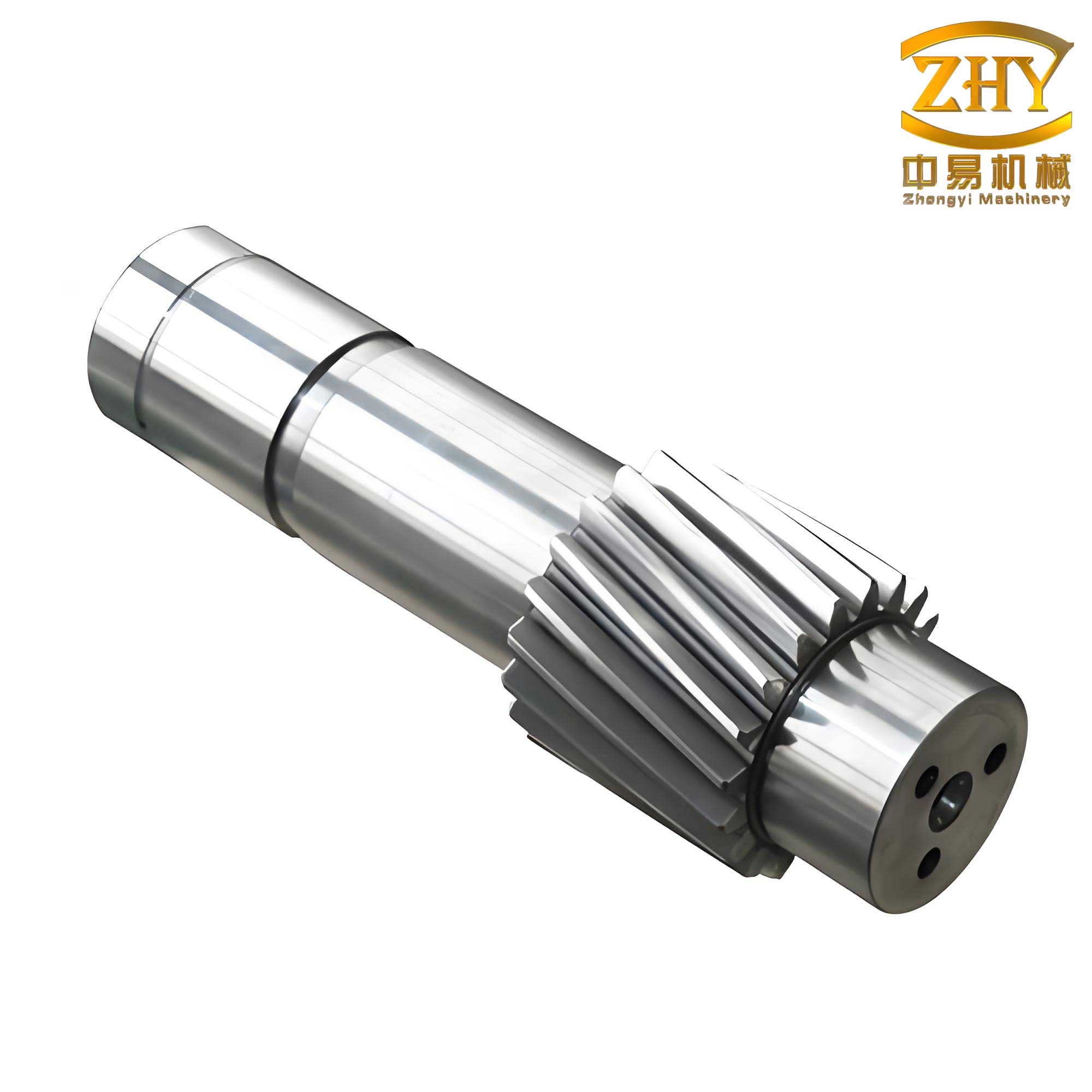
The high-speed gear shaft is designed for use in wind turbine gearboxes, where it operates under high rotational speeds and variable loads. The manufacturing process involves several steps: steelmaking, forging, rough machining,预备热处理 (normalizing and tempering), non-destructive testing, semi-finishing, carburizing and quenching heat treatment, finishing, assembly, and trial runs. The failure occurred during trial runs, indicating a potential flaw in material or processing. To systematically analyze this, I employed a range of methods, including chemical composition analysis, macro- and micro-fractography, metallographic examination, effective case depth measurement, and scanning electron microscopy (SEM). These approaches help in identifying the failure mode and its origins.
Chemical composition analysis was conducted using optical emission spectrometry according to ASTM E415-2008. The results are summarized in Table 1, showing that the material conforms to the specified requirements for 17Cr2Ni2MoA steel. This confirms that the gear shaft’s base material is not the primary cause of failure.
| Element | Measured Value | Technical Requirement |
|---|---|---|
| C | 0.18 | 0.15–0.21 |
| Mn | 0.67 | 0.50–0.90 |
| Si | 0.25 | ≤0.40 |
| P | 0.009 | ≤0.015 |
| S | 0.002 | ≤0.005 |
| Cr | 1.64 | 1.50–1.80 |
| Ni | 1.51 | 1.40–1.70 |
| Al | 0.026 | 0.015–0.04 |
| Cu | 0.12 | ≤0.3 |
| V | 0.01 | — |
| H | ≤0.00002 | ≤0.0002 |
| O | 0.0013 | ≤0.0025 |
| N | 0.0148 | ≤0.015 |
| Mo | 0.29 | 0.25–0.35 |
Macroscopic examination of the failed gear shaft revealed that tooth breakage predominantly occurred in adjacent regions, with cracks originating from the tooth roots. This pattern suggests stress concentration at the root fillets, which are critical zones for bending fatigue. The fracture surfaces exhibited two distinct types: one with a single fatigue origin at the tooth root and clear beach marks, and another with multiple origins near the tooth surface, indicating progressive crack propagation. The presence of beach marks is a hallmark of fatigue failure, often described by the Paris law for crack growth: $$ \frac{da}{dN} = C (\Delta K)^m $$ where \( da/dN \) is the crack growth rate, \( \Delta K \) is the stress intensity factor range, and \( C \) and \( m \) are material constants. This equation helps in understanding the fatigue behavior under cyclic loading.
Further observation of the tooth surfaces showed extrusion marks and pits, indicative of overloading or misalignment during operation. These surface defects can act as stress raisers, exacerbating fatigue initiation. The macro-fractography was complemented by metallographic analysis. Transverse sections were prepared and etched with hydrochloric acid solution to reveal the microstructure. The core material exhibited a fine, uniform structure without significant defects like porosity or segregation. Cracks were observed at the tooth roots and pitch lines, aligning with the fracture origins.
Microscopic examination involved evaluating non-metallic inclusions, microstructure, and grain size. According to ASTM E45-2013, inclusion levels were below 1.0 grade, confirming good steel cleanliness. After etching with 4% nital, the microstructure near the cracks consisted of tempered martensite, with no evidence of oxidation or decarburization. The carburized layer was assessed per JB 6141.3-1992, revealing that the martensite and retained austenite, carbide, and core ferrite levels were all grade 2, meeting specifications. Grain size, determined via ASTM E112-2012, was grade 7, which is acceptable for high-strength applications. However, the effective case depth measurements raised concerns.
The effective hardening layer depth was measured using the Vickers hardness method per ISO 2639-2002, with a 1 kg load and 12 s dwell time. Results are presented in Table 2, showing that the depths at the tooth root, flank, and tip exceeded the technical requirement of 0.8–1.3 mm. This over-carburization, particularly at the tooth root, is critical because it increases martensite brittleness, reducing bending fatigue strength. The relationship between case depth and fatigue strength can be approximated by: $$ \sigma_f = \sigma_0 \cdot f(d) $$ where \( \sigma_f \) is the fatigue strength, \( \sigma_0 \) is the base material strength, and \( f(d) \) is a function of case depth that typically decreases beyond an optimum due to embrittlement.
| Location | Measured Depth (mm) | Technical Requirement (mm) |
|---|---|---|
| Tooth Root | 1.67 | 0.8–1.3 |
| Tooth Flank | 1.60 | |
| Tooth Tip | 1.79 |
Scanning electron microscopy (SEM) was performed on fracture fragments to examine micro-features. The fatigue origin zones showed no inclusions or voids, while the propagation regions displayed fatigue striations, characteristic of cyclic loading. The instant fracture zones exhibited quasi-cleavage morphology. Energy-dispersive X-ray spectroscopy (EDS) analysis of white spherical particles within cracks revealed compositions similar to the matrix, indicating they are not foreign inclusions but rather trapped material from the fracture process. This aligns with minimal energy principles during crack formation.
To quantify the stress state in the gear shaft, bending stress at the tooth root can be calculated using the formula: $$ \sigma_b = \frac{F_t \cdot h}{b \cdot s^2} $$ where \( \sigma_b \) is the bending stress, \( F_t \) is the tangential load, \( h \) is the tooth height, \( b \) is the face width, and \( s \) is the tooth thickness. For a carburized gear shaft, the effective stress intensity factor accounts for case depth: $$ K_I = Y \cdot \sigma \sqrt{\pi a} $$ where \( K_I \) is the stress intensity factor, \( Y \) is a geometry factor, \( \sigma \) is the applied stress, and \( a \) is the crack length. Excessive case depth increases \( a \) and reduces fracture toughness, promoting rapid crack growth.
The discussion centers on the failure mechanism. The gear shaft experienced quick fatigue fracture, initiated at the tooth roots due to over-carburization. Carburizing aims to enhance surface hardness and wear resistance, but an excessive layer depth, especially at the root, leads to martensite embrittlement. This reduces the material’s ability to withstand cyclic bending stresses, which are highest at the root fillet according to gear mechanics principles. During trial runs, even moderate loads could exceed the diminished fatigue limit, causing crack initiation and propagation. The first tooth fracture then redistributed loads, increasing stress on remaining teeth and leading to multi-origin failures.
The absence of metallurgical defects in the gear shaft underscores the role of heat treatment. Proper control of carburizing parameters—such as temperature, time, and atmosphere—is crucial to achieving optimal case depth. The measured depths indicate a process deviation, possibly from prolonged exposure or high carbon potential. This highlights the importance of stringent quality checks during manufacturing. For instance, non-destructive testing and regular hardness profiling can prevent such issues.
From a materials science perspective, the fatigue life of a component is governed by the S-N curve: $$ N = C \cdot \sigma^{-m} $$ where \( N \) is the number of cycles to failure, \( \sigma \) is the stress amplitude, and \( C \) and \( m \) are constants derived from testing. For carburized steels, the curve shifts with case depth; too deep a layer lowers the endurance limit, causing early failure. This aligns with the observed quick fracture during initial operation.
In conclusion, the failure of the high-speed gear shaft is attributed to rapid fatigue fracture caused by excessive effective hardening layer depth at the tooth root. This over-carburization increased martensite brittleness, reducing bending fatigue strength and leading to crack initiation under operational stresses. The material quality was satisfactory, but the heat treatment process required better control. To mitigate such failures, it is recommended to implement rigorous monitoring of carburizing parameters, conduct regular case depth measurements, and optimize gear design to distribute stresses more evenly. Future work could involve finite element analysis to simulate stress concentrations and fatigue life, ensuring reliability in wind turbine applications. As the demand for renewable energy grows, improving the durability of critical components like the gear shaft remains paramount for sustainable power generation.
Further considerations include the impact of operating conditions on gear shaft performance. Wind turbine gearboxes face variable loads due to wind fluctuations, which can induce dynamic stresses. The fatigue analysis should account for spectrum loading, where stress ranges vary over time. The cumulative damage can be estimated using Miner’s rule: $$ D = \sum \frac{n_i}{N_i} $$ where \( D \) is the total damage, \( n_i \) is the number of cycles at stress level \( i \), and \( N_i \) is the cycles to failure at that level. If \( D \geq 1 \), failure occurs. For the failed gear shaft, the excessive case depth likely reduced \( N_i \) values, accelerating damage accumulation.
Additionally, microstructural aspects play a role. Tempered martensite in the carburized layer should have adequate toughness to resist crack propagation. The hardness gradient from surface to core must be gradual to avoid sharp transitions that act as stress risers. The effective case depth should be optimized based on gear geometry and load specifications. A general guideline is to set the depth as a function of module: $$ d_c = k \cdot m $$ where \( d_c \) is the case depth, \( m \) is the module, and \( k \) is a coefficient typically between 0.1 and 0.3. For this gear shaft, assuming a module of 5 mm, the ideal depth would be 0.5–1.5 mm, aligning with the technical requirement.
In practice, quality assurance steps for gear shafts should include: chemical analysis, ultrasonic testing for internal flaws, macro-etching for segregation, microstructure evaluation, hardness traverses, and fatigue testing if feasible. Statistical process control can help maintain consistency in heat treatment. For instance, monitoring carbon potential in the furnace ensures uniform carburization. Post-heat treatment inspections, such as magnetic particle testing, can detect surface cracks before assembly.
The economic implications of gear shaft failure are significant, involving replacement costs, downtime, and potential safety hazards. Therefore, investing in robust manufacturing protocols is essential. Research into advanced materials, such as cleaner steels or alternative alloys, may also enhance performance. For example, modifying the composition with microalloying elements can improve hardenability and toughness without compromising case depth control.
To summarize, this analysis demonstrates the criticality of precise heat treatment in producing reliable high-speed gear shafts. By addressing the root cause—excessive carburization—manufacturers can prevent similar failures and contribute to the longevity of wind turbine systems. Continuous improvement in materials engineering and process optimization will support the growing renewable energy sector, ensuring that components like the gear shaft operate efficiently under demanding conditions.