
The reliable performance of gear transmissions is paramount to the quality and efficiency of modern machinery. As industrial equipment trends towards higher speeds and heavier loads, the lubrication condition at the gear contact interface becomes increasingly critical. Often, components like gears, bearings, and cams may operate under starved lubrication, where the supply of lubricant to the contact inlet is insufficient to form a fully flooded film. In such conditions, the contact is more prone to operate in a mixed lubrication regime, significantly elevating the risk of surface distress such as pitting, scuffing, and wear. Therefore, a comprehensive investigation into the lubrication characteristics of helical gear pairs under starved conditions is not only of academic interest but also of substantial practical importance for guiding the design of robust and durable gear systems.
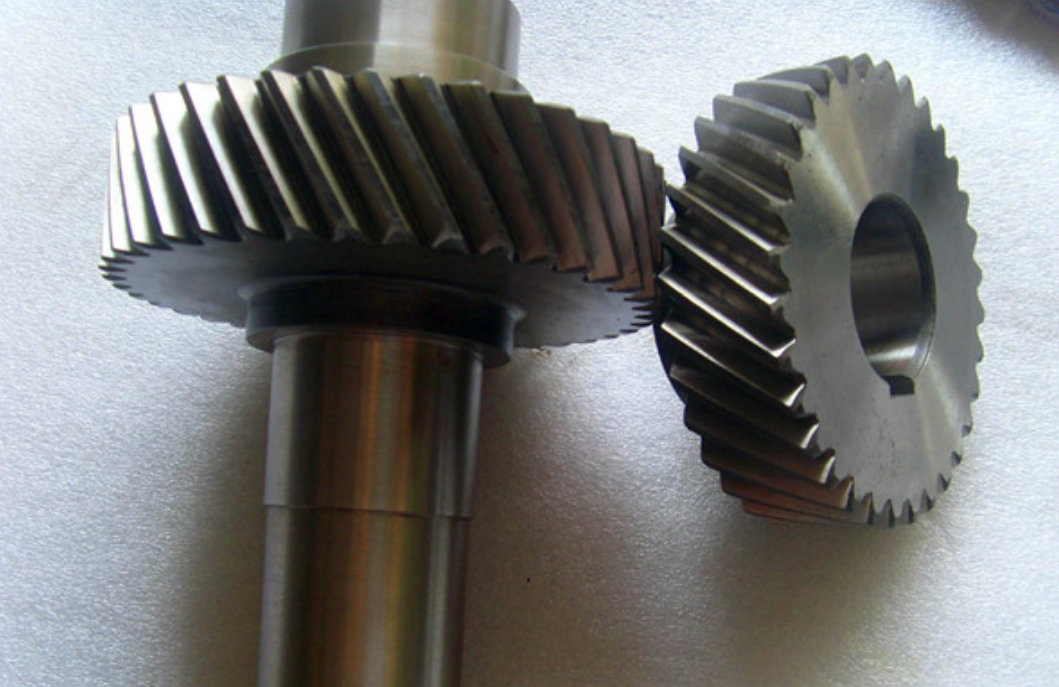
The helical gear, with its inherent advantages in smooth engagement and high load-carrying capacity, is a fundamental component in power transmission systems. Its lubrication analysis, however, is notably more complex than that for spur gears due to its three-dimensional contact geometry and varying contact conditions along the tooth flank. While significant research has been dedicated to fully flooded elastohydrodynamic lubrication (EHL) of helical gear, studies focusing on the starved lubrication regime are relatively scarce. This work aims to bridge that gap by establishing a transient thermal EHL model specifically for a helical gear pair operating under starved lubrication. The model incorporates non-Newtonian fluid rheology, surface roughness, and thermal effects to provide a realistic simulation of the contact conditions. The influence of critical operating parameters, namely inlet oil supply, rotational speed, and surface roughness, on key lubrication performance indicators such as film thickness, friction coefficient, temperature rise, and subsurface stress field will be systematically discussed.
Mathematical Model and Numerical Methodology
Geometry and Kinematics of Helical Gear Mesh
The contact between a pair of meshing helical gear can be conceptually transformed into the contact between two equivalent, opposing conical surfaces at any given instant during the meshing cycle. This geometric equivalence facilitates the analysis. A critical feature of helical gear contact is the inclined contact line, which sweeps across the tooth face from the tip to the root. The length of this contact line varies during engagement, affecting the load distribution and lubrication dynamics.
Considering an arbitrary point K on the contact line, its geometric and kinematic parameters can be derived. The principal radii of curvature for the driving and driven helical gear at this point are given by:
$$R_1(y, t) = \frac{r_{1d}(t) – y \sin \beta_b}{\cos \beta_b}$$
$$R_2(y, t) = \frac{r_{2d}(t) + y \sin \beta_b}{\cos \beta_b}$$
where \( r_{1d} \) and \( r_{2d} \) are the distances from the respective gear axes to the start of the active contact line, \( y \) is the coordinate along the contact line, \( \beta_b \) is the base helix angle, and \( t \) is time.
The surface velocities for the two helical gear teeth at point K are:
$$u_1(y, t) = \omega_1 (r_{1d} – y \sin \beta_b)$$
$$u_2(y, t) = \omega_2 (r_{2d} + y \sin \beta_b)$$
From these, the essential kinematic parameters for lubrication analysis—the entrainment velocity \( u_e \), the sliding velocity \( u_s \), and the slide-to-roll ratio \( \zeta \)—are obtained:
$$u_e(y, t) = \frac{u_1(y, t) + u_2(y, t)}{2}$$
$$u_s(y, t) = u_1(y, t) – u_2(y, t)$$
$$\zeta(y, t) = \frac{u_s(y, t)}{u_e(y, t)}$$
The load per unit length along the contact line varies with the instantaneous contact length and the applied torque, which must be balanced by the integrated fluid pressure over the contact area.
Governing Equations for Starved Thermal EHL
The core of the model is the generalized Reynolds equation, modified to account for starved lubrication by introducing a fractional film content \( \bar{\theta} \), which represents the ratio of the lubricant film thickness \( h_f \) to the total gap \( h \).
$$\frac{\partial}{\partial x} \left( \frac{\bar{\rho}}{\bar{\eta}} h^3 \frac{\partial p}{\partial x} \right) + \frac{\partial}{\partial y} \left( \frac{\bar{\rho}}{\bar{\eta}} h^3 \frac{\partial p}{\partial y} \right) = 12u_e \frac{\partial}{\partial x}(\rho^*_x \bar{\theta} h) + 12 \frac{\partial}{\partial t}(\bar{\rho}_e \bar{\theta} h)$$
where \( p \) is pressure, \( \bar{\rho}/\bar{\eta} \), \( \rho^*_x \), and \( \bar{\rho}_e \) are integral expressions of density \( \rho \) and equivalent viscosity \( \eta^* \) across the film thickness. The fractional film content is defined as:
$$\bar{\theta}(x, y, t) = \frac{h_f(x, y, t)}{h(x, y, t)}$$
The condition governing the boundary between the pressurized (full film) and starved regions is given by:
$$p(x, y, t) \left[ 1 – \bar{\theta}(x, y, t) \right] = 0$$
This implies that where pressure is positive (\( p > 0 \)), the film is complete (\( \bar{\theta} = 1 \)), and where pressure is zero (\( p = 0 \)), the film is starved (\( 0 < \bar{\theta} < 1 \)).
The total film gap \( h \) for the helical gear contact includes contributions from rigid body displacement \( h_0 \), the geometric gap \( h_g \) (which includes crowning or tip relief modifications), surface roughness \( s_1 \) and \( s_2 \), and the elastic deformation \( \delta \):
$$h(x, y, t) = h_0(t) + h_g(x, y, t) + s_1(x, y, t) + s_2(x, y, t) + \delta(x, y, t)$$
where the elastic deformation is calculated using the Boussinesq integral:
$$\delta(x, y, t) = \frac{2}{\pi E’} \iint_{\Omega} \frac{p(x’, y’, t)}{\sqrt{(x – x’)^2 + (y – y’)^2}} dx’ dy’$$
Here, \( E’ \) is the effective elastic modulus. The surface roughness is modeled using two-dimensional sinusoidal functions to simulate deterministic roughness features on the helical gear teeth.
The pressure distribution must balance the applied load \( F(t) \) at each instant:
$$F(t) = \iint_{\Omega} p(x, y, t) dx dy$$
The non-Newtonian behavior of the lubricant is described using the Ree-Eyring fluid model, with the following expressions for viscosity and density:
$$\eta = \eta_0 \exp \left\{ (\ln \eta_0 + 9.67) \left[ -1 + (1 + 5.1 \times 10^{-9}p)^z \left( \frac{T – 138}{T_0 – 138} \right)^{-s} \right] \right\}$$
$$\rho = \rho_0 \left[ 1 + \frac{0.6 \times 10^{-9}p}{1 + 1.7 \times 10^{-9}p} – 6.5 \times 10^{-4} (T – T_0) \right]$$
The equivalent viscosity \( \eta^* \) is then:
$$\eta^* = \eta \frac{\tau_e / \tau_0}{\sinh(\tau_e / \tau_0)}$$
where \( \tau_0 \) is the characteristic shear stress and \( \tau_e \) is the effective shear stress.
The thermal effect is crucial due to the significant sliding in helical gear contacts outside the pitch point. The three-dimensional energy equation for the fluid film, neglecting heat conduction in the x- and y-directions, is:
$$c_f \left( \rho \frac{\partial T}{\partial t} + \rho u_f \frac{\partial T}{\partial x} + \rho v_f \frac{\partial T}{\partial y} – q \frac{\partial T}{\partial z} \right) = k_f \frac{\partial^2 T}{\partial z^2} – \frac{T}{\rho} \frac{\partial \rho}{\partial T} \left( \frac{\partial p}{\partial t} + u_f \frac{\partial p}{\partial x} + v_f \frac{\partial p}{\partial y} \right) + \eta^* \left[ \left( \frac{\partial u_f}{\partial z} \right)^2 + \left( \frac{\partial v_f}{\partial z} \right)^2 \right]$$
where \( c_f \) and \( k_f \) are the lubricant’s specific heat and thermal conductivity, \( u_f \) and \( v_f \) are the fluid velocities, and \( q \) is a flux-related term. The heat conduction into the solid helical gear teeth is governed by:
$$c_{1,2} \rho_{1,2} \left( \frac{\partial T}{\partial t} + u_{1,2} \frac{\partial T}{\partial x} \right) = k_{1,2} \frac{\partial^2 T}{\partial z_{1,2}^2}$$
with continuity of heat flux at the fluid-solid interfaces.
The friction forces on each helical gear tooth surface and the overall friction coefficient \( \mu \) are calculated from the fluid shear stress, which combines Couette and Poiseuille flow components:
$$\tau_1(x, y, t) = \eta^* \cdot \frac{u_1 – u_2}{h_f} + \frac{h_f}{2} \cdot \frac{\partial p}{\partial x}$$
$$\tau_2(x, y, t) = \eta^* \cdot \frac{u_1 – u_2}{h_f} – \frac{h_f}{2} \cdot \frac{\partial p}{\partial x}$$
$$\mu(t) = \frac{ \iint_{\Omega} (\tau_1 + \tau_2) dxdy }{2 F(t)}$$
Numerical Solution Technique
The system of governing equations is highly nonlinear and coupled. A dimensionless formulation is employed using reference parameters based on the Hertzian contact conditions at the helical gear mesh pitch point. The numerical solution employs a robust iterative strategy that simultaneously solves for pressure, fractional film content, and temperature. The separation between the full-film pressurized zone and the starved inlet zone is determined automatically using the Elrod algorithm. The elastic deformation integral is efficiently evaluated using the Discrete Convolution and Fast Fourier Transform (DC-FFT) method. The temperature field is solved using a column-wise sweeping technique. The computational domain is discretized with a grid of 128 × 256 nodes in the x-y plane, 10 nodes across the film thickness, and 5 nodes within each solid body. Convergence is achieved when the relative errors for pressure, load, and temperature fall below specified tolerances (e.g., \( 10^{-5} \), \( 10^{-4} \), and \( 10^{-5} \), respectively). The analysis is performed for the entire meshing cycle, discretized into 190 time steps, focusing on key instants representing entry, mid-mesh (pitch point vicinity), and exit phases of engagement for a helical gear pair with the parameters listed below.
| Parameter | Value |
|---|---|
| Number of teeth, \( z_1 / z_2 \) | 50 / 75 |
| Normal module, \( m_n \) (mm) | 2.5 |
| Helix angle, \( \beta \) (deg) | 25 |
| Face width, \( B \) (mm) | 20 |
| Effective elastic modulus, \( E’ \) (GPa) | 227 |
| Input torque, \( T_{in} \) (N·m) | 400 |
| Input speed, \( n \) (rpm) | 1500 |
| Ambient viscosity, \( \eta_0 \) (Pa·s) | 0.065 |
| Ambient density, \( \rho_0 \) (kg/m³) | 870 |
| Lubricant specific heat, \( c_f \) (J/kg·K) | 2000 |
| Lubricant thermal conductivity, \( k_f \) (W/m·K) | 0.14 |
| Pressure-viscosity coefficient, \( \alpha \) (GPa⁻¹) | 22 |
| Temperature-viscosity coefficient, \( \beta_T \) (K⁻¹) | 0.0143 |
| Ambient temperature, \( T_0 \) (K) | 373.15 |
| Eyring shear stress, \( \tau_0 \) (MPa) | 5 |
Effects of Inlet Oil Supply on Helical Gear Lubrication
The inlet oil supply, often quantified by the available lubricant film thickness \( h_{oil} \) at the contact entry, is the defining parameter for starved lubrication. Its impact on the performance of the helical gear pair is profound and multifaceted.
As the supplied oil film thickness increases, the central and minimum film thicknesses within the contact increase. This relationship, however, is not linear. Under severe starvation, a small increase in supply leads to a sharp rise in film thickness. As the supply becomes more abundant, the rate of film thickness increase diminishes, eventually plateauing when the condition transitions to fully flooded lubrication. This indicates the existence of a critical or “sufficient” supply level for a given helical gear operating condition, beyond which additional lubricant yields negligible benefit to the film thickness. The variation of minimum film thickness over the meshing cycle for different supply levels clearly demonstrates this saturation effect.
| Oil Supply \( h_{oil} \) (μm) | Avg. Min Film Thickness (μm) | Reduction from Starved to Full Film (%) | Transition Supply (μm) |
|---|---|---|---|
| 0.1 | 0.052 | – | ~0.5 |
| 0.3 | 0.185 | 65.1 | |
| 0.5 | 0.320 | 39.4 | |
| 0.7 (Ref) | 0.385 | 26.9 | |
| 1.0 (Full Film) | 0.395 | 0 |
The friction coefficient is significantly affected by the oil supply. Under starved conditions, the thinner film leads to higher shear rates and potentially more direct asperity interaction, resulting in a higher friction coefficient. As the supply increases and the film thickens, the friction coefficient decreases sharply initially and then gradually approaches the stable value characteristic of fully flooded lubrication. The average friction coefficient over the meshing cycle shows a dramatic drop from severely starved to moderately starved conditions, with stabilization occurring around the same critical supply level noted for film thickness.
The thermal behavior of the helical gear contact is also supply-dependent. A starved contact, with its thinner film and higher shear, generates more frictional heat per unit volume. Consequently, the maximum and average flash temperatures in the oil film and on the tooth surfaces are higher under starvation. With increased oil supply, the thicker film and lower friction lead to a reduction in contact temperature rise. The temperature distribution becomes more uniform and approaches the fully flooded thermal profile.
Perhaps one of the most critical aspects is the impact on the subsurface stress field within the helical gear teeth. The combination of contact pressure and tangential traction (friction) induces a complex stress state beneath the surface. Starvation, by increasing friction and potentially altering the pressure spike, exacerbates this stress. The maximum von Mises or orthogonal shear stress amplitude below the surface is higher under starved conditions. As the oil supply increases, this subsurface stress amplitude decreases. Notably, the depth at which the maximum stress occurs also shifts; under severe starvation, the stress peak is often closer to the surface, making the helical gear tooth more susceptible to surface-originated fatigue. With adequate lubrication, the stress peak moves slightly deeper, which is typically associated with longer fatigue life for subsurface-originated pitting.
$$ \sigma_{max}(h_{oil}) \propto \frac{1}{\sqrt{h_{oil}}} \quad \text{(for moderate starvation)}$$
This inverse relationship highlights the dramatic benefit of moving from a severely starved towards a sufficiently lubricated state for the durability of the helical gear.
Influence of Rotational Speed on Starved Helical Gear Lubrication
The rotational speed of the helical gear pair is a key operational parameter that interacts dynamically with the starved lubrication condition. Its effects are analyzed here under a constant, limited oil supply.
The film thickness in an EHL contact has a strong dependence on entrainment velocity (\( h \propto u_e^{\alpha} \)). Therefore, increasing the rotational speed of the helical gear generally increases the film thickness, even under starved conditions. However, under a fixed inlet supply, there is a limiting mechanism. At very low speeds, the meniscus at the contact inlet can draw in most of the available oil. As speed increases, the film thickens but the inlet meniscus may recede, restricting the amount of lubricant entrained per unit time. This competition leads to a characteristic trend: film thickness increases with speed, but the rate of increase slows down and may eventually saturate at high speeds when the starvation becomes “speed-induced.” The minimum film thickness over the gear mesh cycle improves with speed but remains below the fully flooded value.
| Input Speed \( n \) (rpm) | Entrainment Vel. \( u_e \) (m/s) | Min Film Thickness (μm) | % of Full Film Thickness |
|---|---|---|---|
| 500 | 2.1 | 0.21 | 53% |
| 1000 | 4.2 | 0.31 | 78% |
| 1500 (Ref) | 6.3 | 0.385 | 97% |
| 2000 | 8.4 | 0.39 | 99% |
The effect on friction is non-monotonic and depends on the balance between film thickness and shear rate. Initially, as speed increases from a very low value, the friction coefficient may decrease due to the formation of a more substantial lubricant film, reducing asperity contact. However, with further speed increase under constant torque, the higher sliding velocities and shear rates within the now thermally-thinned film can cause the friction coefficient to rise again. The average friction over the mesh cycle often shows a minimum at an intermediate speed for a starved helical gear.
Thermal effects become markedly more severe with increasing speed. The power loss due to friction rises, and the higher sliding velocities directly increase the rate of frictional heat generation (\( \dot{q} \propto \tau \cdot u_s \)). Even though contact time decreases, the net result is a significant increase in the maximum and average contact temperatures for the helical gear pair. Effective cooling strategies become even more critical at high speeds under marginal lubrication.
The subsurface stress field is influenced by speed through changes in both the pressure distribution (film shape) and the tangential traction. While a thicker film at higher speed can slightly reduce pressure spikes, the concomitant increase in friction force (traction) often dominates. This leads to an increase in the amplitude of the subsurface alternating shear stress with increasing rotational speed. The relationship can be complex but generally indicates that high-speed operation under starved conditions is particularly damaging from a contact fatigue perspective for helical gear.
$$\tau_{subsurface} \approx f(p_{max}, \mu, a)$$
where \( a \) is the semi-contact width, which itself is weakly dependent on speed through the material properties.
Impact of Surface Roughness on Starved Helical Gear Contact
Real helical gear surfaces are not perfectly smooth; they possess a certain degree of roughness. Under fully flooded conditions, this roughness may be partially masked by a thick EHL film. However, under starved lubrication, where the nominal film thickness is reduced, the interaction between surface asperities and the lubricant film becomes much more significant, often leading to a mixed lubrication regime.
The introduction of deterministic roughness (modeled, for example, as 2D sinusoidal waves) dramatically alters the pressure distribution. Instead of a smooth Hertzian-like pressure profile with a single central spike, the pressure field exhibits numerous local fluctuations—sharp micro-pressure peaks over asperities and lower pressures in the valleys. These pressure perturbations are more intense under starved conditions due to the thinner separating film. The formula for film thickness now explicitly includes the roughness terms \( s_1(x,y,t) \) and \( s_2(x,y,t) \), which are functions of amplitude, wavelength, and phase, and move with the surfaces of the helical gear.
The film thickness distribution becomes highly non-uniform, mirroring the roughness profile. Local film thickness can be much smaller than the nominal value in constricted areas, increasing the risk of metal-to-metal contact. The performance of a starved helical gear pair is therefore not just a function of the nominal starved film thickness but also of the ratio of this thickness to the composite surface roughness (\( \lambda = h / \sigma \), where \( \sigma \) is the RMS roughness).
| Roughness Amplitude \( R_a \) (μm) | \( \lambda \) Ratio (for \( h_{oil}=0.7 \mu m \)) | Lubrication Regime | Pressure Fluctuation Amplitude |
|---|---|---|---|
| 0.05 (Smooth) | >7 | Full Film EHL | Low |
| 0.1 | ~3.5 | Mixed | High |
| 0.2 | ~1.7 | Severe Mixed/Boundary | Very High |
The most critical consequence of roughness in a starved helical gear contact is its effect on the subsurface stress field. Each micro-pressure peak acts as a local stress concentrator. While the global macroscopic stress field is still present, it is superimposed with highly localized, intense stress fluctuations directly beneath the asperities. This phenomenon significantly increases the probability of fatigue crack initiation at or near the surface. The maximum subsurface stress values calculated for a rough surface can be substantially higher than those for a smooth surface under the same nominal starved conditions. The stress concentration factor \( K_t \) due to a roughness feature can be approximated for simplified geometries, highlighting the danger:
$$ K_t \approx 1 + 2\sqrt{\frac{A}{\rho_c}} $$
where \( A \) is the asperity height and \( \rho_c \) is the radius of curvature at the asperity tip. This stress riser effect is a primary reason why surface finish is especially crucial for helical gear expected to operate with limited lubrication.
Conclusions
This detailed analysis of the thermal elastohydrodynamic lubrication of a helical gear pair under starved conditions leads to several critical conclusions for the design and operation of such systems:
- Oil Supply is Paramount: The inlet oil supply is the dominant factor controlling starved lubrication performance. Increasing the supply film thickness significantly improves the minimum film thickness, reduces the friction coefficient, lowers contact temperatures, and decreases the amplitude of the damaging subsurface stress field in the helical gear teeth. Performance asymptotically approaches the fully flooded condition beyond a critical supply level, indicating an optimal design target for lubrication systems.
- Speed Has Complex Effects: Increasing rotational speed generally improves film thickness under starved conditions but with diminishing returns. However, it simultaneously increases friction-induced heating and can elevate subsurface stress amplitudes due to higher traction, making thermal management and material strength crucial for high-speed starved helical gear applications.
- Roughness Exacerbates Starvation Risks: Surface roughness transforms a nominally starved EHL contact into a mixed lubrication regime. It causes severe pressure fluctuations and acts as a potent stress concentrator, dramatically increasing the local subsurface stress levels and the likelihood of surface-initiated fatigue failures like pitting and micropitting in helical gear. Maintaining a high quality of surface finish is a key strategy for improving survival under marginal lubrication.
- Integrated Analysis is Essential: The interaction between starvation, thermal effects, non-Newtonian rheology, and roughness creates a highly nonlinear system. The presented model, which couples all these aspects, is necessary for a realistic assessment of helical gear performance in demanding applications where perfect, abundant lubrication cannot be guaranteed.
In summary, the transition from fully flooded to starved lubrication represents a significant degradation in the operating regime of a helical gear pair, with marked negative impacts on film formation, efficiency, operating temperature, and most importantly, contact fatigue life. Designers must account for potential starvation scenarios by ensuring adequate and reliable lubricant supply, selecting appropriate materials and surface treatments, and considering thermal effects, especially in high-speed helical gear drives.