
In modern gear manufacturing, the pursuit of higher efficiency, superior quality, and the ability to machine hardened components has driven significant technological innovation. One such advancement is the process of hard gear hobbing, a technique that has revolutionized the finishing of hardened gear shaft teeth. This method employs coated carbide hobs to directly cut or finish gear teeth after heat treatment, presenting a compelling alternative or complement to traditional grinding processes. My experience in applying this technology, particularly to hardened gear shaft components for agricultural machinery, has demonstrated its profound impact on production workflow and component quality.
The core advantage of hard hobbing lies in its remarkable efficiency. Compared to gear grinding, which is a relatively slow, abrasive-based process, hobbing is a continuous cutting operation with significantly higher material removal rates. This efficiency makes it highly attractive for high-volume production. The application of hard hobbing is versatile; it serves as a final finishing process for淬硬齿轮 of standard precision or as a highly effective semi-finishing step prior to grinding for ultra-high-precision gear shafts. In the latter role, its primary function is to efficiently and uniformly remove the distortion induced by carburizing and quenching heat treatments. By leaving a minimal, consistent stock allowance for the subsequent grinding operation, it not only shortens the final grinding time but also enhances the overall quality and consistency of the ground gear shaft. This approach provides a robust and reliable process foundation, enabling the high-precision manufacturing of critical transmission components like those found in tractor gearboxes and final drive systems.
The successful implementation of this technology demands a holistic approach, encompassing precise component analysis, rigorous machine tool selection, specialized tooling design, and meticulous parameter optimization.
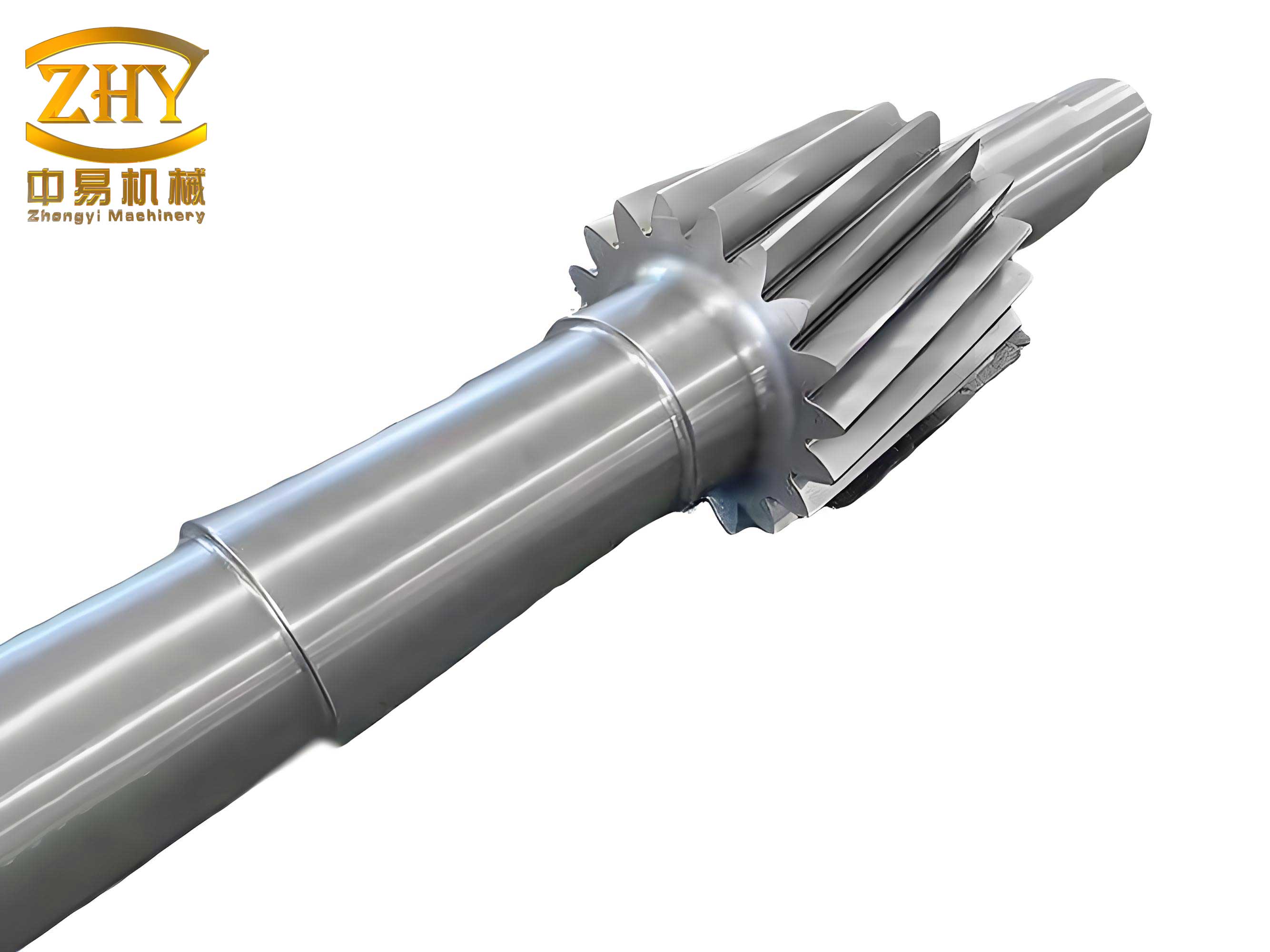
A representative case study involves a sun gear shaft from a wheeled tractor’s final drive system. This specific gear shaft is characterized by its integral design, combining a gear and a shaft into a single component. The technical specifications are demanding: the gear module is 4 mm, the material is 20CrMnMo, subjected to carburizing and quenching to achieve a case depth of 1.0-1.3 mm and a surface hardness of 58-62 HRC. The gear quality must meet GB 7级, with tight tolerances on tooth profile (ff=0.014 mm) and tooth direction (Fβ=0.016 mm), and a required surface roughness of Ra 0.8 μm. Furthermore, critical concentricity requirements exist between the gear teeth and other features on the gear shaft, such as splines, typically within a 0.04 mm tolerance zone. Achieving these specifications on a hardened gear shaft is the precise challenge that hard hobbing is designed to address.
Comprehensive Analysis and Strategic Process Design
The transition from a conventional process (soft hobbing followed by heat treatment and potentially grinding) to a hard hobbing process necessitates a complete reevaluation of the machining strategy. Every element, from the machine tool to the clamping fixture and the cutting tool itself, must be selected and designed to withstand the unique challenges of machining material at 60 HRC and above.
1. Machine Tool Prerequisites
The machine tool forms the foundation of the process. Hard hobbing imposes extreme conditions: high cutting forces due to the material hardness, significant intermittent shock loads as each hob tooth engages the hardened gear shaft tooth, and considerable heat generation. Therefore, the primary requisites for the machine are exceptional static and dynamic rigidity, high driving power, and utmost stability. Any deflection or vibration will directly translate into poor gear geometry and accelerated tool wear. Furthermore, as this is a finishing operation, the machine must possess very high kinematic accuracy and positioning precision to consistently achieve the required gear quality levels (GB 6-7级 or better).
A critical feature for post-heat-treatment machining is an automated tooth search and alignment system. After quenching, the gear shaft will have distorted, meaning the gear teeth are no longer in the exact theoretical position relative to the machining基准. To avoid catastrophic tool collision and to ensure the hob engages the tooth space correctly to remove stock uniformly from both flanks, the machine must be able to automatically locate a reference tooth gap and synchronize the hob’s rotational position with the workpiece’s. Modern multi-axis CNC gear hobbing machines, particularly those with four or more interpolating axes, are ideally suited for this task. The process described herein was executed on an imported six-axis, four-linkage CNC hobbing machine equipped with such an alignment system, providing the necessary technological platform.
| Requirement Category | Specification / Feature | Rationale & Impact |
|---|---|---|
| Rigidity & Stability | High static/dynamic stiffness, massive structure, premium guideways | Absorbs cutting shocks, minimizes vibration/deflection, ensures dimensional stability and surface finish on the gear shaft. |
| Kinematic Accuracy | High-precision gears, ballscrews, encoders; minimal backlash | Directly determines achievable gear accuracy (profile, lead, pitch) on the finished gear shaft. |
| Power & Torque | High spindle power and torque output | Provides necessary force to drive the carbide hob through the hard material of the gear shaft. |
| CNC & Synchronization | Multi-axis control, precise electronic gearbox (EGB) | Enables complex tool paths, taper hobbing, and precise synchronization between hob and workpiece rotation. |
| Automation | Automatic tooth gap search and alignment | Essential for post-heat-treatment machining to align hob with distorted tooth spaces of the gear shaft. |
| Coolant System | High-pressure, high-volume coolant through spindle/tool | Manages cutting temperature, evacuates chips, and prolongs hob life when machining the hard gear shaft. |
2. Workholding and Datum Strategy
Consistent and precise location is paramount, especially when a gear shaft undergoes multiple operations (soft machining, heat treatment, hard machining). Any deviation in基准 between stages will lead to cumulative errors, particularly detrimental to concentricity requirements. The strategy adopted was to unify the primary machining datum for all gear-cutting operations, both pre- and post-heat-treatment.
For the sun gear shaft, the datum was established on the center at one end and a precise conical seat (e.g., a 30° external chamfer) at the other end. This “center and cone” configuration provides excellent axial and radial location. To maintain this after quenching, the same datum features are used. The clamping mechanism employed a draw-bar activated expanding mandrel that grips the bore at one end of the gear shaft. This method offers several advantages: it is concentric, provides uniform clamping force, minimizes workpiece distortion, and allows for quick loading/unloading, which is beneficial for production efficiency. This fixturing solution ensured the critical runout between the gear and the spline on the gear shaft remained within the tight Φ0.04 mm specification.
3. The Heart of the Process: Carbide Hob Design and Selection
The hob is the most critical consumable in hard hobbing. Machining a 60 HRC gear shaft with a cutting tool is a severe application that pushes tooling technology to its limits. Carbide, with its superior hardness and wear resistance at high temperatures compared to high-speed steel (HSS), is the mandatory substrate material. However, carbide is brittle and has poor resistance to mechanical and thermal shock. Therefore, hob design focuses on mitigating these weaknesses.
Commercially available carbide hobs come in three primary constructions:
- Solid Carbide Hobs: The entire hob body and teeth are manufactured from a single piece of carbide. This offers maximum rigidity and potential for the highest precision. It is the preferred choice for small to medium module gears (typically up to module 5) where the cost of the carbide blank is justified by performance.
- Brazed Carbide Hobs: Individual carbide tips are brazed onto a steel body. This is a cost-effective structure that conserves expensive carbide material. However, the brazing process induces thermal stresses that can lead to micro-cracks, posing a reliability risk. The inherent strength of the braze joint can also be a limiting factor under the high alternating loads of hard hobbing.
- Modular/Inserted Carbide Hobs: Indexable carbide inserts are mechanically clamped onto a steel body. This design is most economical for large module gears, as only the inserts are replaced. The challenge lies in achieving a clamp rigid enough to prevent insert movement or lift under severe cutting forces on a hard gear shaft.
For the sun gear shaft (module 4 mm), a solid carbide hob was selected. Its superior rigidity and guaranteed precision were deemed essential for achieving the final gear quality. To combat the inherent brittleness, the hob geometry was optimized with a large negative rake angle (e.g., -20° to -30°). This design strengthens the cutting edge, changes the engagement dynamics to promote a more shearing-dominated cut over a ploughing action, and significantly reduces the risk of micro-chipping and catastrophic failure. The cutting mechanics can be partially described by analyzing the effective rake angle at the cutting point. For a hob with a large negative radial rake angle $\gamma_r$, the effective rake angle $\gamma_e$ in the cutting direction is even more negative, enhancing edge strength.
Furthermore, the hob was coated with advanced hard, lubricious PVD coatings such as TiAlN, AlCrN, or newer nanocomposite coatings. These coatings provide a thermal barrier, reduce friction at the tool-workpiece interface, and drastically increase wear resistance. The combination of solid carbide, a robust negative-rake geometry, and a state-of-the-art coating creates a tool capable of surviving and thriving in the harsh environment of hard gear shaft machining.
| Hob Type | Construction | Advantages | Disadvantages | Typical Application for Gear Shaft |
|---|---|---|---|---|
| Solid Carbide | Monolithic carbide piece | Maximum rigidity & precision, best surface finish, good for high speeds | Highest initial cost, limited to smaller modules | High-precision, medium-volume gear shafts (module ≤ 5) |
| Brazed Carbide | Carbide tips brazed to steel body | Good cost/performance balance, saves carbide material | Risk of braze failure/cracks, limited by braze strength | General purpose hardened gear shafts |
| Modular (Inserted) | Indexable inserts clamped on body | Lowest cost per edge, ideal for large modules, quick indexing | Lower rigidity & potential precision, complex clamping required | Large module, heavy-duty gear shafts |
4. Parameter Optimization: The Key to Performance
Selecting the correct cutting parameters is not merely a recommendation; it is a decisive factor separating success from rapid tool failure or poor part quality when machining a hardened gear shaft. The three key parameters are stock allowance, cutting speed ($v_c$), and feed rate ($f_z$ or $s$, the axial feed per workpiece revolution).
A. Stock Allowance (Post-Hardening): This is the amount of material left on the gear teeth after soft hobbing, specifically for removal by the hard hobbing operation. The goal is to leave enough to reliably clean up the worst-case heat treatment distortion, but no more. Excessive stock increases cutting forces, accelerates hob wear, induces more heat, and can lead to hob failure. A general guideline is to leave a total stock per tooth flank in the range of 0.10 to 0.25 mm. For the sun gear shaft, a total stock of 0.20 mm (resulting in a measured reduction in chordal tooth thickness or span measurement) was validated as optimal. It is crucial that this stock is distributed as evenly as possible on both flanks of the gear shaft tooth. An eccentric stock condition leads to unbalanced radial forces on the hob, causing vibration and non-uniform wear. Furthermore, the stock should ideally be removed only from the flanks; the hob should not be required to cut the root diameter, as the pointed tip of the hob is its weakest point and would wear rapidly.
B. Cutting Speed ($v_c$): This is the peripheral speed of the hob. In hard hobbing, a paradox exists: too low a speed leads to rubbing, excessive built-up edge, poor surface finish, and rapid abrasive wear. Increasing the speed shifts the cutting mechanism towards a more thermally favorable regime where heat is carried away with the chip, reducing the heat transferred into the tool and workpiece. Coated carbide hobs can operate at speeds far beyond HSS. For a 60 HRC gear shaft, effective speeds typically range from 50 to 120 m/min, depending on the specific carbide grade and coating. The relationship between cutting speed and tool life often follows a modified Taylor’s Tool Life Equation:
$$ v_c \cdot T^n = C $$
where $v_c$ is the cutting speed, $T$ is the tool life (e.g., in minutes of cut time), $n$ is the Taylor exponent (lower for carbide, indicating speed has a very strong influence), and $C$ is a constant. For our application, a speed of $v_c = 70$ m/min was found to provide an excellent balance between productivity, surface finish (achieving Ra 0.8 μm), and predictable hob life.
C. Feed Rate ($s$ or $f_z$): The axial feed per revolution of the workpiece determines the chip thickness and the lead of the helical path cut into the gear shaft. A higher feed increases productivity but also increases cutting forces and negatively impacts surface finish. More subtly, the feed rate directly influences the theoretical profile error. The hob’s cutting edges generate a series of cuts that create a polygonal approximation of the ideal involute profile. The maximum profile deviation $\Delta f_f$ is related to the feed $s$ and the hob diameter $d_0$:
$$ \Delta f_f \propto \frac{s^2}{d_0} $$
This shows that profile error increases with the square of the feed rate. Therefore, for high-precision gear shafts, the feed must be constrained. For hard finishing operations targeting GB 6-7级, feeds typically range from 1.0 to 2.5 mm per workpiece revolution. A feed of $s = 1.4$ mm/rev was selected for the sun gear shaft, providing a good compromise between cycle time and geometric accuracy.
The combination of these parameters defines the metal removal rate (MRR), a key productivity metric:
$$ \text{MRR} \approx \pi \cdot d_w \cdot b \cdot s \cdot n_w $$
where $d_w$ is the workpiece (gear shaft) diameter, $b$ is the face width, $s$ is the axial feed, and $n_w$ is the workpiece rotational speed (linked to $v_c$ by $v_c = \pi \cdot d_0 \cdot n_0$, where $d_0$ and $n_0$ are hob diameter and speed).
| Parameter | Symbol | Selected Value | Rationale & Effect |
|---|---|---|---|
| Cutting Speed | $v_c$ | 70 m/min | High enough for clean cutting and good finish, within safe range for coated carbide hob life. |
| Axial Feed | $s$ | 1.4 mm/rev | Balances productivity with controlled profile error and acceptable cutting forces on the gear shaft. |
| Stock per Flank | $a_p$ | ~0.10 mm (0.20 mm total tooth thickness reduction) | Sufficient to correct heat treat distortion without overloading the hob on the gear shaft. |
| Cutting Direction | – | Conventional (Up) Milling | Hob enters cut at zero chip thickness, reducing initial shock load compared to climb milling when engaging the hard gear shaft. |
| Coolant | – | High-pressure emulsion | Essential for cooling, chip evacuation, and prolonging hob life. |
Results, Validation, and Broader Implications
The implementation of the described strategy for the tractor sun gear shaft yielded outstanding results. The hard hobbing process consistently produced gears measuring to GB 6级精度, exceeding the specified requirement. The surface roughness was reliably at Ra 0.8 μm. Most importantly, the cycle time for the hard hobbing operation was approximately 4.5 minutes per gear shaft. When this process is deployed as a semi-finishing step before grinding, its efficiency is 2 to 3 times greater than using a grinding machine to remove the same amount of distorted stock from a hardened gear shaft. This represents a monumental gain in productivity.
Critical lessons and prerequisites for success can be distilled:
- Machine Tool Capability: The foundation is a rigid, precise, and appropriately equipped CNC hobbing machine.
- Holistic Tooling Strategy: The selection of a suitable carbide hob (solid for high precision) with an optimized negative-rake geometry and advanced coating is non-negotiable. Equally important is the use of a matched “pre-hob” for the soft machining stage, designed to leave the correct and uniform hard-finishing stock on the gear shaft.
- Parameter Discipline: Cutting parameters must be chosen scientifically, respecting the limits imposed by the hard material of the gear shaft, the brittle nature of the carbide tool, and the required final gear quality. They are not arbitrary settings.
- Process Stability: Consistent workpiece location, effective cooling, and stable machine conditions are vital for predictable tool life and part quality across a production batch of gear shafts.
The potential of hard gear hobbing extends far beyond this single application. For standard-precision, hardened gears (e.g., GB 8-7级), it can serve as the final machining operation, completely eliminating the need for grinding and slashing manufacturing costs. This is transformative for components like tractor transmission gears, where high durability is required but ultra-precision is not always mandated. The technology enables the production of more durable, quieter gears by allowing the use of harder materials while maintaining an economical machining process.
Future developments are poised to expand its reach further. Research into even tougher carbide substrates (e.g., those with higher fracture toughness), more resilient coatings, and optimized chip-breaker geometries on hob teeth will push the boundaries of applicable hardness and module. The integration of in-process monitoring systems to detect tool wear or chatter will enhance reliability. Furthermore, the exploration of near-dry or dry hobbing with specialized tool coatings could offer environmental and operational benefits. As these innovations mature, hard gear hobbing will solidify its position as an indispensable, high-performance manufacturing solution for the critical gear shafts that drive modern machinery, opening new doors for design and production efficiency across the automotive, aerospace, and heavy equipment industries.