
In the field of automotive engineering, the transmission system plays a critical role in vehicle performance and durability. As a key component, the gear shaft within the transmission is subjected to various internal and external excitations during operation, leading to mechanical vibrations. When these excitation frequencies approach the natural frequencies of the structure, resonance can occur, resulting in excessive noise, reduced lifespan, and potential failure. Therefore, optimizing the dynamic characteristics of the gear shaft is essential to enhance its vibrational performance. In this study, we focus on the modal analysis and optimization of an automotive transmission gear shaft, aiming to elevate its lower-order natural frequencies to avoid resonance and minimize vibration and noise.
The gear shaft is a fundamental element in transmitting torque and motion between gears. Its design directly influences the overall vibrational behavior of the transmission. To address this, we employ a comprehensive approach integrating computer-aided design (CAD) and computer-aided engineering (CAE) tools. This involves parameterized modeling, finite element analysis (FEA) for modal extraction, and an integrated optimization platform to automate the design improvement process. Our goal is to systematically enhance the gear shaft’s dynamic properties through structural modifications, specifically by optimizing its journal diameters.
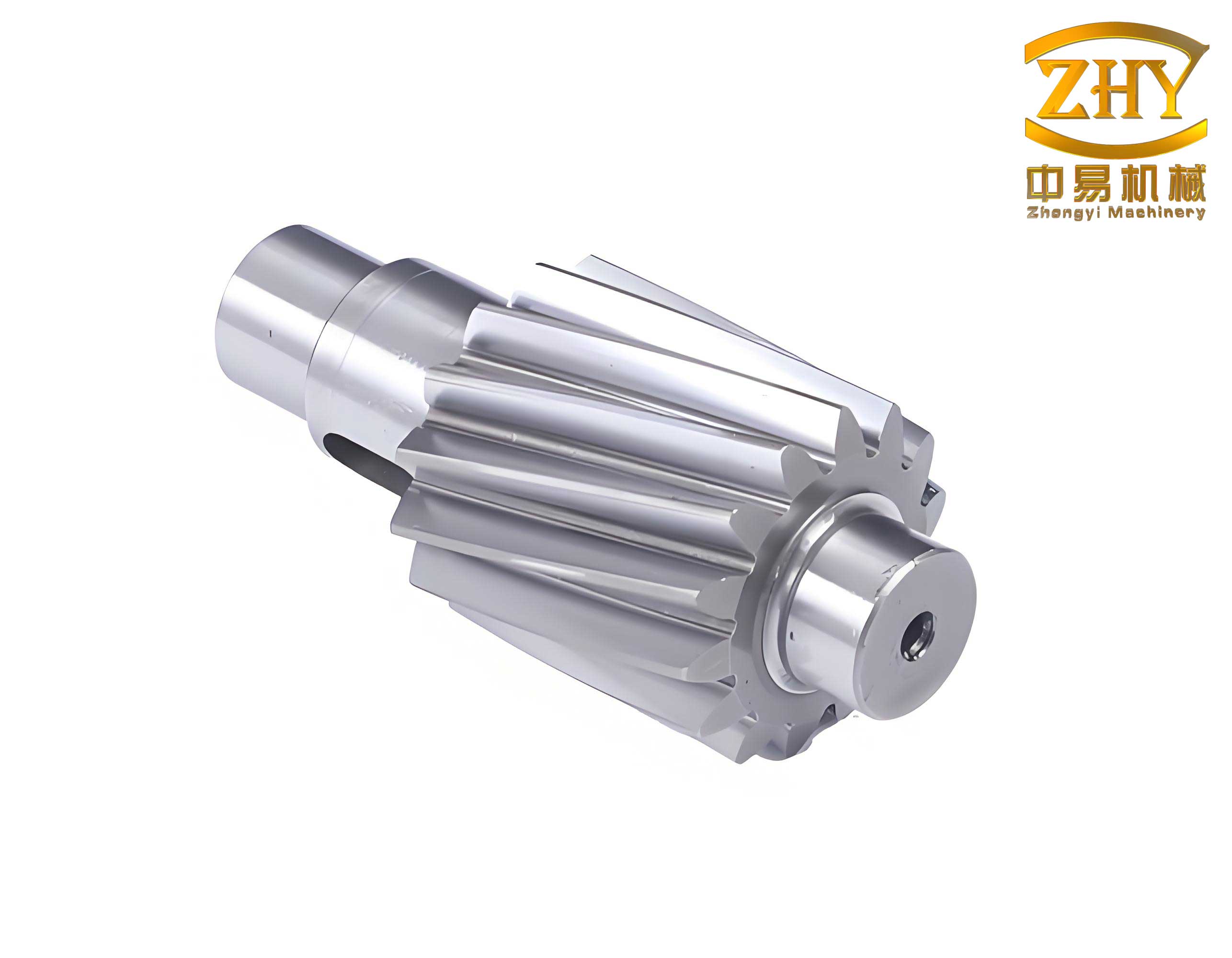
Modal analysis serves as the foundation for understanding the vibrational characteristics of the gear shaft. It determines the natural frequencies and mode shapes, which are intrinsic properties dependent on mass and stiffness distributions. The governing equation for undamped free vibration of a gear shaft can be derived from the principles of structural dynamics. The general motion equation for a multi-degree-of-freedom system is given by:
$$ M\ddot{x} + C\dot{x} + Kx = P(t) $$
where \( M \) is the mass matrix, \( C \) is the damping matrix, \( K \) is the stiffness matrix, \( \ddot{x} \) is the acceleration vector, \( \dot{x} \) is the velocity vector, \( x \) is the displacement vector, and \( P(t) \) is the external force vector. For modal analysis, we consider the free vibration case by setting \( P(t) = 0 \) and neglecting damping effects, leading to:
$$ M\ddot{x} + Kx = 0 $$
Assuming harmonic motion, we express the displacement as \( x = \phi e^{i\omega t} \), where \( \phi \) is the mode shape vector and \( \omega \) is the angular frequency. Substituting into the equation yields the eigenvalue problem:
$$ (K – \omega^2 M)\phi = 0 $$
Solving this eigenvalue problem provides the natural frequencies \( f_n = \frac{\omega_n}{2\pi} \) and corresponding mode shapes for the gear shaft. Typically, lower-order modes dominate the vibrational response, so we concentrate on the first six modes in our analysis.
To perform the modal analysis, we first create a parameterized 3D model of the gear shaft using CAD software. The gear shaft features two journal diameters, denoted as \( d_1 \) and \( d_2 \), which are critical design variables. The initial dimensions are set to \( d_1 = 27 \, \text{mm} \) and \( d_2 = 17 \, \text{mm} \). The model is then imported into a CAE software for finite element analysis. We mesh the gear shaft with tetrahedral solid elements to capture its geometry accurately. Boundary conditions are applied to simulate realistic constraints: the gear shaft is assumed to rotate about its axis, so we restrict all degrees of freedom at both end faces except for rotation around the axial direction. This ensures that the modal analysis reflects the operational conditions.
The results from the initial modal analysis reveal the natural frequencies and mode shapes of the gear shaft. The first six natural frequencies are summarized in the table below:
| Mode Number | Natural Frequency (Hz) |
|---|---|
| 1 | 801.6 |
| 2 | 801.8 |
| 3 | 2301.3 |
| 4 | 2578.8 |
| 5 | 2625.5 |
| 6 | 4840.7 |
The mode shapes indicate significant deformations at the journal locations corresponding to \( d_1 \) and \( d_2 \), suggesting that these diameters are sensitive parameters for vibrational performance. This insight guides our optimization strategy to modify these dimensions to shift the natural frequencies upward.
Optimization of the gear shaft involves defining an objective function that encapsulates our goal of increasing the lower-order natural frequencies. We formulate a weighted sum of the first six natural frequencies as the objective function \( F \):
$$ F = \sum_{i=1}^{6} w_i f_i $$
where \( w_i \) are weighting coefficients assigned as 0.3, 0.3, 0.1, 0.1, 0.1, and 0.1 for modes 1 through 6, respectively. This weighting emphasizes the importance of the first two modes, which are often most critical for resonance avoidance. The design variables are the journal diameters \( d_1 \) and \( d_2 \), with practical constraints based on structural requirements:
$$ 25 \, \text{mm} \leq d_1 \leq 32 \, \text{mm} $$
$$ 15 \, \text{mm} \leq d_2 \leq 20 \, \text{mm} $$
To automate the optimization process, we integrate CAD and CAE tools through an optimization platform. The workflow begins with the parameterized CAD model, where a log file captures the design variables. This model is exported to the CAE software for modal analysis, which outputs the natural frequencies into a report file. An optimization algorithm then iteratively adjusts the design variables, updates the CAD model, re-runs the modal analysis, and evaluates the objective function until convergence is achieved. This closed-loop automation significantly reduces manual effort and enhances design efficiency.
For the optimization algorithm, we select the Adaptive Simulated Annealing (ASA) method. Simulated Annealing (SA) is a probabilistic technique inspired by the annealing process in metallurgy. It explores the design space by allowing occasional uphill moves to escape local optima, gradually cooling the system to converge to a global optimum. The ASA variant improves upon traditional SA by dynamically adjusting parameters like temperature and step size, leading to faster and more reliable convergence. The algorithm is configured with a maximum iteration count of 100 and a convergence tolerance of \( 1.0 \times 10^{-8} \), ensuring precise results.
The optimization process executes 107 cycles before convergence. The optimal design variables are found to be \( d_1 = 31.925 \, \text{mm} \) and \( d_2 = 19.264 \, \text{mm} \). The evolution of the design variables and objective function over iterations is illustrated in the following table, which samples key points during the optimization:
| Iteration | \( d_1 \) (mm) | \( d_2 \) (mm) | Objective Function \( F \) |
|---|---|---|---|
| 0 | 27.000 | 17.000 | 1754.6 |
| 20 | 29.456 | 18.123 | 1856.3 |
| 40 | 30.892 | 18.945 | 1912.7 |
| 60 | 31.567 | 19.102 | 1945.8 |
| 80 | 31.824 | 19.221 | 1960.4 |
| 100 | 31.912 | 19.258 | 1966.2 |
| 107 | 31.925 | 19.264 | 1967.1 |
The objective function increases from an initial value of 1754.6 to a final value of 1967.1, representing an improvement of 12.1%. This enhancement directly translates to higher natural frequencies for the gear shaft, as shown in the comparison table below:
| Mode Number | Natural Frequency Before (Hz) | Natural Frequency After (Hz) |
|---|---|---|
| 1 | 801.6 | 973.3 |
| 2 | 801.8 | 1043.7 |
| 3 | 2301.3 | 2576.8 |
| 4 | 2578.8 | 3044.2 |
| 5 | 2625.5 | 3167.4 |
| 6 | 4840.7 | 5107.2 |
All six natural frequencies experience significant increases, with the first two modes showing particularly notable gains. This shift ensures that the gear shaft’s resonant frequencies are farther from typical excitation sources, such as engine harmonics or gear meshing frequencies, thereby reducing the risk of resonance-induced vibrations and noise.
To further analyze the optimization outcome, we examine the sensitivity of the natural frequencies to changes in the journal diameters. Using partial derivatives, we can approximate the influence of each design variable. For instance, the change in the first natural frequency \( f_1 \) with respect to \( d_1 \) can be expressed as:
$$ \frac{\partial f_1}{\partial d_1} \approx \frac{\Delta f_1}{\Delta d_1} $$
Given the optimization data, we compute these sensitivities for each mode. The results indicate that increasing \( d_1 \) and \( d_2 \) generally boosts stiffness, which raises the natural frequencies. However, the relationship is nonlinear due to the complex geometry of the gear shaft. The optimization algorithm effectively navigates this nonlinearity to find the optimal balance.
Another aspect to consider is the mass effect. While larger diameters increase stiffness, they also add mass, which can lower natural frequencies. The net effect depends on the ratio of stiffness to mass changes. For the gear shaft, the stiffness increase dominates, leading to higher frequencies. This is consistent with the fundamental frequency formula for a simple beam:
$$ f \propto \sqrt{\frac{k}{m}} $$
where \( k \) is stiffness and \( m \) is mass. In our gear shaft, the journal diameters primarily affect the bending stiffness, which scales with the fourth power of the diameter for a circular cross-section:
$$ k_{\text{bending}} \propto d^4 $$
Meanwhile, mass increases linearly with the cross-sectional area:
$$ m \propto d^2 $$
Thus, the frequency scales as:
$$ f \propto \sqrt{\frac{d^4}{d^2}} = d $$
This simplified model suggests that increasing diameter should raise natural frequencies, aligning with our optimization results. However, the actual gear shaft has non-uniform geometry, so the optimization accounts for these complexities.
The integrated optimization platform proves highly effective in automating the design process. By linking CAD and CAE, it eliminates manual re-modeling and re-analysis, reducing the design cycle time. The use of ASA ensures robust convergence to a global optimum, even in a multimodal design space. This approach can be extended to other components, such as gears or housings, for comprehensive transmission system optimization.
In conclusion, the modal optimization of the automotive transmission gear shaft successfully enhances its dynamic performance. Through parameterized modeling, finite element analysis, and adaptive simulated annealing, we achieve a 12.1% improvement in the weighted natural frequencies. The optimized gear shaft exhibits higher lower-order natural frequencies, mitigating resonance risks and contributing to reduced vibration and noise. This methodology underscores the value of integrated CAD/CAE tools and advanced algorithms in modern mechanical design, offering a systematic framework for similar engineering challenges. Future work could explore multi-objective optimization, incorporating factors like stress constraints or weight minimization, to further refine the gear shaft design.
Additionally, the role of the gear shaft in overall transmission dynamics cannot be overstated. As a critical load-bearing element, its vibrational behavior influences gear mesh alignment, bearing loads, and housing radiation. By optimizing the gear shaft, we indirectly improve the durability and acoustics of the entire transmission system. This holistic perspective is essential for advancing automotive engineering towards quieter, more reliable vehicles.
To summarize the key equations used in this analysis, we list them below for reference:
1. General motion equation: $$ M\ddot{x} + C\dot{x} + Kx = P(t) $$
2. Free vibration equation: $$ M\ddot{x} + Kx = 0 $$
3. Eigenvalue problem: $$ (K – \omega^2 M)\phi = 0 $$
4. Objective function: $$ F = \sum_{i=1}^{6} w_i f_i $$
5. Stiffness-mass relationship: $$ f \propto \sqrt{\frac{k}{m}} $$
The tables presented throughout this article provide a clear comparison of pre- and post-optimization data, highlighting the effectiveness of the approach. The integration of visual elements, such as the gear shaft image, complements the technical discussion by offering a tangible representation of the component under study.
Ultimately, this study demonstrates that targeted optimization of gear shaft parameters can yield substantial improvements in vibrational characteristics. By leveraging computational tools and algorithms, engineers can efficiently design gear shafts that meet stringent performance criteria, contributing to the development of high-quality automotive transmissions.