
The reliable operation of hydraulic motors is critical in demanding applications within mining and engineering machinery. A key component contributing to this reliability is the gear shaft, which is prized for its structural simplicity, compact size, lightweight nature, and cost-effectiveness. These gear shafts often operate at high rotational speeds and must withstand significant cyclic loads. To meet these challenges, the material of choice is frequently 38CrMoAl nitriding steel, selected for its excellent response to surface nitriding treatments. Nitriding imparts a high surface hardness, superior wear resistance, good fatigue strength, and improved corrosion resistance, thereby extending the service life of the component. However, in-service failures of these critical gear shafts can lead to costly downtime. This analysis presents a detailed investigation into a specific failure mode observed in such gear shafts, focusing on the root cause and proposing effective engineering solutions. The study is based on the comparative analysis of a failed gear shaft and an unfailed reference sample from the same production batch.
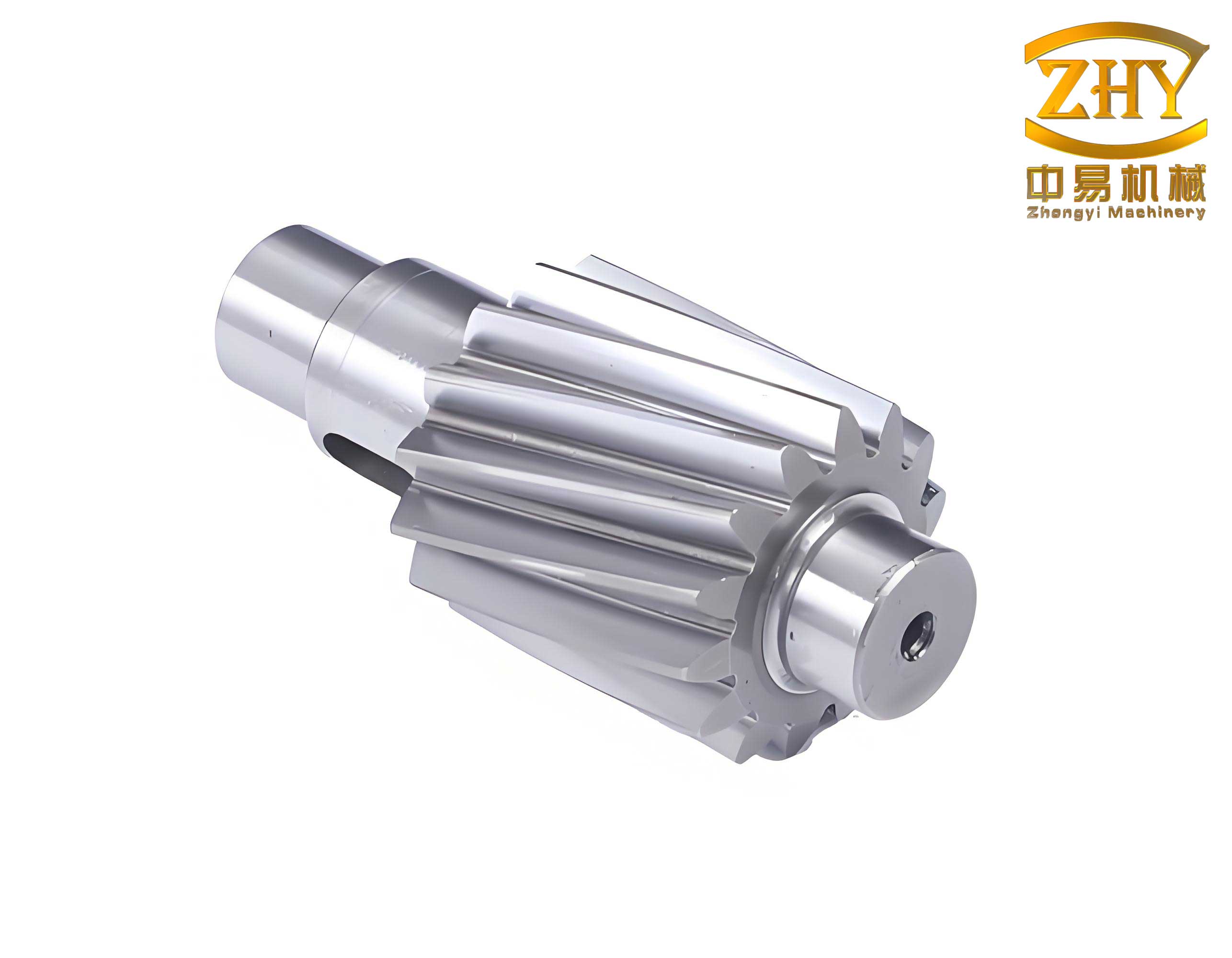
The primary function of these gear shafts is to transmit torque within the hydraulic motor assembly. Their performance is intrinsically linked to the integrity of the surface-engineered layer. The failure under investigation manifested as severe surface damage, compromising this integrity. A systematic materials engineering approach was employed to diagnose the problem, encompassing trace analysis, chemical composition verification, metallographic examination, microhardness profiling, and scanning electron microscopy (SEM) with energy-dispersive X-ray spectroscopy (EDS).
Experimental Methodology and Initial Observations
Samples were sectioned from both failed and unfailed gear shafts using wire electrical discharge machining to preserve the microstructural features of the nitrided case. Standard metallographic preparation techniques were employed, culminating in etching with a 4% nital solution. Chemical analysis was performed using optical emission spectrometry. Microstructural evaluation was conducted using optical microscopy and a scanning electron microscope equipped with an EDS detector. The hardness gradient from the surface to the core was measured using a microhardness tester with a Vickers indenter under a standard load.
The macroscopic examination of the failed gear shaft revealed extensive surface deterioration. Large areas exhibited spallation, where substantial fragments of the surface layer had detached from the substrate. In contrast, the non-damaged regions of the surface appeared smooth and intact. At higher magnification under SEM, the damaged zones clearly showed a brittle, flaking morphology characteristic of coating or case delamination, distinct from adhesive or abrasive wear patterns.
Material Composition and Conformity
The first step in the failure analysis was to rule out material non-conformity as a root cause. The chemical composition of the failed gear shaft was determined and compared against the standard specification for 38CrMoAl steel. The results are summarized in the table below:
| Element | Standard 38CrMoAl (wt%) | Failed Gear Shaft (wt%) |
|---|---|---|
| C | 0.35 – 0.42 | 0.41 |
| Al | 0.70 – 1.10 | 0.904 |
| Si | 0.20 – 0.45 | 0.201 |
| Cr | 1.35 – 1.65 | 1.36 |
| Mn | 0.30 – 0.60 | 0.416 |
| Mo | 0.15 – 0.25 | 0.237 |
| S | ≤ 0.015 | 0.015 |
| P | ≤ 0.020 | 0.0091 |
The analysis confirmed that the bulk material chemistry of the failed gear shafts was well within the specified range. This finding conclusively eliminated incorrect base material selection or gross compositional error as the direct cause of the premature failure. The investigation then shifted focus to the quality and characteristics of the surface-engineered nitrided layer.
Metallographic and Microstructural Analysis of the Nitrided Case
Cross-sectional analysis provided definitive evidence of abnormal nitride layer formation. The microstructures of the unfailed and failed gear shaft samples are starkly different, as qualitatively described below:
| Sample | White Layer Morphology | Subsurface Zone | Microstructure Rating |
|---|---|---|---|
| Unfailed Gear Shaft | Uniform, continuous, and relatively thin. | Dense diffusion zone with minimal, finely dispersed precipitates. | Grade 1 (Excellent) |
| Failed Gear Shaft | Thicker and less uniform. | Presence of a pronounced, near-surface band containing massive, blocky precipitates. | Grade 5 (Abnormal, severely embrittled) |
In standard nitriding of gear shafts, the white layer (or compound layer) primarily consists of ε-(Fe2-3N) and γ’-(Fe4N) phases, underlain by a nitrogen diffusion zone with fine alloy nitride precipitates (e.g., AlN, CrN, Mo2N). The unfailed sample exhibited this ideal structure. The failed gear shaft, however, showed a pathological microstructure. Just beneath the white layer, a dense band of large, angular carbides and carbonitrides was observed. These blocky phases are brittle intermetallic compounds.
SEM-EDS analysis was performed on the blocky precipitates within the failed gear shaft’s case. The spectra showed significantly elevated carbon and nitrogen signals, along with chromium, molybdenum, and iron. This confirms the precipitates are complex (Cr, Mo, Fe)x(C,N)y carbides and carbonitrides. Their formation is tied to local carbon enrichment and specific kinetic conditions during the nitriding process. The hardness of this band, as inferred from micro-indentation size, was exceedingly high, far exceeding the desired hardness for a tough nitrided case.
Microhardness Profile and Mechanical Implications
The microhardness traverse from the surface to the core of the failed gear shaft revealed a problematic gradient. The profile can be conceptually modeled. The surface hardness (HVsurface) was extremely high due to the compound layer and the underlying band of blocky precipitates. This was followed by a steep hardness drop into the diffusion zone (HVdiffusion) and finally down to the core hardness (HVcore).
The hardness as a function of distance from the surface, \( x \), can be described by a piecewise function highlighting the abnormal zone:
$$
H(x) =
\begin{cases}
\text{HV}_{\text{surface}} \approx 1100 & \text{for } 0 \leq x \leq d_{\text{band}} \\
\text{HV}_{\text{diffusion}}(x) \approx A e^{-kx} + B & \text{for } d_{\text{band}} < x \leq d_{\text{case}} \\
\text{HV}_{\text{core}} \approx 300 & \text{for } x > d_{\text{case}}
\end{cases}
$$
where \( d_{\text{band}} \) is the depth of the embrittled precipitate band, \( d_{\text{case}} \) is the total case depth, and \( A, B, k \) are constants fitting the diffusion zone’s decay. The critical issue is the magnitude of HVsurface and the severe discontinuity in mechanical properties at the interface between the brittle band and the relatively softer diffusion zone beneath it. This creates a site of high stress concentration under applied load.
Mechanism of Failure: Spallation under Cyclic Loading
The failure mechanism is identified as subsurface-origin spallation (or exfoliation) of the nitrided case, a direct consequence of the abnormal microstructure. The massive, blocky carbides/carbonitrides act as intrinsic stress concentrators and pre-existing brittle interfaces. During service, the gear shafts are subjected to cyclic Hertzian contact stresses and bending stresses.
The maximum shear stress \( \tau_{max} \) under a contact load occurs at a subsurface location. In a healthy nitrided gear shaft, this stress is well-supported by a graded, tough microstructure. In the failed gear shafts, the brittle band resides precisely within this high-stress region. The cyclic stress intensity factor \( \Delta K \) at the tip of a micro-crack associated with a blocky carbide can be approximated for a surface flaw:
$$
\Delta K = Y \Delta \sigma \sqrt{\pi a}
$$
where \( Y \) is a geometric factor, \( \Delta \sigma \) is the cyclic stress range, and \( a \) is the flaw size (related to the carbide dimension). The large size of the blocky precipitates provides a significant initial flaw size \( a \). The high hardness and low fracture toughness of this zone result in a very low critical stress intensity factor \( K_{IC} \) for the material in that band.
Under repeated loading, the condition \( \Delta K \geq \Delta K_{th} \) (threshold for crack growth) is easily met. Cracks initiate at the carbide/matrix interfaces and propagate preferentially through the brittle band or along its boundary with the diffusion zone. Eventually, these interconnected cracks cause the overlying material to detach in large flakes, leading to the observed macroscale spallation. This process severely compromises the load-bearing capacity and wear resistance of the gear shafts, leading to catastrophic functional failure.
Root Cause Analysis and Mitigation Strategies for Gear Shafts
The presence of the deleterious blocky carbide band is a process-related anomaly, not a material one. The root cause lies in the specific conditions of the nitriding process applied to these gear shafts. Two primary factors contribute to this microstructure:
- Excessive Carbon Potential and/or Temperature: A combination of high temperature and a carbon-containing atmosphere (e.g., from residual oils or improper gas mixtures) can lead to simultaneous nitriding and carburizing in the near-surface region. This promotes the nucleation and growth of large alloy carbides.
- Pre-existing Microstructure: The initial microstructure of the 38CrMoAl steel prior to nitriding is crucial. A spheroidized or heavily banded structure with carbide networks can provide nucleation sites for abnormal growth during nitriding.
Therefore, the solution pathway must address both material preparation and process control to prevent the formation of embrittling phases in future production of gear shafts.
Comprehensive Solution for Reliable Gear Shafts
| Control Area | Specific Action | Technical Rationale & Target |
|---|---|---|
| Material Incoming Inspection | Mandatory microstructural audit of bar stock. | Ensure a uniform, tempered martensite structure prior to nitriding. Reject material with spheroidized carbides or severe banding. |
| Strict verification of chemical composition (especially C, Cr, Mo). | Confirm material is within the narrow specification suitable for deep, stable nitriding. | |
| Pre-Nitriding Preparation | Implement rigorous and validated cleaning procedures. | Remove all oils, greases, and contaminants from gear shaft surfaces to prevent uncontrolled carbon ingress. |
| Optimize pre-heat treatment (quenching & tempering). | Achieve a core hardness of ~300 HV with a fine, homogeneous martensitic lattice to ensure uniform nitrogen diffusion. | |
| Control surface finish and avoid cold working. | A smooth surface reduces intrinsic stress and promotes even compound layer formation. | |
| Nitriding Process Optimization | Precise control of furnace temperature profile. | Maintain temperature within ±5°C of setpoint (e.g., 500-520°C for gas nitriding) to control kinetics. |
| Precise regulation of nitriding potential (KN). | Use a multi-stage process: a high KN for rapid nucleation followed by a lower KN to control white layer growth and prevent porosity. The nitriding potential is defined as $$K_N = \frac{p_{NH_3}}{(p_{H_2})^{1.5}}$$ and must be carefully profiled over time. | |
| Eliminate carbon sources from the atmosphere. | Use high-purity NH3 and H2 gases; ensure furnace integrity to avoid air ingress (which can cause decarburization followed by anomalous reactions). | |
| Implement controlled cooling. | Slow cooling under protective atmosphere to minimize thermal stresses that could exacerbate cracking in a brittle case. | |
| Quality Assurance & Monitoring | Regular metallographic audit of production gear shafts. | Monitor case depth, white layer thickness, and most critically, the absence of a continuous network of blocky precipitates. Establish an Acceptable Quality Limit (AQL). |
| Statistical Process Control (SPC) of nitriding parameters. | Continuously log temperature, gas flows, and calculated KN to ensure process stability and capability (Cpk > 1.33). |
By implementing this holistic control strategy, the nitriding process for gear shafts can be stabilized to consistently produce a high-quality case. The target microstructure features a thin, continuous white layer (optimally < 15 µm) and a deep diffusion zone with fine, dispersed alloy nitride precipitates, free of the massive brittle bands. This results in an optimal hardness profile with high surface hardness for wear resistance, a gradual transition to mitigate stress concentration, and a tough core for load support. The performance of gear shafts treated under such a optimized regime can be quantitatively compared to the failed ones using parameters like the fatigue limit \( \sigma_f \) and the wear coefficient \( k \), which are expected to show significant improvement.
Conclusion and Outlook
This failure analysis conclusively determined that the spallation of nitrided gear shafts was caused by the formation of a near-surface band of massive, brittle carbides and carbonitrides during the nitriding process. This microstructural anomaly created a region of extreme hardness and low fracture toughness within the critical stress-bearing depth. Under cyclic operational loads, this led to crack initiation and propagation, culminating in large-scale exfoliation of the case. The integrity of gear shafts is therefore not solely dependent on correct material selection but is profoundly sensitive to the precise control of the thermochemical surface engineering process.
The proposed mitigation strategy emphasizes a closed-loop approach, integrating strict incoming material checks, meticulous pre-cleaning, and precisely controlled nitriding atmosphere kinetics. Future work could involve advanced characterization of the optimized case using techniques like XRD phase analysis and residual stress measurement, further refining the process-window for 38CrMoAl gear shafts. Furthermore, exploring alternative or complementary surface treatments, such as low-temperature plasma nitriding or nitrocarburizing with post-oxidation, may offer even better control over the compound layer properties for specific applications, enhancing the durability and performance envelope of these essential power transmission components.