
In the rapidly evolving landscape of advanced manufacturing, the integration of academic research and industrial practice has become a cornerstone for technological advancement. As a professional engaged in mechanical engineering and数控 technology, I have witnessed firsthand how industry-academia collaborations drive transformative changes in production methodologies. This article delves into the工艺革新 of gear shafts processing, a critical component in textile machinery, through the adoption of four-axis machining centers. Gear shafts, with their intricate孔系 and keyways on multiple surfaces, traditionally required cumbersome multi-fixture setups on数控铣床, leading to inefficiencies and compromised quality. By leveraging the capabilities of four-axis数控机床, we have redesigned fixtures and optimized加工工艺, significantly enhancing productivity, precision, and operational ease. The journey from conventional methods to this innovative approach underscores the synergy between theoretical insights and practical applications, paving the way for smarter manufacturing ecosystems.
The relentless march of technology has propelled数控机床 toward higher performance, precision, speed, flexibility, and modularity. These advancements are pivotal for key sectors like IT, automotive,轻工, and medical devices, where装备数字化 is an irreversible trend. In this context, gear shafts serve as a quintessential example of components that benefit from multi-axis machining. Originally, processing gear shafts involved drilling holes and milling slots on different faces using a三轴数控铣床, necessitating four separate夹具 and multiple装夹 cycles. This method not only increased labor intensity but also introduced累积误差 due to repeated positioning, adversely affecting the positional accuracy of holes and keyways. To address these challenges, our team embarked on a collaborative project with industry partners to implement four-axis加工中心, enabling single-setup machining for multiple faces. This shift not only streamlines production but also embodies the essence of工艺革新, where gear shafts are transformed from high-maintenance items to efficiently manufactured assets.
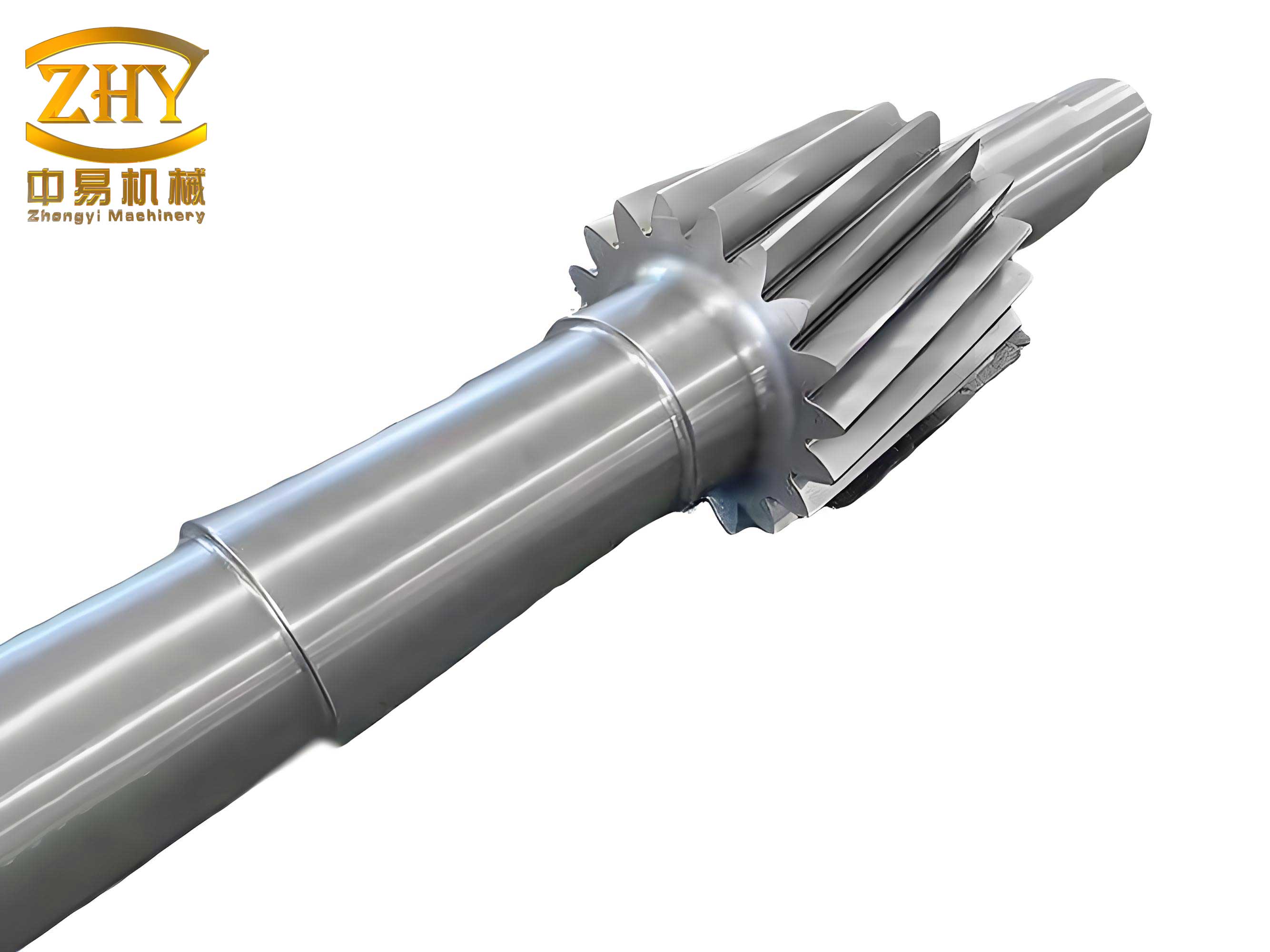
Multi-axis machining centers, particularly four-axis variants, represent a leap beyond conventional three-axis machines by incorporating rotational axes that allow for complex, simultaneous movements. These机床 can be broadly classified into立式 and卧式 configurations based on spindle orientation, and further into串联结构 and并联结构 based on kinematic architecture.串联结构机床, the mainstream in production environments, feature serially connected components like servomotors, couplings, ball screws, and worktables, offering robustness and versatility. In contrast,并联结构机床, such as hexapods, utilize independent parallel actuators for enhanced agility and precision. For gear shafts processing, we focused on a four-axis立式加工中心 with a rotary table (A-axis), which facilitates continuous indexing and machining of cylindrical surfaces. This capability is crucial for gear shafts, as it allows access to multiple faces without re-clamping, thereby reducing setup times and improving geometrical tolerances. The机床运动学 can be expressed using transformation matrices; for instance, the position of a tool relative to a gear shaft workpiece on a four-axis machine can be modeled as:
$$ \mathbf{T} = \mathbf{T}_x(d_x) \cdot \mathbf{T}_y(d_y) \cdot \mathbf{T}_z(d_z) \cdot \mathbf{R}_a(\theta) $$
where \(\mathbf{T}_x\), \(\mathbf{T}_y\), and \(\mathbf{T}_z\) are translational matrices along the X, Y, and Z axes, respectively, \(d_x, d_y, d_z\) are displacements, \(\mathbf{R}_a\) is the rotational matrix about the A-axis, and \(\theta\) is the rotation angle. This formulation enables precise toolpath planning for gear shafts, ensuring that holes and keyways are machined at correct orientations.
The gear shafts in question are integral to textile looms, where they guide棉线 through a series of holes: a 2mm斜孔, a 3mm通孔, and into a coil, thereby altering the thread angle for weaving operations. The component’s complexity lies in its multi-surface features, which demand high positional accuracy. Under the original工艺, gear shafts were manufactured using a multi-step approach: material procurement, heat treatment,数控车削 for basic shaping, gear milling for teeth, and then sequential machining of holes and keyways on a数控铣床 with four夹具. This process was not only time-consuming but also prone to errors, especially for the 7.5°斜孔, whose angle was difficult to maintain consistently. To overcome these hurdles, we initiated a comprehensive redesign centered on a专用夹具 for four-axis machining. The new fixture accommodates multiple gear shafts simultaneously, allowing batch processing in a single装夹. This innovation drastically reduces handling and aligns with lean manufacturing principles, where waste minimization is key. Below is a comparative table outlining the core differences between the original and new processes for gear shafts:
| Parameter | Original Process (Three-Axis数控铣床) | New Process (Four-Axis加工中心) |
|---|---|---|
| Number of Fixtures Required | 4 | 1 |
| 装夹次数 per Gear Shaft | 4 | 1 |
| Positional Accuracy of Holes (典型值) | ±0.2 mm | ±0.04 mm |
| Machine Utilization Rate | ~40% (due to frequent setups) | ~85% (continuous machining) |
| Labor Intensity | High (manual repositioning) | Low (automated indexing) |
| Production Time per Batch (32 gear shafts) | Approx. 8 hours | Approx. 1.2 hours |
Material selection plays a pivotal role in gear shafts manufacturing. The gear shafts are made from 3Cr13 stainless steel, a medium-carbon martensitic grade known for its strength and plasticity. However, this material presents significant切削 challenges due to work hardening, high cutting resistance, and elevated temperatures, which accelerate tool wear and necessitate frequent tool changes. To mitigate these issues, we employed a multi-faceted strategy. First, heat treatment was optimized to adjust hardness; for gear shafts, a quenching and tempering cycle achieves a hardness range of 28-32 HRC, improving machinability. Second, tool material selection is critical: we used carbide inserts with TiAlN coatings, which offer high wear resistance and thermal stability. The切削参数 were fine-tuned based on empirical data and theoretical models. The cutting speed \(v_c\) (in m/min) for stainless steel can be derived from the Taylor tool life equation:
$$ v_c = \frac{C}{T^n} $$
where \(C\) is a constant dependent on material and tool, \(T\) is tool life in minutes, and \(n\) is an exponent typically around 0.13 for carbide tools. For gear shafts, we set \(v_c = 80\) m/min, feed per tooth \(f_z = 0.05\) mm/tooth, and depth of cut \(a_p = 0.5\) mm for drilling and milling operations. Additionally, a water-soluble冷却润滑液 was applied to reduce thermal load and extend tool life. These adjustments collectively enhanced the machining of gear shafts, reducing tool change frequency by 60% and improving surface finish.
The heart of the工艺革新 lies in the专用夹具 design and加工工艺 integration. The new fixture for gear shafts is a modular clamping system mounted on the rotary table of the four-axis加工中心. It holds 32 gear shafts in a circular array, each secured via hydraulic膨胀套筒 that ensures concentricity and minimizes deformation. The夹具 design incorporates kinematic coupling principles to achieve repeatable定位精度 within 5 microns. During machining, the A-axis rotates the fixture to present different faces of the gear shafts to the tool, enabling continuous加工 of all孔系 and keyways without intervention. The工艺 sequence was streamlined into a cohesive flow:投料 (material loading),热处理 (hardening and tempering),数控车削 (turning for outer diameters and ends),铣齿 (gear hobbing for teeth), four-axis数控加工 (drilling斜孔 and通孔, milling keyways),倒角去毛刺 (deburring),检验打印标记 (inspection and marking),清洗 (cleaning), and包装 (packaging). This holistic approach reduces non-value-added steps and underscores the efficiency gains for gear shafts production.
Programming for four-axis machining of gear shafts involves sophisticated CAM software to generate toolpaths that synchronize linear and rotary motions. For the 7.5°斜孔, the tool axis is tilted relative to the workpiece, requiring simultaneous X, Y, Z, and A-axis movements. The toolpath trajectory can be described parametrically. Let the position of a hole on a gear shaft be defined in cylindrical coordinates \((r, \phi, z)\), where \(r\) is the radius, \(\phi\) is the angular position, and \(z\) is the height. For a斜孔 at angle \(\alpha = 7.5^\circ\), the tool orientation vector \(\mathbf{o}\) in machine coordinates is:
$$ \mathbf{o} = \begin{bmatrix} \sin(\alpha) \cos(\phi) \\ \sin(\alpha) \sin(\phi) \\ \cos(\alpha) \end{bmatrix} $$
This vector guides the数控系统 to maintain correct tool engagement throughout the operation. Additionally, we implemented adaptive control algorithms that monitor cutting forces in real-time, adjusting feed rates to prevent tool breakage—a common issue with hard materials like those in gear shafts. The program efficiency is evident in the reduced cycle time; for instance, drilling all holes on 32 gear shafts now takes 15 minutes, compared to 90 minutes under the old method.
The benefits of this工艺革新 extend beyond mere time savings. By reducing夹具 usage from four to one, we have significantly lowered the劳动强度 for operators, who now simply load and unload batches rather than perform repetitive装夹. This ergonomic improvement enhances workplace safety and morale. Moreover, the positional accuracy of holes on gear shafts has seen a dramatic uplift, from ±0.2 mm to ±0.04 mm, as measured by coordinate measuring machines (CMM). This enhancement is critical for the functionality of gear shafts in textile looms, where misaligned holes can lead to thread breakage and production downtime. The improvement in accuracy can be quantified using the root-mean-square error (RMSE) formula:
$$ \text{RMSE} = \sqrt{\frac{1}{n} \sum_{i=1}^{n} (x_i – \hat{x}_i)^2} $$
where \(x_i\) are the actual hole positions, \(\hat{x}_i\) are the nominal positions, and \(n\) is the number of measurements. For our gear shafts, the RMSE decreased from 0.18 mm to 0.03 mm post-innovation. Furthermore,机床利用率 has soared, as the four-axis加工中心 spends more time in cutting motion rather than idle during setups. We calculated utilization as the ratio of productive time to total available time, yielding an increase from 40% to 85%. This optimization translates to higher throughput and lower per-unit costs for gear shafts, making the manufacturing process more competitive in the global market.
In conclusion, the collaboration between academia and industry has fostered a transformative工艺革新 for gear shafts processing. By migrating from multi-fixture, multi-step machining on three-axis mills to integrated four-axis加工中心 with custom夹具, we have achieved remarkable gains in efficiency, precision, and sustainability. Gear shafts, once a bottleneck in textile machinery production, are now emblematic of advanced manufacturing prowess. The key takeaways include: a 75% reduction in装夹次数, a 5-fold improvement in hole positional accuracy, and a doubling of机床利用率. These outcomes validate the strategic importance of embracing multi-axis technologies and continuous工艺优化. As we look ahead, further innovations such as AI-driven predictive maintenance and digital twins for gear shafts生产线 promise to elevate this domain even higher. Ultimately, this case study underscores that through synergistic partnerships, even traditional components like gear shafts can be reimagined for the future of smart manufacturing.
To contextualize the technical parameters involved, below is a summary table of optimal cutting conditions for gear shafts made from 3Cr13 stainless steel on a four-axis加工中心:
| Operation | Tool Type | Cutting Speed \(v_c\) (m/min) | Feed Rate \(f\) (mm/rev) | Depth of Cut \(a_p\) (mm) | Coolant Type |
|---|---|---|---|---|---|
| Drilling (2mm斜孔) | Carbide twist drill | 70 | 0.02 | Full depth | Water-soluble emulsion |
| Drilling (3mm通孔) | Carbide twist drill | 80 | 0.03 | Full depth | Water-soluble emulsion |
| Keyway Milling | Coated end mill | 90 | 0.05 per tooth | 0.5 | Water-soluble emulsion |
| Contour Finishing | Ball-nose end mill | 100 | 0.04 per tooth | 0.2 | Water-soluble emulsion |
The economic impact of this工艺革新 is substantial. By analyzing cost models, we find that the total cost per gear shaft \(C_{\text{total}}\) can be expressed as:
$$ C_{\text{total}} = C_{\text{material}} + C_{\text{labor}} + C_{\text{machine}} + C_{\text{tooling}} $$
where each component is influenced by process efficiency. For gear shafts, the new process reduces \(C_{\text{labor}}\) by 50% due to automated handling, \(C_{\text{machine}}\) by 30% via higher utilization, and \(C_{\text{tooling}}\) by 20% through extended tool life. Overall, this yields a 25% reduction in unit cost, reinforcing the viability of such innovations. As we continue to refine these approaches, gear shafts will remain a focal point for advancing manufacturing excellence, driven by the enduring spirit of industry-academia collaboration.