
In my extensive experience with automotive transmission systems, I have consistently observed that gear shafts play a pivotal role in ensuring operational integrity and longevity. Specifically, planetary gear shafts within differential assemblies are critical components responsible for torque transmission and distribution, enabling differential wheel motion. These gear shafts are subjected to complex loading conditions, including torsional and bending stresses, which necessitate rigorous material selection and heat treatment. The failure of such gear shafts can lead to catastrophic system breakdowns, as evidenced in a recent durability test where a planetary gear shaft fractured during differential endurance testing. This incident prompted a comprehensive failure analysis, which I will detail in this article, emphasizing the importance of microstructure integrity in gear shafts.
The differential assembly, integral to automotive transmissions, comprises several components: the differential case, planetary gears, side gears, ring gear, shims, bearings, and the planetary gear shaft. The primary function of the gear shaft is to transfer torque to the planetary gears, facilitating torque distribution and allowing wheels to rotate at different speeds. During operation, gear shafts endure significant mechanical stresses, making their durability paramount. The gear shaft in question was manufactured from 42CrMo alloy steel, conforming to the GB/T 3077 standard for alloy structural steels. To enhance wear resistance and fatigue strength, the gear shaft underwent a heat treatment process consisting of quenching, tempering, and subsequent gas nitriding to form a surface nitride layer. However, during differential durability testing, an abnormal noise emerged from the transmission, leading to immediate test termination. Upon disassembly, I found the differential case damaged and the planetary gear shaft fractured, necessitating a thorough investigation.
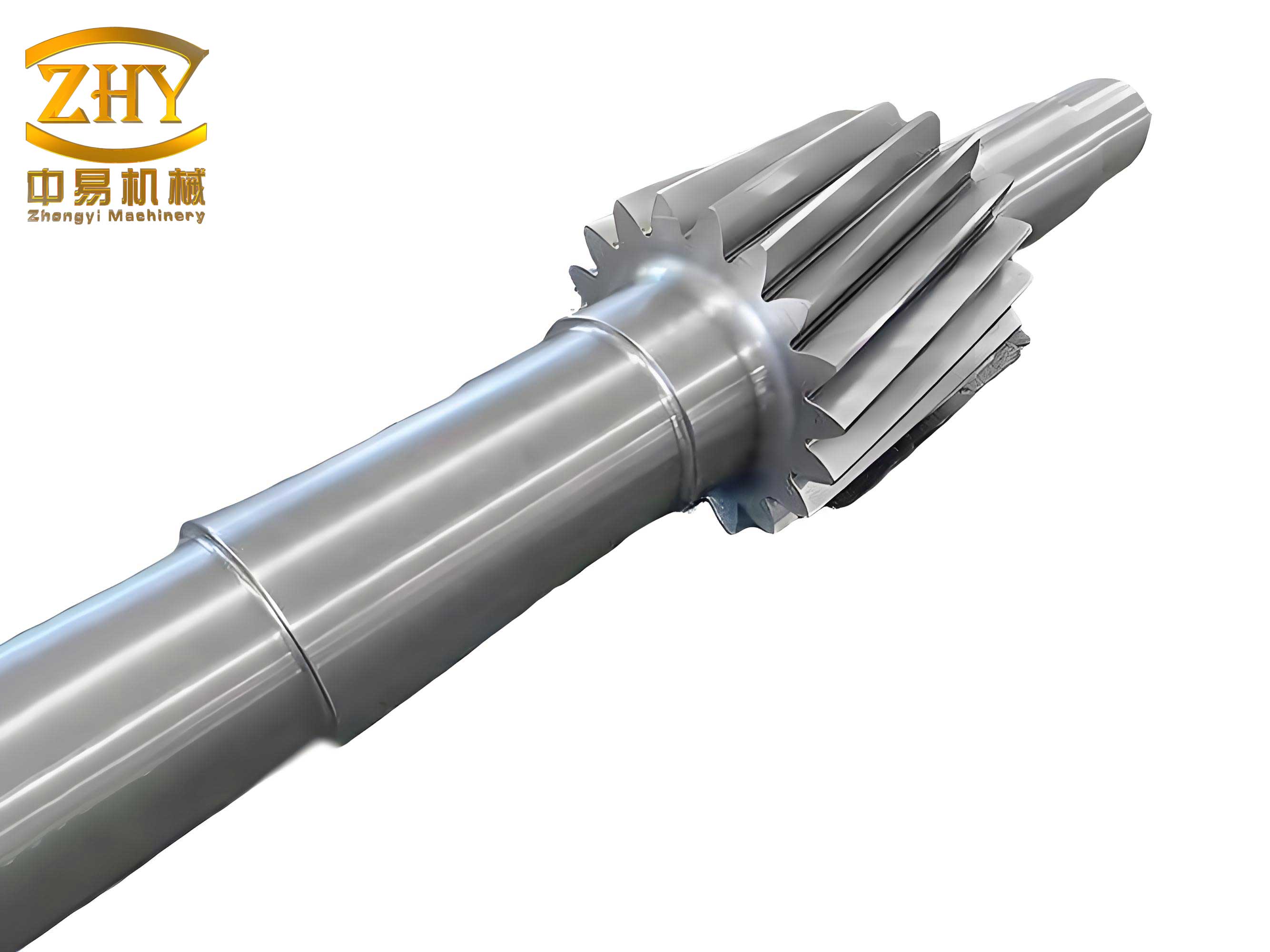
My analysis began with a macroscopic examination of the failed gear shaft. The fracture occurred in a manner indicative of fatigue failure, with the crack origin located on the circumferential surface. The fracture surface exhibited severe wear near the origin, suggesting initial crack propagation from the surface inward. The final fracture zone was situated near the center of the gear shaft, typical of overload failure after crack growth. This macroscopic observation led me to suspect surface-related issues, possibly linked to the nitriding process. Gear shafts, by design, must maintain surface integrity to withstand cyclic loads, and any discontinuity can serve as a stress concentrator, initiating cracks.
To delve deeper, I conducted a series of microscopic analyses, starting with chemical composition verification. Using energy-dispersive spectroscopy (EDS), I analyzed the material of the gear shaft. The results, summarized in Table 1, confirm that the composition aligns with 42CrMo specifications, ruling out material mis-specification as a cause. Gear shafts require precise alloying to achieve desired mechanical properties, and any deviation could compromise performance.
| Element | Standard Range (GB/T 3077) | Measured Value |
|---|---|---|
| C | 0.38–0.45 | 0.396 |
| Si | 0.17–0.37 | 0.226 |
| Mn | 0.50–0.80 | 0.714 |
| P | ≤0.020 | 0.017 |
| S | ≤0.020 | 0.005 |
| Cr | 0.90–1.20 | 1.11 |
| Mo | 0.15–0.25 | 0.204 |
Next, I evaluated the hardness and metallographic structure of the gear shaft. Surface hardness and core hardness were measured using a Vickers hardness tester, calibrated with standard blocks. The nitrided layer depth, nitride morphology, brittleness, and porosity were assessed through optical microscopy after standard sample preparation. The results are presented in Table 2. While surface hardness, core hardness, nitrided layer depth, nitride morphology, and brittleness met technical requirements, the surface porosity was rated at level 4, exceeding the acceptable range of levels 1–2. This excessive porosity, indicative of nitride layer loosening, significantly reduces surface strength and fatigue resistance, making gear shafts prone to crack initiation under load.
| Parameter | Technical Requirement | Measured Value |
|---|---|---|
| Surface Hardness (HV) | ≥ 600 | 727 |
| Core Hardness (HV) | 300–400 | 346 |
| Nitrided Layer Depth (μm) | 12–20 | 16 |
| Nitride Morphology (Level) | 1–2 | 2 |
| Brittleness (Level) | 1–2 | 2 |
| Porosity (Level) | 1–2 | 4 |
The metallographic observation revealed a porous nitride compound layer on the surface of the gear shaft. Porosity in nitrided layers often arises from improper process parameters, such as excessive ammonia dissociation or high temperature, leading to void formation. This defect acts as a stress raiser, drastically reducing fatigue life. For gear shafts, the fatigue life under cyclic stress can be modeled using the Basquin equation:
$$ N_f = C \cdot \sigma^{-m} $$
where \( N_f \) is the number of cycles to failure, \( \sigma \) is the stress amplitude, and \( C \) and \( m \) are material constants. The presence of porosity effectively increases the local stress concentration factor \( K_t \), modifying the equation to:
$$ N_f = C \cdot \left( \frac{\sigma}{K_t} \right)^{-m} $$
Thus, even nominal stresses can lead to premature failure in gear shafts with porous surfaces. The hardness of the nitrided layer is crucial for wear resistance, and porosity undermines this by creating weak points. The Vickers hardness, measured as 727 HV, is computed from the indentation dimensions using the formula:
$$ HV = 0.1891 \times \frac{F}{d^2} $$
where \( F \) is the applied force in newtons and \( d \) is the diagonal length of the indentation in millimeters. While the hardness value is acceptable, the underlying porosity means the effective load-bearing capacity is reduced.
To further characterize the fracture, I employed scanning electron microscopy (SEM) to examine the fracture surface. The crack origin region exhibited fatigue striations, indicative of progressive crack growth under cyclic torsion. The striations were oriented circumferentially, aligning with the direction of torsional loading on the gear shaft. This observation confirms that the failure initiated from the surface and propagated inward. The SEM images of the propagation zone showed cleavage features, suggesting brittle fracture under high stress. The final fracture zone displayed dimpled morphology, typical of ductile overload. EDS analysis at the crack origin, specifically at porous regions, revealed elevated oxygen content, as summarized in Table 3. This oxidation within pores indicates environmental exposure, possibly during nitriding or subsequent handling, further embrittling the surface and accelerating crack initiation in gear shafts.
| Spectrum | C | N | O | Si | Cr | Mn | Fe | Tb | Total |
|---|---|---|---|---|---|---|---|---|---|
| 1 | 13.70 | 6.00 | 6.44 | 0.23 | 0.95 | 0.54 | 72.15 | — | 100 |
| 2 | 4.86 | — | 1.45 | — | 1.17 | 0.56 | 88.66 | 3.29 | 100 |
| 3 | 10.93 | — | 2.91 | 0.32 | 1.06 | 0.65 | 84.13 | — | 100 |
| 4 | 12.48 | 5.15 | 12.69 | 0.29 | 0.91 | 0.55 | 67.93 | — | 100 |
The nitriding process is designed to enhance surface properties of gear shafts by forming a hard nitride layer. The depth of this layer \( d \) can be approximated by the diffusion equation:
$$ d = k \sqrt{t} $$
where \( k \) is a temperature-dependent constant and \( t \) is the nitriding time. For 42CrMo steel, typical nitriding depths range from 0.1 to 0.5 mm, but the quality of the layer depends on process control. Porosity, as observed in this gear shaft, often results from excessive nitrogen potential or prolonged exposure, leading to nitride precipitation and void coalescence. The porosity level of 4, on a scale where 1–2 is acceptable, indicates severe loosening, which I attribute to suboptimal nitriding parameters. This defect not only reduces fatigue strength but also compromises corrosion resistance, as oxidized pores act as crack nuclei.
In discussing the failure mechanism, I consider the stress state in gear shafts during operation. The planetary gear shaft is subjected to combined torsion and bending. The torsional stress \( \tau \) can be calculated as:
$$ \tau = \frac{T \cdot r}{J} $$
where \( T \) is the torque, \( r \) is the radius, and \( J \) is the polar moment of inertia. For a solid circular shaft, \( J = \frac{\pi d^4}{32} \), with \( d \) being the diameter. The bending stress \( \sigma_b \) is given by:
$$ \sigma_b = \frac{M \cdot y}{I} $$
where \( M \) is the bending moment, \( y \) is the distance from the neutral axis, and \( I \) is the area moment of inertia. In service, gear shafts experience fluctuating stresses, leading to fatigue. The presence of surface porosity raises the local stress concentration, effectively amplifying these stresses. The stress concentration factor \( K_t \) for a pore can be estimated using empirical formulas, such as:
$$ K_t = 1 + 2 \sqrt{\frac{a}{\rho}} $$
where \( a \) is the pore depth and \( \rho \) is the root radius. For gear shafts with porous nitrided layers, \( K_t \) can exceed 3, drastically reducing fatigue life. The crack initiation from the surface is consistent with high surface stresses exacerbated by porosity.
To prevent such failures in gear shafts, process optimization is essential. The nitriding process should be controlled to minimize porosity. Key parameters include temperature, time, and gas composition. For instance, lower ammonia dissociation rates can reduce porosity. Additionally, post-nitriding treatments, such as shot peening, can introduce compressive residual stresses, enhancing fatigue performance. The hardness gradient from surface to core must be managed to avoid brittleness. I often recommend using finite element analysis (FEA) to simulate stress distributions in gear shafts under load, identifying critical regions for quality control.
Moreover, material selection for gear shafts is crucial. While 42CrMo is common, alternative steels with better nitriding response, such as 34CrAlMo5, may be considered. The fatigue limit \( \sigma_e \) of gear shafts can be estimated using the modified Goodman relation:
$$ \frac{\sigma_a}{\sigma_e} + \frac{\sigma_m}{\sigma_u} = 1 $$
where \( \sigma_a \) is the alternating stress, \( \sigma_m \) is the mean stress, and \( \sigma_u \) is the ultimate tensile strength. For nitrided gear shafts, \( \sigma_e \) is enhanced by the surface layer, but porosity negates this benefit. Non-destructive testing methods, like eddy current or ultrasonic inspection, should be employed to detect subsurface defects in gear shafts before assembly.
In conclusion, the fracture of the planetary gear shaft was fundamentally caused by excessive porosity in the surface nitride compound layer, rated at level 4 against a requirement of levels 1–2. This porosity led to crack initiation under torsional and bending loads during durability testing, followed by propagation and final overload fracture. The chemical composition, hardness, and other metallurgical parameters met specifications, highlighting that process-induced defects can be insidious. Gear shafts are critical components, and their reliability depends on stringent control of surface treatments. Future manufacturing should focus on optimizing nitriding parameters to eliminate porosity, ensuring the durability of gear shafts in automotive transmissions. This analysis underscores the importance of comprehensive quality assurance in producing robust gear shafts for high-stress applications.
To further elaborate on the importance of gear shafts, I can discuss additional factors such as lubrication effects, thermal cycling, and design modifications. For instance, the friction between gear shafts and planetary gears can generate heat, affecting material properties. The coefficient of friction \( \mu \) influences wear, and proper lubrication reduces it. The Archard wear equation is relevant:
$$ V = K \frac{F_n \cdot s}{H} $$
where \( V \) is wear volume, \( K \) is a wear coefficient, \( F_n \) is normal load, \( s \) is sliding distance, and \( H \) is hardness. For nitrided gear shafts, high hardness should minimize wear, but porosity can increase \( K \) due to abrasive particles. Thermal expansion during operation can also induce stresses. The linear thermal expansion coefficient \( \alpha \) causes dimensional changes:
$$ \Delta L = \alpha \cdot L \cdot \Delta T $$
where \( \Delta L \) is length change, \( L \) is original length, and \( \Delta T \) is temperature change. In constrained gear shafts, this can lead to thermal stresses, compounding mechanical loads. Design improvements, such as fillets or surface coatings, can mitigate stress concentrations. For example, a fillet radius \( R \) reduces stress concentration factor \( K_t \) according to:
$$ K_t = A \left( \frac{R}{d} \right)^{-b} $$
where \( A \) and \( b \) are constants. Implementing such features in gear shafts enhances fatigue life. Additionally, statistical analysis of failure data can help predict reliability. The Weibull distribution is often used for fatigue life of gear shafts:
$$ F(t) = 1 – e^{-(t/\eta)^\beta} $$
where \( F(t) \) is cumulative failure probability, \( t \) is time or cycles, \( \eta \) is scale parameter, and \( \beta \) is shape parameter. By analyzing multiple gear shafts, we can estimate these parameters to improve design and maintenance schedules.
In summary, this failure analysis of gear shafts highlights the criticality of surface integrity in nitrided components. Through meticulous examination using chemical, hardness, metallographic, and fractographic techniques, I identified porosity as the root cause. The integration of engineering formulas and tables elucidates the underlying mechanisms, emphasizing that gear shafts must be manufactured with precision to withstand operational demands. Moving forward, continuous improvement in heat treatment processes and quality control will ensure the reliability of gear shafts in automotive transmissions, ultimately enhancing vehicle safety and performance.