
In modern gear manufacturing, the demand for high-precision and high-efficiency processing of hardened gear shafts has led to significant innovations. As a manufacturing engineer specializing in gear production, I have extensively explored the hard tooth surface hobbing process, which revolutionizes the finishing of hardened gears. This technique employs coated carbide hobs to cut hardened tooth surfaces, offering superior efficiency compared to traditional grinding methods. It is widely applied both domestically and internationally, primarily for post-heat treatment finishing or as a semi-finishing step before grinding. For gear shafts with accuracy above Grade 6 and high-volume production, this process replaces rough grinding, removing heat treatment distortions and leaving minimal, uniform grinding allowances. This not only enhances grinding quality but also reduces grinding time. Moreover, it provides a robust process foundation for precision hobbing of commonly hardened gear shafts on high-end hobbing machines, enabling innovations in processing transmission components such as those in tractor gearboxes and final drive systems. Throughout this article, I will delve into the technical details, emphasizing the critical role of this process in manufacturing high-quality gear shafts.
The hard tooth surface hobbing process is particularly advantageous for gear shafts subjected to carburizing and quenching, where surface hardness reaches 58-62 HRC. In my experience, this method effectively corrects deformations from heat treatment, ensuring dimensional stability and improved accuracy. The key lies in optimizing equipment, tooling, and cutting parameters, which I will discuss in detail. This article aims to provide a comprehensive reference for the widespread adoption of hard hobbing, focusing on its application to gear shafts in agricultural machinery, such as tractor final drive systems. By sharing insights from practical implementations, I hope to contribute to the advancement of gear manufacturing technologies.
To begin, let’s consider the structural and technical requirements of typical gear shafts processed via hard hobbing. These gear shafts often feature integrated gears and splines, requiring high concentricity and surface finish. For instance, in a tractor final drive sun gear shaft, the gear section must meet stringent standards. The material is typically alloy steel like 20CrMnMo, carburized and hardened to a case depth of 1.0-1.3 mm, with tooth surface hardness of 58-62 HRC. Accuracy requirements include Grade 7 per GB standards, with tooth profile tolerance $f_f = 0.014$ mm, tooth direction tolerance $F_{\beta} = 0.016$ mm, and surface roughness $Ra = 0.8$ μm. Additionally, concentricity between the gear and spline sections must be within $\phi 0.04$ mm. These specifications underscore the need for precise processing methods to achieve reliable performance in gear shafts.
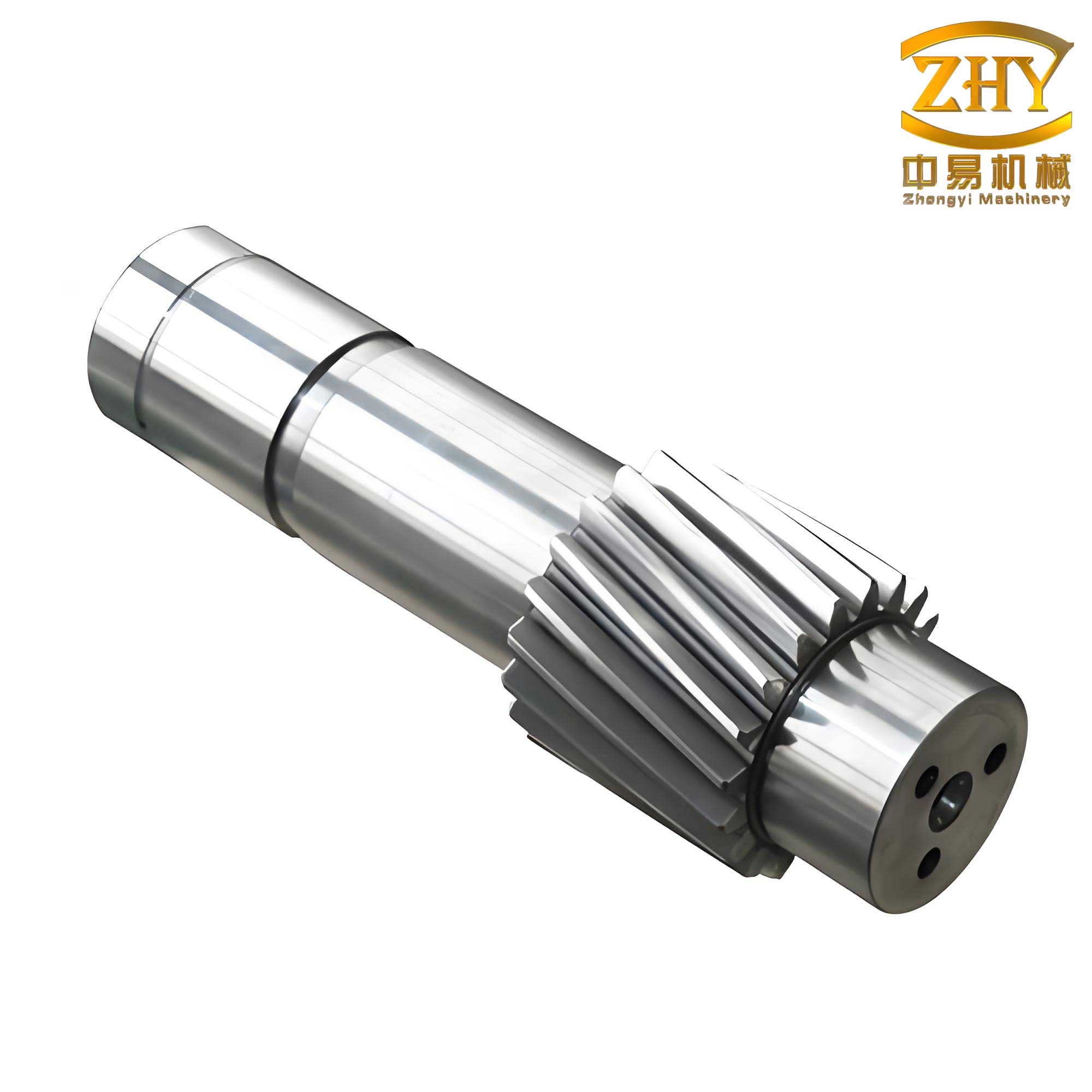
In designing the processing scheme for such gear shafts, several factors must be addressed to ensure success. First, equipment selection is paramount. Hard hobbing involves significant cutting forces and thermal loads due to the high hardness of gear shafts. Therefore, machines must exhibit excellent rigidity, stable transmission accuracy, and effective cooling systems. Modern CNC hobbing machines with multiple axes and automatic tooth alignment capabilities are ideal, as they enable precise engagement between the hob and gear teeth, crucial for efficient cutting. In my work, I utilize a six-axis, four-linkage CNC hobbing machine with automatic tooth searching, which provides the necessary conditions for implementing hard hobbing on gear shafts. The machine’s robustness minimizes vibrations and ensures consistent quality across production batches.
Second, workpiece positioning and clamping are critical for maintaining accuracy. For gear shafts, I recommend using unified benchmarks before and after heat treatment to preserve concentricity. Typically, centers or precise bores serve as reference points. In one case, I designed a fixture using a drawbar and expansion sleeve mechanism to clamp the internal bore of the gear shaft end. This approach allows quick and secure clamping via the machine’s automatic tightening system, minimizing setup time and ensuring repeatability. The fixture must be rigid enough to withstand cutting forces without inducing distortions in the gear shafts. Table 1 summarizes key considerations for fixture design in hard hobbing of gear shafts.
| Consideration | Description | Impact on Gear Shafts |
|---|---|---|
| Benchmark Uniformity | Use same reference points (e.g., centers or bores) pre- and post-heat treatment | Ensures concentricity between gear and spline sections |
| Clamping Method | Drawbar with expansion sleeve for internal bore clamping | Provides secure grip, reduces vibrations during cutting |
| Rigidity | High-stiffness fixture materials and design | Prevents workpiece deflection, maintains accuracy |
| Automation | Integration with machine auto-tightening systems | Speeds up setup, improves consistency |
Third, hob design is a cornerstone of hard hobbing. Carbide hobs are essential due to their wear resistance, but they are prone to chipping when cutting hardened gear shafts. Based on my experience, I prefer solid carbide hobs coated with advanced materials like TiN, TiAlN, or carbon nanocomposites. These coatings enhance durability and allow higher cutting speeds. The hob geometry must be optimized; for instance, using large negative rake angles (e.g., -20°) reduces impact forces and protects the cutting edges. The relationship between rake angle $\gamma$ and cutting force can be expressed as:
$$F_c \propto \frac{1}{\sin(\gamma + \alpha)}$$
where $F_c$ is the cutting force, $\gamma$ is the rake angle (negative in this case), and $\alpha$ is the clearance angle. A more negative $\gamma$ increases the effective shear angle, mitigating shock and extending tool life. Table 2 compares different hob structures for processing hardened gear shafts.
| Hob Type | Advantages | Disadvantages | Suitability for Gear Shafts |
|---|---|---|---|
| Solid Carbide | High rigidity, precision, suitable for high speeds | High cost, limited to smaller modules (e.g., m ≤ 5 mm) | Ideal for high-precision, small-module gear shafts |
| Mechanically Clamped | Replaceable inserts, cost-effective for large modules | Complex clamping, less reliable under high loads | Best for large-module gear shafts with moderate precision |
| Brazed | Simple structure, high joint strength | Welding stresses can cause cracks, requires skilled welding | Suitable for medium-module gear shafts with careful control |
Fourth, selecting appropriate cutting parameters is vital for achieving desired outcomes in gear shafts. The cutting allowance, speed, and feed rate must be optimized based on material hardness and gear geometry. For hardened gear shafts, I recommend a single-side tooth thickness allowance of 0.2–0.25 mm. Exceeding this range increases axial forces and accelerates tool wear, compromising accuracy. The allowance can be calculated using the formula:
$$A_s = \frac{W_{pre} – W_{post}}{2 \cos(\beta)}$$
where $A_s$ is the single-side allowance, $W_{pre}$ and $W_{post}$ are the pre- and post-hobbing chordal tooth thicknesses, and $\beta$ is the helix angle. In practice, I reserve 0.15–0.30 mm on the chordal dimension after soft hobbing to account for heat treatment distortions. Importantly, the tooth root should not have excess allowance to avoid hob tip engagement, which reduces tool life.
Cutting speed significantly influences tool wear and surface finish. With coated carbide hobs, speeds of 50–90 m/min are achievable on modern CNC machines. The cutting speed $V_c$ relates to hob diameter $D_h$ and spindle speed $N$ as:
$$V_c = \frac{\pi D_h N}{1000} \text{ m/min}$$
Higher speeds reduce rubbing and improve surface quality, but must be balanced with cooling to manage heat. Feed rate affects both productivity and accuracy; excessive feed increases tooth profile errors. Based on trials, I use axial feeds $S = 1.1–2.4$ mm/rev, depending on gear shaft精度 requirements. Table 3 summarizes optimal cutting parameters for hard hobbing of typical gear shafts.
| Parameter | Range | Effect on Gear Shafts | Notes |
|---|---|---|---|
| Cutting Allowance (single-side) | 0.2–0.25 mm | Minimizes forces, ensures accuracy | Avoid uneven allowances to prevent tool chipping |
| Cutting Speed | 50–90 m/min | Reduces tool wear, improves surface finish (Ra 0.8 μm achievable) | Use coated hobs and ample coolant |
| Axial Feed Rate | 1.1–2.4 mm/rev | Balances efficiency and profile accuracy | Lower feeds for higher precision gear shafts |
| Coolant Application | High-pressure flood cooling | Dissipates heat, extends tool life | Essential for hardened gear shafts |
To validate the process, I conducted trials on tractor final drive sun gear shafts. The gear shafts were made of 20CrMnMo, carburized and hardened to 60 HRC. Using a solid carbide hob with -20° rake angle and TiAlN coating, I set the chordal allowance to 0.20 mm, cutting speed to 70 m/min, and feed rate to 1.4 mm/rev. The hobbing was performed on a six-axis CNC machine with automatic tooth alignment, employing up-milling (conventional milling) to ensure smooth engagement. Results showed that the gear shafts achieved Grade 6 accuracy (exceeding the required Grade 7), with tooth profile error $f_f < 0.012$ mm, tooth direction error $F_{\beta} < 0.014$ mm, and surface roughness $Ra = 0.8$ μm. Concentricity between gear and spline sections was within $\phi 0.03$ mm. The processing time per gear shaft was 4.5 minutes, which is 2–3 times faster than conventional grinding on similar gear shafts. This demonstrates the efficiency and precision of hard hobbing for high-volume production of gear shafts.
The success of hard hobbing for gear shafts depends on several best practices. First, machine rigidity and accuracy are non-negotiable; investing in high-end CNC hobbing machines pays off in consistency. Second, hob selection must align with gear shaft specifications—solid carbide hobs with coatings are preferable for small to medium modules. Third, parameter optimization requires iterative testing; I recommend starting with conservative values and adjusting based on tool wear and surface measurements. Additionally, using matching pre-heat treatment hobs to leave uniform allowances is crucial for post-heat treatment hobbing of gear shafts. Other considerations include regular tool maintenance, monitoring of coolant quality, and implementing in-process inspection for critical gear shafts.
Looking ahead, advancements in CNC technology and tool materials will further enhance hard hobbing for gear shafts. Emerging trends such as AI-driven parameter optimization, advanced coatings like diamond-like carbon, and integrated digital twins for simulation promise to push the boundaries. For gear shafts in demanding applications like automotive transmissions or industrial machinery, these innovations will enable even higher precision and efficiency. Moreover, the environmental benefits of reduced energy consumption compared to grinding make hard hobbing a sustainable choice for gear shaft manufacturing.
In conclusion, hard tooth surface hobbing is a transformative process for processing hardened gear shafts, offering a blend of accuracy, efficiency, and cost-effectiveness. Through careful design of fixtures, selection of coated carbide hobs, and optimization of cutting parameters, manufacturers can achieve superior results for gear shafts in various industries. My experience with tractor final drive components confirms that this process not only meets stringent technical requirements but also reduces overall production time. As the gear industry evolves, the adoption of hard hobbing for gear shafts will continue to grow, driven by the need for high-performance transmission systems. I encourage engineers to explore this technique and contribute to its refinement, ensuring that gear shafts remain at the heart of reliable machinery.
To summarize key equations and relationships discussed, here is a consolidated list:
1. Cutting force approximation: $$F_c \approx K \cdot A_s \cdot V_c^{m} \cdot S^{n}$$ where $K$ is a material constant, $A_s$ is allowance, $V_c$ is cutting speed, $S$ is feed rate, and $m, n$ are exponents determined empirically for gear shafts.
2. Tool life model (Taylor’s equation for hobs): $$V_c \cdot T^{p} = C$$ where $T$ is tool life, $p$ is Taylor exponent, and $C$ is a constant dependent on hob and gear shaft material.
3. Surface roughness estimation: $$Ra = k \cdot \frac{S^2}{r_e}$$ where $k$ is a factor, $S$ is feed rate, and $r_e$ is hob edge radius, relevant for achieving fine finishes on gear shafts.
These formulas guide parameter selection for optimal processing of gear shafts. By integrating theoretical principles with practical insights, hard hobbing can be mastered to produce high-quality gear shafts consistently.