
The dynamic performance of mechanical systems, particularly those operating under high rotational speeds and significant loads, is critically dependent on their vibrational characteristics. In the context of oilfield operations, tubing power clamps are essential for the efficient make-up and break-out of threaded pipe connections. A key component within the drive train of these clamps is the dual gear shaft assembly. As operational speeds increase to improve efficiency, the resulting vibrations can escalate, leading to potential issues with reliability, noise, and structural integrity. Therefore, a thorough understanding of the modal parameters—natural frequencies and mode shapes—of these gear shafts is paramount for predictive maintenance and design optimization. This article presents an integrated approach to the modal analysis of a dual gear shaft, combining theoretical calculations, finite element analysis (FEA), and experimental modal analysis (EMA) to validate the dynamic model and ensure operational safety away from resonant conditions.
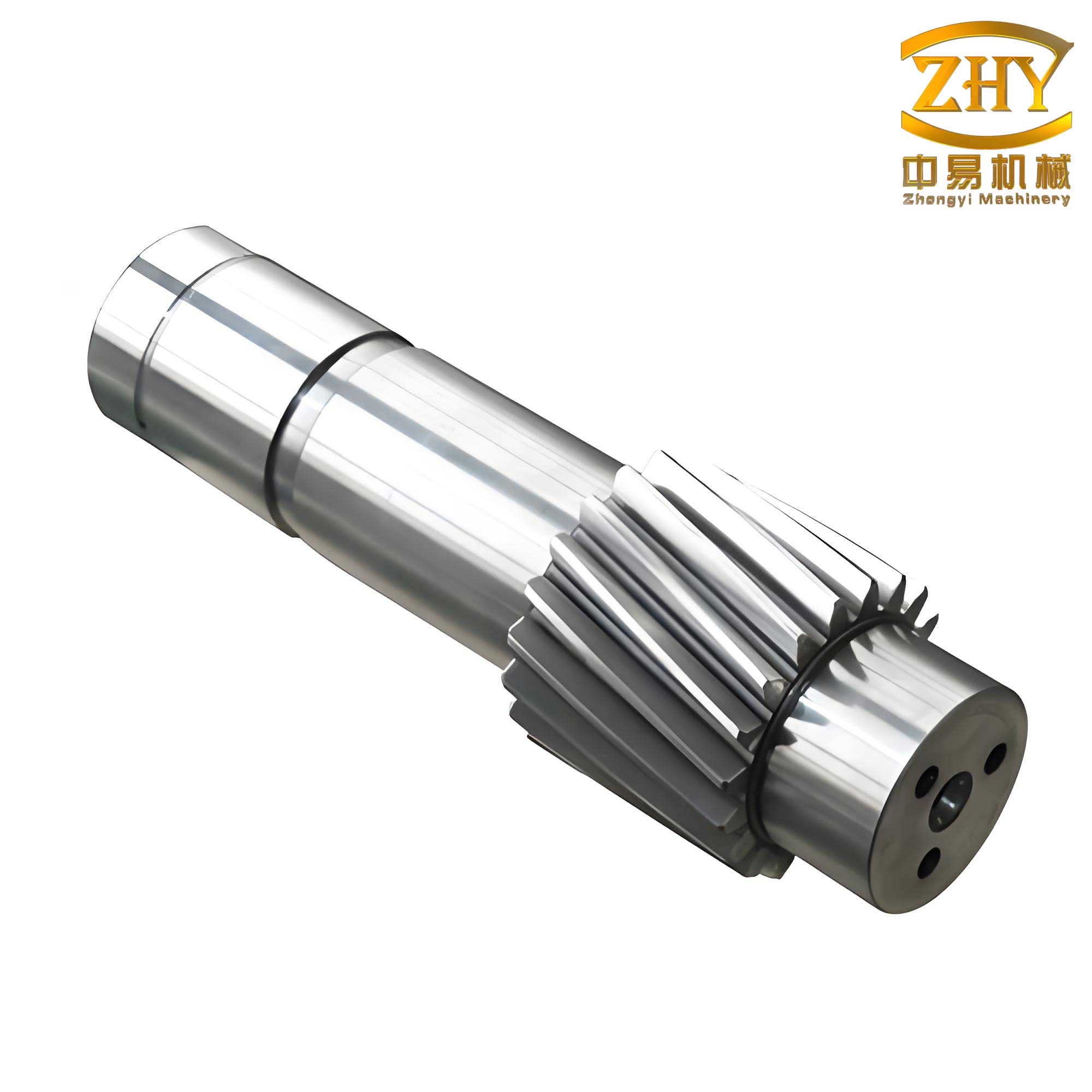
The primary drive system of a typical tubing power clamp utilizes a gear transmission. The dual gear shaft is central to this system, responsible for transmitting torque from the hydraulic motor to the gripping jaws. Under heavy load, the meshing of gear teeth involves continuous contact-impact cycles, which act as a periodic internal excitation source. This excitation can excite the natural modes of the gear shafts, leading to amplified vibrations if the excitation frequency coincides with a natural frequency. To mitigate this risk, a detailed modal investigation is conducted. The physical assembly consists of the shaft itself, mounted gears, bearings, seals, and bushings. For analytical and numerical modeling, this complex assembly is often simplified. A critical simplification involves representing the stepped shaft as an equivalent uniform shaft with a constant diameter, calculated using the formula for the equivalent bending stiffness:
$$ d = \frac{L}{\sqrt[4]{\sum_{i=1}^{n} \frac{l_i}{d_i^4}}} $$
where \( L \) is the total length of the shaft, \( l_i \) and \( d_i \) are the length and diameter of each uniform segment, respectively, and \( d \) is the resulting equivalent diameter. This simplification facilitates the creation of a lumped-parameter physical model with discrete masses and stiffnesses, which serves as the basis for theoretical calculations.
Theoretical Calculation of Natural Frequencies
Theoretical methods provide a foundational understanding and first approximation of the system’s dynamic behavior. For the simplified multi-degree-of-freedom (MDOF) model of the dual gear shaft, the free vibration equation of motion, neglecting damping, is given by:
$$ \mathbf{[M]}\{\ddot{x}\} + \mathbf{[K]}\{x\} = \{0\} $$
where \( \mathbf{[M]} \) is the mass matrix, \( \mathbf{[K]} \) is the stiffness matrix, \( \{x\} \) is the displacement vector, and \( \{\ddot{x}\} \) is the acceleration vector. Solving this eigenvalue problem yields the system’s natural frequencies (eigenvalues) and mode shapes (eigenvectors). Two complementary theoretical approaches are employed: the Rayleigh Quotient method and the Flexibility Coefficient method.
Rayleigh Quotient Method for Fundamental Frequency Estimation
The Rayleigh Quotient provides an upper-bound estimate for the fundamental (lowest) natural frequency. It is expressed as:
$$ \lambda = \omega^2 = R(\mathbf{w}) = \frac{\mathbf{w}^T \mathbf{[K]} \mathbf{w}}{\mathbf{w}^T \mathbf{[M]} \mathbf{w}} $$
where \( \omega \) is the circular natural frequency, \( \lambda \) is the eigenvalue, \( R(\mathbf{w}) \) is the Rayleigh Quotient, and \( \mathbf{w} \) is an assumed displacement vector (trial vector). The accuracy of the result depends on the quality of the assumed mode shape \( \mathbf{w} \). Using a reasonable approximation based on the geometry and constraints of the gear shaft, this method yields an estimated fundamental frequency. For the dual gear shaft under study, the Rayleigh Quotient method provided a fundamental frequency \( f_{1,Rayleigh} \).
Flexibility Coefficient Method for Multiple Modes
While the Rayleigh Quotient estimates only the first mode, the Flexibility Coefficient method allows for the calculation of multiple natural frequencies. The equation of motion is reformulated in terms of flexibility (the inverse of stiffness) and eigenvalues:
$$ \left( -\frac{1}{\omega^2} \mathbf{[I]} + \mathbf{[F][M]} \right) \{X\} = \{0\} $$
Here, \( \mathbf{[I]} \) is the identity matrix, and \( \mathbf{[F]} \) is the flexibility matrix, where each element \( f_{ij} \) represents the displacement at point \( i \) due to a unit force at point \( j \). The elements of the flexibility matrix for a uniform beam with equivalent diameter \( d \) can be derived from standard beam deflection formulas. Solving this eigenvalue problem provides the first several natural frequencies. The relationship between circular frequency \( \omega \) and frequency \( f \) in Hz is:
$$ f = \frac{\omega}{2\pi} $$
The results from the Flexibility Coefficient method for the first three bending modes of the dual gear shaft are summarized in the table below.
| Mode Order | Natural Frequency (Hz) – Theoretical (Flexibility Method) |
|---|---|
| 1 | 3954.23 |
| 2 | 7267.65 |
| 3 | 11124.39 |
A comparison shows that the Rayleigh Quotient result is approximately 2.3% higher than the first frequency from the Flexibility method, which is expected as Rayleigh’s method provides an upper bound. More importantly, all calculated frequencies are orders of magnitude higher than the typical operating excitation frequency from the hydraulic motor (around 16 Hz), indicating a low risk of resonance under normal operating conditions for these gear shafts.
Finite Element Modal Analysis
To obtain a more detailed and spatially continuous understanding of the dynamic behavior, a finite element model of the dual gear shaft was constructed. The process involves several key steps:
- Geometry Modeling: A detailed 3D CAD model of the gear shaft was created. Minor features like small fillets and chamfers were suppressed to simplify meshing without significantly affecting global dynamic characteristics.
- Material Properties: The shaft material was defined with standard structural steel properties:
- Density (\( \rho \)): 7800 kg/m³
- Young’s Modulus (\( E \)): 2.0 x 10¹¹ Pa
- Poisson’s Ratio (\( \nu \)): 0.3
- Meshing: A free mesh was generated using tetrahedral elements with a global element size of 2 mm. This provided a good balance between computational accuracy and resource requirements.
- Boundary Conditions: A free-free boundary condition was applied for the modal analysis. This is standard practice for component-level modal analysis to identify its intrinsic dynamic properties, decoupled from any specific mounting stiffness, which can vary in application.
- Analysis Setup: A block Lanczos solver was used to extract the first 13 modes of the system.
The results of the FEA modal analysis are presented below. The first six modes (1-6) are rigid body modes (three translations and three rotations) with frequencies near 0 Hz, as expected for a freely suspended component. The subsequent modes are flexible bending modes of the gear shaft.
| Mode Order | Natural Frequency (Hz) – FEA | Mode Shape Description |
|---|---|---|
| 7 | 3900.0 | First bending mode (in one plane) |
| 8 | 3913.5 | First bending mode (in orthogonal plane) |
| 9 | 7194.2 | Second bending mode (in one plane) |
| 10 | 7248.4 | Second bending mode (in orthogonal plane) |
| 11 | ~0 (Rigid Body) | Rigid body rotation |
| 12 | 12291.0 | Third bending mode (in one plane) |
| 13 | 12298.0 | Third bending mode (in orthogonal plane) |
The finite element analysis clearly shows the paired nature of the bending modes (e.g., Modes 7 & 8, 9 & 10, 12 & 13). This pairing occurs because the gear shaft is axisymmetric in its geometry and mass distribution; the two modes in a pair have identical natural frequencies but their bending occurs in two perpendicular planes. The mode shapes visualize the deformation patterns, with higher-order modes exhibiting more nodes (points of zero displacement). Critically, the fundamental flexible frequency from FEA is 3900 Hz, confirming the high-frequency nature of the gear shaft’s dynamics relative to the low-frequency operational excitation.
Experimental Modal Analysis
Experimental modal analysis serves as the ground truth to validate both the theoretical and finite element models. The test was conducted on a physical dual gear shaft assembly using a B&K data acquisition system and transducers. The standard procedure was followed:
- Test Setup: The gear shaft was suspended softly using elastic cords to approximate free-free boundary conditions, matching the FEA setup.
- Excitation: An impact hammer with a force transducer was used to apply a broadband impulsive excitation at various predefined points on the shaft.
- Response Measurement: A lightweight accelerometer was roved to different locations to measure the vibrational response.
- Data Acquisition & Processing: For each hammer impact, the force and acceleration signals were recorded. Frequency Response Functions (FRFs) were computed by taking the ratio of the Fourier Transform of the response to the Fourier Transform of the force: \( H(\omega) = \frac{X(\omega)}{F(\omega)} \).
- Parameter Identification: Modal parameters (natural frequencies, damping ratios, and mode shapes) were extracted from the set of measured FRFs using curve-fitting algorithms in the analysis software.
The experimentally identified fundamental bending frequency of the dual gear shaft was found to be 4068.14 Hz. This value, along with the theoretical and FEA results, allows for a crucial cross-validation.
Synthesis and Comparative Error Analysis
The convergence of results from three independent methodologies—theoretical, numerical, and experimental—provides strong confidence in the identified dynamic characteristics of the dual gear shaft. The table below summarizes the fundamental frequency results and calculates the relative errors.
| Analysis Method | Fundamental Frequency (Hz) | Error Relative to Theoretical (Flexibility Method) |
|---|---|---|
| Theoretical (Flexibility Coefficient) | 3954.23 | Baseline (0%) |
| Finite Element Analysis (FEA) | 3900.00 | -1.37% |
| Experimental Modal Analysis (EMA) | 4068.14 | +2.88% |
The errors are remarkably small. The 1.4% discrepancy between the theoretical and FEA results validates the accuracy of the finite element model, including its geometry simplifications, material properties, and boundary conditions. The slightly larger 2.9% error between the theoretical and experimental results is well within acceptable limits for engineering analysis and can be attributed to several factors inherent in real-world testing: unavoidable deviations from ideal free-free boundary conditions in the experiment, slight variations in material properties from the nominal values used in the models, and the sensitivity of the parameter identification process. This close agreement confirms the accuracy of the experimental setup and procedures for these gear shafts.
Conclusions and Implications for Dynamics Optimization
This integrated modal analysis of the dual gear shaft from a tubing power clamp successfully demonstrates the synergy between different engineering analysis tools. The theoretical calculations using the Flexibility Coefficient method provided a reliable baseline, predicting a fundamental frequency of approximately 3954 Hz. The finite element modal analysis refined this prediction to 3900 Hz and, more importantly, provided detailed visualizations of multiple bending mode shapes, revealing the axisymmetric pairing of modes. Finally, the experimental modal analysis confirmed the dynamic behavior with a measured frequency of 4068 Hz.
The minimal errors between these independent approaches (1.4% between theory and FEA, 2.9% between theory and experiment) provide a strong validation loop. This process verifies that the finite element model is a sufficiently accurate digital twin of the physical gear shaft assembly. Consequently, this validated model becomes an invaluable tool for subsequent dynamics optimization studies. Engineers can now confidently use this model to:
- Perform forced-response analyses under simulated gear meshing forces.
- Investigate the effects of potential design modifications (e.g., changes in shaft diameter, gear mass, or material) on the natural frequencies without the need for costly and time-consuming physical prototyping.
- Conduct harmonic or spectral analyses to ensure vibrational stresses remain within safe limits across the entire operating speed range.
Most significantly, all analyses conclusively show that the natural frequencies of the dual gear shafts (starting from ~3900 Hz) are vastly higher than the primary excitation frequency from the hydraulic motor (~16 Hz). This large frequency separation ensures that the gear shaft operates far from resonance during normal use, which is a key contributor to the reliability and longevity of the power clamp. This work establishes a rigorous foundation for advancing the dynamic performance and design robustness of critical gear shaft components in demanding oilfield equipment.