
In modern aerospace engineering, the reliability of transmission components, particularly gear shafts, is paramount for ensuring the safe operation of aircraft systems. Gear shafts are integral parts of accessory gearboxes in aero-engines, transmitting power to critical subsystems such as fuel pumps, generators, and hydraulic systems. During engine start-up, rapid acceleration, or deceleration, these gear shafts are subjected to severe transient torque loads, which can induce dynamic stresses exceeding material limits and lead to catastrophic failures like root fractures. This study focuses on analyzing the impact stress response of a specific aero-engine accessory gearbox gear shaft under shock loads, employing explicit dynamics simulations. The primary objective is to investigate the failure mechanism observed in testing—where the gear shaft fractured at the gear root under constant speed and impact torque—and to propose an optimized design that enhances durability while minimizing mass. The analysis integrates both static and dynamic stress evaluations, considering centrifugal effects, and utilizes finite element methods (FEM) for simulation. Furthermore, a parametric optimization approach is implemented to refine the gear shaft geometry, ensuring adequate safety margins against dynamic overloads. Throughout this work, the term ‘gear shafts’ is emphasized to highlight their critical role in mechanical power transmission systems.
The accessory gearbox in a turbojet engine operates under demanding conditions, with gear shafts experiencing high rotational speeds and variable loads. Typically, during normal operation, the torque on gear shafts is relatively low, but transient events such as engine start-up or sudden load changes can impose冲击扭矩 that magnitude rapidly. This dynamic loading generates stress concentrations, especially at geometric discontinuities like gear roots and ventilation holes, which are common in gear shafts. Previous studies have indicated that dynamic stresses under impact can significantly exceed static predictions, leading to unforeseen failures. For instance, research on ship propulsion shafts and diesel engine components has demonstrated that冲击响应 can cause substantial displacements and stresses, necessitating careful design considerations. In this context, we employ explicit dynamics via LS-DYNA and implicit static analysis via ANSYS Workbench to capture the full stress history of gear shafts under impact. The explicit method is particularly suited for modeling short-duration, high-rate events, as it solves the equations of motion directly without requiring iterative convergence, thus providing accurate dynamic stress profiles for gear shafts.
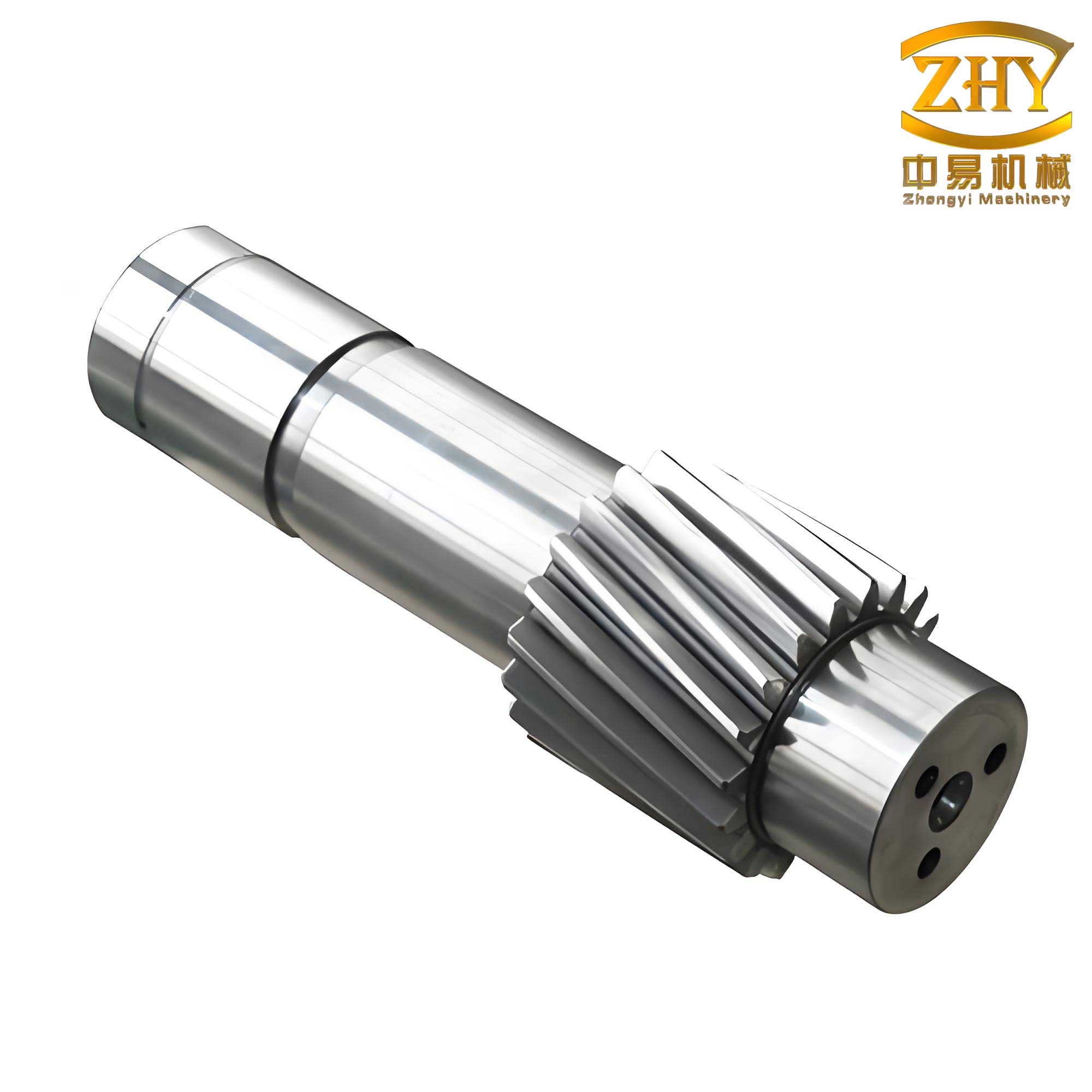
Explicit dynamics is a numerical technique used to solve transient dynamic problems involving high nonlinearities, such as impact, contact, and large deformations. The core of this method lies in the explicit time integration scheme, which calculates accelerations, velocities, and displacements at discrete time steps. For gear shafts subjected to冲击载荷, this approach allows for the precise tracking of stress waves and inertial effects. The governing equations are derived from Newton’s second law, expressed in matrix form for finite element analysis. The acceleration at time \( t \) is computed as:
$$ \mathbf{a}_t = \mathbf{M}^{-1} (\mathbf{F}^{\text{ext}}_t – \mathbf{F}^{\text{int}}_t) $$
Here, \( \mathbf{M} \) represents the mass matrix, which is often diagonalized for computational efficiency in explicit schemes. \( \mathbf{F}^{\text{ext}}_t \) denotes the vector of external forces, including applied torques and body forces like centrifugal effects due to rotation. \( \mathbf{F}^{\text{int}}_t \) is the internal force vector, which resists deformation and is given by:
$$ \mathbf{F}^{\text{int}}_t = \sum \int_{\Omega} \mathbf{B}^T \boldsymbol{\sigma}_n \, d\Omega + \mathbf{F}^{\text{hg}} + \mathbf{F}^{\text{contact}} $$
In this equation, the term \( \int_{\Omega} \mathbf{B}^T \boldsymbol{\sigma}_n \, d\Omega \) represents the equivalent nodal forces from the current stress field \( \boldsymbol{\sigma}_n \), where \( \mathbf{B} \) is the strain-displacement matrix. \( \mathbf{F}^{\text{hg}} \) is the hourglass control force, introduced to mitigate zero-energy modes that arise from reduced integration elements—a common issue in explicit dynamics simulations of gear shafts. \( \mathbf{F}^{\text{contact}} \) accounts for contact forces between interacting surfaces, such as gear teeth meshing, which is crucial for accurately modeling gear shafts in operation. The velocity and displacement updates are performed using the central difference method:
$$ \mathbf{v}_{t+\Delta t/2} = \mathbf{v}_{t-\Delta t/2} + \mathbf{a}_t \Delta t $$
$$ \mathbf{u}_{t+\Delta t} = \mathbf{u}_t + \mathbf{v}_{t+\Delta t/2} \Delta t_{t+\Delta t/2} $$
where \( \mathbf{v} \) is the velocity vector, \( \mathbf{u} \) is the displacement vector, and \( \Delta t \) is the time step. The geometry is updated incrementally: \( \mathbf{x}_{t+\Delta t} = \mathbf{x}_0 + \mathbf{u}_{t+\Delta t} \), with \( \mathbf{x}_0 \) being the initial configuration. The critical time step \( \Delta t_{\text{cr}} \) for stability is determined by the smallest element in the mesh, following the Courant-Friedrichs-Lewy condition:
$$ \Delta t \leq \Delta t_{\text{cr}} = \frac{2}{\omega_{\text{max}}} $$
Here, \( \omega_{\text{max}} \) is the highest natural frequency of the system, derived from the eigenvalue problem \( |\mathbf{K}_e – \omega^2 \mathbf{M}_e| = 0 \) for the smallest element, where \( \mathbf{K}_e \) and \( \mathbf{M}_e \) are the element stiffness and mass matrices. For gear shafts with fine meshes around stress concentration areas, this necessitates small time steps, making explicit methods computationally intensive but accurate for impact analysis.
The material properties of the gear shafts and associated components are critical for realistic simulations. The gear shaft and gears are typically made of high-strength alloy steel, with properties as summarized in Table 1. These parameters are used throughout the static and dynamic analyses to ensure consistency.
| Material Property | Gear (Component 3) | Gear Shaft |
|---|---|---|
| Elastic Modulus (MPa) | 210,000 | 210,000 |
| Density (kg/m³) | 7,860 | 7,860 |
| Poisson’s Ratio | 0.4 | 0.4 |
| Yield Stress \(\sigma_{0.2}\) (MPa) | 1,130 | 1,130 |
To establish a baseline, we first perform a static stress analysis of the gear shaft under equilibrium conditions, incorporating centrifugal forces due to rotation. This preliminary step helps identify high-stress regions and validates the finite element model. The gear shaft assembly includes multiple gears and a central shaft with ventilation holes and slots. As shown in the model, boundary conditions are applied: the gear shaft is constrained axially and radially at bearing locations, while rotational degrees of freedom are permitted to allow torque transmission. A constant rotational speed of 2,841.68 rad/s (approximately 27,136 rpm) is imposed, simulating the operational condition. Torques are applied at both ends of the gear shaft—0.528 N·m on the left and 67.21 N·m on the right—with a counter-torque of 67.738 N·m on gear 3 to maintain equilibrium. Contact pairs are defined between mating gears to simulate meshing interactions.
The static analysis results reveal the stress distribution under combined torsional and centrifugal loads. The von Mises equivalent stress and maximum principal stress are computed, with peak values occurring near the gear root and ventilation slots. Table 2 summarizes the stress magnitudes, comparing cases with and without centrifugal effects. The inclusion of centrifugal stress increases the maximum equivalent stress by approximately 50% and the maximum principal stress by over 66%, underscoring the importance of considering rotational inertia in gear shafts design.
| Stress Type | Without Centrifugal Stress (Pa) | With Centrifugal Stress (Pa) |
|---|---|---|
| Von Mises Equivalent Stress | 4.89 × 10⁸ | 7.36 × 10⁸ |
| Maximum Principal Stress | 5.12 × 10⁸ | 8.52 × 10⁸ |
All static stress values remain below the material yield strength of 1,130 MPa, indicating that under steady-state conditions, the gear shaft should not fail. However, the high-stress zones, particularly around the gear root and slots, serve as potential initiation sites for动态疲劳 cracks under transient loads. This static analysis provides a reference for subsequent dynamic simulations, where impact loads are applied.
For the dynamic impact stress analysis, we model the gear shaft under a transient torque scenario representative of engine start-up. The rotational speed is maintained at 27,136 rpm, while the load torque on the left end of the gear shaft is increased from 0.528 N·m to 67.21 N·m over a duration of 2 seconds, as depicted in the load history curve. This ramp-up mimics the冲击扭矩 encountered during testing that led to failure. The finite element model for explicit dynamics is constructed with refined meshing in critical areas to capture stress gradients accurately. To reduce computational cost, bearing stiffness is neglected, and constraints are applied to simulate fixed support conditions. The gear shaft is modeled with full integration solid elements to avoid hourglassing and ensure precision in stress calculations.
The dynamic simulation captures the time-varying stress response. Key outputs include the gear mesh excitation forces and the dynamic stress history at vulnerable locations. The mesh force between gears exhibits initial fluctuations due to backlash and contact nonlinearities, stabilizing after about 0.8 seconds. The dynamic stress in the gear root and ventilation hole regions rises sharply with the increasing torque. At approximately 1.1 seconds, the stress approaches the material yield limit, and by 1.18 seconds, it exceeds 1,130 MPa, confirming that the observed fracture in testing is attributable to excessive dynamic stress induced by the冲击载荷. This dynamic stress amplification is quantified by comparing peak dynamic stresses to static values. For instance, at the gear root, the dynamic stress peak is nearly twice the static equivalent stress under the same load magnitude, highlighting the inertial and rate-dependent effects that are critical for gear shafts durability.
To further elucidate the dynamic behavior, we analyze the stress propagation through the gear shafts. The governing wave equation for torsional vibration can be expressed as:
$$ \frac{\partial^2 \theta}{\partial t^2} = c^2 \frac{\partial^2 \theta}{\partial x^2} $$
where \( \theta \) is the angular displacement, \( c = \sqrt{G/\rho} \) is the wave speed, \( G \) is the shear modulus, and \( \rho \) is the density. For steel gear shafts, \( c \approx 3,100 \, \text{m/s} \), meaning stress waves travel rapidly, causing reflections at boundaries that can superimpose and elevate local stresses. This phenomenon is particularly pronounced in gear shafts with geometric discontinuities, where impedance changes lead to stress concentrations. The dynamic stress concentration factor \( K_t \) for a notch under impact can be estimated as:
$$ K_t = 1 + \frac{2\sqrt{A}}{\sqrt{\pi r}} $$
where \( A \) is the cross-sectional area change and \( r \) is the notch radius. For the gear root fillet, a small radius increases \( K_t \), exacerbating dynamic stresses. This analytical insight aligns with our FEM results, showing peak stresses at fillet locations.
Based on the dynamic stress findings, we proceed to optimize the gear shaft geometry to mitigate failure risks while minimizing mass—a crucial objective for aerospace applications where weight savings are paramount. The optimization focuses on two critical regions: the gear root fillet and the ventilation slot. These areas are parameterized using design variables: the fillet radius \( R_R \) and the axial length \( L_L \) of the connecting segment in the ventilation slot. The initial design constraints ensure adequate airflow for cooling, with \( L_L \) bounded by minimum functional requirements. The optimization workflow is illustrated in a flowchart: we define the objective function as mass minimization, subject to constraints that the maximum dynamic stresses at the gear root (\( VA_1 \)) and slot (\( VA_2 \)) remain below 50% of the yield strength (\( M_{is} = 565 \, \text{MPa} \)). This safety margin accounts for uncertainties and fatigue effects. The optimization loop uses APDL (ANSYS Parametric Design Language) to iteratively adjust \( R_R \) and \( L_L \), simulating each design with explicit dynamics until constraints are satisfied.
The optimization results in an improved gear shaft design with enlarged fillet radii and modified slot geometry. Table 3 presents the design variables and outcomes for the optimal configuration. The mass reduction achieved is approximately 12% compared to the initial design, while dynamic stresses are controlled within safe limits.
| Design Variable | Initial Value (mm) | Optimal Value (mm) | Percentage Change |
|---|---|---|---|
| Gear Root Fillet Radius \( R_R \) | 1.5 | 3.0 | +100% |
| Slot Connecting Length \( L_L \) | 10.0 | 15.0 | +50% |
| Maximum Dynamic Stress at Root \( VA_1 \) (MPa) | 1,150 | 420 | -63.5% |
| Maximum Dynamic Stress at Slot \( VA_2 \) (MPa) | 1,100 | 400 | -63.6% |
| Total Mass (kg) | 2.85 | 2.51 | -11.9% |
The optimized gear shaft exhibits dynamic stresses around 420 MPa, well below the 565 MPa threshold, ensuring a safety factor greater than 1.5 against yield under impact. The stress distribution in the optimized design is more uniform, with reduced concentrations at the fillet and slot. This improvement is attributed to smoother geometry transitions, which lower stress concentration factors and dissipate stress waves more effectively. Additionally, the increased slot length enhances structural integrity without compromising ventilation functionality. These modifications demonstrate that targeted parametric optimization can significantly enhance the dynamic performance of gear shafts, making them more resilient to transient loads.
To generalize the findings, we consider the implications for gear shafts design across various industries. The dynamic stress amplification factor \( DAF \) for impact loads can be defined as the ratio of dynamic to static stress for the same load magnitude. For the studied gear shafts, \( DAF \) ranges from 1.5 to 2.0, depending on the load rise time and geometry. This factor can be incorporated into design codes for gear shafts to account for transient effects. A proposed empirical formula for estimating peak dynamic stress in gear shafts under torque impact is:
$$ \sigma_{\text{dyn}} = \sigma_{\text{static}} \times \left(1 + \beta \frac{\tau_r}{T}\right) $$
where \( \sigma_{\text{static}} \) is the static stress under equivalent steady torque, \( \beta \) is a geometry-dependent coefficient (approximately 0.8 for gear shafts with fillets), \( \tau_r \) is the load rise time, and \( T \) is the natural period of the gear shafts in torsion. For short rise times relative to \( T \), the dynamic amplification becomes significant, as observed in our simulations. This underscores the necessity of dynamic analysis in the design phase of gear shafts, especially for applications involving rapid load changes.
In conclusion, this comprehensive analysis of gear shafts under impact torque using explicit dynamics reveals critical insights for engineering design. First, static stress analyses that include centrifugal effects show stress increases of 50–70% compared to non-rotating cases, emphasizing the need to account for rotational inertia in gear shafts. Second, dynamic冲击载荷 can produce stresses 1 to 2 times higher than static predictions, leading to failures that static assessments might overlook. Therefore, designers must incorporate dynamic stress evaluations for gear shafts subjected to transient loads, such as those in aero-engine start-ups. Third, parametric optimization of stress concentration regions, like gear root fillets and ventilation slots, can effectively reduce dynamic stresses while minimizing mass, enhancing the overall safety and efficiency of gear shafts. The optimized gear shaft design presented here meets functional requirements with ample safety margins, demonstrating the value of integrating explicit dynamics simulations and optimization tools in the development of robust transmission components. Future work could explore material nonlinearities, thermal effects, and fatigue life prediction for gear shafts under cyclic impact loads, further advancing the reliability of these essential mechanical elements.