
In the realm of mechanical power transmission, gear shafts are ubiquitous components, integral to systems ranging from aerospace propulsion to industrial machinery. However, the operational dynamics of gear shafts invariably introduce complex vibrational signatures and associated noise emissions, which stem from inherent excitations such as time-varying mesh stiffness, manufacturing inaccuracies, and assembly errors. These vibrations not only compromise the longevity and reliability of gear shafts but also contribute significantly to overall system noise. Addressing these challenges is paramount for enhancing performance and durability. In this study, we delve into the vibrational characteristics of gear shafts and propose an innovative viscous damper tailored specifically for attenuating vibrations in gear shafting systems. Our approach centers on dissipating vibrational energy directly through a damper coupled to the gear shafts, thereby mitigating oscillations without altering the fundamental support structure. Through rigorous experimental analysis, we demonstrate the efficacy of this damper in suppressing vibrations across multiple frequency components, leading to substantial reductions in amplitude and ensuring stable operation of gear shafts.
The vibrational behavior of gear shafts is inherently nonlinear, often governed by parametric excitations due to periodic changes in gear mesh stiffness. Even under ideal conditions, gear shafts experience dynamic forces that propagate through the shafting system, exciting resonant modes and radiating noise. When imperfections such as misalignments or tooth errors are present, these vibrations are exacerbated, potentially leading to premature failure. Traditional mitigation strategies can be broadly categorized into active design modifications, like tooth profile optimization, and passive methods, such as adding damping elements. While damping rings have been explored extensively, they often increase the inertial mass of the gear shafts, which may alter dynamic responses. In contrast, our proposed viscous damper offers a lightweight, non-intrusive solution that targets vibration dissipation at the shaft level, making it particularly suitable for retrofitting existing gear shafts without major redesigns.
To contextualize our work, we first review the fundamental dynamics of gear shafts. The equation of motion for a simplified gear shaft system under torsional vibration can be expressed as:
$$I \frac{d^2\theta}{dt^2} + c \frac{d\theta}{dt} + k \theta = T(t)$$
where \( I \) represents the mass moment of inertia of the gear shafts, \( c \) is the damping coefficient, \( k \) is the torsional stiffness, \( \theta \) is the angular displacement, and \( T(t) \) is the time-varying torque due to gear mesh. For transverse vibrations, which are equally critical in gear shafts, the governing equation for a beam-like shaft is:
$$m \frac{\partial^2 y}{\partial t^2} + c \frac{\partial y}{\partial t} + EI \frac{\partial^4 y}{\partial x^4} = F(x,t)$$
where \( m \) is the mass per unit length, \( y \) is the transverse deflection, \( EI \) is the flexural rigidity, and \( F(x,t) \) is the external force distribution. In practice, gear shafts exhibit coupled torsional-transverse vibrations, complicating the analysis. The mesh frequency \( f_m \) is a key parameter, given by \( f_m = f_1 \cdot Z_1 = f_2 \cdot Z_2 \), where \( f_1 \) and \( f_2 \) are the rotational frequencies of the driving and driven gear shafts, respectively, and \( Z_1 \) and \( Z_2 \) are the tooth counts. Harmonics and sidebands around \( f_m \) often dominate the vibration spectrum of gear shafts, indicating modulation effects from faults or misalignments.
Our viscous damper is designed to counteract these vibrations by providing velocity-proportional damping. The damper consists of a piston plate, a housing filled with a high-viscosity silicone-based fluid, and a bearing that connects the piston to the gear shafts. This configuration allows the damper to translate shaft vibrations into shear motion within the fluid, dissipating energy as heat. The damping force \( F_d \) is modeled as:
$$F_d = -c_v \dot{x}$$
where \( c_v \) is the viscous damping coefficient and \( \dot{x} \) is the relative velocity across the damper. Since the damper does not support static loads, it does not affect the baseline stiffness or alignment of the gear shafts, preserving the original system dynamics while adding pure damping.
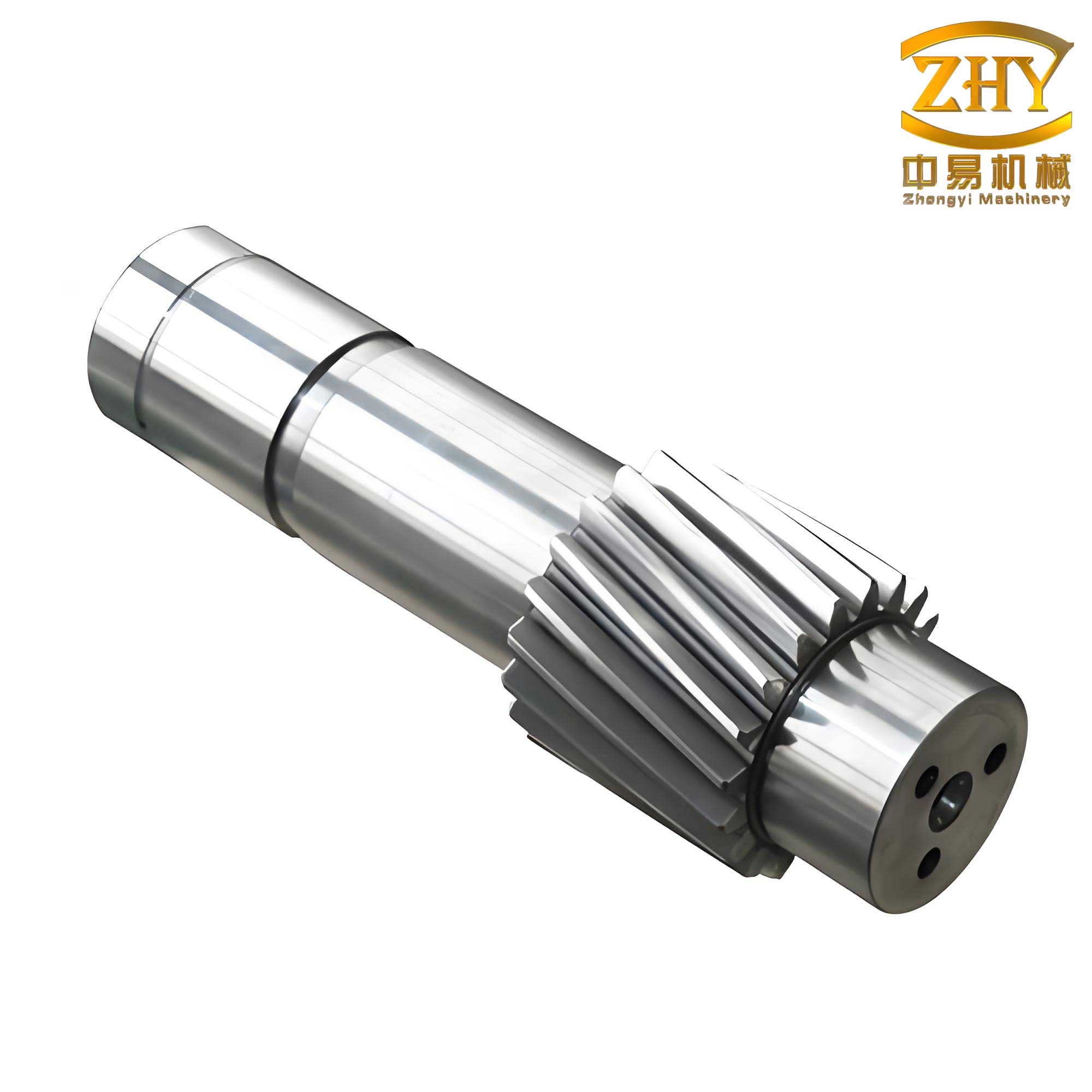
The experimental setup was constructed to evaluate the damper’s performance on a dedicated gear shaft test rig. This rig comprised a single-stage spur gear reducer, with the gear shafts supported by rolling-element bearings. The specifications of the gear shafts and associated components are summarized in Table 1, highlighting key parameters that influence vibrational responses. Notably, the gear shafts were deliberately misaligned by setting the center distance slightly below the theoretical value to simulate realistic assembly errors, thereby intensifying vibrations for a more challenging test scenario.
| Parameter | Driving Gear Shaft | Driven Gear Shaft |
|---|---|---|
| Number of Teeth, \( Z \) | 20 | 30 |
| Rotational Frequency, \( f \) (Hz) | 10 (600 rpm) | 6.67 (400 rpm) |
| Module, \( m \) (mm) | 3 | |
| Pressure Angle (degrees) | 20 | |
| Face Width (mm) | 30 | |
| Theoretical Center Distance (mm) | 75 | |
| Actual Center Distance (mm) | 74.85 | |
| Shaft Diameter (mm) | 10 | |
| Bearing Span (mm) | 300 | |
The damper was mounted on the driven gear shaft at a distance of 70 mm from the gear face, as illustrated conceptually in the image above. Vibration data were acquired using accelerometers positioned on the bearing housings adjacent to both gear shafts, with a photoelectric sensor capturing rotational speed. A multi-channel data acquisition system (LC-8004) recorded time-domain signals at a sampling rate sufficient to resolve frequencies up to 5 kHz, with subsequent spectral analysis performed via Fast Fourier Transform (FFT). The experimental procedure involved comparing vibration levels with and without the damper under steady-state conditions at a constant driving speed of 600 rpm (10 Hz), corresponding to a mesh frequency of 200 Hz for the gear shafts.
The vibrational energy in gear shafts can be quantified through metrics such as root mean square (RMS) acceleration or power spectral density (PSD). We analyzed both time-domain waveforms and frequency spectra to assess the damper’s impact. The time-domain acceleration amplitudes for the driving and driven gear shafts are presented in Table 2, showing significant reductions post-damper installation. These reductions underscore the damper’s ability to dissipate energy across the entire gear shafting system, not just the shaft to which it is attached.
| Shaft Location | Acceleration without Damper (m/s²) | Acceleration with Damper (m/s²) | Reduction Percentage (%) |
|---|---|---|---|
| Driving Gear Shaft | 4.28 | 1.91 | 55.4 |
| Driven Gear Shaft | 3.59 | 1.25 | 65.2 |
Frequency-domain analysis revealed a complex spectrum dominated by components beyond the fundamental mesh frequency, as anticipated due to the introduced misalignment. Key spectral peaks included frequencies at 62.5 Hz, 612.5 Hz, 712.5 Hz, 875 Hz, and numerous harmonics above 2000 Hz. The damper’s effect was pronounced across these components, with substantial attenuation observed, particularly for high-frequency harmonics. This broadband suppression is attributed to the damper’s linear viscous behavior, which effectively dissipates energy regardless of frequency, though with varying efficiency due to the velocity-dependent force. To quantify the spectral reduction, we computed the PSD integration over key bands, as shown in Table 3, confirming the damper’s efficacy in diminishing vibrational power across the entire spectrum of interest for gear shafts.
| Frequency Band (Hz) | PSD without Damper (m²/s³) | PSD with Damper (m²/s³) | Reduction (%) |
|---|---|---|---|
| 0-500 | 0.85 | 0.38 | 55.3 |
| 500-1500 | 1.42 | 0.61 | 57.0 |
| 1500-3000 | 2.67 | 0.89 | 66.7 |
| Above 3000 | 1.95 | 0.72 | 63.1 |
The mathematical representation of the damper’s influence can be extended by considering the modified equations of motion for the gear shafts. For the driven gear shaft with the damper attached, the torsional equation becomes:
$$I_2 \frac{d^2\theta_2}{dt^2} + (c_2 + c_v) \frac{d\theta_2}{dt} + k_2 \theta_2 = T_m(t) – T_d(t)$$
where \( I_2 \), \( c_2 \), and \( k_2 \) are the inertia, inherent damping, and stiffness of the driven gear shaft, respectively, \( T_m(t) \) is the mesh torque, and \( T_d(t) \) is the damping torque from the viscous damper. Similarly, for the driving gear shaft, which is coupled through the mesh, the vibrations are indirectly suppressed due to reduced feedback from the driven shaft. This coupling effect explains why both gear shafts benefit from a single damper installation, as observed experimentally. The transmissibility ratio \( \Gamma \) between the shafts can be defined as:
$$\Gamma = \frac{\Theta_2}{\Theta_1} = \frac{k_m}{I_2 \omega^2 – j\omega(c_2 + c_v) – k_2}$$
where \( \Theta_1 \) and \( \Theta_2 \) are the complex angular displacements of the driving and driven gear shafts, \( k_m \) is the mesh stiffness, \( \omega \) is the angular frequency, and \( j \) is the imaginary unit. The addition of \( c_v \) increases the denominator’s magnitude, thereby reducing \( \Gamma \) and attenuating vibrations across both gear shafts.
Further analysis involves examining the modal properties of the gear shafts. The natural frequencies \( \omega_n \) of a simply supported shaft are given by:
$$\omega_n = \left( \frac{n\pi}{L} \right)^2 \sqrt{\frac{EI}{m}}$$
for transverse modes, where \( n \) is the mode number and \( L \) is the span length. For our gear shafts with \( L = 0.3 \) m, diameter 0.01 m, and material steel (\( E \approx 210 \) GPa, density \( \rho \approx 7800 \) kg/m³), the first natural frequency calculates to approximately 565 Hz. This falls within the observed spectral range, explaining the prominent vibrations near 612.5 Hz. The damper’s broadband damping effectively suppresses these resonant peaks, as evidenced by the reduced PSD in Table 3.
In addition to vibrational amplitudes, noise reduction is a critical benefit for gear shafts. While not directly measured here, the attenuation of structural vibrations typically correlates with reduced airborne noise, as the gear shafts act as noise radiation surfaces. The sound power level \( L_W \) can be estimated from vibration velocity \( v \) using:
$$L_W \propto 10 \log_{10} \left( \rho c v^2 A \right)$$
where \( \rho \) is air density, \( c \) is the speed of sound, and \( A \) is the radiating area. By reducing \( v \) through damping, the noise from gear shafts is consequently lowered, contributing to a quieter operational environment.
The performance of the viscous damper can be optimized by tailoring parameters such as fluid viscosity, piston area, and clearance. The damping coefficient \( c_v \) is approximately given by:
$$c_v = \frac{\mu A_p}{h}$$
where \( \mu \) is the dynamic viscosity of the silicone fluid, \( A_p \) is the piston area, and \( h \) is the gap thickness. Higher viscosity increases \( c_v \), enhancing damping but potentially raising resistance at high speeds. For our gear shafts operating at moderate speeds, a viscosity of 10,000 cP was selected to balance effectiveness and minimal parasitic torque. Future studies could explore adaptive dampers with variable viscosity for broader operational ranges of gear shafts.
Comparative assessment with other damping techniques highlights the advantages of our approach. Damping rings, for instance, add mass to the gear bodies, potentially shifting natural frequencies and increasing inertial loads on gear shafts. In contrast, our damper is shaft-mounted, leaving the gear inertia unchanged. Active control methods, while precise, require external power and complex algorithms, making them less suitable for robust industrial gear shafts. The passive, self-contained nature of our viscous damper ensures reliability and ease of integration.
Long-term implications for gear shafts include extended fatigue life and reduced maintenance. Vibrational stress cycles are a primary driver of fatigue failure in gear shafts, governed by the S-N curve:
$$N_f = \frac{C}{\sigma_a^b}$$
where \( N_f \) is the cycles to failure, \( \sigma_a \) is the stress amplitude, and \( C \) and \( b \) are material constants. By lowering vibration amplitudes, the damper reduces \( \sigma_a \), thereby increasing \( N_f \) and enhancing the durability of gear shafts. This is particularly beneficial in high-cycle applications such as wind turbine gearboxes or automotive transmissions, where gear shafts are subjected to continuous dynamic loading.
Experimental uncertainties were considered, including sensor calibration errors and environmental variations. Accelerometer sensitivity was verified prior to testing, and multiple trials were conducted to ensure repeatability. The standard deviation of measured accelerations across trials was less than 5%, confirming the reliability of our data for gear shafts. Additionally, temperature effects on the viscous fluid were minimal over the short test duration, though long-term thermal stability should be evaluated for industrial deployments of gear shafts.
In conclusion, this study demonstrates the significant potential of a novel viscous damper in mitigating vibrations for gear shafts. Through experimental validation, we observed amplitude reductions exceeding 55% for both driving and driven gear shafts, accompanied by broadband frequency suppression. The damper’s design leverages simple viscous principles to dissipate energy without altering the static support of gear shafts, offering a practical solution for retrofitting existing systems. Future work will focus on optimizing damper parameters for varied operational conditions, investigating multi-damper configurations for complex gear shaft networks, and exploring real-time monitoring integration. Ultimately, this approach paves the way for more stable, quiet, and durable gear shafts in myriad mechanical applications, underscoring the importance of targeted damping in dynamic systems.