
In the realm of mechanical power transmission, screw gear pairs, particularly cylindrical worm and worm wheel drives, occupy a critical position due to their ability to provide high reduction ratios and compact design within a single stage. The kinematic and geometric analysis of such spatial gearing, however, is notoriously complex, involving the study of conjugate surfaces in three-dimensional space. Traditional methods require dealing with intricate equations of meshing, relative velocities, and complex coordinate transformations. This complexity often acts as a barrier to intuitive understanding and streamlined design procedures.
This article presents a detailed exploration of a powerful analytical simplification specific to orthogonal-axis cylindrical screw gear pairs. The core proposition is that the unique geometry of such a pair—where the axes of the worm and the wheel are perpendicular—allows for a mathematically rigorous and geometrically intuitive conversion of the spatial meshing problem into an equivalent planar rack-and-pinion meshing problem. This conversion not only demystifies the analysis but also significantly simplifies the design calculations for screw gears. We will delve into the mathematical foundation of this transformation, derive the equivalent meshing conditions, and analyze critical characteristics such as limit points and the meshing axis, consistently emphasizing the properties of the screw gear system.
1. Mathematical Model and the Fundamental Meshing Condition
To establish a rigorous foundation, we begin by defining the coordinate systems for the orthogonal-axis screw gear pair. Let us consider a fixed global reference frame. The worm, representing the driving screw gear, is associated with a moving coordinate system \( S_1(o_1; i_1, j_1, k_1) \), where the \( k_1 \)-axis coincides with the worm’s axis of rotation and its angular velocity vector \( \boldsymbol{\omega}^{(1)} \). The worm wheel, the driven member of the screw gear pair, is associated with system \( S_2(o_2; i_2, j_2, k_2) \), with the \( k_2 \)-axis coinciding with its angular velocity vector \( \boldsymbol{\omega}^{(2)} \). The axes are arranged orthogonally with a center distance \( A \), such that \( i_2 = -i_1 \), \( j_2 = -k_1 \), and \( k_2 = -j_1 \). The angular velocity magnitudes are normalized for simplicity: \( |\boldsymbol{\omega}^{(1)}| = 1 \) and \( |\boldsymbol{\omega}^{(2)}| = I \), where \( I \) is the gear ratio.
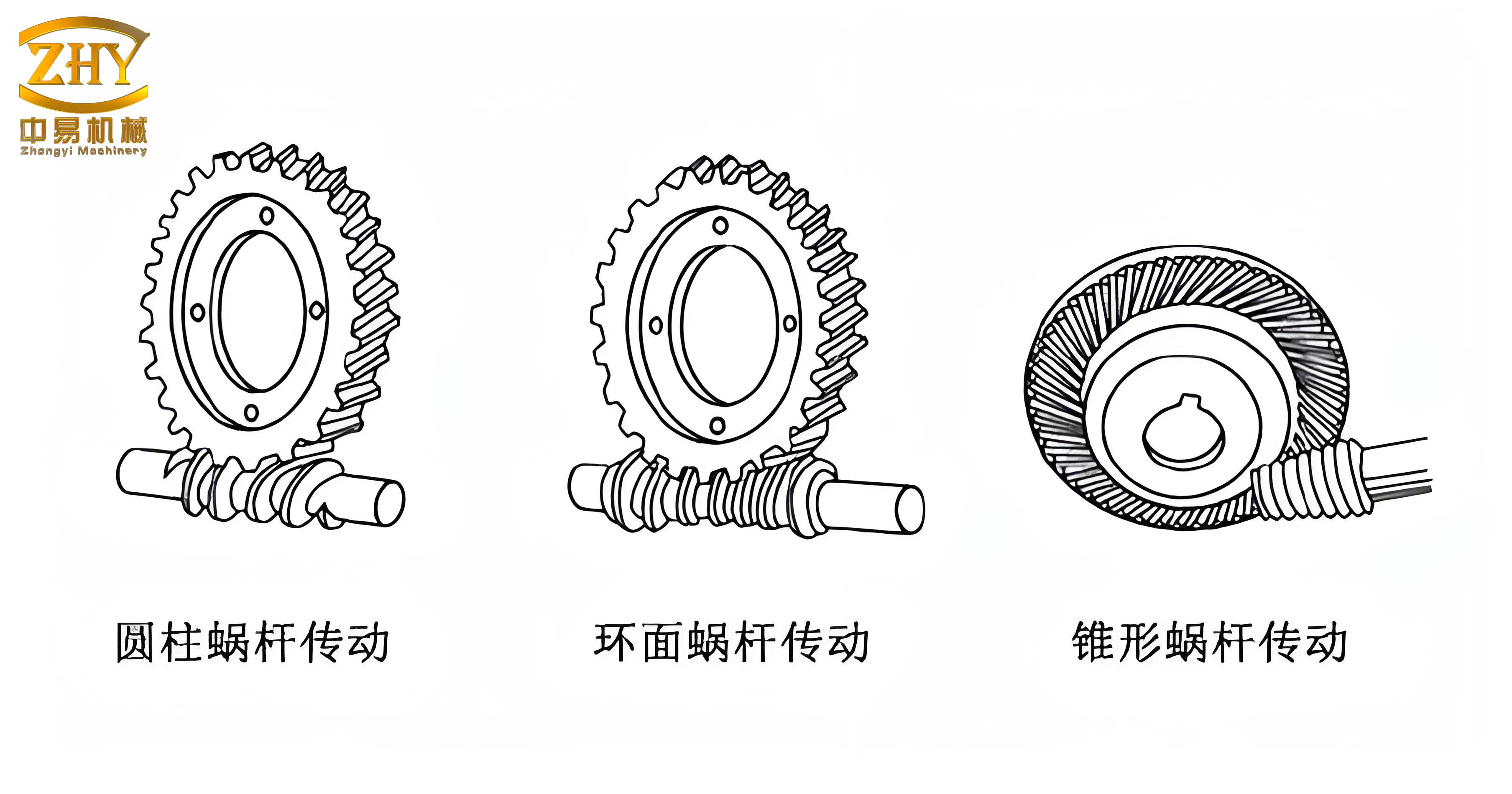
The surface of a cylindrical worm, a type of screw gear with a constant lead, can be represented as a helicoid. Its equation in \( S_1 \) is given by:
$$ \boldsymbol{R}^{(1)}(u, \lambda) = \xi(u) \boldsymbol{e}(\lambda) + \eta(u) \boldsymbol{e}_1(\lambda) + (\zeta(u) + p\lambda)\boldsymbol{k}_1 $$
where \( u \) and \( \lambda \) are the surface parameters, \( p \) is the screw parameter (lead divided by \( 2\pi \)), and \( \boldsymbol{e}(\lambda) = \cos\lambda \boldsymbol{i}_1 + \sin\lambda \boldsymbol{j}_1 \), \( \boldsymbol{e}_1(\lambda) = -\sin\lambda \boldsymbol{i}_1 + \cos\lambda \boldsymbol{j}_1 \) are circular vector functions.
As the worm rotates, it generates a family of surfaces. The family of worm surfaces in the fixed space is:
$$ \boldsymbol{r}^{(1)}(u, \lambda, \phi_1) = \mathbf{B}_1(\phi_1) \boldsymbol{R}^{(1)} = \xi(u) \boldsymbol{e}(\lambda+\phi_1) + \eta(u) \boldsymbol{e}_1(\lambda+\phi_1) + (\zeta(u) + p\lambda)\boldsymbol{k}_1 $$
where \( \mathbf{B}_1(\phi_1) \) is the rotation matrix about \( k_1 \) and \( \phi_1 \) is the rotation parameter (worm angle).
The fundamental equation of meshing for spatial gearing states that at the point of contact, the relative velocity vector must lie in the common tangent plane, i.e., it must be perpendicular to the common surface normal \( \boldsymbol{n} \). The general form is:
$$ f(u, \lambda, \phi_1) = (\boldsymbol{\omega}^{(2)} \times \boldsymbol{r}^{(2)} – \boldsymbol{\omega}^{(1)} \times \boldsymbol{r}^{(1)}) \cdot \boldsymbol{n} = 0 $$
where \( \boldsymbol{r}^{(2)} \) is the position vector of the contact point on the worm wheel surface in the fixed space.
For a helicoidal worm surface, a key identity always holds due to its screw motion nature: \( (p\boldsymbol{\omega}^{(1)} + \boldsymbol{\omega}^{(1)} \times \boldsymbol{r}^{(1)}) \cdot \boldsymbol{n} = 0 \). Adding this zero term to the meshing equation does not change it:
$$ f(u, \lambda, \phi_1) = [\boldsymbol{\omega}^{(2)} \times \boldsymbol{r}^{(2)} – (\boldsymbol{\omega}^{(1)} \times \boldsymbol{r}^{(1)} + p\boldsymbol{\omega}^{(1)}) + p\boldsymbol{\omega}^{(1)}] \cdot \boldsymbol{n} = [\boldsymbol{\omega}^{(2)} \times \boldsymbol{r}^{(2)} – ( -p\boldsymbol{\omega}^{(1)})] \cdot \boldsymbol{n} = 0 $$
This transformed equation, \( [\boldsymbol{\omega}^{(2)} \times \boldsymbol{r}^{(2)} + p\boldsymbol{\omega}^{(1)}] \cdot \boldsymbol{n} = 0 \), has a profound physical interpretation. The term \( \boldsymbol{\omega}^{(2)} \times \boldsymbol{r}^{(2)} \) is the linear velocity of the worm wheel point. The term \( p\boldsymbol{\omega}^{(1)} \) is now a constant translational velocity vector in the direction of \( \boldsymbol{\omega}^{(1)} \). This implies that the meshing condition is identical to that between a rotating gear (the worm wheel) and a translating rack (the worm, now perceived as having no rotation, only translation). Thus, the spatial screw gear meshing is converted into an equivalent planar rack-and-pinion meshing.
In this equivalent model, the pitch radius of the imaginary gear (worm wheel) is \( R_{2j} = p / I \). The pitch line of the imaginary rack is offset from the gear center by \( R_{1j} = A – R_{2j} \). This axis of instantaneous relative motion (the pitch cylinder) for the gear-rack pair is given by:
$$ \boldsymbol{r}_j = R_{1j} \boldsymbol{i}_1 – Q \boldsymbol{j}_1 $$
where \( Q \) is a parameter. According to the fundamental theorem of gear tooth action, the common normal at the contact point must pass through this pitch axis. This leads to an alternative, elegant form of the meshing condition:
$$ (\boldsymbol{r}^{(1)} \times \boldsymbol{j}_1 – R_{1j} \boldsymbol{k}_1) \cdot \boldsymbol{n} = 0 $$
This equation is entirely equivalent to the earlier derived condition and is often more convenient for analysis. It directly links the worm geometry \( (\boldsymbol{r}^{(1)}, \boldsymbol{n}) \) to the derived pitch radius \( R_{1j} \).
2. Cross-Sectional Analysis: From Spatial to Planar Meshing
The conversion to a rack-and-pinion model becomes even more powerful and intuitive when we examine cross-sections. Consider a plane perpendicular to the worm wheel axis \( k_2 \). The intersection of this plane with the worm surface yields a planar curve—the tooth profile of the imaginary translating rack. The intersection with the worm wheel yields its conjugate tooth profile—the tooth profile of the imaginary rotating gear.
The meshing condition for these planar profiles must be consistent with the spatial condition. A fundamental geometric proposition ensures this: For any non-singular point on a surface, the normal vector to a cross-sectional curve at that point lies in the plane containing the surface normal and the normal vector to the cross-section plane itself. Consequently, the spatial meshing condition \( (\boldsymbol{r}^{(1)} \times \boldsymbol{j}_1 – R_{1j} \boldsymbol{k}_1) \cdot \boldsymbol{n} = 0 \) reduces to the planar condition when constrained to a specific cross-section defined by \( \boldsymbol{r}^{(1)} \cdot \boldsymbol{j}_1 = C \), where \( C \) is a constant. Therefore, the planar analysis solves the system:
$$
\begin{cases}
(\boldsymbol{r}^{(1)} \times \boldsymbol{j}_1 – R_{1j} \boldsymbol{k}_1) \cdot \boldsymbol{n} = 0 \\
\boldsymbol{r}^{(1)} \cdot \boldsymbol{j}_1 = C
\end{cases}
$$
The conjugate worm wheel profile in that cross-sectional plane is then obtained by transforming the contact point from the fixed frame to the wheel frame:
$$ \boldsymbol{R}^{(2)} = \mathbf{B}_2^{-1}(\phi_2) (\boldsymbol{r}^{(1)} – A \boldsymbol{i}_1) $$
where \( \mathbf{B}_2(\phi_2) \) is the rotation of the wheel.
This cross-sectional method brilliantly simplifies the design and analysis of cylindrical screw gear pairs. For many common worm types, the rack profile in the appropriate cross-section is a straight-sided tool, making the conjugate wheel profile an involute. The table below summarizes this for three major types of cylindrical screw gears:
| Type of Cylindrical Screw Gear (Worm) | Characteristic Cross-Section (Condition) | Rack Profile in Cross-Section | Conjugate Wheel Profile |
|---|---|---|---|
| Archimedean (Straight Sided in Axial Section) | \( \boldsymbol{r}^{(1)} \cdot \boldsymbol{j}_1 = 0 \) (Axial Plane) | Straight line (tool with pressure angle \( \alpha_a \)) | Involute |
| Involute Helicoid (Straight Sided in Normal Section to base helix) | \( \boldsymbol{r}^{(1)} \cdot \boldsymbol{j}_1 = R_b \) (Plane tangent to base cylinder) | Straight line (tool with pressure angle \( \alpha_n \)) | Involute |
| Normal Straight-Sided (Tool set in normal plane of tooth groove) | \( \boldsymbol{r}^{(1)} \cdot \boldsymbol{j}_1 = -R_h \) (Plane through reference/guiding cylinder radius \( R_h \)) | Straight line (tool with normal pressure angle) | Involute |
3. Analysis of Limit Points and the Meshing Axis
3.1 First-Type (Undercutting) Limit Points
First-type limit points on the generated wheel surface correspond to points where the line of contact (on the worm surface) has an envelope. At these points, undercutting of the worm wheel tooth begins. Geometrically, at a first-type limit point on the worm wheel, the normal to the surface of action (the locus of contact points in the fixed space) passes through the axis of rotation of the wheel.
From the equivalent planar model, a powerful corollary emerges: On the planar conjugate profile (wheel tooth), a first-type limit point occurs where the normal to the path of contact (the planar intersection of the surface of action) passes through the center of rotation of the wheel profile. Let the surface of action be defined as \( \boldsymbol{r}^{(2)} = \boldsymbol{r}^{(1)}(u, \lambda, \phi_1(u,\lambda)) – A\boldsymbol{i}_1 \), where \( \phi_1 \) is solved from the meshing equation. Its normal is \( \boldsymbol{n}_p = \boldsymbol{r}^{(2)}_u \times \boldsymbol{r}^{(2)}_\lambda \). The first-type limit condition is then:
$$ (\boldsymbol{r}^{(2)}, \boldsymbol{n}_p, \boldsymbol{k}_2) = \boldsymbol{r}^{(2)} \cdot (\boldsymbol{n}_p \times \boldsymbol{k}_2) = 0 $$
For the planar cross-section analysis, this condition is applied together with the cross-section constraint \( \boldsymbol{r}^{(2)} \cdot \boldsymbol{k}_2 = \text{constant} \). This point, \( N \), signifies the transition from regular conjugate action to undercutting on the screw gear wheel.
3.2 Second-Type (Point of Regression) Limit Points
Second-type limit points define the boundary of the usable contact line on the worm (tool) surface itself. They are the envelope of the family of contact lines. A more intuitive geometric interpretation can be established. Consider the family of normal lines to the worm surface generated as the worm rotates. This family forms a normal line congruence. At a regular meshing point, one of these normal lines passes through the pitch axis (the pitch line in the planar model). At a second-type limit point, this normal line is tangent to the locus of points where normals intersect the pitch axis—meaning the pitch axis is tangent to the normal line congruence.
Mathematically, we define a surface traced by a normal line of the worm: \( \boldsymbol{r}_h(\phi_1, s) = \boldsymbol{r}^{(1)}(u, \lambda, \phi_1) + s \boldsymbol{n} \), where \( s \) is a parameter along the normal. The condition for this normal line to pass through the pitch axis \( \boldsymbol{r}_j = R_{1j}\boldsymbol{i}_1 – Q\boldsymbol{j}_1 \) is given by solving for \( s = S_0 \) and \( Q = Q_0 \). The second-type limit point occurs when, at \( s = S_0 \), the pitch axis is tangent to the normal line surface \( \boldsymbol{r}_h \). The condition for tangency is that the pitch direction \( \boldsymbol{j}_1 \) is perpendicular to the surface normal of \( \boldsymbol{r}_h \) at that point. This leads to the condition:
$$ (\boldsymbol{r}_{h\phi_1}, \boldsymbol{r}_{hs}, \boldsymbol{j}_1) = 0 \quad \text{at} \quad s = S_0 $$
This formulation provides a clear geometric criterion for identifying the end points of active contact on a screw gear worm tooth.
3.3 The Meshing Axis
In spatial gearing, a meshing axis is a stationary line in the fixed frame such that the common surface normal at every point of contact, at a given instant, intersects this line. For a screw gear pair where one member (the worm) is a helicoid, it is known that two such axes exist. Our conversion method allows for their straightforward derivation.
The first meshing axis is immediately identified as the derived pitch axis from our rack-and-pinion model: \( \boldsymbol{r}_{1f} = R_{1j}\boldsymbol{i}_1 – Q\boldsymbol{j}_1 \). This is the axis about which the equivalent gear and rack have pure rolling.
The second meshing axis can be found by considering an equivalent composite motion. The relative motion between the worm and wheel can be decomposed into two independent rotations about two different, non-parallel axes that are fixed in space. Let the second axis be defined as:
$$ \boldsymbol{r}_{2f} = R_{2f}\boldsymbol{i}_1 + v(-\cos\alpha \boldsymbol{k}_1 + \sin\alpha \boldsymbol{j}_1) $$
with associated angular velocity vectors \( \boldsymbol{\omega}_1 = \omega_1 \boldsymbol{j}_1 \) (about an axis parallel to \( \boldsymbol{j}_1 \) through a point on the first meshing axis) and \( \boldsymbol{\omega}_2 = \omega_2 (-\cos\alpha \boldsymbol{k}_1 + \sin\alpha \boldsymbol{j}_1) \). The sum of these rotations must equal the original relative motion, and the net moment about any point must be zero to represent the same screw motion. This leads to the system:
$$
\begin{cases}
\boldsymbol{\omega}_1 + \boldsymbol{\omega}_2 = \boldsymbol{\omega}^{(2)} – \boldsymbol{\omega}^{(1)} \\
R_{1j}\boldsymbol{i}_1 \times \boldsymbol{\omega}_1 + R_{2f}\boldsymbol{i}_1 \times \boldsymbol{\omega}_2 – A\boldsymbol{i}_1 \times \boldsymbol{\omega}^{(2)} = \boldsymbol{0}
\end{cases}
$$
Solving this system yields: \( R_{2f} = 0 \) and \( \tan\alpha = p / R_{1j} \). Therefore, the second meshing axis is given by:
$$ \boldsymbol{r}_{2f} = v(-\cos\alpha \boldsymbol{k}_1 + \sin\alpha \boldsymbol{j}_1) $$
which passes through the origin \( o_1 \) and is inclined at an angle \( \alpha = \arctan(p / R_{1j}) \) relative to the worm axis \( \boldsymbol{k}_1 \). Notably, \( \alpha \) is precisely the lead angle of the worm on its reference (pitch) cylinder. All contact normals at a given instant intersect both of these fixed axes, a unique property of the screw gear drive with a helicoidal worm.
4. Conclusion and Design Implications
The methodology of converting the spatial meshing problem of an orthogonal-axis cylindrical screw gear pair into an equivalent planar rack-and-pinion problem provides a significant simplification for analysis and design. The core transformation relies on the kinematic identity of the helicoidal worm surface, allowing its rotary motion to be reinterpreted as a translation. This leads to the compact and powerful meshing condition \( (\boldsymbol{r}^{(1)} \times \boldsymbol{j}_1 – R_{1j} \boldsymbol{k}_1) \cdot \boldsymbol{n} = 0 \).
By further analyzing specific cross-sections perpendicular to the worm wheel axis, the problem reduces entirely to planar gearing. This approach makes the determination of conjugate wheel profiles straightforward, especially for common worm types (Archimedean, involute, normal straight-sided) where the worm’s cross-sectional profile becomes a simple straight-edged rack, invariably generating an involute profile on the wheel in that section.
The geometric interpretations of limit points are clarified through this conversion. First-type limits relate to the normal of the path of contact passing through the wheel center in the planar model. Second-type limits correspond to the tangency condition between the pitch line and the congruence of worm surface normals. Furthermore, the existence and equations of the two meshing axes are derived elegantly, with the second axis’s direction being directly linked to the worm’s lead angle.
This conversion method is universally applicable to all cylindrical screw gear pairs satisfying the conditions of orthogonal axes and a constant lead (screw parameter). It demystifies the complex three-dimensional interactions, provides intuitive geometric checks, and enables the use of well-established planar gear design principles and software tools in the design process of these efficient and compact spatial screw gear drives. The primary benefit is a streamlined workflow where the complex spatial enveloping process is broken down into a series of simpler, verifiable planar generation steps, ultimately leading to more robust and optimized screw gear designs.