
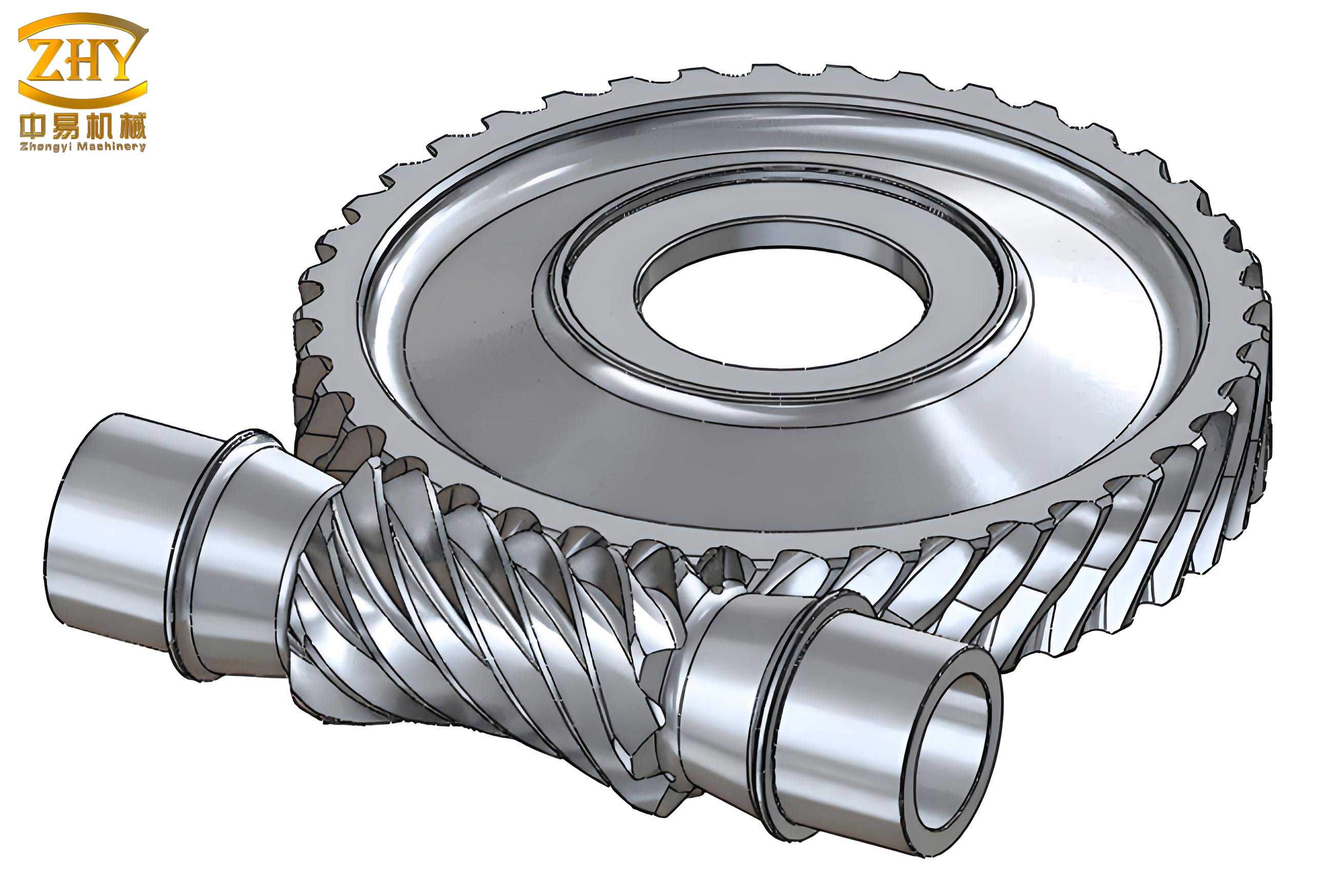
In modern automotive electric power steering (EPS) systems, the demand for efficient, quiet, and cost-effective transmission mechanisms has led to the widespread adoption of screw gear transmissions, specifically configurations involving nylon helical gears paired with steel worms. This screw gear arrangement offers advantages such as smooth operation, reduced noise, and lower manufacturing costs compared to traditional worm gear systems. However, the unique material properties of nylon, a polymer, introduce challenges that render conventional worm gear design criteria inadequate. The screw gear transmission, essentially an adaptation of crossed helical gear principles, requires specialized optimization to ensure performance, durability, and cost-efficiency. This article explores the optimization design of screw gear transmissions for automotive EPS applications, focusing on structural parameter selection, safety factor analysis, and validation through simulation tools. By integrating theoretical analysis with software-assisted design, we propose a methodology for determining optimal modification coefficients and design parameters, ultimately enhancing the comprehensive performance of screw gear systems.
The screw gear transmission in EPS systems typically involves a steel worm engaging with a nylon helical gear. This combination leverages the high strength and wear resistance of steel for the worm, while the nylon gear contributes to noise reduction, weight savings, and corrosion resistance. However, nylon’s lower elastic modulus and yield strength compared to metals necessitate careful design to prevent premature failure, particularly in terms of tooth bending and contact stresses. The screw gear mechanism operates under principles similar to crossed helical gears, where the worm can be considered a helical gear with a high helix angle and a small number of teeth (equal to the number of starts). This perspective allows for the application of gear theory, but material disparities require adjustments in design parameters, such as profile shift coefficients, to balance strength and functionality.
In this study, we approach the screw gear optimization from a first-person perspective, detailing our analytical process, design decisions, and validation steps. We emphasize the use of tables and formulas to summarize key findings and ensure clarity. The keyword “screw gear” is consistently highlighted throughout to underscore its relevance in automotive EPS transmissions. Our goal is to provide a comprehensive guide for engineers designing such systems, focusing on practical methodologies backed by simulation evidence.
Theoretical Analysis of Screw Gear Transmission
The fundamental challenge in screw gear design lies in adapting traditional gear equations to account for the nylon gear’s material behavior. For a helical gear (the nylon component) in mesh with a worm (the steel component), the tooth root bending stress is a critical factor. According to gear theory, the bending stress for a helical gear can be expressed as:
$$\sigma_F = \frac{K F_t Y_{Fa} Y_{Sa} Y_{\beta}}{b m_n \epsilon_{\alpha}}$$
where:
- $\sigma_F$ is the tooth root bending stress,
- $K$ is the load factor,
- $F_t$ is the tangential force, calculated as $F_t = 2T / d$ with $T$ being torque and $d$ the pitch diameter,
- $Y_{Fa}$ is the form factor for the helical gear,
- $Y_{Sa}$ is the stress correction factor,
- $Y_{\beta}$ is the helix angle factor,
- $b$ is the face width,
- $m_n$ is the normal module,
- $\epsilon_{\alpha}$ is the transverse contact ratio.
This formula is essential for evaluating the screw gear’s durability, but it must be complemented by considerations for profile modification. In standard screw gear transmissions, the tooth thickness of the gear and worm are typically equal, but for material optimization, profile shifting (or modification) is employed. The tooth thickness for a standard helical gear is:
$$s_a = \frac{\pi m_n}{2}$$
For a modified helical gear with profile shift coefficient $x$, the tooth thickness becomes:
$$s_{la} = \frac{\pi m_n}{2} + 2 x m_n \tan \alpha$$
Conversely, for the worm, the modified tooth thickness is:
$$s_{ga} = \frac{\pi m_n}{2} – 2 x m_n \tan \alpha$$
where $\alpha$ is the pressure angle. The profile shift alters the tooth geometry without changing the tip and root diameters, allowing for strength adjustments. A key constraint in screw gear design is preventing the worm tooth tip from becoming too thin, which could lead to weakening. Based on the principle of maintaining a minimum worm tip thickness (e.g., $0.4 m_n$, typically between 0.6 to 1 mm), we derive the profile shift coefficient for the worm as:
$$x^* = \frac{\pi – 0.8}{4 \tan \alpha} – 1$$
This ensures the screw gear’s worm remains robust while allowing for gear strengthening. Alternatively, some literature suggests a tooth thickness ratio of 7:3 between the polymer gear and metal worm for balanced strength, yielding a different shift coefficient:
$$x = \frac{\pi}{10 \tan \alpha}$$
Comparing these, for pressure angles below 15°, the first formula ($x^*$) provides a slightly larger shift, potentially offering better gear strength without compromising the worm’s integrity. This theoretical foundation guides our optimization approach, focusing on easy processing, non-failure, and equal strength principles for the screw gear transmission.
To further illustrate the theoretical parameters, we summarize key equations and their implications in Table 1. This table highlights the relationships between design variables and performance metrics for screw gear systems.
| Parameter | Formula | Description |
|---|---|---|
| Bending Stress | $\sigma_F = \frac{K F_t Y_{Fa} Y_{Sa} Y_{\beta}}{b m_n \epsilon_{\alpha}}$ | Tooth root stress in helical gear |
| Tangential Force | $F_t = 2T / d$ | Force acting on gear teeth |
| Standard Tooth Thickness | $s_a = \frac{\pi m_n}{2}$ | Base thickness without modification |
| Modified Gear Thickness | $s_{la} = \frac{\pi m_n}{2} + 2 x m_n \tan \alpha$ | Thickness with profile shift $x$ |
| Modified Worm Thickness | $s_{ga} = \frac{\pi m_n}{2} – 2 x m_n \tan \alpha$ | Worm thickness with shift $x$ |
| Worm Tip Thickness Constraint | $x^* = \frac{\pi – 0.8}{4 \tan \alpha} – 1$ | Shift based on tip thickness limit |
| Balanced Strength Shift | $x = \frac{\pi}{10 \tan \alpha}$ | Shift for 7:3 thickness ratio |
These formulas are integral to optimizing screw gear transmissions, as they directly influence stress distribution and load capacity. In practice, the choice of profile shift coefficient must consider manufacturing feasibility and material limits, especially for nylon gears. Our analysis indicates that the screw gear’s performance can be significantly enhanced by selecting an appropriate $x$ value, which we will explore through a design case.
Design Case Verification Using Kisssoft Software
To validate the theoretical framework, we conducted a design case study for an automotive EPS screw gear transmission. The design requirements are based on typical EPS specifications, as outlined in Table 2. These parameters serve as inputs for our optimization process using Kisssoft, a specialized software for gear design and analysis.
| Parameter | Helical Gear (Nylon) | Worm (Steel) |
|---|---|---|
| Module (mm) | 2 | 2 |
| Number of Starts/Teeth | 41 teeth | 2 starts |
| Transmission Ratio | 20.5 | – |
| Pressure Angle (°) | 13.5 | 13.5 |
| Center Distance (mm) | 50 | 50 |
| Input Power (kW) | – | 0.3 |
| Speed (rpm) | – | 1000 |
Using Kisssoft’s Crossed Helical Gears and Precision Mechanics Worms module, we input the basic parameters: normal module of 2 mm, pressure angle of 13.5°, center distance of 50 mm, helical gear teeth count of 41, and worm starts of 2. The software calculated the worm helix angle as 74.3795°, which aligns with screw gear geometry. Additional settings were configured to reflect material properties and lubrication conditions. The material properties for the screw gear components are summarized in Table 3, which highlights the contrast between nylon and steel.
| Material | Elastic Modulus (GPa) | Poisson’s Ratio | Density (kg/m³) | Yield Strength (MPa) |
|---|---|---|---|---|
| Nylon (PA66) | 1.4 | 0.38 | 1140 | 83 |
| Steel (40Cr) | 211.7 | 0.3 | 7850 | 785 |
For lubrication, we selected grease lubrication with a specific lubricant (Grafloscon C-SG 2000 ULTRA) to mimic real-world EPS conditions. The tooth profile was set to a standard configuration with addendum, dedendum, and clearance coefficients of 1.00, 1.25, and 0.25, respectively. The initial calculation results from Kisssoft, without profile modification, are shown in Table 4. These results indicate baseline safety factors, with the nylon gear having a lower tooth root safety factor (1.6002) compared to the worm (10.701), underscoring the need for optimization in screw gear design.
| Parameter | Helical Gear (Nylon) | Worm (Steel) |
|---|---|---|
| Module (mm) | 2 | 2 |
| Number of Starts/Teeth | 41 | 2 |
| Transmission Ratio | 20.5 | – |
| Pressure Angle (°) | 13.5 | 13.5 |
| Helix Angle (°) | 15.6205 | 74.3795 |
| Center Distance (mm) | 50 | 50 |
| Pitch Diameter (mm) | 85.145 | 15.455 |
| Tip Diameter (mm) | 89.145 | 18.855 |
| Contact Ratio | 2.184 | 2.184 |
| Tooth Root Safety Factor | 1.6002 | 10.701 |
To improve the screw gear’s performance, we applied profile shift modifications based on the theoretical formulas. In Kisssoft, we enabled options to maintain tip and root circles during shift changes, effectively altering only tooth thickness. We tested two shift coefficients: $x = 1.3086$ (from the balanced strength formula) and $x^* = 1.4383$ (from the worm tip constraint formula). The results after modification are presented in Table 5, demonstrating significant enhancements in the nylon gear’s tooth root safety factor—increasing by approximately 52% and 57%, respectively, without adversely affecting the worm. This validates the effectiveness of profile shifting in screw gear optimization, particularly for polymer-metal combinations.
| Profile Shift Coefficient | Helical Gear Safety Factor | Worm Safety Factor |
|---|---|---|
| $x = 1.3086$ | 2.4309 | 5.3453 |
| $x^* = 1.4383$ | 2.5138 | 4.8974 |
The Kisssoft analysis confirms that our theoretical approach to screw gear design is practical, with profile shift coefficients derived from worm tip constraints offering superior gear strength. This case study emphasizes the importance of software tools in refining screw gear parameters for automotive EPS applications.
Detailed Static Strength Verification Using Ansys Workbench
To further validate the optimized screw gear design, we performed a static strength analysis using Ansys Workbench. This step involved creating 3D models of the screw gear components—both standard and modified versions—based on the dimensions from Kisssoft. The models were assembled in CATIA and imported into Workbench via STEP format. Material properties from Table 3 were assigned, and meshing was conducted with global automatic settings for accuracy.
The screw gear transmission operates with multiple tooth pairs in contact due to a contact ratio of 2.184. Therefore, we defined two contact pairs in Workbench, using a bonded contact type to simulate the engagement between the nylon gear and steel worm. Boundary conditions were set to replicate experimental testing: the worm was fixed at one end, and a torque of 60 N·m was applied to the gear’s output shaft, representing typical EPS loading. This setup allows for evaluating stress distributions under operational conditions.
The simulation results for tooth root bending stress are summarized in Table 6. For the standard screw gear (no profile shift), the maximum equivalent stress in the nylon gear was 62.24 MPa, located at the tooth root. In contrast, the modified screw gears showed reduced stresses: 41.122 MPa for $x = 1.3086$ and 38.177 MPa for $x^* = 1.4383$. Given nylon’s yield strength of 83 MPa, the safety factors for the modified gears are calculated as:
$$\text{Safety Factor} = \frac{\text{Yield Strength}}{\text{Maximum Stress}}$$
For $x = 1.3086$: $$\text{Safety Factor} = \frac{83}{41.122} \approx 2.018$$
For $x^* = 1.4383$: $$\text{Safety Factor} = \frac{83}{38.177} \approx 2.174$$
These values align with the Kisssoft predictions, though slightly lower due to Workbench’s simulation of two-tooth contact versus the multi-tooth engagement considered in Kisssoft. The stress reduction highlights the benefit of profile shifting in screw gear transmissions, enhancing durability without compromising the worm’s integrity.
| Design Configuration | Maximum Stress in Helical Gear (MPa) | Calculated Safety Factor |
|---|---|---|
| Standard (No Shift) | 62.24 | 1.334 |
| Modified ($x = 1.3086$) | 41.122 | 2.018 |
| Modified ($x^* = 1.4383$) | 38.177 | 2.174 |
The Workbench analysis provides a detailed view of stress concentrations, confirming that the screw gear’s critical area is the tooth root. The modified designs distribute stress more evenly, reducing peak values and improving overall performance. This verification step is crucial for ensuring the screw gear transmission meets automotive EPS requirements for reliability and longevity.
Discussion on Screw Gear Optimization Factors
Optimizing screw gear transmissions involves multiple factors beyond profile shift. Key considerations include material selection, lubrication, manufacturing tolerances, and operational conditions. For instance, nylon’s hygroscopic nature can affect dimensions and strength, necessitating environmental controls in EPS applications. Additionally, the screw gear’s helix angle and pressure angle influence contact patterns and efficiency. We derived formulas for optimal angles based on minimum sliding velocity, but for brevity, focus on the core optimization parameters.
The contact ratio $\epsilon_{\alpha}$ plays a vital role in screw gear smoothness and noise. For our design, $\epsilon_{\alpha} = 2.184$ ensures multiple tooth engagement, reducing load per tooth and minimizing vibration. The formula for contact ratio in screw gears can be expressed as:
$$\epsilon_{\alpha} = \frac{\sqrt{r_{a1}^2 – r_{b1}^2} + \sqrt{r_{a2}^2 – r_{b2}^2} – a \sin \alpha_t}{p_{bt}}$$
where $r_a$ and $r_b$ are tip and base radii, $a$ is center distance, $\alpha_t$ is transverse pressure angle, and $p_{bt}$ is base pitch. This complexity underscores the need for software like Kisssoft in screw gear design.
Furthermore, thermal effects due to friction in screw gear engagements can impact nylon’s performance. We recommend incorporating thermal analysis in future studies, using formulas for heat generation $Q = \mu F_t v$, where $\mu$ is friction coefficient and $v$ is sliding velocity. This aspect is critical for EPS systems operating under continuous load.
To summarize optimization steps for screw gear transmissions, we provide Table 7, outlining a systematic approach from theory to validation.
| Step | Action | Tool/Formula | Outcome |
|---|---|---|---|
| 1 | Define Requirements | Specify torque, speed, center distance | Input parameters for design |
| 2 | Theoretical Analysis | Use bending stress and shift formulas | Initial parameter estimates |
| 3 | Software Design | Kisssoft for gear geometry and safety | Optimized dimensions and shifts |
| 4 | 3D Modeling | CAD software (e.g., CATIA) | Visual and assembly check |
| 5 | Simulation Validation | Ansys Workbench for stress analysis | Confirmation of strength and safety |
| 6 | Iterate and Refine | Adjust parameters based on results | Finalized screw gear design |
This process ensures a holistic approach to screw gear optimization, balancing theoretical rigor with practical validation.
Conclusion
In this study, we explored the optimization design of screw gear transmissions for automotive EPS systems, focusing on nylon helical gears paired with steel worms. Through theoretical analysis, we derived formulas for profile shift coefficients that enhance gear strength while maintaining worm integrity. The screw gear design was validated using Kisssoft software, showing significant improvements in tooth root safety factors—up to 57% increase—with shift coefficients based on worm tip constraints. Further verification via Ansys Workbench simulations confirmed reduced bending stresses and higher safety margins for modified screw gears.
Our findings highlight the importance of tailored design methodologies for screw gear transmissions, especially when involving polymer-metal combinations. The proposed optimization approach, integrating easy processing, non-failure, and equal strength principles, provides a practical framework for engineers. Key recommendations include:
- Adopt profile shift coefficients from worm tip constraint formulas (e.g., $x^* = \frac{\pi – 0.8}{4 \tan \alpha} – 1$) for superior screw gear performance.
- Utilize software tools like Kisssoft and Workbench for parameter optimization and validation.
- Consider material properties and lubrication in screw gear design to ensure durability under EPS operating conditions.
The screw gear transmission, with its advantages in noise reduction and cost, is well-suited for modern automotive applications. Future work could extend to dynamic analysis, thermal effects, and experimental testing to further refine screw gear designs. Ultimately, this research contributes to advancing EPS technology, ensuring reliable and efficient steering systems through optimized screw gear mechanisms.
By emphasizing the screw gear throughout this article, we underscore its critical role in automotive transmissions. The integration of tables and formulas provides a comprehensive reference for designers, facilitating the development of robust screw gear systems that meet the evolving demands of the automotive industry.