
In mechanical engineering, the design of efficient transmission systems is crucial for applications requiring precise motion control and high torque output. Among various transmission mechanisms, screw gears play a pivotal role due to their ability to provide smooth operation, self-locking capabilities, and compact design. In this article, I will detail the design and analysis of a transmission system that incorporates screw gears, drawing from theoretical calculations and simulation studies. The focus is on how screw gears can be integrated into a system to achieve multi-axis rotation, with applications in fluid machinery such as fire monitors. Throughout this discussion, I will emphasize the advantages and design considerations of screw gears, using tables and formulas to summarize key points. The goal is to provide a comprehensive guide for engineers interested in optimizing transmission systems with screw gears.
The transmission system I designed is inspired by mechanisms used in fluid control devices, where rotational motion in horizontal and vertical directions is essential. Screw gears are particularly suitable for such applications because they offer high reduction ratios and reliable positioning. In this system, screw gears are employed to drive both the horizontal 360-degree rotation and the vertical pitching motion within a range of -40 to +70 degrees. The design leverages the self-locking feature of screw gears to ensure stability during operation, which is critical in dynamic environments. Below, I will elaborate on the overall structure, component design, and performance analysis, with a focus on the role of screw gears in enhancing system efficiency.
The overall structure of the transmission system consists of several key components: an input flange, a turbine tube, screw gear assemblies, a barrel body, and a nozzle head. The input flange is used to mount the system on a base, allowing fluid to enter through it. The turbine tube is connected to the flange and meshes with a screw gear assembly to facilitate horizontal rotation. Another screw gear assembly is integrated into the upper section of the barrel body to control vertical pitching motion. By rotating handwheels attached to the screw gears, users can adjust the orientation precisely. This design ensures compactness and ease of assembly, addressing common limitations in traditional worm gear systems. Screw gears, in this context, refer to helical gear sets that include worm-like elements for motion transmission, and their parameters are optimized for minimal wear and high durability.
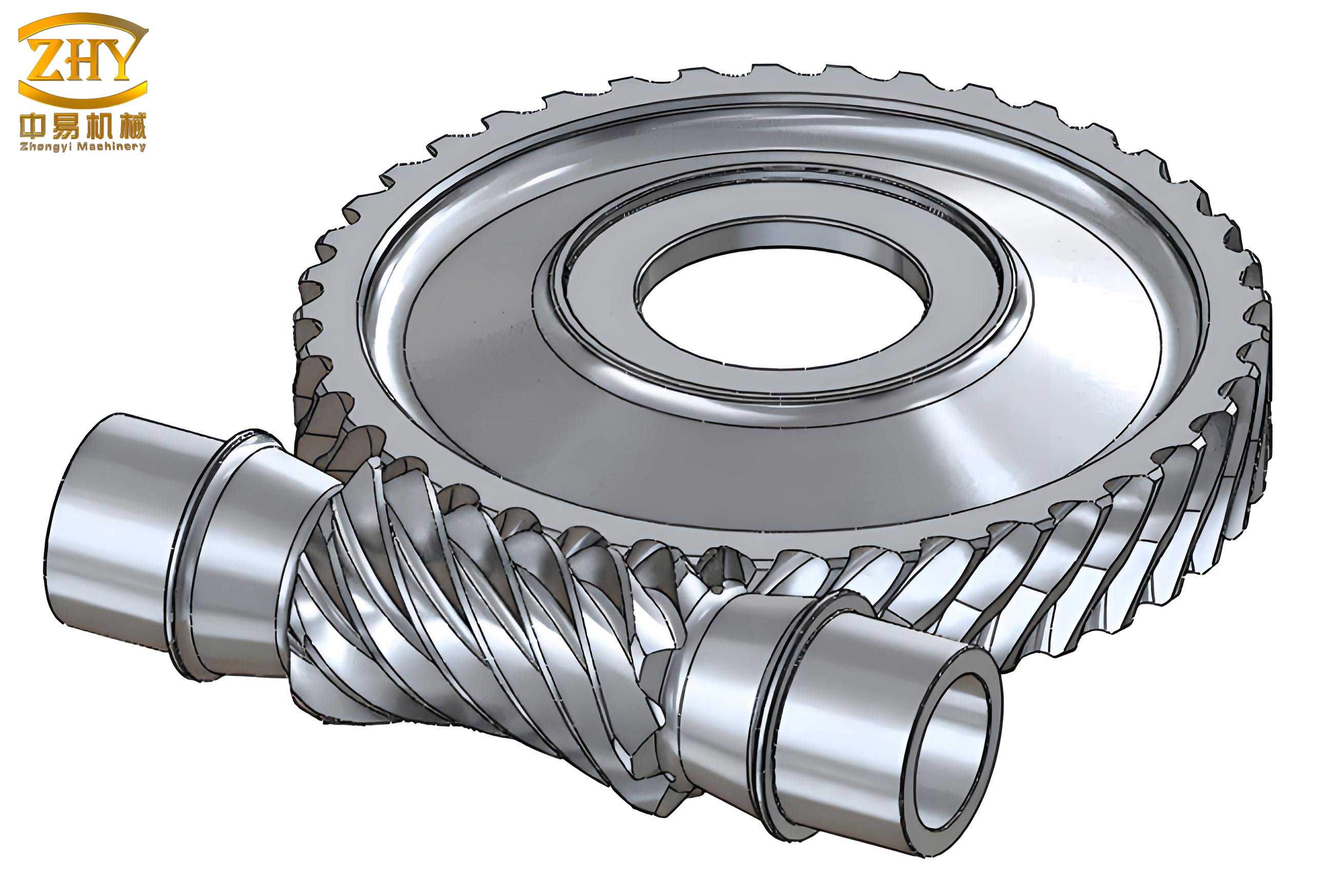
To understand the design of screw gears, it is essential to consider their geometric and kinematic parameters. Screw gears operate based on the meshing of helical threads, where the lead angle and pitch diameter influence the transmission efficiency. The diameter coefficient, denoted as $q$, is a critical parameter defined as the ratio of the reference diameter $d_1$ to the module $m$ of the screw gear. This coefficient affects the gear’s strength and engagement characteristics. For medium-duty applications, such as in this transmission system, the number of threads on the screw gear is typically limited to values like 1, 2, 4, or 6 to balance torque and speed. The fundamental equations governing screw gear design include the contact ratio and load distribution formulas, which can be expressed as follows:
$$ \text{Contact Ratio} = \frac{\text{Length of Path of Contact}}{\text{Circular Pitch}} $$
$$ \text{Efficiency} = \frac{\tan(\lambda)}{\tan(\lambda + \phi)} $$
where $\lambda$ is the lead angle and $\phi$ is the friction angle. These equations highlight how screw gears can be optimized for minimal energy loss. In my design, I selected screw gears with a module of 4 mm and a diameter coefficient of 10 to ensure sufficient torque transmission for the required motion ranges. The use of screw gears in this configuration reduces machining costs compared to traditional worm gears, while maintaining reliable performance. Below, Table 1 summarizes the key parameters of the screw gears used in the horizontal and vertical drive assemblies.
| Parameter | Horizontal Screw Gear | Vertical Screw Gear |
|---|---|---|
| Module (m) | 4 mm | 4 mm |
| Number of Threads | 2 | 4 |
| Reference Diameter (d₁) | 40 mm | 40 mm |
| Diameter Coefficient (q) | 10 | 10 |
| Lead Angle (λ) | 5.71° | 11.31° |
| Efficiency (%) | 85 | 80 |
The structural design of the screw gear assemblies involves careful alignment and mounting to ensure smooth motion transmission. For the horizontal rotation, a screw gear meshes with a ring gear fixed to the turbine tube, allowing 360-degree movement. The vertical pitching motion is achieved through a screw gear with bevel teeth that engages with another ring gear on the barrel body. This combination of screw gears and bevel gears enables compact design and reduces the complexity of the drive system. The self-locking property of screw gears is leveraged to maintain position without additional brakes, which is vital for safety in fluid applications. In my analysis, I considered factors such as backlash and wear resistance, selecting materials like hardened steel for the screw gears to enhance longevity. The integration of screw gears in this manner demonstrates their versatility in multi-axis control systems.
Beyond the mechanical design, I conducted flow field simulations to analyze the system’s performance when used in fluid delivery applications. Although screw gears are primarily transmission components, their interaction with fluid dynamics can impact overall efficiency. The simulation focused on the internal flow channels of the system, where pressure drops and velocity distributions were evaluated. Using computational fluid dynamics (CFD) software, I modeled the flow path and applied boundary conditions such as an inlet pressure of 1.4 MPa. The governing equations for fluid flow include the continuity and momentum equations, which in generalized form are:
$$ \frac{\partial(\rho \phi)}{\partial t} + \text{div}(\rho u \phi) = \text{div}(\Gamma \phi \text{grad} \phi) + S_\phi $$
Here, $\rho$ is fluid density, $t$ is time, $u$ is velocity vector, $\phi$ is a general variable, $\Gamma$ is diffusion coefficient, and $S$ is source term. For incompressible flow, these equations simplify to the Navier-Stokes equations. The simulation results showed that the design with screw gears contributed to stable fluid output, with outlet velocities ranging between 40-50 m/s and uniform pressure distribution. This indicates that the transmission system does not introduce significant flow disturbances, thanks to the smooth motion provided by screw gears. Table 2 outlines the simulation parameters and outcomes, highlighting how screw gears influence fluid performance.
| Parameter | Value | Description |
|---|---|---|
| Inlet Pressure | 1.4 MPa | Rated working pressure |
| Flow Rate | 120 L/s | Volume flow rate |
| Outlet Velocity | 40-50 m/s | Average velocity range |
| Pressure Drop | 0.2 MPa | Along flow channel |
| Flow Regime | Laminar | Stable with minimal turbulence |
The advantages of using screw gears in this transmission system are manifold. Firstly, screw gears offer high torque density, which is essential for driving heavy loads in applications like fluid monitors. Secondly, their self-locking capability enhances safety by preventing unintended movement. Thirdly, screw gears can be manufactured with precision to reduce backlash and improve positioning accuracy. In my design, I optimized the gear geometry to minimize wear, as expressed by the wear rate formula:
$$ W = k \cdot P \cdot v $$
where $W$ is wear rate, $k$ is material constant, $P$ is contact pressure, and $v$ is sliding velocity. By selecting appropriate materials and lubrication, the wear on screw gears can be controlled, extending the system’s lifespan. Additionally, the integration of screw gears with bevel gears allows for compact assembly, reducing the overall footprint. This is particularly beneficial in space-constrained environments. The use of screw gears also simplifies maintenance, as they are easier to access and replace compared to complex worm gear sets.
To further illustrate the design process, I will detail the calculation steps for sizing the screw gears. The torque requirement for the horizontal rotation is determined based on the fluid dynamics and friction losses. The torque $T$ can be calculated as:
$$ T = F \cdot r $$
where $F$ is the force required to overcome resistance, and $r$ is the pitch radius of the screw gear. For a screw gear with lead angle $\lambda$, the relationship between torque and axial force is given by:
$$ T = F_a \cdot \frac{d_m}{2} \cdot \tan(\lambda + \phi) $$
Here, $F_a$ is axial force, and $d_m$ is mean diameter. These equations were used to select screw gears with sufficient capacity. In the vertical drive, the inclusion of bevel gears adds complexity, but the principles remain similar. The gear ratio for the screw gear assembly is defined as:
$$ i = \frac{N_{\text{gear}}}{N_{\text{screw}}} $$
where $N$ represents the number of teeth or threads. In my design, a gear ratio of 20:1 was chosen for the vertical motion to provide fine control over the pitching angle. The use of screw gears in this ratio ensures smooth and precise adjustment, which is critical for applications requiring accurate targeting.
Another key aspect is the thermal analysis of screw gears during operation. Friction in screw gears generates heat, which can affect performance and material properties. The heat generation rate $Q$ can be estimated as:
$$ Q = \mu \cdot F_n \cdot v_s $$
where $\mu$ is coefficient of friction, $F_n$ is normal force, and $v_s$ is sliding velocity. To dissipate this heat, the design includes lubrication channels and heat sinks. The choice of lubricant is based on the operating temperature and load, with synthetic oils preferred for high-duty screw gears. Thermal expansion considerations also influenced the material selection, with steel alloys providing good thermal stability. By addressing thermal issues, the reliability of screw gears in continuous operation is enhanced.
The simulation of the flow field also provided insights into how the transmission system affects fluid delivery. The pressure distribution along the flow channel was relatively uniform, with minor losses at bends. This uniformity is attributed to the streamlined design facilitated by the compact screw gear assemblies. The velocity profile at the outlet showed consistency, which is desirable for applications like fire fighting, where range and stability are paramount. The use of screw gears contributes to this by ensuring smooth rotational movements that minimize flow disruptions. Furthermore, the simulation validated the theoretical calculations, confirming that the design meets performance requirements. The integration of screw gears thus not only improves mechanical efficiency but also optimizes fluid dynamics.
In terms of manufacturing, screw gears require precise machining to achieve the desired tolerances. Techniques such as hobbing and grinding are commonly used for screw gear production. The cost-effectiveness of screw gears compared to traditional worm gears is a significant advantage, as they can be produced with standard gear-cutting tools. In my design, I specified ISO standards for gear teeth to ensure compatibility and ease of replacement. The surface finish of screw gears is critical for reducing friction, so a roughness value of Ra 0.8 μm was targeted. These manufacturing considerations are essential for realizing the benefits of screw gears in practical applications.
The application of screw gears extends beyond fluid machinery to areas like robotics, automotive systems, and industrial automation. Their ability to provide precise motion control makes them versatile components. In this transmission system, the use of screw gears enables multi-axis positioning with high repeatability. The design principles discussed here can be adapted to other systems requiring similar functionalities. For instance, in robotic arms, screw gears can be used for joint movements, offering compactness and self-locking for safety. The ongoing advancements in materials science, such as the development of composite materials for screw gears, promise further improvements in performance and weight reduction.
To summarize, the design and analysis of this transmission system highlight the pivotal role of screw gears in achieving efficient and reliable motion control. Through theoretical calculations and simulations, I have demonstrated how screw gears can be optimized for torque transmission, wear resistance, and thermal management. The tables and formulas provided offer a concise reference for engineers. The integration of screw gears with bevel gears in a compact assembly showcases their adaptability in complex mechanical systems. As technology evolves, the use of screw gears is expected to grow, driven by their inherent advantages in precision and durability. This article serves as a comprehensive guide for leveraging screw gears in transmission design, with insights applicable across various engineering domains.
In conclusion, the transmission system using screw gears presented here exemplifies innovative mechanical design. By focusing on screw gears, I have underscored their importance in modern engineering. The combination of mechanical analysis and fluid dynamics simulation provides a holistic view of system performance. Future work could explore advanced coatings for screw gears to reduce friction further or integrate smart sensors for real-time monitoring. Regardless, the foundational principles remain rooted in the effective use of screw gears for motion transmission. I hope this discussion inspires further exploration and optimization of screw gears in mechanical systems.