
As a researcher focused on advanced gear design, I have extensively studied the limitations of traditional involute profiles in strain wave gear transmissions. The unique operating principle, relying on controlled elastic deformation of a flexspline, demands a tooth profile specifically optimized for this dynamic meshing condition. My work presents a comprehensive design and validation methodology for a double-circular-arc profile that achieves a breakthrough: continuous conjugate action across the entire engagement region. This significantly increases the number of simultaneously meshing tooth pairs, directly enhancing the load capacity, torsional stiffness, and positioning accuracy of the strain wave gear.
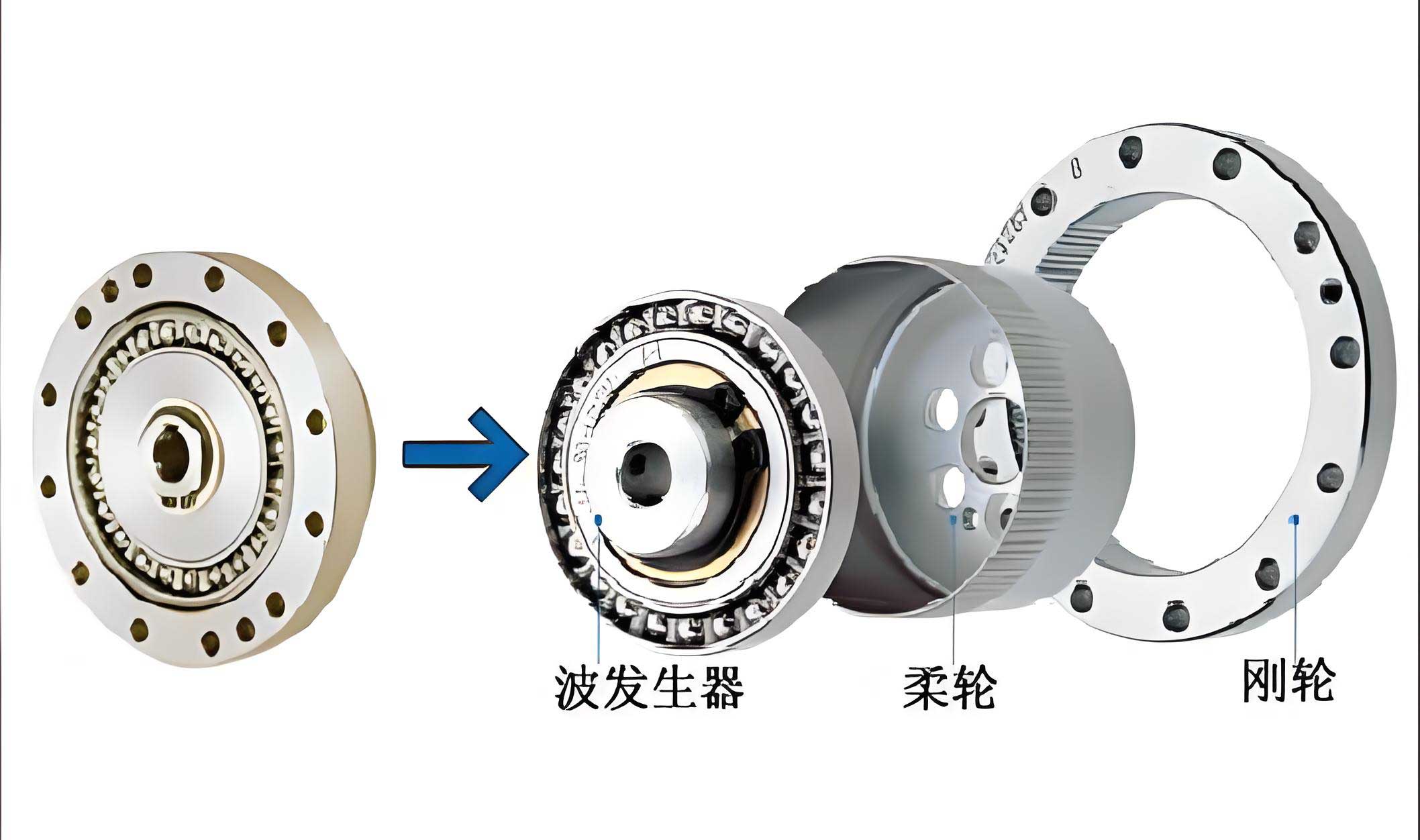
The conventional involute profile, while successful in rigid gear trains, is suboptimal for strain wave gears. Analysis reveals a very narrow conjugate existence interval near the wave generator’s major axis, leading to edge contact and susceptibility to interference under load. My approach centers on a parametric double-circular-arc profile for the flexspline, comprised of two circular arcs connected by a common tangent. The profile is defined within a local coordinate system \((x_f, y_f)\) attached to the tooth, where the \(y_f\)-axis is tangent to the neutral curve of the undeformed flexspline.
The parametric equations for this piecewise profile, expressed using a Heaviside function approach with arc length \(s\) as the parameter, are crucial for precise analysis. The key design parameters are defined relative to the module \(m\). A primary set of these parameters is summarized in the table below.
| Symbol | Definition | Typical Relation |
|---|---|---|
| \(h_{a1}^*\) | Flexspline addendum coefficient | \(h_{a1} = h_{a1}^* \cdot m\) |
| \(h_{f1}^*\) | Flexspline dedendum coefficient | \(h_{f1} = h_{f1}^* \cdot m\) |
| \(h_{l1}^*\) | Coefficient for tangent point height | – |
| \(s_1^*\) | Flexspline tooth thickness coefficient at pitch circle | \(s_1 = s_1^* \cdot m \cdot \pi / 2\) |
| \(\rho_{a1}^*\) | Flexspline tip arc radius coefficient | \(\rho_{a1} = \rho_{a1}^* \cdot m\) |
| \(\rho_{f1}^*\) | Flexspline root arc radius coefficient | \(\rho_{f1} = \rho_{f1}^* \cdot m\) |
| \(\zeta_1\) | Inclination angle of the common tangent | – |
The conjugate tooth profile for the circular spline is derived using an exact envelope algorithm based on the assembly deformation of the flexspline. This method accurately accounts for the rotation of the tooth profile’s symmetry axis due to both the circumferential displacement \(v\) and the geometric relationship of the neutral curve’s radial deformation \(u\). The position and orientation of a flexspline tooth originally at angular coordinate \(\Phi\) on the undeformed neutral circle (radius \(r_m\)) are determined for its deformed state at \(\varphi\).
The fundamental conjugate condition is expressed by the transformation from the flexspline tooth profile \(\mathbf{X}_f(x_f, y_f)\) to the circular spline profile \(\mathbf{X}_c(x_c, y_c)\):
$$
\mathbf{X}_c(\varphi) = \mathbf{M}(\varphi) \cdot \mathbf{X}_f(s)
$$
where the transformation matrix \(\mathbf{M}(\varphi)\) incorporates the radial displacement \(\rho(\varphi)\), the rotation \(\theta_{uz}(\varphi)\), and the kinematic angle \(\varphi\). The exact expression for the rotation angle is critical:
$$
\theta_{uz} = \arctan\left( -\frac{\dot{u}}{r_m + u} \right)
$$
where \(\dot{u} = du/d\varphi\). The conjugate profile must satisfy the envelope equation:
$$
\frac{\partial x_c}{\partial s} \cdot \frac{\partial y_c}{\partial \varphi} – \frac{\partial y_c}{\partial s} \cdot \frac{\partial x_c}{\partial \varphi} = 0
$$
Solving this equation numerically for the engagement angle \(\varphi\) for each point on the flexspline profile (parameter \(s\)) yields the conjugate existence intervals and the corresponding circular spline profile points.
My analysis reveals a fascinating and significant phenomenon for the double-circular-arc profile in a strain wave gear. Unlike the involute profile, two distinct conjugate existence intervals are identified, corresponding to different phases of the meshing cycle.
| Interval Name | Angular Location | Meshing Phase | Profile Segments Involved |
|---|---|---|---|
| Meshing Zone | Near the wave generator’s major axis (\(\varphi \approx 0^\circ\)) | Full engagement | Entire profile (root arc, tangent, tip arc) |
| Ingress Zone | Between major and minor axes (e.g., \(\varphi \approx 15^\circ-60^\circ\)) | Tooth entry | Primarily tip arc and tangent |
For a given set of initial parameters, the solution to the conjugate equation produces two branches, as conceptually shown in the relation between arc length \(s\) and conjugate angle \(\varphi\). The ingress zone interval is typically much wider than the meshing zone interval. The conjugate tooth profiles generated in these two zones are physically distinct. This leads to the phenomenon of double conjugation: a single point on the flexspline tip arc can generate two different conjugate points on the circular spline at two different engagement phases.
The key to achieving continuous conjugate transmission is to make both conjugate branches usable and to ensure they connect smoothly to form a practical, continuous circular spline tooth profile. This is achieved through strategic parameter design. The width and position of the conjugate intervals are highly sensitive to a subset of the original profile parameters.
| Highly Sensitive Parameter | Primary Influence on Conjugate Intervals |
|---|---|
| Common tangent inclination angle \(\zeta_1\) | Shifts and alters the width of both intervals. |
| Tangent point height coefficient \(h_{l1}^*\) | Affects the transition between intervals and profile smoothness. |
| Tip arc radius coefficient \(\rho_{a1}^*\) | Crucial for shaping the usable conjugate profile in the ingress zone. |
| Root arc radius coefficient \(\rho_{f1}^*\) | Influences the meshing zone profile and root clearance. |
By iteratively adjusting these parameters—particularly \(\zeta_1\) and \(h_{l1}^*\)—the gap between the meshing and ingress zones can be minimized or eliminated. The design objective is to have the usable portion of the ingress zone conjugate profile form the addendum (outer part) of the circular spline tooth, and the usable portion of the meshing zone conjugate profile form its dedendum (inner part). The transition point between these two branches becomes a carefully designed fillet or smooth connection on the circular spline.
To validate this design, I perform a kinematic simulation by plotting the movement trace of the flexspline tooth profile relative to the circular spline tooth space. This graphical method clearly illustrates the envelope formation. The traces show that the flexspline’s tip arc generates two separate envelopes within the circular spline space: one during the deep meshing phase and another during the ingress phase. The outer envelope from the ingress phase defines the circular spline’s tooth tip, while the inner envelope from the meshing phase defines its tooth root. The successful design is confirmed when these envelopes combine to create a clean, continuous, and non-interfering tooth slot for the circular spline.
The mathematical proof of smooth transition lies in ensuring the continuity of the first derivative (\(dy_c/dx_c\)) of the circular spline profile at the junction point between the two conjugate branches. This requires satisfying specific geometric conditions derived from the conjugate equations at the corresponding transition points on the flexspline profile (typically near the junction of the tip arc and the common tangent). The condition can be expressed as a constraint involving the sensitive parameters \((\zeta_1, h_{l1}^*, \rho_{a1}^*)\) and the wave generator deformation function \(u(\varphi)\):
$$
\left. \frac{dy_c}{dx_c} \right|_{\text{branch 1}} = \left. \frac{dy_c}{dx_c} \right|_{\text{branch 2}} \quad \text{at the junction } \varphi_j
$$
Optimizing parameters to meet this constraint ensures a smooth transition, which is vital for low vibration, high efficiency, and stable transmission in the strain wave gear.
The final, optimized design parameters yield a significant performance improvement. The conjugate existence interval can be expanded across a substantial angular range (e.g., from \(-1.5^\circ\) to over \(65^\circ\)), meaning a much larger number of teeth are in a state of precise conjugate contact at any given time. The following table contrasts the characteristics of the proposed design with a conventional one.
| Feature | Conventional Design (e.g., Involute) | Optimized Double-Circular-Arc Design |
|---|---|---|
| Conjugate Zone(s) | Single, very narrow zone near major axis. | Two zones (Meshing & Ingress) designed to be continuous. |
| Simultaneous Tooth Pairs | Limited, often ~15-20% of teeth. | Dramatically increased, potentially 30-40% of teeth. |
| Load Distribution | Poor, prone to stress concentration. | Excellent, due to many teeth sharing the load. |
| Transmission Stiffness | Lower, more susceptible to backlash. | Higher and more consistent. |
| Critical Design Parameters | Pressure angle, module. | \(\zeta_1\), \(h_{l1}^*\), \(\rho_{a1}^*\), \(\rho_{f1}^*\). |
In conclusion, my research establishes a robust framework for designing double-circular-arc tooth profiles for strain wave gears. The core insight is the recognition and exploitation of the double conjugate phenomenon. By employing an exact envelope algorithm and focusing on the optimization of key geometric parameters—specifically the common tangent’s geometry and the arc radii—the conjugate existence intervals can be merged into a functionally continuous range. This enables a state of continuous conjugate transmission where a significantly higher number of tooth pairs are in theoretically ideal contact throughout the engagement cycle. The result is a strain wave gear with fundamentally enhanced capabilities: greater torque capacity, improved positioning accuracy and stiffness, and more stable performance—addressing the key demands of advanced applications in robotics, aerospace, and precision machinery.