
As a critical mechanical transmission mechanism, involute screw gear drives are widely employed in industries such as automotive and hoisting transportation due to their advantages of smooth transmission, high load-bearing capacity, and compact structure. The fatigue wear and contact performance of screw gear mechanisms critically impact the overall operational performance of the mechanical system. The contact finite element method is extensively used for studying gear contact stresses. To investigate the strength variations during the transmission process of screw gear pairs, dynamic analysis is necessary. The meshing forces generated during the engagement of the worm and wheel significantly influence the motion smoothness of the transmission system and the service life of the mechanical structure. Simulation research on gear meshing forces is essential for the study of mechanical transmission dynamic systems. Therefore, this paper employs a combined approach using finite element analysis and multi-body dynamics simulation to study the meshing force variation and stress distribution in involute screw gear drives.
Based on the analysis of the machining principle for involute screw gears, it is known that an involute worm is machined on a lathe using a trapezoidal tool with a straight cutting edge. Consequently, the three-dimensional solid model of the worm can be established by sweeping the worm’s transverse tooth profile along a helix.
Mathematical Foundation and 3D Modeling
The mathematical definition of the tooth surfaces is fundamental for accurate modeling. For a right-handed involute worm, the equation of the helicoid surface can be expressed in the worm coordinate system \( S_1(o_1x_1y_1z_1) \) as follows:
$$ \begin{cases}
x_1 = r_b \cos(\theta + \mu) + u \cos \lambda_b \sin(\theta + \mu) \\
y_1 = r_b \sin(\theta + \mu) – u \cos \lambda_b \cos(\theta + \mu) \\
z_1 = p \theta – u \sin \lambda_b
\end{cases} $$
where \( r_b \) is the base circle radius, \( p \) is the spiral parameter (\( p = r_b \cot \lambda_b \)), \( \lambda_b \) is the base lead angle, \( \theta \) is the rotation angle parameter of the tool around the worm axis, \( u \) is a parameter representing the distance along the tool edge, and \( \mu = \frac{\pi}{2Z_1} – \text{inv}\alpha_t \), with \( Z_1 \) being the number of worm threads and \( \alpha_t \) the transverse pressure angle. For a left-handed helicoid, \( p\theta \) is replaced by \( -p\theta \).
The axial tooth profile of the involute cylindrical worm, which is crucial for understanding its geometry, is given by the parametric equations:
$$ \begin{cases}
r = \frac{r_b}{\cos(\theta + \mu)} \\
z = p(\theta + \mu) – r_b \tan(\theta + \mu)
\end{cases} $$
where \( r \) is the radial distance from a point on the profile to the axis, and \( z \) is its axial coordinate.
To derive the worm wheel tooth surface, coordinate transformation from the worm system \( S_1 \) to the wheel system \( S_2(o_2x_2y_2z_2) \) is performed via an auxiliary coordinate system \( S_p(o_px_py_pz_p) \) and a fixed space system \( S(o_{xyz}) \). The transformation accounts for the center distance \( a \) and the rotation angles \( \phi_1 \) (worm) and \( \phi_2 \) (wheel), related by the gear ratio \( i_{12} = \frac{Z_2}{Z_1} = \frac{\phi_1}{\phi_2} \). After transformation, the worm wheel tooth surface equation in \( S_2 \) is obtained as:
$$ \begin{cases}
x_2 = [x_1 \cos \phi_1 + y_1 \sin \phi_1 – a] \cos \phi_2 + [y_1 \cos \phi_1 – x_1 \sin \phi_1] \sin \phi_2 \\
y_2 = -[x_1 \cos \phi_1 + y_1 \sin \phi_1 – a] \sin \phi_2 + [y_1 \cos \phi_1 – x_1 \sin \phi_1] \cos \phi_2 \\
z_2 = z_1
\end{cases} $$
where \( \phi_2 = \phi_1 / i_{12} \). This equation, combined with the worm surface equation, defines the conjugate wheel tooth surface.
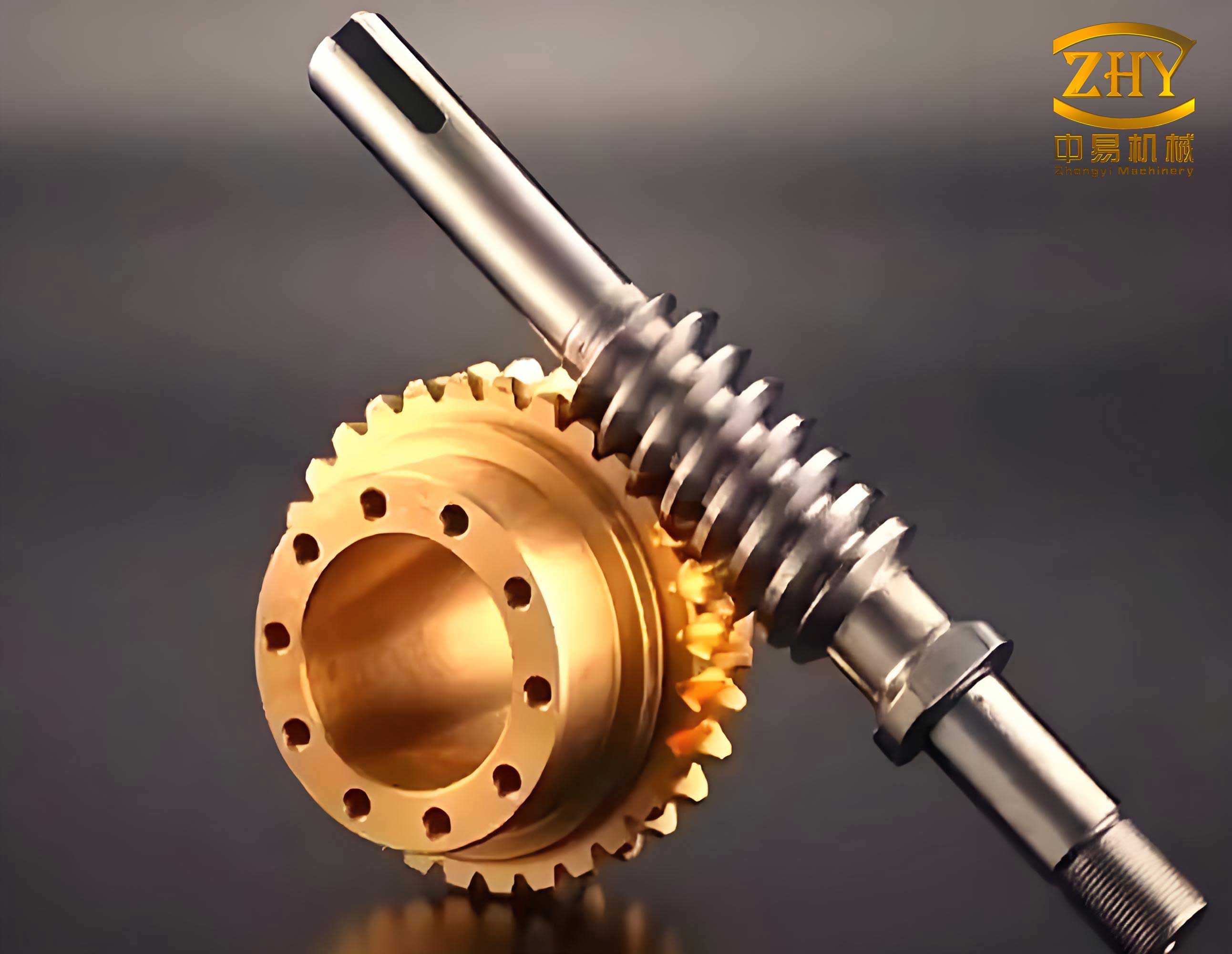
The basic geometric parameters for the modeled screw gear pair are listed in the table below:
| Component | Number of Teeth/Threads (Z) | Module (m) mm | Pressure Angle (α) deg | Diameter Factor (q) | Center Distance (a) mm |
|---|---|---|---|---|---|
| Worm | 1 (Single-start) | 10 | 20 | 9 | 100 |
| Worm Wheel | 41 | 10 | 20 | – |
Using these parameters and the derived equations, the worm model was created in SolidWorks based on its axial profile and helical sweep feature. For the worm wheel, the tooth profile curve was generated by programming the mathematical equations in MATLAB. This precise curve was then imported into SolidWorks to create a single tooth entity, which was patterned circumferentially to form the complete wheel. The final assembly of the involute screw gear pair was created, ensuring proper meshing alignment.
Dynamic Contact Finite Element Analysis
To study the transient stress distribution during meshing, dynamic contact analysis was performed. The assembly was imported into a finite element analysis software (ANSYS).
Material Properties and Mesh
Material selection is crucial for screw gears due to high sliding friction. The worm, requiring higher strength, was assigned 40Cr steel, while the wheel was assigned cast aluminum bronze (ZCuAl10Fe3) for its good anti-galling and wear properties.
| Component | Material | Density (ρ) kg/m³ | Young’s Modulus (E) GPa | Poisson’s Ratio (ν) |
|---|---|---|---|---|
| Worm | 40Cr Steel | 7850 | 206 | 0.277 |
| Worm Wheel | Cast Aluminum Bronze | 7600 | 119 | 0.330 |
To reduce computational cost while maintaining accuracy, the models were simplified by retaining only the teeth involved in the meshing zone. A tetrahedral mesh with the Patch Conforming algorithm was applied. The mesh was refined in the contact regions to capture stress gradients accurately.
Contact Definition, Constraints, and Loads
A frictional contact pair was defined between the worm (contact surface) and wheel (target surface) with a friction coefficient of 0.15. The initial geometric interference was adjusted to zero to ensure no penetration at the start. Boundary conditions reflected the operational state: the worm was constrained to rotate only about its axis, and an angular velocity of \( n_1 = 1450 \, \text{rpm} \) (approximately \( 151.84 \, \text{rad/s} \)) was applied. The wheel was constrained to rotate about its axis and subjected to a resisting torque \( T_2 \).
The input power was \( P = 15 \, \text{kW} \). Considering a transmission efficiency of \( \eta = 0.7 \), the output torque on the wheel was calculated as:
$$ T_2 = \frac{9550 \cdot P \cdot \eta}{n_2} $$
where \( n_2 = n_1 / i_{12} = 1450 / 41 \approx 35.37 \, \text{rpm} \) is the theoretical output speed. Thus,
$$ T_2 \approx \frac{9550 \times 15 \times 0.7}{35.37} \approx 2835 \, \text{N·m} $$
This torque was applied as a remote force on the wheel’s cylindrical surface.
Solution and Stress Results
The analysis time was set to correspond to the wheel rotating through the pitch of one tooth (a full meshing cycle). With the given speeds, this period is approximately \( 60 / (n_2 \cdot Z_2) \approx 0.0415 \, \text{s} \). A time of 0.05s with 120 steps was used for the analysis.
The results revealed significant variation in stress distribution at different engagement positions. At the initial point of contact between a single tooth pair, the contact area is minimal, leading to high localized contact stresses. As the rotation progresses and more tooth pairs come into engagement, the load is shared, reducing the maximum contact stress. The peak contact stress consistently occurred near the tooth tip region of both the worm and wheel. The maximum bending stress, however, was concentrated at the root fillet of the wheel teeth, which is a critical location for fatigue failure. This dynamic analysis provides a more comprehensive understanding of stress evolution compared to a static analysis at a single position.
Kinetics Simulation using Multi-Body Dynamics
To complement the stress analysis and specifically study the meshing force variation, a kinetics simulation was conducted. The 3D CAD assembly was exported in a Parasolid (*.x_t) format and imported into the multi-body dynamics software ADAMS.
Virtual Prototype Setup
Material densities were defined, and gravity was activated. Revolute joints were created between the worm and the ground (allowing rotation about its axis) and between the wheel and the ground. A contact force between the worm and wheel teeth was defined using the Impact function method in ADAMS.
The contact force \( F_{\text{impact}} \) is generally modeled as:
$$ F_{\text{impact}} = K \cdot \delta^e + \text{STEP}(\delta, 0, 0, d_{\max}, C_{\max}) \cdot \dot{\delta} $$
where:
- \( K \) is the contact stiffness.
- \( \delta \) is the penetration depth (\( q_0 – q \)).
- \( e \) is the force exponent (typically 1.5 for metals).
- \( \text{STEP} \) function provides a nonlinear damping coefficient \( C \).
- \( \dot{\delta} \) is the penetration velocity.
The stiffness \( K \) can be estimated based on material properties and contact geometry (e.g., using Hertzian contact theory for initial approximation). A static friction coefficient of 0.1 and a dynamic coefficient of 0.05 were applied. A rotational motion of \( 151.84 \, \text{rad/s} \) was applied to the worm’s revolute joint.
Simulation Results: Speed and Meshing Force
The rotational speed of the worm wheel was measured during simulation. The average output speed stabilized at approximately 35.0 rpm, which shows excellent agreement with the theoretical value of 35.37 rpm, with an error of about 1.0%. This validates the accuracy of the virtual prototype’s geometry and kinematic constraints.
The meshing force between the worm and wheel was measured over time. The force profile showed a characteristic pattern:
- Initial Impact Peak: At the very start of motion, a sharp peak force (around 2500 N) was observed. This is attributed to the sudden engagement and initial impact between the gear teeth, causing transient vibration.
- Stabilized Fluctuation: After the initial transient, the meshing force dropped significantly and settled into a periodic fluctuation around an average value of approximately 500 N. These fluctuations correspond to the cyclic variation in the number of contacting tooth pairs and the changing contact conditions as the teeth roll and slide through the mesh. The maximum force during normal, steady-state meshing consistently occurred at or near the region where a new wheel tooth entered the engagement zone.
This kinetic analysis of the screw gear pair provides direct insight into the dynamic loading conditions, which are vital for assessing vibration, noise, and fatigue life. The correlation between the high-stress regions identified in the FEA and the points of high meshing force in the dynamics simulation reinforces the findings.
Conclusion
This integrated study employing both dynamic finite element analysis and multi-body kinetics simulation provides a comprehensive investigation into the performance of involute screw gears. The key conclusions are as follows:
- The stress state within the screw gear teeth undergoes significant variation depending on the precise meshing position. A static analysis at a single position is insufficient to capture the complete loading history critical for fatigue assessment.
- During the meshing cycle, the maximum contact stress is predominantly located in the tooth tip region, while the most critical bending stress is concentrated at the root fillet of the worm wheel teeth. This identifies the primary zones for potential pitting and bending fatigue failures.
- The kinetics simulation successfully captured the dynamic behavior. The initial high-impact force during startup and the periodic fluctuation of the meshing force during steady-state operation were quantified. The steady-state meshing force reaches its peak value at the point where a wheel tooth first enters the engagement region with the worm.
- The combination of mathematical modeling, precise 3D CAD generation, dynamic FEA, and kinetics simulation forms a robust methodology for analyzing screw gears. The validated model and the insights gained into stress distribution and force variation provide a solid theoretical foundation for the optimal design, material selection, and failure prediction of involute screw gear drives.
Future work could involve extending this analysis to study the effects of manufacturing errors, thermal loads due to friction, and optimizing tooth profile modifications to reduce the initial impact force and smooth out the meshing force fluctuations for even quieter and more durable screw gear transmissions.