
In my extensive experience within the field of mechanical manufacturing and precision engineering, I have consistently sought methods to enhance calibration accuracy and automate complex processes. One particularly effective solution I developed involves a lever-type dial indicator mount for lathes, which allows for the high-speed, high-accuracy calibration of small bores, internal grooves, and workpieces with coordinate-bored positioning holes. This system, combined with a novel differential mechanism utilizing screw gears for automated length compensation during sintering, represents a significant advancement in metrology and process control. Throughout this discussion, I will elaborate on the design, application, and underlying principles of these systems, emphasizing the critical role of screw gears in enabling precise motion control and force transmission. The integration of such gear systems is pivotal for achieving the tolerances required in modern manufacturing.
The core lever dial indicator mount is designed to be affixed to the lathe’s compound rest or tool post. The mount body, which holds the dial indicator, is inserted into a rotatable split sleeve and secured using the lathe’s existing clamping screw. This arrangement firmly fixes the entire assembly. For measuring the bottom and sides of internal grooves, external cylindrical surfaces, or face runout, various attachments can be employed. A key attachment features a pivoting lever with a small spherical contact point. This point is inserted into a small bore in the workpiece, and upon rotating the workpiece, any deviation is directly reflected on the dial indicator’s pointer. This method is exceptionally useful for aligning workpieces on faceplates that have been pre-drilled with positioning holes on a boring mill.
The versatility of this setup is further demonstrated by its ability to measure external diameters, thread pitch diameters, and root diameters for radial runout, as well as assess out-of-roundness and straightness errors. Furthermore, the mount body can be removed from the split sleeve and directly clamped in a lathe chuck for alternative workpiece alignment scenarios. The reading on the dial indicator is not always a direct representation of the actual displacement at the workpiece contact point. It is derived from a fundamental lever amplification principle. The relationship is given by the following formula:
$$ R = \frac{L_1}{L_2} \times f $$
Where:
$R$ is the final reading on the dial indicator (e.g., in millimeters or inches).
$L_1$ is the distance from the contact point of the lever’s probing end to the pivot axis center.
$L_2$ is the distance from the pivot axis center to the point where the dial indicator’s stylus contacts the lever.
$f$ is the inherent precision value per division of the dial indicator itself.
This formula reveals a powerful aspect of the design: by manipulating the ratio $L_1/L_2$, one can effectively change the system’s sensitivity. For instance, if $L_1$ is less than $L_2$ ($L_1/L_2 < 1$), the system amplifies the indicator’s inherent precision, yielding a higher effective resolution for measuring very small deviations. Conversely, different lever arms can be crafted for various measurement ranges. I typically manufacture these lever ends in different standardized lengths and mark them with their effective magnification factor. The selection of the appropriate attachment depends entirely on the specific calibration task. The following table summarizes common attachments and their primary applications:
| Attachment Type | Lever End Configuration | Typical Application | Approximate $L_1$ / $L_2$ Ratio Range |
|---|---|---|---|
| Internal Groove/Groove Side | Extended straight probe with spherical tip | Measuring groove depth and sidewall runout | 0.5 to 1.5 |
| Small Bore Alignment | Short, 90-degree bent lever with spherical tip | Aligning pre-bored holes on faceplates | 0.2 to 0.8 |
| External Diameter & Runout | Lever with flat contact pad or V-groove | Checking radial runout of shafts and external diameters | 1.0 to 2.0 |
| High Magnification | Long $L_2$, very short $L_1$ probe | Ultra-fine assessment of roundness and form | 0.1 to 0.3 |
The mathematical foundation extends beyond the simple ratio. Consider the geometry when measuring an internal diameter. The actual diametral error $D_e$ is related to the indicator reading $R$ by a factor involving the lever angle $\theta$. For small angles, the relationship can be approximated as:
$$ D_e \approx 2 \times R \times \frac{L_2}{L_1} \times \frac{1}{\cos(\theta)} $$
However, in practical setup, we strive to keep $\theta$ near zero to minimize cosine error, simplifying the calculation back to the core formula. The ability to interchange levers and precisely know their $L_1$ dimension is what makes this tool so versatile and accurate.
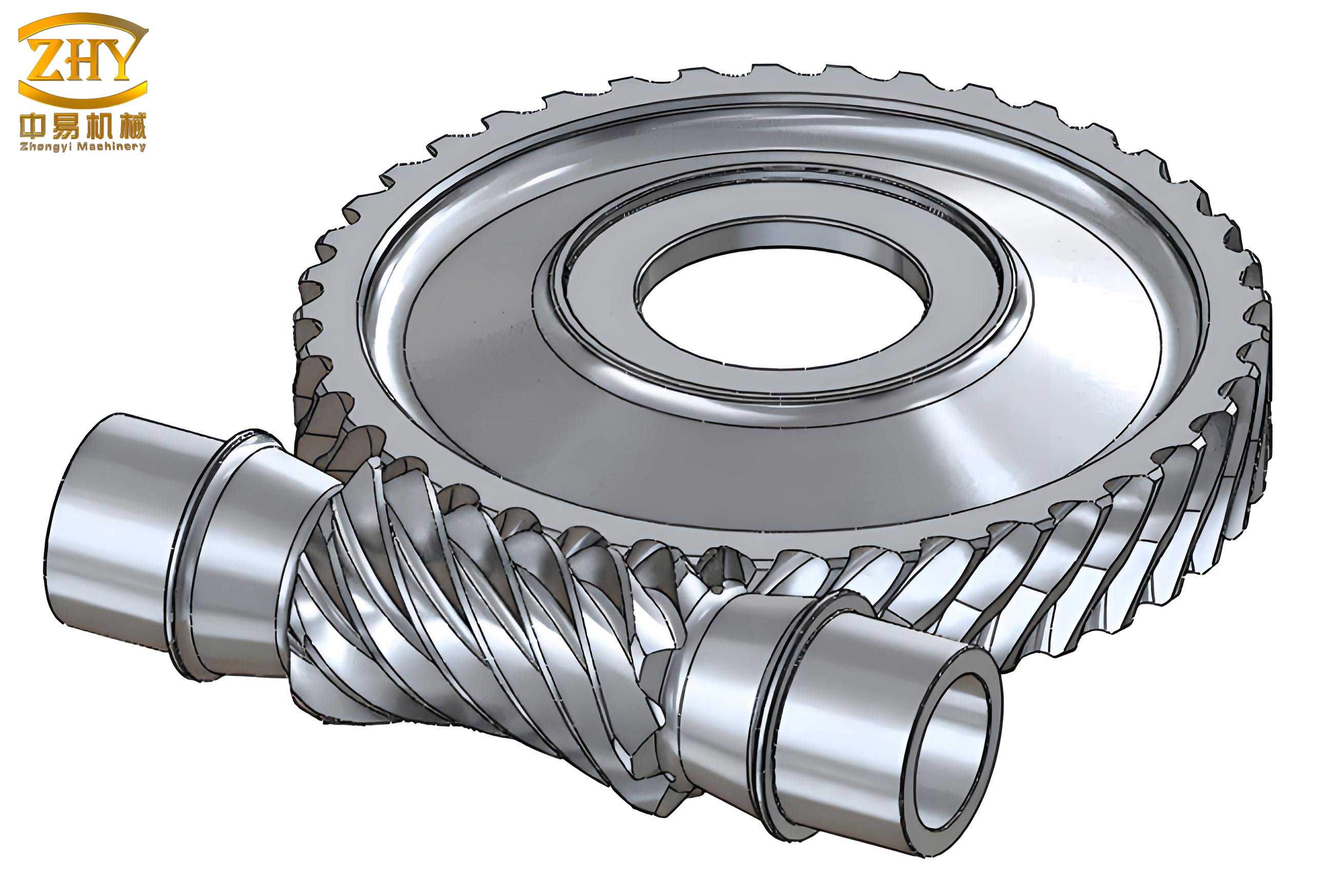
The principles of precision leverage find parallels in other areas of machine design, particularly in motion transmission systems. A compelling challenge I addressed involved the sintering process for long, vertical alloy rods. In such furnaces, the material undergoes significant thermal expansion and contraction. A traditional counterweight system attached to the lower chuck could not dynamically adjust to the material’s real-time length change, often leading to bending or separation of the rod from the chuck, severely compromising quality. My solution was to replace the passive counterweight with an active, automated system centered around a differential mechanism driven by screw gears.
This system integrates a pressure sensor at the lower chuck and a worm gear differential speed reducer (a classic example of screw gears in action) connected rigidly below it. The pressure sensor monitors the force between the chuck and the rod. The worm gear differential, a masterpiece of mechanical synthesis, has two input shafts and one output shaft that controls the vertical travel of the lower chuck. One input is driven by a constant-speed AC motor, providing a base reference motion. The other input is driven by a variable-speed DC motor. The output speed is the algebraic sum or difference of the inputs, governed by the gear ratios. The kinematics of a standard worm gear set, a type of screw gear, are defined by:
$$ V_{wormwheel} = \frac{V_{worm} \times P_{worm}}{N_{wormwheel}} $$
Where $V$ is rotational speed, $P_{worm}$ is the pitch of the worm (lead), and $N_{wormwheel}$ is the number of teeth on the worm wheel. In the differential configuration, the relationship becomes more complex. For the specific double-input worm gear differential I designed, the output linear velocity $V_{out}$ of the chuck is given by:
$$ V_{out} = k_1 \cdot \omega_{AC} \pm k_2 \cdot \omega_{DC} $$
Here, $\omega_{AC}$ and $\omega_{DC}$ are the angular velocities of the AC and DC motor shafts, respectively, and $k_1$ and $k_2$ are constants derived from the lead of the screw gears (worms) and the reduction ratios of the planetary elements within the differential. The pressure sensor’s signal is fed into a control circuit that modulates the DC motor’s speed. If the rod contracts during sintering, the pressure drops, signaling the DC motor to adjust its speed so that the differential’s output raises the chuck, maintaining constant tension. Conversely, if the rod expands, the process reverses. This creates a perfect, automatic synchronization between the chuck movement and the rod’s thermal dynamics.
The choice of screw gears for this differential was deliberate. Their high reduction ratio in a single stage, compactness, and self-locking characteristic (when the lead angle is small) are invaluable. The self-locking property prevents back-driving under load, ensuring the chuck position is held securely unless actively driven by the motors. This is crucial for maintaining stability during the sinter. The design parameters for such a screw gear differential system are multifaceted. Below is a table outlining key design considerations and typical values for a system intended for a vertical sintering furnace:
| Design Parameter | Symbol | Typical Value / Range | Notes |
|---|---|---|---|
| Worm Lead (Primary) | $P_w$ | 5 – 20 mm | Determines linear travel per motor revolution |
| Worm Wheel Teeth | $N_{ww}$ | 30 – 60 | Affects reduction ratio and smoothness |
| Lead Angle | $\lambda$ | 3° – 6° | Chosen for balance between efficiency and self-locking |
| AC Motor Base Speed | $\omega_{AC}$ | 1000 – 1500 RPM | Provides baseline chuck feed rate |
| DC Motor Speed Range | $\omega_{DC}$ | -500 to +500 RPM | Provides adjustable compensation speed |
| Differential Constant $k_1$ | $k_1$ | 0.05 – 0.1 mm/(rev) | Derived from gear train geometry |
| Differential Constant $k_2$ | $k_2$ | 0.02 – 0.05 mm/(rev) | Derived from gear train geometry |
| Max Chuck Travel | $S_{max}$ | 200 – 400 mm | Total compensation range required |
The efficiency $\eta$ of the screw gear set is also a critical factor in motor sizing and is approximated by:
$$ \eta \approx \frac{\tan(\lambda)}{\tan(\lambda + \phi)} $$
where $\phi$ is the friction angle, dependent on the materials and lubrication. For the bronze-on-steel screw gears I typically use with a lead angle of 4°, the efficiency might range from 40% to 60%. This inherent loss is acceptable given the primary need for precise positioning and holding rather than high power transmission. The control logic for the DC motor can be modeled as a proportional-integral (PI) controller, where the motor speed correction $\Delta \omega_{DC}$ is:
$$ \Delta \omega_{DC}(t) = K_p \cdot e(t) + K_i \int_0^t e(\tau) d\tau $$
with $e(t)$ being the error signal from the pressure sensor (desired force minus actual force). The constants $K_p$ and $K_i$ are tuned for the specific mechanical response of the system dominated by the inertia of the screw gears and the moving mass.
Beyond this specific application, screw gears are fundamental components in a vast array of precision machinery. Their ability to provide smooth, quiet, and high-ratio motion conversion makes them ideal for indexing tables, rotary actuators in measurement devices, and fine-adjustment mechanisms. For instance, in the context of the dial indicator mount itself, one could envision a micro-adjustment stage for precisely setting the $L_2$ distance using a fine-pitch screw gear mechanism, though in my design, this is set manually via calibrated slots. The mathematical modeling of such systems often involves understanding the torsional stiffness of the screw gear shaft, which impacts positional accuracy under load. The stiffness $K_t$ can be estimated as:
$$ K_t = \frac{G \cdot J}{L} $$
where $G$ is the shear modulus of the shaft material, $J$ is the polar moment of inertia of the cross-section, and $L$ is the effective length. When combined with the linear stiffness of the nut interface, it determines the system’s overall compliance.
Reflecting on these two systems—the lever-based metrology tool and the screw gear-driven automated compensator—highlights a unifying theme: the intelligent application of mechanical advantage and controlled motion. The lever amplifies small displacements for measurement, while the screw gear differential translates rotary motor commands into precise, feedback-controlled linear motion. Both rely on a deep understanding of geometry, force, and material behavior. The table below draws a comparative summary of these core principles:
| Aspect | Lever Dial Indicator System | Screw Gear Differential System |
|---|---|---|
| Primary Function | Amplification and measurement of geometric deviation | Transmission and control of motion with compensation |
| Key Mechanical Element | Pivoting lever (1st class lever) | Worm and wheel set (screw gears) |
| Governing Ratio | $$ M = \frac{L_1}{L_2} $$ (Mechanical Advantage) | $$ GR = \frac{N_{wormwheel}}{P_{worm}} $$ (Gear Reduction) |
| Critical Precision Factor | Accurate knowledge of $L_1$ and $L_2$ distances; pivot bearing play | Lead accuracy of screw gears; backlash control |
| Feedback/Control | Visual reading from dial; operator judgment | Electronic pressure sensor; closed-loop PI control |
| Typical Accuracy Goal | 0.001 – 0.01 mm effective resolution | 0.1 – 0.5 mm positional tracking over long stroke |
In practice, the development and refinement of these systems involved iterative prototyping. For the dial indicator mount, ensuring the rigidity of the split sleeve and the repeatability of the lever pivot was paramount. Any flex or play would introduce error multiples larger than the deviations being measured. Similarly, for the screw gear differential, selecting the right material pair—often a hardened steel worm mating with a phosphor bronze worm wheel—was essential for wear resistance and smooth operation over long periods. The lubrication regime for the screw gears also needed careful specification; a consistent film of high-pressure grease is necessary to maintain efficiency and prevent seizure under the intermittent high loads from the sintering rod.
The broader implications for manufacturing are substantial. The lever mount enables faster setup and more accurate alignment of complex parts, reducing scrap and rework. The automated chuck system prevents defects in sintered materials, improving yield and material properties. Both contribute to leaner, more reliable production lines. Furthermore, the principles embedded in these designs are scalable. The lever magnification concept can be applied to optical or electronic probes, and the screw gear differential principle can be adapted for synchronizing multiple axes in complex machinery, such as in printing or textile manufacturing equipment.
To delve deeper into the mathematics, let’s consider the error propagation in the lever system. If there is an uncertainty $\delta L_1$ in the length $L_1$ and $\delta L_2$ in $L_2$, the uncertainty in the calculated actual displacement $A$ (where $A = R \times (L_2/L_1)$) can be approximated using partial derivatives:
$$ \delta A \approx \left| \frac{\partial A}{\partial L_1} \right| \delta L_1 + \left| \frac{\partial A}{\partial L_2} \right| \delta L_2 = A \cdot \left( \frac{\delta L_1}{L_1} + \frac{\delta L_2}{L_2} \right) $$
This shows that for high magnification (small $L_1/L_2$ ratio), the relative error in $L_1$ becomes critically important, mandating high-precision fabrication of the lever ends. For the screw gears, the positioning accuracy $\Delta x$ of the chuck is influenced by the angular backlash $\beta$ in the gear mesh:
$$ \Delta x \approx \frac{\beta}{360^\circ} \times P_w $$
Minimizing backlash through pre-loading techniques or using dual-path screw gear systems is often necessary for high-precision applications. In my differential design, the constant meshing force provided by the planetary arrangement within the differential helps mitigate this issue to a great extent.
In conclusion, the journey from a simple lever clamp to an automated gear-driven system underscores the power of fundamental mechanical principles when applied with innovation. The lever dial indicator mount solves a persistent metrology challenge with elegance and versatility, its performance quantifiable through a straightforward yet powerful formula. The sintering chuck compensator tackles a dynamic process control problem by harnessing the unique capabilities of screw gears within a differential configuration, enabling real-time, force-feedback synchronization. Both systems exemplify how careful design, rooted in solid engineering mathematics and a deep appreciation for components like screw gears, can yield robust solutions that enhance precision, efficiency, and quality in manufacturing. The continuous evolution of such tools, perhaps integrating digital readouts and direct CNC interface for the mount, or advanced adaptive control algorithms for the differential, promises even greater capabilities for the future of precision engineering.