
In my extensive experience with mechanical power transmission systems, I have consistently observed that the selection of lubricating oil is a pivotal factor determining the operational longevity and efficiency of components. Among the various parameters, lubricant viscosity stands out as a critical property, especially in the context of cylindrical screw gears. This article delves into the profound impact of lubricant viscosity on the performance and durability of screw gears and associated bearings, providing a comprehensive analysis backed by formulas, tables, and practical insights. The aim is to equip engineers and designers with the knowledge to make informed decisions regarding lubricant selection, thereby optimizing the lifecycle of screw gear transmissions.
The transmission of motion and power through screw gears involves a complex interaction between the worm and the wheel, characterized by sliding contact under high stress. This interaction necessitates effective lubrication to minimize wear, prevent failure modes such as pitting and scuffing, and ensure smooth operation. I will explore how lubricant viscosity directly influences the formation of protective oil films, the mitigation of surface fatigue, and the extended service life of both the screw gears and the supporting bearings. Through detailed mathematical modeling and empirical data, I will establish guidelines for selecting appropriate viscosity grades, balancing the trade-offs between enhanced protection and operational efficiency.
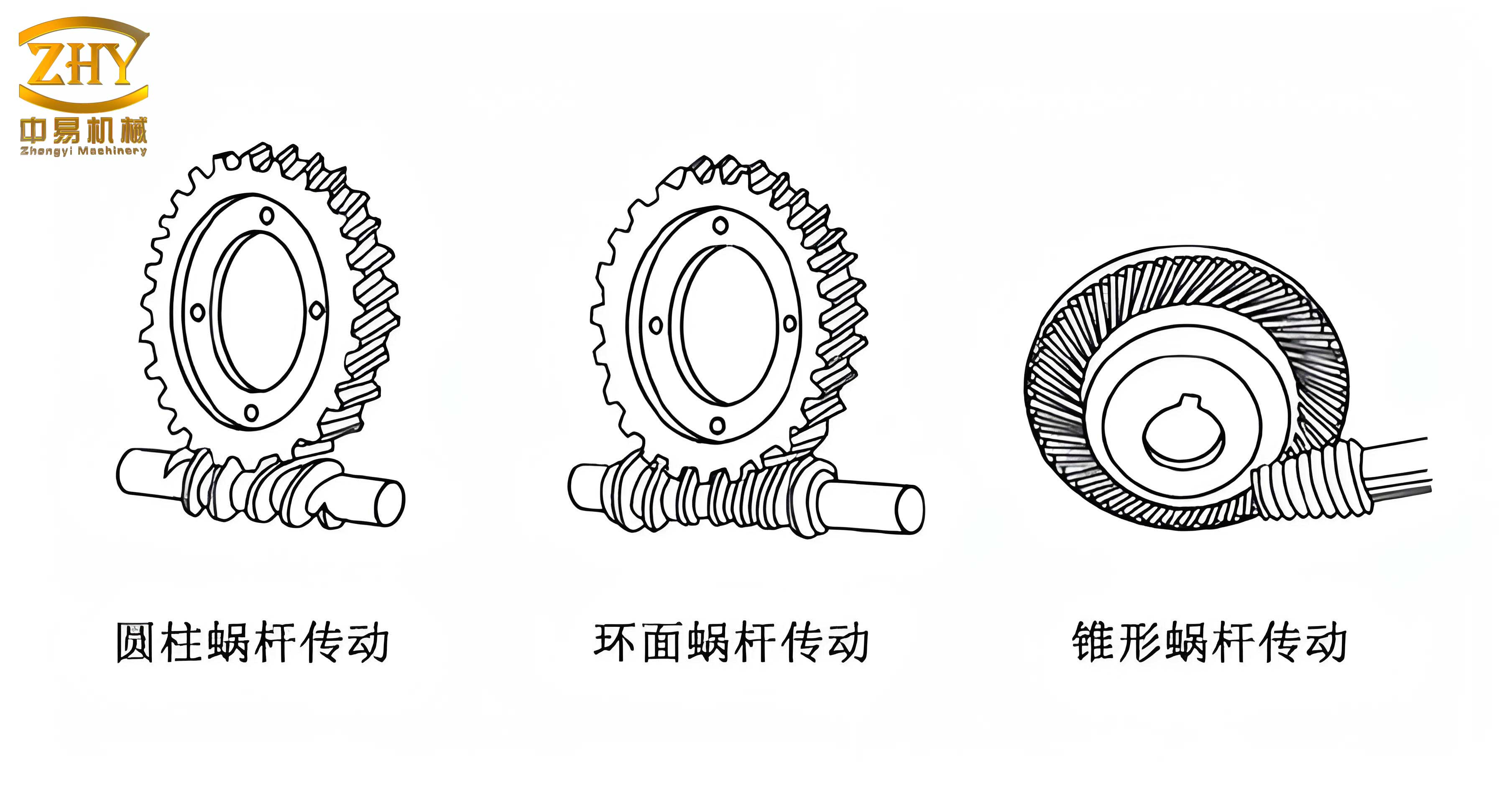
The functionality of screw gears is intrinsically linked to the lubricant’s ability to separate the mating surfaces. A key metric in this regard is the film thickness ratio, denoted by $\lambda$. This ratio is defined as the minimum oil film thickness $h_{\min}$ divided by the composite surface roughness $\sigma$ of the gear teeth: $$\lambda = \frac{h_{\min}}{\sigma}$$. Research and practical evidence indicate that when $\lambda \geq 3$, the risk of surface distress like pitting and adhesive wear (scuffing) is significantly reduced, allowing the screw gears to operate reliably at their designed efficiency. Therefore, achieving a sufficient $h_{\min}$ is paramount, and lubricant viscosity is the most influential variable controlling this parameter.
For cylindrical screw gears under bath lubrication, the minimum oil film thickness can be estimated using a specialized formula that accounts for gear geometry, operating conditions, and lubricant properties. The generalized form of this equation is: $$h_{\min} = h^* \cdot a_c \cdot \eta \cdot \left( \frac{n_1}{a} \right)^{\alpha} \cdot \left( \frac{E_{\text{red}}}{T_2} \right)^{\beta}$$. In this expression, $h^*$ is a transmission coefficient dependent on screw gear design factors such as the worm profile, center distance $a$, number of worm starts, number of wheel teeth, profile shift coefficient, and face width. The coefficient $a_c$ is specific to the lubricant type, with typical values provided in the table below. The dynamic viscosity $\eta$ is a central variable, calculated from the kinematic viscosity $\nu_m$ at the meshing temperature: $$\eta = \rho \cdot \nu_m$$. Here, $\rho$ represents the lubricant density at the meshing temperature, which can be derived from its density at 15°C, $\rho_{15}$, using the relation $\rho = \rho_{15} – k \cdot (t – 15)$, where $t$ is the temperature in °C and $k$ is a lubricant-type coefficient. The exponent $\alpha$ and $\beta$ are derived from elastohydrodynamic lubrication theory for screw gears. Other parameters include the worm speed $n_1$ (in rpm), the center distance $a$ (in mm), the reduced modulus of elasticity $E_{\text{red}}$ (in N/mm²), and the output torque $T_2$ (in Nm).
| Lubricant Type | Coefficient $a_c$ | Density-Temperature Coefficient $k$ |
|---|---|---|
| Mineral Oil | $1.7 \times 10^{-8}$ | $6.5 \times 10^{-4}$ |
| Polyglycol | $1.3 \times 10^{-8}$ | $7.5 \times 10^{-4}$ |
| Polyalphaolefin (PAO) | $1.5 \times 10^{-8}$ | $6.8 \times 10^{-4}$ |
| Ester-Based Oil | $1.6 \times 10^{-8}$ | $7.0 \times 10^{-4}$ |
The dynamic viscosity $\eta$ is thus the linchpin in this equation. A higher viscosity generally promotes a thicker oil film, increasing $\lambda$ and protecting the screw gears. However, the relationship is not linear and must be considered alongside the operating temperature, as viscosity decreases with rising temperature. For screw gears, which often operate with significant sliding friction and associated heat generation, selecting a viscosity grade that maintains adequate film thickness at the expected operating temperature is crucial. I recommend conducting thermal analysis to estimate the meshing temperature accurately before finalizing the lubricant choice for screw gears.
Beyond the direct impact on the screw gears themselves, lubricant viscosity plays an equally vital role in determining the lifespan of the bearings that support the worm and wheel shafts. The latest international standard for calculating adjusted bearing life, as per ISO 281, incorporates lubricant effects explicitly. The basic formula for the rating life $L_{nm}$ is: $$L_{nm} = a_1 \cdot a_{\text{ISO}} \cdot L_{10}$$. Here, $L_{10}$ is the basic rating life in millions of revolutions, calculated from the basic dynamic load rating $C$ and the equivalent dynamic bearing load $P$: $$L_{10} = \left( \frac{C}{P} \right)^p$$, where $p=10/3$ for roller bearings commonly used in screw gear units. The factor $a_1$ is a reliability adjustment factor. The core innovation in modern bearing life calculation is the introduction of the life adjustment factor $a_{\text{ISO}}$, which integrates influences from lubrication, contamination, and installation conditions.
| Reliability (%) | Rating Life Notation | $a_1$ |
|---|---|---|
| 90 | $L_{10m}$ | 1.00 |
| 95 | $L_{5m}$ | 0.64 |
| 96 | $L_{4m}$ | 0.55 |
| 97 | $L_{3m}$ | 0.47 |
| 98 | $L_{2m}$ | 0.37 |
| 99 | $L_{1m}$ | 0.25 |
| 99.2 | $L_{0.8m}$ | 0.22 |
| 99.4 | $L_{0.6m}$ | 0.19 |
| 99.6 | $L_{0.4m}$ | 0.16 |
The factor $a_{\text{ISO}}$ is calculated based on the viscosity ratio $\kappa$, the contamination level, and the bearing’s fatigue load limit $C_u$. The viscosity ratio is defined as: $$\kappa = \frac{\nu}{\nu_1}$$. Here, $\nu$ is the actual kinematic viscosity of the lubricant at the operating temperature of the bearing, and $\nu_1$ is the reference kinematic viscosity. The reference viscosity $\nu_1$ depends on the bearing mean diameter $d_m$ (in mm) and speed $n$ (in rpm):
For $n < 1000 \text{ rpm}$: $$\nu_1 = 45000 \cdot n^{-0.83} \cdot d_m^{-0.5}$$
For $n \geq 1000 \text{ rpm}$: $$\nu_1 = 10000 \cdot n^{-0.5} \cdot d_m^{-0.5}$$
The contamination level is quantified by the contamination factor $e_c$, which ranges from 1 for extremely clean conditions to 0 for severely contaminated environments, as detailed in the following table.
| Contamination Level | $e_c$ for $d_m < 100$ mm | $e_c$ for $d_m \geq 100$ mm |
|---|---|---|
| Extremely Clean | 1.0 | 1.0 |
| Very Clean | 0.8 – 0.9 | 0.9 – 0.95 |
| Normally Clean | 0.6 – 0.8 | 0.8 – 0.9 |
| Slightly Contaminated | 0.5 – 0.6 | 0.6 – 0.8 |
| Typically Contaminated | 0.3 – 0.5 | 0.4 – 0.6 |
| Heavily Contaminated | 0.1 – 0.3 | 0.2 – 0.4 |
| Severely Contaminated | 0 – 0.1 | 0 – 0.2 |
For roller bearings such as cylindrical or tapered roller bearings, which are frequently employed in screw gear assemblies, the life adjustment factor $a_{\text{ISO}}$ can be derived using the following piecewise functions based on the viscosity ratio $\kappa$:
For $0.1 \leq \kappa < 0.4$:
$$a_{\text{ISO}} = 1 – \left[ 1 – \left( \frac{C_u}{P} \right)^{0.4} \cdot e_c \right] \cdot \left( 1.5859 \cdot \kappa^{1.2348} – 0.3993 \right)$$
For $0.4 \leq \kappa < 1$:
$$a_{\text{ISO}} = 1 – \left[ 1 – \left( \frac{C_u}{P} \right)^{0.4} \cdot e_c \right] \cdot \left( 1.9087 \cdot \kappa^{0.0717} – 0.3993 \right)$$
For $1 \leq \kappa \leq 4$:
$$a_{\text{ISO}} = 1 – \left[ 1 – \left( \frac{C_u}{P} \right)^{0.4} \cdot e_c \right] \cdot \left( 1.3907 \cdot \kappa^{0.0717} – 0.3993 \right)$$
In practical applications, if $\kappa > 4$, it should be taken as $\kappa = 4$ for calculation purposes. Furthermore, the value of $a_{\text{ISO}}$ is typically capped at a maximum of 50 to reflect physical limits.
The interconnection between lubricant viscosity for the screw gears and for the bearings is evident. The same lubricant bath often serves both components. Therefore, selecting a viscosity must satisfy two criteria: forming an adequate film between the screw gear teeth and achieving a favorable viscosity ratio $\kappa$ for the bearings. A higher viscosity generally increases $\kappa$, which in turn raises $a_{\text{ISO}}$ and extends the calculated bearing life, as demonstrated in the formulas above. This dual benefit underscores the importance of viscosity selection in screw gear system design.
In practical application for screw gears, the influence of lubricant viscosity on wear is particularly pronounced. The final manufacturing process for the worm wheel often involves hobbing, which typically yields a higher surface roughness compared to ground gears. In my work, I have seen that achieving a surface roughness better than Ra 1.6 µm for screw gear components requires specialized processes. Consequently, to compensate for this inherent roughness and prevent direct metal-to-metal contact during the initial run-in period, a lubricant with a sufficiently high viscosity is essential. A higher viscosity facilitates the formation of a robust oil film, protecting the surfaces from abrasive wear and promoting a smoother running-in process that optimizes the long-term performance of the screw gears. For most industrial cylindrical screw gears, I recommend starting with a synthetic gear oil with a minimum viscosity grade of VG 220 (ISO VG 220).
However, a critical trade-off exists. While higher viscosity oils enhance protection for both screw gears and bearings, they also increase churning and drag losses within the gearbox. This results in lower transmission efficiency and higher operating temperatures. Elevated temperatures accelerate oil oxidation and degrade seals. Therefore, the selection process is an optimization exercise: choosing the lowest viscosity that reliably maintains the required film thickness ratio $\lambda$ for the screw gears and an acceptable $\kappa$ for the bearings at the system’s equilibrium operating temperature.
To illustrate the tangible impact of viscosity on bearing life in a screw gear context, consider a typical scenario. Assume a screw gear reducer utilizes a cylindrical roller bearing NU2210ECP on the worm shaft. The bearing’s basic dynamic load rating $C$ is 90 kN. Under the applied loads in this screw gear assembly, the equivalent dynamic load $P$ is calculated to be 20 kN. The worm shaft speed $n$ is 600 rpm. From the bearing manufacturer’s catalog, the fatigue load limit $C_u$ is found to be 11.4 kN. The operating temperature at the bearing is estimated to be 100°C. The environment is considered normally clean ($e_c = 0.7$), and a reliability of 90% ($a_1 = 1$) is targeted.
First, calculate the basic rating life $L_{10}$:
$$L_{10} = \left( \frac{C}{P} \right)^{10/3} = \left( \frac{90}{20} \right)^{10/3} \approx 150 \text{ million revolutions}$$
This corresponds to approximately 4167 hours of operation at 600 rpm.
Now, consider two different lubricants for the screw gear unit: a VG 220 polyglycol oil and a VG 460 polyglycol oil. At 100°C, their kinematic viscosities are approximately $\nu_{220} = 22 \text{ mm}^2/\text{s}$ and $\nu_{460} = 46 \text{ mm}^2/\text{s}$, respectively.
For the bearing NU2210ECP, the mean diameter $d_m$ is approximately 85 mm. Since $n=600 < 1000$ rpm, the reference viscosity is:
$$\nu_1 = 45000 \cdot 600^{-0.83} \cdot 85^{-0.5} \approx 18.9 \text{ mm}^2/\text{s}$$
For the VG 220 oil: $\kappa_{220} = \frac{22}{18.9} \approx 1.164$. Since $1 \leq \kappa < 4$, we use the third formula. Assuming $e_c = 0.7$:
$$a_{\text{ISO},220} = 1 – \left[ 1 – \left( \frac{11.4}{20} \right)^{0.4} \cdot 0.7 \right] \cdot \left( 1.3907 \cdot (1.164)^{0.0717} – 0.3993 \right)$$
$$a_{\text{ISO},220} \approx 1.14$$
The adjusted bearing life becomes:
$$L_{nm,220} = a_1 \cdot a_{\text{ISO},220} \cdot L_{10} = 1 \cdot 1.14 \cdot 150 \approx 171 \text{ million rev} \ (4750 \text{ hours})$$
For the VG 460 oil: $\kappa_{460} = \frac{46}{18.9} \approx 2.434$. Using the same formula:
$$a_{\text{ISO},460} = 1 – \left[ 1 – \left( \frac{11.4}{20} \right)^{0.4} \cdot 0.7 \right] \cdot \left( 1.3907 \cdot (2.434)^{0.0717} – 0.3993 \right)$$
$$a_{\text{ISO},460} \approx 1.75$$
The adjusted bearing life becomes:
$$L_{nm,460} = 1 \cdot 1.75 \cdot 150 \approx 262.5 \text{ million rev} \ (7292 \text{ hours})$$
This example clearly demonstrates that increasing the lubricant viscosity from VG 220 to VG 460 can extend the calculated bearing life by over 50% in this screw gear application. A similar positive effect on the film thickness ratio $\lambda$ for the screw gears themselves would be expected, further justifying the choice, provided the increase in churning loss and operating temperature is manageable.
The selection of lubricant viscosity for screw gears is not a one-size-fits-all decision. It requires a systematic approach. I propose the following step-by-step methodology for engineers designing screw gear transmissions:
- Determine Operating Conditions: Establish the key parameters: output torque $T_2$, worm speed $n_1$, center distance $a$, expected operating temperature range, and duty cycle for the screw gears.
- Assess Surface Finish: Obtain or specify the expected composite surface roughness $\sigma$ for the worm and wheel teeth. This sets the target for the minimum film thickness $h_{\min}$ to achieve $\lambda \geq 3$.
- Calculate Required Film Thickness: Using the film thickness formula, work backwards to estimate the required dynamic viscosity $\eta$ at the operating temperature. This provides a baseline viscosity grade for the screw gears.
- Evaluate Bearing Requirements: Identify the supporting bearings, their loads $P$, speeds $n$, and fatigue limits $C_u$. Calculate the reference viscosity $\nu_1$ and determine the viscosity ratio $\kappa$ for the baseline lubricant from step 3.
- Calculate Bearing Life Adjustment: Using the contamination factor $e_c$ (based on housing sealing and filtration) and the formulas for $a_{\text{ISO}}$, assess if the baseline lubricant yields an acceptable bearing life $L_{nm}$.
- Optimize and Iterate: If the bearing life is insufficient, consider a higher viscosity grade. Recalculate $h_{\min}$ and $\kappa$. Conversely, if efficiency is paramount and conditions allow, a lower viscosity might be tested. Always verify that $\lambda$ remains above the safety threshold.
- Consider Lubricant Type: Refer to Table 1. Synthetic oils like polyglycols often offer better film strength and thermal stability than mineral oils at similar viscosities, potentially allowing for a lower viscosity grade to achieve the same protection in screw gears.
| Center Distance (mm) | Worm Speed (rpm) | Ambient Temperature | Suggested ISO VG (Mineral/Synthetic) | Expected $\kappa$ Range for Typical Bearings |
|---|---|---|---|---|
| 50 – 100 | < 500 | Moderate (20-40°C) | VG 220 / VG 150 | 0.8 – 1.5 |
| 50 – 100 | 500 – 1500 | Moderate | VG 150 / VG 100 | 0.6 – 1.2 |
| 100 – 200 | < 500 | Moderate | VG 320 / VG 220 | 1.2 – 2.5 |
| 100 – 200 | 500 – 1500 | Moderate | VG 220 / VG 150 | 0.9 – 1.8 |
| Any | Any | High (>50°C) or Heavy Shock Load | VG 460 or higher / VG 320 or higher | > 1.5 |
In conclusion, the meticulous selection of lubricating oil viscosity is a cornerstone of reliable screw gear transmission design. From my analysis, it is unequivocal that viscosity directly governs the elastohydrodynamic film separating the screw gear teeth, thereby controlling wear and fatigue life. Simultaneously, through the viscosity ratio $\kappa$, it is a primary determinant of the adjusted fatigue life of the supporting roller bearings. Selecting a viscosity that ensures a film thickness ratio $\lambda \geq 3$ for the screw gears and a favorable $\kappa$ for the bearings can dramatically enhance the system’s durability and operational reliability.
However, this pursuit of extended life through higher viscosity must be tempered by an understanding of the associated costs. Increased viscosity invariably leads to higher churning losses, reduced mechanical efficiency, greater heat generation, and potentially accelerated lubricant aging. Therefore, the design process for screw gears must involve a holistic optimization that balances protection, efficiency, and thermal management. I advocate for the use of synthetic lubricants where possible, as they often provide superior performance envelopes. Ultimately, investing time in calculating the film thickness and bearing life adjustments based on accurate operating data pays significant dividends in the form of robust, long-lasting screw gear transmissions.