
In the evolving landscape of mechanical transmission systems, the demand for higher precision, lower noise, reduced size, greater power capacity, and enhanced durability is paramount. Consequently, achieving high precision in hardened gears necessitates economical and efficient finishing methods to correct errors in tooth profile and tooth alignment (lead) induced by heat treatment distortion. For medium-hard tooth flanks with a required accuracy grade of 7-6 (according to standards like JB179-60), post-heat treatment gear shaving stands out as one of the most practical machining processes.
Post-heat treatment gear shaving, in mass production, involves pre-shaving the gear teeth, leaving a specific stock allowance, followed by heat treatment (hardening), and finally, the gear shaving operation itself. Compared to pre-heat treatment shaving, the post-treatment process demands meticulous attention to several critical technical requirements to ensure success.
1. Process Requirements for the Pre-Shaved Gear
Successful post-heat treatment gear shaving hinges on stringent control over the pre-hardening gear’s precision, the amount of stock left for shaving, and the management of quenching distortion.
1.1. Gear Accuracy Before Quenching
The precision of the gear before quenching must be rigorously assured, particularly the radial runout of the gear ring (Fr), the variation in base tangent length (Fw), and the face runout. These should be minimized to the greatest extent possible due to the intrinsic nature of the gear shaving process. Excessive face runout or radial runout not only compromises the final shaving accuracy but also causes localized, intermittent cutting at the start of the cycle. This leads to severe vibration, risking damage to both the cutting tool and the workpiece.
To address runout issues, the foundational accuracy of the gear blank is crucial. The tolerances for the gear blank, especially the bore, should be tightly controlled. For instance, the dimensional tolerance for the bore of a Grade 6 precision blank should be IT6, and for Grade 7, IT7. The form tolerance of the bore should be constrained to about 2/3 of its size tolerance. The surface finish should not be lower than ▽7. The runout tolerances for the datum surfaces (the outer diameter for radial, and the face for axial) should be calculated based on established formulas. A key requirement is machining the gear face and bore in a single setup to guarantee perpendicularity. When using taper mandrels for finishing, their precision must be high (e.g., taper not less than 1:6000, radial runout ≤ 0.03 mm).
To ensure gear cutting accuracy, precision hobbing is generally employed. The fit clearance between the hobbing arbor and the workpiece bore should not exceed 0.01 mm. The installation accuracy of the hobbing fixture is critical, as detailed in the following table for checks at specific points (A, B, C):
| Check Point | Radial Runout (mm) | Face Runout (mm) |
|---|---|---|
| A | 0.008 | 0.003 |
| B | 0.005 | – |
| C | 0.003 | 0.005 |
Excessive variation in base tangent length (Fw) primarily stems from non-uniform rotation of the machine table per revolution. Beyond inherent machine tool accuracy, factors include poor quality or loose meshing of the index change gears, and large tangential cutting forces. To minimize Fw, index gears should be of Grade 6 or better (JB179-60) with undamaged teeth and a meshing backlash within 0.20 mm. For helical gears, selecting a hob with the same hand as the gear is preferable, making the tangential cutting force oppose the workpiece rotation. Before cutting, the table’s rotational repeatability error should be checked and must not exceed 0.04 mm.
During hobbing, the following tolerances for radial runout Fr and base tangent variation Fw should not be exceeded:
| Pitch Diameter (mm) | Normal Module (mm) | Fr (µm) | Fw (µm) |
|---|---|---|---|
| ≤ 125 | 1.0 – 3.5 | 32 | 20 |
| >3.5 – 6.5 | 40 | 25 | |
| >6.5 – 10 | 50 | 32 | |
| 125 – 400 | 1.0 – 3.5 | 40 | 25 |
| >3.5 – 6.5 | 50 | 32 | |
| >6.5 – 10 | 63 | 40 |
1.2. Stock Allowance for Post-Hardening Shaving
An appropriate stock allowance is vital for ensuring the accuracy of the hardened gear shaving process, improving efficiency, and extending tool life. The recommended allowance for post-heat treatment gear shaving is as follows (values represent total stock on tooth thickness):
| Pitch Diameter (mm) | Stock Allowance by Normal Module (mm) | |||
|---|---|---|---|---|
| ≤ 2 | >2 – 3 | >3 – 4 | >4 | |
| ≤ 100 | 0.03 | 0.05 | 0.055 | 0.05 |
| >100 – 200 | 0.035 | 0.040 | 0.035 | 0.040 – 0.045 |
Excessive stock leads to prolonged cutting of the fully hardened layer, causing premature tool dulling and generating screeching noise. A beneficial factor in post-hardening gear shaving is the decarburized layer formed on the tooth surface during heat treatment. This layer, typically 0.05–0.15 mm thick, has lower hardness. The stock allowance in the table above is designed so that the gear shaving operation primarily removes this soft decarburized layer, requiring only minimal cutting into the hard core material, thus making the process more feasible. Alloy steels containing chromium have a reduced tendency to decarburize; for such materials, the allowance can be reduced to about 2/3 of the values in the table.
1.3. Preventing Incomplete Shaving (Uncut “Black Skin”)
Beyond pre-machining accuracy, strict heat treatment control is essential. Processes like normalizing after forging and semi-finishing help improve machinability and relieve stresses. For induction hardening, parameters like voltage, current, coil gap (1.5–3 mm), heating temperature (~870–900°C), and time must be tightly controlled to minimize distortion. Generally, post-heat treatment distortion should not exceed half the tolerance specified for the final gear grade. Furthermore, the bore of the hardened gear must be finish-ground or broached, using the datum face as reference, to ensure concentricity. This allows the gear shaving process to start with balanced cutting across all teeth simultaneously, guaranteeing final quality.
2. Process Equipment for Hard Flank Gear Shaving
After quenching, medium-hard tooth flanks typically reach a hardness of HRC 48–52. Consequently, the cutting forces during post-hardening gear shaving are significantly higher than in pre-hardening shaving. To adapt, the usable capacity of the shaving machine should be derated. The maximum allowable module for hardened gear shaving, MH, is given by:
$$ M_H = (0.5 \text{ to } 0.7) \times M_S $$
where \( M_S \) is the maximum module rating of the shaving machine.
Key accuracy requirements for the shaving machine include:
- Spindle (cutter arbor) radial runout ≤ 0.008 mm; face runout ≤ 0.003 mm; wear ≤ 0.008 mm.
- Alignment of the workpiece centers: coaxiality error ≤ 0.05 mm; centers must be in good condition.
- Hydraulic tailstock pressure ≥ 2 kgf/cm².
Requirements for the gear shaving mandrel (arbor):
- Center holes must contact the machine centers predominantly at the large end (outer mouth); contact area ≥ 75%; surface finish ≥ ▽8.
- For solid mandrels: working diameter radial runout ≤ 0.01 mm; face runout ≤ 0.04 mm; fit clearance with workpiece ≤ 0.01 mm.
- Mandrel design must be chosen based on gear geometry. For gears with a small outer diameter relative to width \( \left( \frac{B}{d} > 1 \right) \), a stub-type mandrel is suitable. For gears with a large outer diameter relative to width \( \left( \frac{B}{D_e} < 1 \right) \), a long-shaft design is necessary. Substitution should be avoided.
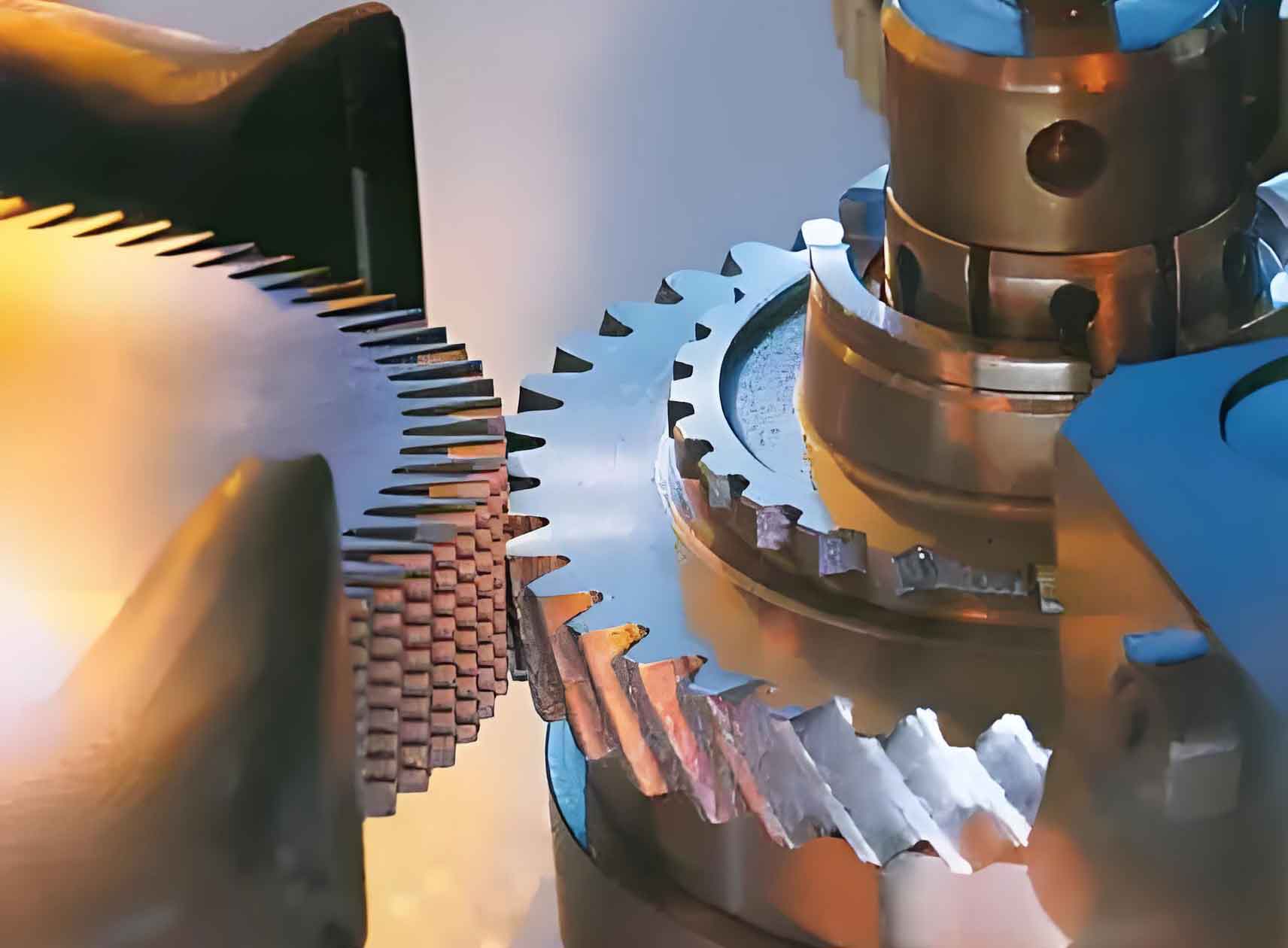
3. Selection of Gear Shaving Cutters
Tool material selection is critical for hard flank gear shaving. Recently developed high-speed steels like SF-9 (W10Mo4Cr4V3Al) and particularly M42 (W2Mo9.5Cr3.75V1.15Co5) show excellent performance. M42 offers high hardness (HRC 66.5–69) and superior hot hardness (HRC 53.5 at 600°C), making it highly suitable for medium-hard flank gear shaving. One sharpening can typically shave 1000–1500 gears.
The commonly used W18Cr4V material (HRC 62–65) is less suitable for shaving HRC 48–52 flanks. If such a cutter must be used, the following selections are recommended: a larger nominal pitch diameter; a spiral angle of 15° if possible; a cutter in its mid-life period (i.e., has shaved some pre-hard gears but not yet been re-sharpened); one that has undergone nitriding treatment; and a precision grade of at least B (Grade A for finishing Grade 6 gears).
For helical gear shaving, the crossed-axes angle (Σ) between the cutter and workpiece should not be excessively large, generally limited to 15°–20°. Larger angles accelerate tool dulling and chipping, and leave pronounced, regular mesh patterns on the tooth flank.
A standard shaving cutter with a true involute profile tends to produce a characteristic “mid-profile dip” or “hollow” at the pitch line of the shaved gear tooth, approximately 0.01–0.025 mm. To produce a true involute on the workpiece, the shaving cutter should be profile-modified during grinding, introducing a corresponding relief in its own profile. This improves final gear tooth form and can reduce gear noise by 1–2 dB. A mid-life cutter, having worn slightly more at the pitch diameter (0.005–0.015 mm), exhibits a natural form of this modification, reducing the mid-profile dip in the shaved gear compared to a brand-new cutter, yielding about 1 dB noise reduction. Tolerances for a re-sharpened, mid-life cutter should meet the following:
| Tolerance Item | Allowable Deviation (µm) |
|---|---|
| Tooth Profile Error | 5 |
| Adjacent Pitch Error | 3 |
| Pitch Accumulation Error | 10 |
| Radial Runout | 15 |
| Tooth Alignment (Directional) | 6 |
Using a brand-new, freshly sharpened cutter for hard flank gear shaving often yields poor results. Despite a sharp edge, it is prone to micro-chipping, resulting in a poor surface finish (▽3–▽4) with a rough, mesh-like pattern. Nitriding a W18Cr4V cutter can increase its surface hardness to approx. HRC 68, significantly improving its life for hard flank gear shaving.
4. Process Parameters, Cooling, and Lubrication
4.1. Selection of Feed Rates
Feed rates for post-hardening gear shaving should be lower than those for pre-hardening shaving. Recommended values for radial and longitudinal feeds are provided in the tables below.
| Gear Precision Grade | Target Surface Finish | Longitudinal Feed per Workpiece Rev (mm) | Radial Feed per Stroke (mm) |
|---|---|---|---|
| 6 | ≥ ▽8 | 0.15 – 0.25 | 0.005 – 0.01 |
| 7 | ≥ ▽7 | 0.26 – 0.40 | 0.01 – 0.015 |
| Workpiece Material (Hardness HRC 48–52) | Normal Module (mm) | ||
|---|---|---|---|
| < 2 | 2 – 4 | >4 – 8 | |
| 45, 50 Steel; 40Cr; 18CrMnTi | 120 – 150 | 100 – 130 | 80 – 110 |
4.2. Shaving Direction: Conventional vs. Climb Shaving
For hard flank gear shaving, the conventional or “up-shaving” method is generally preferred. In this method, the sliding direction of the cutter on the tooth flank is opposite to the axial feed direction of the workpiece. This creates a larger effective cutting angle, preventing excessive plastic deformation and “plowing” of the hard material. If the crossed-axes angle is relatively large and results in mesh patterns, the climb or “down-shaving” method (where sliding and feed directions are the same) can be tried. Regardless of the direction, it is essential to include 4–6 or more finishing passes without any radial feed at the end of the cycle. These spark-out passes are crucial for enhancing tooth profile accuracy, tooth alignment, and surface finish.
4.3. Cooling and Lubrication
Effective cooling and lubrication are indispensable for successful hard flank gear shaving. Sulfurized cutting oil is the recommended fluid. The supply must be ample, with a flow rate of no less than 5.5 liters per minute, to effectively dissipate heat, reduce friction, flush away chips, and prevent tool welding.
5. Conclusion
The gear shaving of medium-hard tooth flanks after heat treatment is a sophisticated but highly effective process for achieving precise, quiet, and durable gears in high-volume production. Its success is not based on a single factor but on a holistic and tightly controlled system. This system encompasses precision-engineered gear blanks, optimized pre-hard machining with calculated stock allowances, meticulous heat treatment to control distortion and decarburization, robust and precise shaving machine tooling, specially selected or treated shaving cutters—often in their optimal mid-life state—and carefully chosen cutting parameters with ample cooling. When all these elements are aligned, the gear shaving process transcends a mere finishing operation; it becomes a reliable and economical method for correcting heat treatment distortions and finalizing critical gear tooth geometry, directly contributing to the performance demands of modern mechanical transmissions. Mastering hard flank gear shaving requires deep process understanding and rigorous attention to each detail, from the initial blank to the final spark-out pass.