
In the field of precision gear manufacturing, gear shaving is a critical finishing process used to improve the accuracy and surface quality of gears. However, one persistent issue that arises during gear shaving is the tooth profile concave error, which detrimentally affects gear performance by increasing vibration, noise, and reducing service life. Understanding and predicting this error is essential for producing high-precision gears that meet the demands of modern technology. In this article, I present a comprehensive study on a multi-source coupled prediction model for the concave error in gear shaving, focusing on the axial gear shaving method. The model integrates various factors such as installation errors, gear shaving contact ratio, and machine tool movements, coupling them into a single parameter—the mesh point single cutting area—to quantitatively predict and analyze the formation mechanism of the concave error.
The tooth profile concave error in gear shaving has been traditionally studied through single-factor analyses, including mesh point load, induced normal curvature, relative sliding velocity, elastic-plastic deformation, cutting forces, and installation errors. While these studies provide insights, they often fall short in revealing the underlying mechanisms due to the complex interactions among multiple factors. For instance, prior research has suggested that uneven load distribution, excessive cutting at the pitch circle, or plastic deformation at mesh points might be primary causes. However, a holistic approach that couples these factors is necessary for accurate prediction and control. My work addresses this gap by developing a model that simultaneously considers installation errors—such as axial angle error, center distance error, and high-speed axis synchronization error—along with kinematic parameters and gear geometry, thereby offering a more robust framework for error prediction.
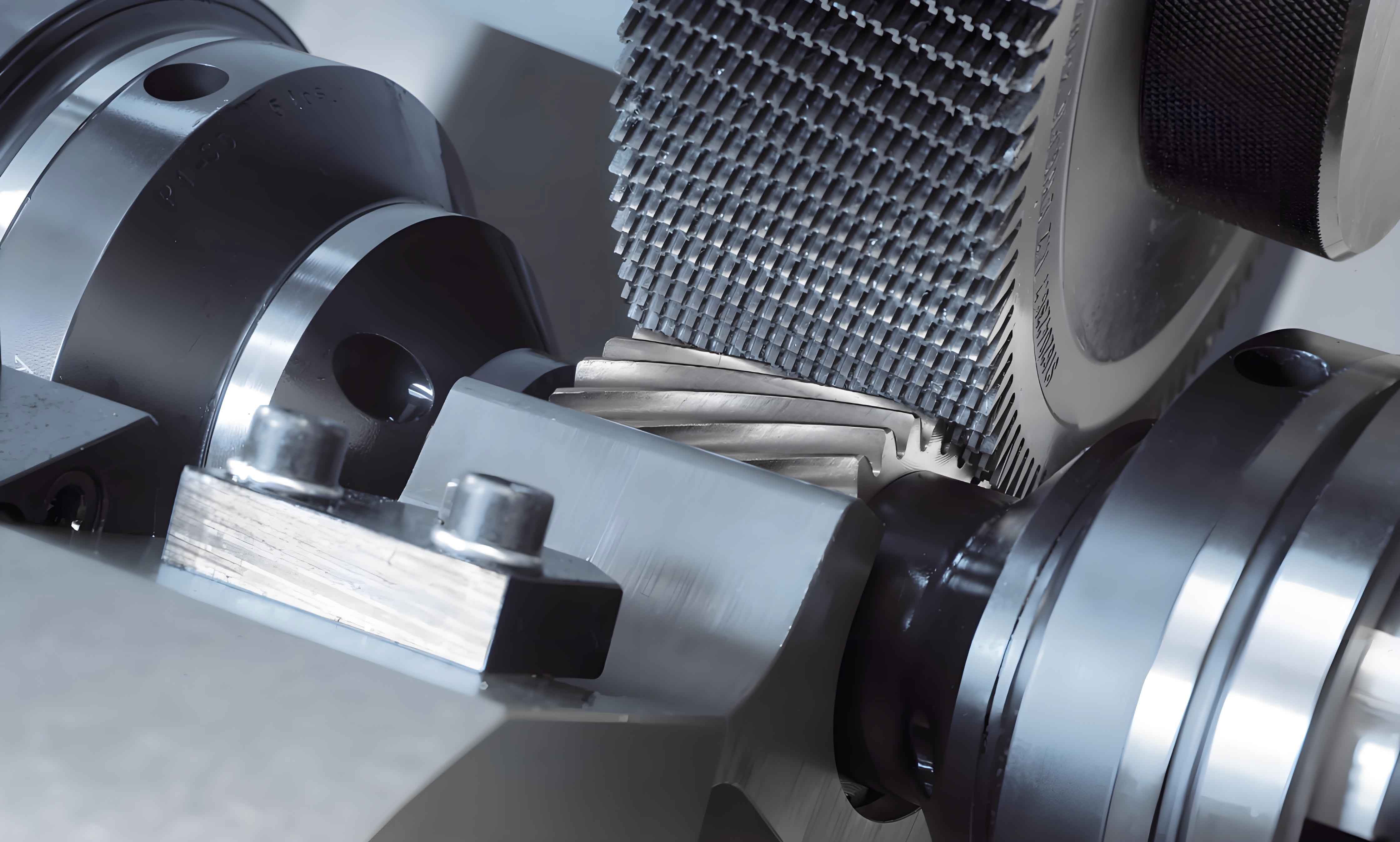
To begin, I establish an analytical model for gear shaving that incorporates installation errors. In gear shaving, the relative motion between the shaving cutter and the workpiece gear is crucial, and errors in alignment can significantly impact the final tooth profile. The installation errors considered include the axial angle error $\Delta\Sigma$, center distance error $\Delta a$, and synchronization errors of the high-speed axes $\Delta\omega_1$ and $\Delta\omega_2$. These errors manifest as deviations in the gear tooth flank, affecting the mesh point geometry and cutting conditions. The coordinate systems for the shaving cutter and workpiece gear are defined, with transformations accounting for the errors. The relative sliding velocity $\mathbf{V}$ at the mesh point, considering these errors, is derived as:
$$
\begin{aligned}
V_x &= -\omega_2′ z \sin\Sigma’ + \omega_2′ y \cos\Sigma’ – \omega_1′ y, \\
V_y &= \omega_1′ x – \omega_2′ (x – a’) \cos\Sigma’ – v_{02} \sin\Sigma’, \\
V_z &= \omega_2′ (x – a’) \sin\Sigma’ – v_{02} \cos\Sigma’,
\end{aligned}
$$
where $\Sigma’ = \Sigma + \Delta\Sigma$, $a’ = a + \Delta a$, $\omega_1′ = \omega_1 + \Delta\omega_1$, and $\omega_2′ = \omega_2 + \Delta\omega_2$. Here, $(x, y, z)$ are the coordinates of the mesh point in the fixed coordinate system $S$, $\Sigma$ is the theoretical axial angle, $a$ is the theoretical center distance, $\omega_1$ and $\omega_2$ are the angular velocities of the shaving cutter and workpiece gear, respectively, and $v_{02}$ is the axial feed velocity of the workpiece gear. The cutting velocity $V_1$, which is the component of $\mathbf{V}$ perpendicular to the cutting edge, is given by:
$$
V_1 = \omega_2 (x – a’) \sin\Sigma’ \cos\beta_2 + \omega_2 (x – a’) \cos\Sigma’ \sin\beta_1 + v_{02} \sin\Sigma’ \sin\beta_1 – v_{02} \cos\Sigma’ \cos\beta_2 – \omega_1 x \sin\beta_1,
$$
where $\beta_1$ and $\beta_2$ are the helix angles of the shaving cutter and workpiece gear, respectively.
The installation errors alter the mesh point trajectory, which can be described using gear meshing principles. The modified mesh point position vector $\mathbf{r}_e^{(2)}$ is expressed as:
$$
\mathbf{r}_e^{(2)}(u_2, \theta_2; \Sigma’, a’, \omega_1′, \omega_2′) = \mathbf{M}_{21} \mathbf{r}^{(1)}(u_1, \theta_1),
$$
where $\mathbf{r}^{(1)}$ is the tooth surface equation of the shaving cutter in coordinate system $S_1$, $\mathbf{M}_{21}$ is the transformation matrix from $S_1$ to $S_2$, and $(u, \theta)$ are the surface parameters. Based on this, the induced normal curvature $K$ at the mesh point is calculated as:
$$
K = \frac{\sin\lambda – \left[1 – \frac{1}{r_{b1}} + \frac{P^2}{r_{b1}} \sin\Sigma’ \cos\Delta_1 + P \cos\Sigma’\right]}{\sqrt{x^2 + y^2 + z^2}},
$$
with $\Delta_1 = \arctan\left(\frac{x}{y}\right) – \arcsin\left[r_{b1}(x^2 + y^2)^{-\frac{1}{2}}\right]$, where $r_{b1}$ is the base radius of the shaving cutter, $\lambda$ is the rotation parameter of the tooth profile, and $P$ is the helical parameter of the shaving cutter tooth surface.
The depth of cut $a_p$ at the mesh point is influenced by radial feed, mesh point indentation, and tooth bending. It is defined as:
$$
a_p = \Delta f_r + \delta_c + \delta_w,
$$
where $\Delta f_r$ is the radial feed per pass, $\delta_c$ is the indentation depth at the mesh point, and $\delta_w$ is the total bending deformation of the tooth. The radial feed per pass and indentation depth are given by:
$$
\Delta f_r = \frac{\Delta}{2 \sin\alpha}, \quad \delta_c = e \left( \frac{3\pi \lambda F_{nc}}{2 \sum_{i=1}^m K c_i^{3/2}} \right)^{\frac{2}{3}},
$$
where $\Delta$ is the total cutting allowance, $\alpha$ is the normal pressure angle, $e$ is the ratio of gullet spacing to width in the shaving cutter, $c_i$ depends on the principal curvatures, and $F_{nc}$ is the normal cutting force at the mesh point. The bending deformation $\delta_w$ is simplified using a cantilever beam model for the workpiece gear, leading to:
$$
\delta_w = \delta_{F_{AA}w} – \delta_{F_{BA}w},
$$
where $\delta_{F_{AA}w}$ and $\delta_{F_{BA}w}$ are bending deformations at point A due to radial forces $F_A$ and $F_B$ at mesh points A and B, respectively. Additionally, the center distance error $\Delta a$ affects the depth of cut, introducing an error $\Delta a_p$:
$$
\Delta a_p = \sqrt{(z \sin\Sigma’ – y \cos\Sigma’)^2 + (x + a’)^2} \sin\Sigma’.
$$
Thus, the effective depth of cut per radial feed becomes:
$$
a_p = \frac{\Delta}{2 \sin\alpha} + e \left( \frac{3\pi \lambda F_{nc}}{2 \sum_{i=1}^m K c_i^{3/2}} \right)^{\frac{2}{3}} + \sum_{i=1}^n (\delta_{F_{AA}v_i} – \delta_{F_{BA}v_i}) + \sqrt{(z \sin\Sigma’ – y \cos\Sigma’)^2 + (x + a’)^2} \sin\Sigma’.
$$
This analytical model comprehensively accounts for installation errors, kinematics, and deformation, providing a foundation for multi-factor coupling in gear shaving.
To integrate the multi-source factors, I introduce the concept of the mesh point single cutting area $U$. This parameter couples the effects of contact ratio, machine tool movements, and installation errors into a single metric that represents the area removed from the workpiece tooth flank during one mesh point engagement. The single cutting area is derived from a single-point cutting model, considering three contact states: initial contact, maximum depth of cut, and final contact. Let $\phi_1$, $\phi_2$, and $\phi_3$ be the rotation angles of the shaving cutter corresponding to these states. The actual depth of cut $a_p’$ varies with the induced curvature and cutter rotation, satisfying:
$$
a_p'(\phi) =
\begin{cases}
a_p(\phi) – \int_{s(\phi)}^{s(\phi_2)} K(\phi) \, ds, & \phi_1 < \phi < \phi_2, \\
a_p(\phi) – \int_{s(\phi_2)}^{s(\phi)} K(\phi) \, ds, & \phi_2 < \phi < \phi_3,
\end{cases}
$$
where $s(\phi) = \frac{r_{b1} \phi}{2\pi^2 \times 64800}$ is the arc length along the cutting edge. The cutting length $l$ during the single engagement is:
$$
l = \int V_1(\phi) \, d\phi,
$$
and the single cutting area $U$ is then:
$$
U = \int_{\phi_1}^{\phi_3} a_p'(\phi) V_1(\phi) \, d\phi.
$$
This formulation effectively combines the influences of various parameters into $U$, enabling a unified analysis of their impact on the tooth profile concave error in gear shaving.
Based on the single cutting area, I develop a prediction model for the concave error using a genetic algorithm-improved backpropagation neural network (GA-BP). The concave error is typically measured as the tooth profile form deviation, which is the distance between two identical curves enclosing the actual profile trace. Since the single cutting area correlates with the depth of the profile trace, its maximum $U_{\text{max}}$ and minimum $U_{\text{min}}$ values, along with the angular position $\theta_{\text{max}}$ of $U_{\text{max}}$, are selected as input features. The output is the concave error magnitude $E$ and its center position $\theta$. The GA-BP network optimizes the initial weights and thresholds through genetic algorithms, enhancing prediction accuracy. The fitness function for the genetic algorithm is the inverse of the mean square error (MSE):
$$
f(x) = \frac{1}{\frac{\sum (T – O)^2}{N}},
$$
where $T$ is the target output, $O$ is the predicted output, and $N$ is the number of samples. This approach allows for quantitative prediction of the concave error while accounting for multi-source coupling in gear shaving.
To validate the model, I conduct experiments using small-module gears with a module of 4.2333 mm, 17 teeth, pressure angle of 20°, and profile shift coefficient of 0.0468. Four shaving cutters with different contact ratios are selected, as summarized in Table 1. The gear shaving process is performed on a YW423 shaving machine, with variations in spindle speed $n$, radial feed speed $V_{\text{rad}}$, axial feed speed $V_{\text{ax}}$, and installation errors. The single cutting area is computed for each parameter set, and the concave error is measured using a universal gear measuring instrument GM3040a.
| Parameter | Cutter 1 | Cutter 2 | Cutter 3 | Cutter 4 |
|---|---|---|---|---|
| Number of Teeth | 53 | 52 | 53 | 52 |
| Module (mm) | 4.2333 | 4.2333 | 4.2333 | 4.2333 |
| Pressure Angle (°) | 20 | 20 | 20 | 20 |
| Helix Angle (°) | 15 | 15 | 10 | 10 |
| Profile Shift Coefficient | -0.3793 | -0.3744 | -0.3649 | -0.3603 |
| Contact Ratio | 1.8294 | 1.7712 | 1.7133 | 1.6548 |
A total of 24 parameter combinations are tested, with 14 sets used for training the GA-BP model and 10 sets for validation. The network configuration includes 10 hidden neurons, a learning rate of 0.01, and a target error of 0.0001 over 10,000 training steps. The prediction results are compared with experimental measurements, as shown in Table 2. The maximum error in concave error prediction is 9.35%, with an average error of 6.93%, while the center position prediction has a maximum error of 3.89% and an average error of 2.19%. These results demonstrate the model’s accuracy and feasibility for predicting concave errors in gear shaving.
| Data No. | $U_{\text{max}}$ (μm²) | $U_{\text{min}}$ (μm²) | $\theta_{\text{max}}$ (°) | $E$ Predicted (mm) | $E$ Measured (mm) | Error (%) | $\theta$ Predicted (°) | $\theta$ Measured (°) | Error (%) |
|---|---|---|---|---|---|---|---|---|---|
| 1 | 2.157 | 0.745 | 27.11 | 0.0303 | 0.0321 | 5.56 | 27.57 | 26.96 | 2.26 |
| 2 | 2.349 | 0.846 | 28.57 | 0.0249 | 0.0267 | 6.48 | 29.08 | 27.99 | 3.89 |
| 3 | 2.235 | 0.694 | 27.76 | 0.0297 | 0.0319 | 6.78 | 28.99 | 27.95 | 3.72 |
| 4 | 2.219 | 0.679 | 27.78 | 0.0315 | 0.0330 | 4.53 | 28.47 | 27.20 | 4.67 |
| 5 | 1.216 | 0.397 | 25.45 | 0.0213 | 0.0229 | 6.95 | 25.37 | 25.76 | 1.51 |
| 6 | 1.516 | 0.541 | 26.24 | 0.0231 | 0.0249 | 7.15 | 26.66 | 26.53 | 0.49 |
| 7 | 1.624 | 0.467 | 26.78 | 0.0239 | 0.0261 | 8.34 | 27.48 | 26.71 | 2.88 |
| 8 | 1.245 | 0.347 | 25.54 | 0.0227 | 0.0246 | 7.76 | 26.42 | 26.38 | 0.15 |
| 9 | 0.804 | 0.216 | 24.78 | 0.0181 | 0.0194 | 6.46 | 25.23 | 25.45 | 0.86 |
| 10 | 0.756 | 0.214 | 24.54 | 0.0160 | 0.0176 | 9.35 | 24.92 | 25.28 | 1.42 |
The relationship between the single cutting area and the concave error is further analyzed. As illustrated in Figure 5 (conceptual), the concave error initially increases with the single cutting area but decreases after exceeding a certain threshold. This indicates that excessive cutting is a primary cause of the concave error in gear shaving, and there exists an optimal range for the single cutting area to minimize error. The curve peaks at a maximum error point, suggesting that process parameters should be adjusted to avoid this peak. Moreover, gear shaving involves multiple cutting engagements; the initial concave error reduces the induced curvature at that location, thereby decreasing subsequent single cutting areas and leading to error correction. Thus, a larger initial single cutting area accelerates this correction, explaining the decrease in error beyond the threshold.
The center of the concave error aligns closely with the position of the maximum single cutting area, and as the single cutting area increases, the center shifts toward the tooth tip. This is because the maximum single cutting area dictates the error center, and increased radial forces cause greater bending deformation on the tooth tip side, enlarging the single cutting area more rapidly there and shifting the maximum toward the tip.
To understand how cutting parameters affect the single cutting area, I perform a sensitivity analysis using a one-variable-at-a-time approach. Table 3 lists the maximum single cutting area $U_{\text{max}}$ for different parameter sets. The contact ratio in gear shaving has a non-linear effect: as it increases from 1.6548 to 1.7712, $U_{\text{max}}$ decreases, but further increase to 1.8294 leads to a rise. This is because higher contact ratios reduce induced curvature but increase cutting length; beyond a point, the length effect dominates, enlarging the single cutting area and exacerbating the concave error. Radial feed speed $V_{\text{rad}}$ and axial feed speed $V_{\text{ax}}$ are positively correlated with $U_{\text{max}}$, while spindle speed $n$ is negatively correlated. Installation errors—axial angle error $\Delta\Sigma$, center distance error $\Delta a$, and synchronization error $\Delta\omega_1$—also increase $U_{\text{max}}$, with $\Delta\Sigma$ and $\Delta a$ having the most significant impact due to their direct influence on the depth of cut.
| No. | Contact Ratio | $V_{\text{ax}}$ (mm/s) | $V_{\text{rad}}$ (μm/s) | $n$ (r/s) | $\Delta\Sigma$ (°) | $\Delta a$ (mm) | $\Delta\omega_1$ (r/min) | $U_{\text{max}}$ (μm²) |
|---|---|---|---|---|---|---|---|---|
| 1 | 1.8294 | 1.0 | 5.8 | 6 | 0.1 | 0.01 | 0.01 | 2.157 |
| 2 | 1.7712 | 1.0 | 5.8 | 6 | 0.1 | 0.01 | 0.01 | 2.349 |
| 3 | 1.7133 | 1.0 | 5.8 | 6 | 0.1 | 0.01 | 0.01 | 2.235 |
| 4 | 1.6548 | 1.0 | 5.8 | 6 | 0.1 | 0.01 | 0.01 | 2.219 |
| 5 | 1.8294 | 1.0 | 5.8 | 6 | 0.1 | 0.01 | 0.01 | 1.216 |
| 6 | 1.8294 | 1.0 | 5.8 | 8 | 0.1 | 0.01 | 0.01 | 1.516 |
| 7 | 1.8294 | 0.5 | 5.8 | 6 | 0.1 | 0.01 | 0.01 | 1.624 |
| 8 | 1.8294 | 0.85 | 5.8 | 6 | 0.1 | 0.01 | 0.01 | 1.245 |
| 9 | 1.8294 | 1.0 | 3.3 | 6 | 0.1 | 0.01 | 0.01 | 0.804 |
| 10 | 1.8294 | 1.0 | 5.8 | 6 | 0.3 | 0.01 | 0.01 | 1.956 |
| 11 | 1.8294 | 1.0 | 5.8 | 6 | 0.1 | 0.03 | 0.01 | 1.534 |
| 12 | 1.8294 | 1.0 | 5.8 | 6 | 0.1 | 0.01 | 0.03 | 1.227 |
From this analysis, practical recommendations for gear shaving emerge. To minimize the concave error, it is advisable to optimize the contact ratio—avoiding excessively high values—increase spindle speed, reduce radial and axial feed speeds, and严格控制 installation errors, particularly axial angle and center distance errors. These adjustments help reduce the single cutting area, thereby mitigating the concave error in gear shaving.
In conclusion, the multi-source coupled prediction model presented here offers a significant advancement in understanding and controlling the tooth profile concave error in gear shaving. By integrating installation errors, kinematic parameters, and gear geometry into a single cutting area parameter, and employing a GA-BP neural network for prediction, the model achieves accurate quantitative forecasts with average errors below 7% for error magnitude and 3% for center position. The study reveals that excessive single cutting area is a primary driver of the concave error, and the error center shifts with changes in this area. Furthermore, the effects of cutting parameters on the single cutting area are elucidated, providing actionable insights for process optimization. This work underscores the importance of multi-factor coupling in gear shaving analysis and paves the way for more precise and reliable gear manufacturing techniques. Future research could extend this model to other gear shaving methods or incorporate real-time monitoring for adaptive control, further enhancing the quality and efficiency of gear shaving processes.
The gear shaving process, as detailed, involves complex interactions that require careful consideration of multiple variables. The model’s ability to couple these variables into a manageable parameter like the single cutting area simplifies analysis without sacrificing accuracy. Moreover, the use of advanced neural networks like GA-BP enhances predictive capabilities, making it a valuable tool for industries reliant on high-precision gears. As technology advances, such models will become increasingly integral to automated manufacturing systems, ensuring consistent quality in gear shaving applications across automotive, aerospace, and robotics sectors. By continuously refining these models and incorporating more data, we can push the boundaries of gear accuracy and performance, meeting the ever-growing demands of modern engineering.