
The pursuit of compact, high-ratio, and reliable transmission systems for demanding applications like robotics and aerospace has led to significant interest in novel drive principles. Among these, the nutation drive, inspired by gyroscopic motion, presents a compelling alternative to conventional speed reducers. The core of a single-stage nutation drive typically consists of a pair of meshing bevel gears. This article provides a comprehensive kinematic analysis of such a drive system from a first-person perspective in engineering research. We will delve into the fundamental principles, derive the governing equations of motion using Euler’s formalism, and analyze the relative motion at the gear interface by employing the theory of conjugate curves, thereby simplifying the complex three-dimensional interaction inherent to intersecting-axis bevel gears.
Fundamental Principle of the Nutation Drive
The operational principle of a nutation drive can be understood through its basic mechanical layout. The system is designed for coaxial input and output shafts. The input shaft is connected to an inclined axle, which forms a fixed angle, known as the nutation angle (θ), with the main input axis. A bevel gear, termed the nutating gear, is mounted on this inclined axle but is prevented from rotating about its own axis by a pin or similar constraint. A second, internally-toothed bevel gear, termed the fixed or output gear, is mounted on the output shaft and meshes with the nutating gear.
When the input shaft rotates, it imparts a sweeping motion to the inclined axle. The constraint on the nutating gear prevents its simple spin, forcing it to undergo a complex motion known as nutation—a rotation about a fixed point. This motion is essentially the gyroscopic precession of the nutating bevel gear’s axis. The meshing of the nutating bevel gear with the fixed internal bevel gear converts this nutating motion into a slow, continuous rotation of the output shaft. The significant speed reduction is achieved because for every full rotation of the input shaft, the nutating gear only advances a few teeth on the fixed gear. This mechanism offers advantages such as a high reduction ratio in a single stage, compactness, and smooth torque transmission.
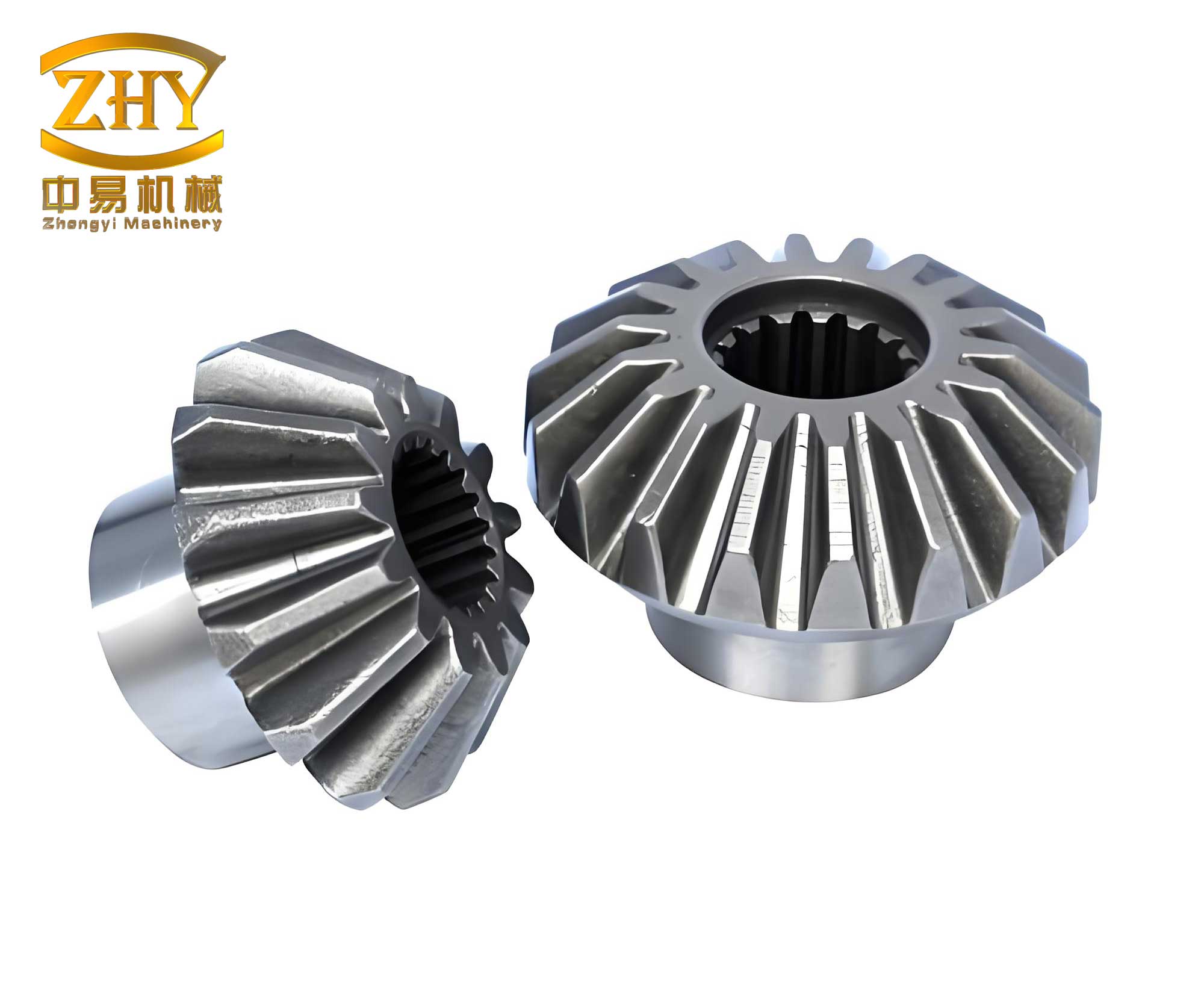
Kinematics of the Nutating Bevel Gear: Euler’s Angles
To mathematically describe the motion of the nutating bevel gear, we treat it as a rigid body rotating about a fixed point (the conic apex, common to both bevel gears). The most effective way to parameterize this motion is through Euler’s angles. We define two coordinate systems: a fixed (or space) frame O-ξηζ and a body-fixed frame O-xyz attached to the nutating bevel gear, both originating at the fixed point O.
The orientation of the body frame relative to the fixed frame is described by three successive rotations:
- Precession (φ): A rotation about the fixed Oζ axis.
- Nutation (θ): A rotation about the line of nodes (an intermediate axis, ON). In our drive, the nutation angle is constant and determined by the pitch cone angles of the bevel gears: θ = π – (δ₁ + δ₂). The negative sign convention indicates its direction relative to the initial position.
- Spin (ψ): A rotation about the body-fixed Oz axis, which coincides with the axis of the nutating bevel gear.
For the nutation drive, these angles are functions of time. The input shaft’s rotation drives the precession, so φ = ωHt, where ωH is the input angular velocity. The nutation angle θ is constant. The spin angle ψ arises from the relative motion between the nutating gear and the input; we can express it as ψ = -ω1H t, where ω1H is the relative angular speed of the nutating bevel gear about its own axis.
The absolute angular velocity vector ω of the nutating bevel gear is the vector sum of the angular velocities associated with each Euler angle:
$$ \boldsymbol{\omega} = \dot{\varphi} \mathbf{e}_3 + \dot{\theta} \mathbf{i}_1 + \dot{\psi} \mathbf{k} $$
where \(\mathbf{e}_3\) is the unit vector along Oζ, \(\mathbf{i}_1\) is along the line of nodes ON, and \(\mathbf{k}\) is along the body axis Oz.
Angular Velocity in the Body Frame (O-xyz)
We project ω onto the body-fixed axes (x, y, z). This requires expressing the unit vectors \(\mathbf{e}_3\) and \(\mathbf{i}_1\) in terms of \(\mathbf{i}, \mathbf{j}, \mathbf{k}\). Through geometric decomposition, we arrive at the Euler kinematic equations in the body frame:
$$
\begin{aligned}
\omega_x &= \dot{\varphi} \sin\theta \sin\psi + \dot{\theta} \cos\psi = \omega_H \sin\theta \sin(\omega_1^H t) \\
\omega_y &= \dot{\varphi} \sin\theta \cos\psi – \dot{\theta} \sin\psi = \omega_H \sin\theta \cos(\omega_1^H t) \\
\omega_z &= \dot{\varphi} \cos\theta + \dot{\psi} = \omega_H \cos\theta – \omega_1^H
\end{aligned}
$$
Since θ is constant, \(\dot{\theta} = 0\), which simplifies the expressions. The motion described is a steady precession with constant nutation.
Angular Velocity in the Fixed Frame (O-ξηζ)
Similarly, projecting ω onto the fixed axes provides its components relative to the global frame. This perspective is crucial for understanding the motion as seen from the fixed internal bevel gear.
$$
\begin{aligned}
\omega_\xi &= \dot{\theta} \cos\varphi + \dot{\psi} \sin\theta \sin\varphi = -\omega_1^H \sin\theta \sin(\omega_H t) \\
\omega_\eta &= \dot{\theta} \sin\varphi – \dot{\psi} \sin\theta \cos\varphi = \omega_1^H \sin\theta \cos(\omega_H t) \\
\omega_\zeta &= \dot{\varphi} + \dot{\psi} \cos\theta = \omega_H – \omega_1^H \cos\theta
\end{aligned}
$$
| Parameter | Symbol | Expression/Value | Description |
|---|---|---|---|
| Precession Angle | φ | ωH t | Driven by input shaft. |
| Nutation Angle | θ | Constant = π – (δ₁+δ₂) | Defined by bevel gear geometry. |
| Spin Angle | ψ | -ω1H t | Relative rotation of the nutating bevel gear. |
| Body-frame ωx | ωx | ωH sinθ sin(ω1H t) | Time-varying component. |
| Body-frame ωz | ωz | ωH cosθ – ω1H | Constant component along the bevel gear axis. |
| Fixed-frame ωζ | ωζ | ωH – ω1H cosθ | Component along the fixed output axis. |
Gear Meshing and Relative Motion: Conjugate Curve Theory
Analyzing the contact between the two meshing bevel gears traditionally relies on complex spatial conjugate surface theory. However, a powerful simplification is offered by the concept of conjugate curves. This theory posits that the continuous transmission of motion between two gears can be analyzed by considering a pair of smooth curves (one on each gear) that remain in contact according to the prescribed motion law. The actual tooth surfaces are then generated as envelopes of families of these curves or as surfaces containing them. For bevel gears, a natural choice for such a curve is the spherical involute, which lies on the pitch sphere.
This approach significantly reduces the complexity of the kinematic analysis for intersecting-axis gears like our bevel gears, transforming a challenging 3D surface contact problem into a more manageable curve contact problem.
Coordinate Systems for Meshing Analysis
To apply this theory, we establish a set of coordinate systems, as shown conceptually in the provided figure.
- S0(O0; ξ, η, ζ): A fixed frame where the ζ-axis aligns with the axis of the fixed internal bevel gear.
- S1(O1; x1, y1, z1): A frame rigidly attached to the fixed bevel gear.
- Sp(Op; xp, yp, zp): An auxiliary fixed frame where the zp-axis aligns with the axis of the nutating bevel gear in its initial position. The angle between ζ and zp is the nutation angle θ.
- S2(O2; x2, y2, z2): A frame rigidly attached to the nutating bevel gear.
The motion involves the fixed gear rotating about ζ by an angle φ1, and the nutating gear undergoing its compound nutation motion, which includes the precession φ about ζ (equivalent to the input rotation) and the spin ψ about its own axis. The transmission ratio i is defined as i = ωH / ω1, where ω1 is the output angular velocity (dφ1/dt). From kinematics, it can be shown that ω1H = i ω1, and therefore φ = i φ1.
Homogeneous Transformation Matrices
The relative positions and orientations of these coordinate systems are described using 4×4 homogeneous transformation matrices, which combine rotation and translation. The transformations between key frames are:
From S1 (fixed gear) to S0 (fixed space):
$$ \mathbf{M}_{01} = \begin{bmatrix}
\cos\varphi_1 & -\sin\varphi_1 & 0 & 0 \\
\sin\varphi_1 & \cos\varphi_1 & 0 & 0 \\
0 & 0 & 1 & 0 \\
0 & 0 & 0 & 1
\end{bmatrix} = \begin{bmatrix}
\cos(\varphi/i) & -\sin(\varphi/i) & 0 & 0 \\
\sin(\varphi/i) & \cos(\varphi/i) & 0 & 0 \\
0 & 0 & 1 & 0 \\
0 & 0 & 0 & 1
\end{bmatrix} $$
From S0 to Sp: This is a static rotation by θ about the ξ-axis.
$$ \mathbf{M}_{p0} = \begin{bmatrix}
1 & 0 & 0 & 0 \\
0 & \cos\theta & -\sin\theta & 0 \\
0 & \sin\theta & \cos\theta & 0 \\
0 & 0 & 0 & 1
\end{bmatrix} $$
From Sp to S2 (nutating gear): This represents the spin of the nutating bevel gear about its axis.
$$ \mathbf{M}_{2p} = \begin{bmatrix}
\cos\varphi & -\sin\varphi & 0 & 0 \\
\sin\varphi & \cos\varphi & 0 & 0 \\
0 & 0 & 1 & 0 \\
0 & 0 & 0 & 1
\end{bmatrix} $$
The complete transformation from the fixed bevel gear frame (S1) to the nutating bevel gear frame (S2) is given by the product:
$$ \mathbf{M}_{21} = \mathbf{M}_{2p} \mathbf{M}_{p0} \mathbf{M}_{01} $$
$$
\mathbf{M}_{21} = \begin{bmatrix}
\cos\varphi_1 \cos\varphi + \sin\varphi \sin\varphi_1 \cos\theta & \cos\varphi \cos\theta \sin\varphi_1 – \cos\varphi_1 \sin\varphi & \sin\varphi_1 \sin\theta & 0 \\
\cos\varphi_1 \cos\theta \sin\varphi – \cos\varphi \sin\varphi_1 & \cos\varphi_1 \cos\theta \cos\varphi + \sin\varphi \sin\varphi_1 & \cos\varphi_1 \sin\theta & 0 \\
-\sin\theta \sin\varphi & -\sin\theta \cos\varphi & \cos\theta & 0 \\
0 & 0 & 0 & 1
\end{bmatrix}
$$
Derivation of Relative Velocity at the Meshing Point
The fundamental condition for proper conjugate motion between the two bevel gears is that the relative velocity at the point of contact between the postulated curves must lie in the common tangent plane. This ensures no penetration or separation. Therefore, calculating this relative velocity is paramount.
Let \(\mathbf{r}_1^1\) denote the position vector of a potential contact point on the tooth curve of the fixed bevel gear, expressed in its own frame S1. Its representation in the fixed frame S0 is \(\mathbf{r}_1^0 = \mathbf{M}_{01} \mathbf{r}_1^1\).
The absolute angular velocities of the two gears in the fixed frame S0 are:
- Fixed bevel gear: \(\boldsymbol{\omega}_1^0 = (0, 0, \omega_1)^T = (0, 0, \omega_H / i)^T\).
- Nutating bevel gear: \(\boldsymbol{\omega}_2^0 = (\omega_\xi, \omega_\eta, \omega_\zeta)^T\) as derived from Euler’s equations.
The relative velocity of the nutating gear with respect to the fixed gear, observed in the fixed frame S0, is given by:
$$ \mathbf{v}_{12}^0 = \boldsymbol{\omega}_1^0 \times \mathbf{r}_1^0 – \boldsymbol{\omega}_2^0 \times \mathbf{r}_1^0 $$
This cross product can be expressed in matrix form using skew-symmetric matrices. Let \(\mathbf{W}\) be the skew-symmetric matrix representation of an angular velocity vector \(\boldsymbol{\omega} = (\omega_x, \omega_y, \omega_z)^T\), such that \(\mathbf{W} \mathbf{r} = \boldsymbol{\omega} \times \mathbf{r}\):
$$ \mathbf{W} = \begin{bmatrix}
0 & -\omega_z & \omega_y \\
\omega_z & 0 & -\omega_x \\
-\omega_y & \omega_x & 0
\end{bmatrix} $$
Thus, we define \(\mathbf{W}_1^0\) for the fixed gear’s rotation and \(\mathbf{W}_2^0\) for the nutating gear’s rotation. The relative velocity in S0 becomes:
$$ \mathbf{v}_{12}^0 = \mathbf{W}_1^0 \mathbf{r}_1^0 – \mathbf{W}_2^0 \mathbf{r}_1^0 = (\mathbf{W}_1^0 – \mathbf{W}_2^0) \mathbf{M}_{01} \mathbf{r}_1^1 $$
For meshing analysis, it is often more convenient to express this relative velocity in the frame of one of the gears, say the fixed gear frame S1. This is achieved by the inverse transformation:
$$ \mathbf{v}_{12}^1 = \mathbf{M}_{10} \mathbf{v}_{12}^0 = \mathbf{M}_{10} (\mathbf{W}_1^0 – \mathbf{W}_2^0) \mathbf{M}_{01} \mathbf{r}_1^1 $$
Since \(\mathbf{M}_{10} = \mathbf{M}_{01}^{-1} = \mathbf{M}_{01}^T\) (for rotation matrices), we have the final compact form:
$$ \mathbf{v}_{12}^1 = \mathbf{M}_{01}^T (\mathbf{W}_1^0 – \mathbf{W}_2^0) \mathbf{M}_{01} \mathbf{r}_1^1 $$
This equation \(\mathbf{v}_{12}^1 (\mathbf{r}_1^1, t) = 0\) (in the direction normal to the tooth curve) is central to solving for the gear tooth profile or for performing contact analysis under the conjugate curve assumption. The matrices \(\mathbf{W}_1^0\) and \(\mathbf{W}_2^0\) are constructed from the constant ω1 and the time-varying components (ωξ, ωη, ωζ) from the Euler analysis, respectively.
| Symbol | Expression | Description |
|---|---|---|
| \(\mathbf{r}_1^1\) | \([x_1, y_1, z_1, 1]^T\) | Contact point in fixed bevel gear coordinates (S1). |
| \(\mathbf{M}_{01}\) | Rotation by φ1 = φ/i about ζ. | Transforms from S1 to fixed frame S0. |
| \(\mathbf{W}_1^0\) | \(\begin{bmatrix} 0 & -\omega_1 & 0 \\ \omega_1 & 0 & 0 \\ 0 & 0 & 0 \end{bmatrix}\) | Skew-sym matrix for fixed bevel gear angular velocity. |
| \(\mathbf{W}_2^0\) | \(\begin{bmatrix} 0 & -\omega_\zeta & \omega_\eta \\ \omega_\zeta & 0 & -\omega_\xi \\ -\omega_\eta & \omega_\xi & 0 \end{bmatrix}\) | Skew-sym matrix for nutating bevel gear angular velocity. |
| \(\mathbf{v}_{12}^1\) | \(\mathbf{M}_{01}^T (\mathbf{W}_1^0 – \mathbf{W}_2^0) \mathbf{M}_{01} \mathbf{r}_1^1\) | Relative velocity vector expressed in the fixed bevel gear frame (S1). |
Transmission Ratio and Kinematic Relationship
A critical outcome of this kinematic analysis is the derivation of the transmission ratio for the bevel gear nutation drive. From the geometry of motion and the condition that the bevel gears roll without slip at their pitch cones, a relationship between the input rotation (φ), the output rotation (φ1), and the spin (ψ) can be established. The fundamental kinematic constraint stems from the fact that the angular velocity component of the nutating bevel gear along the common element of contact must match the required rolling condition.
Analyzing the angular velocity \(\boldsymbol{\omega}_2^0\) of the nutating gear, its component along the output axis (ζ) is ωζ = ωH – ω1H cosθ. For a meshing condition with the fixed gear rotating at ω1, a detailed engagement analysis yields the relationship:
$$ \omega_1^H = \frac{\omega_H}{1 – (N_f / N_n) \cos \theta} $$
where \(N_f\) and \(N_n\) are the number of teeth on the fixed internal bevel gear and the nutating bevel gear, respectively. The transmission ratio i is then:
$$ i = \frac{\omega_H}{\omega_1} = \frac{N_f}{N_n – N_f \cos \theta} $$
This formula highlights the role of the nutation angle θ and the tooth numbers of the bevel gears in achieving high reduction ratios. For example, with θ close to 180° (i.e., nearly opposing axes) and a small difference in tooth numbers, a very large ratio can be obtained.
Conclusion and Perspective
This analysis provides a rigorous yet simplified framework for understanding the kinematics of nutation drives employing bevel gears. By decomposing the complex spatial motion of the nutating member using Euler’s angles, we obtained clear expressions for its angular velocity in both body-fixed and space-fixed coordinates. This foundational step is crucial for all subsequent dynamic and contact force analyses.
The introduction of conjugate curve theory for the meshing analysis of the bevel gears offers a significant methodological advantage. It reduces the inherently complex three-dimensional surface contact problem to a more tractable analysis of curve engagement, simplifying the derivation of the essential relative velocity equation. The final expression for \(\mathbf{v}_{12}^1\), incorporating transformation matrices and the skew-symmetric representations of angular velocities, forms the basis for solving tooth geometry, simulating contact paths, or analyzing lubrication conditions in these drives.
The unique motion of nutation drives, enabled by the specific geometry of the meshing bevel gears, allows for compact, high-ratio speed reduction. The kinematic model developed here, linking input motion (ωH), geometric parameters (θ, Nf, Nn), and output motion (ω1), serves as a critical tool for designers. Future work building upon this kinematic foundation includes dynamic modeling to account for inertial forces and vibrations, elastohydrodynamic lubrication analysis of the conjugate curves, and precision manufacturing techniques for the specialized bevel gears required to realize the full potential of nutation drive systems in advanced robotic and aerospace actuators.