
In the field of power tools, the electric drill stands as a fundamental instrument, designed for creating holes in a variety of materials including metal, wood, and plastic. Its popularity stems from its portability, flexibility, and ease of use, making it indispensable for daily tasks in construction and decoration. A critical component ensuring the reliable transmission of power from the motor to the drill chuck is the gear train. This article, based on first-hand experience in manufacturing and failure analysis, delves into a specific and severe failure mode observed in a model of light-duty electric drill: catastrophic wear induced by a phenomenon known as gear shaving.
The subject drill was classified as a light-duty, high-speed model with a rated power of 320W and a no-load speed of 3,000 rpm. Its transmission system consisted of a single-stage gear reduction. The specific parameters of the original design are summarized in the table below:
| Component | Number of Teeth (z) | Material | Module (m) in mm | Surface Hardness (Target) |
|---|---|---|---|---|
| Pinion (Driver) | 5 | 35CrMo | 0.6 | HRC 48-52 |
| Gear (Driven) | 47 | 40Cr | 0.6 | HRC 42-46 |
Both gears were designed as hardened gears, meaning their tooth surfaces underwent high-frequency induction hardening after a prior quenching and tempering treatment for core toughness.
Failure Mode and Initial Assessment
Field returns from customers indicated a sudden loss of functionality. Disassembly and inspection of failed units revealed a distinctive and localized wear pattern, not typical of gradual pitting or bending fatigue. The driven gear exhibited severe damage concentrated on the tip of approximately five specific teeth. These teeth showed pronounced wear and a twisted, deformed profile. The remaining teeth on this gear appeared largely normal. Conversely, the pinion showed wear on the tip of every tooth, where the original sharp tooth profile had been completely worn away into a smooth, rounded contour.
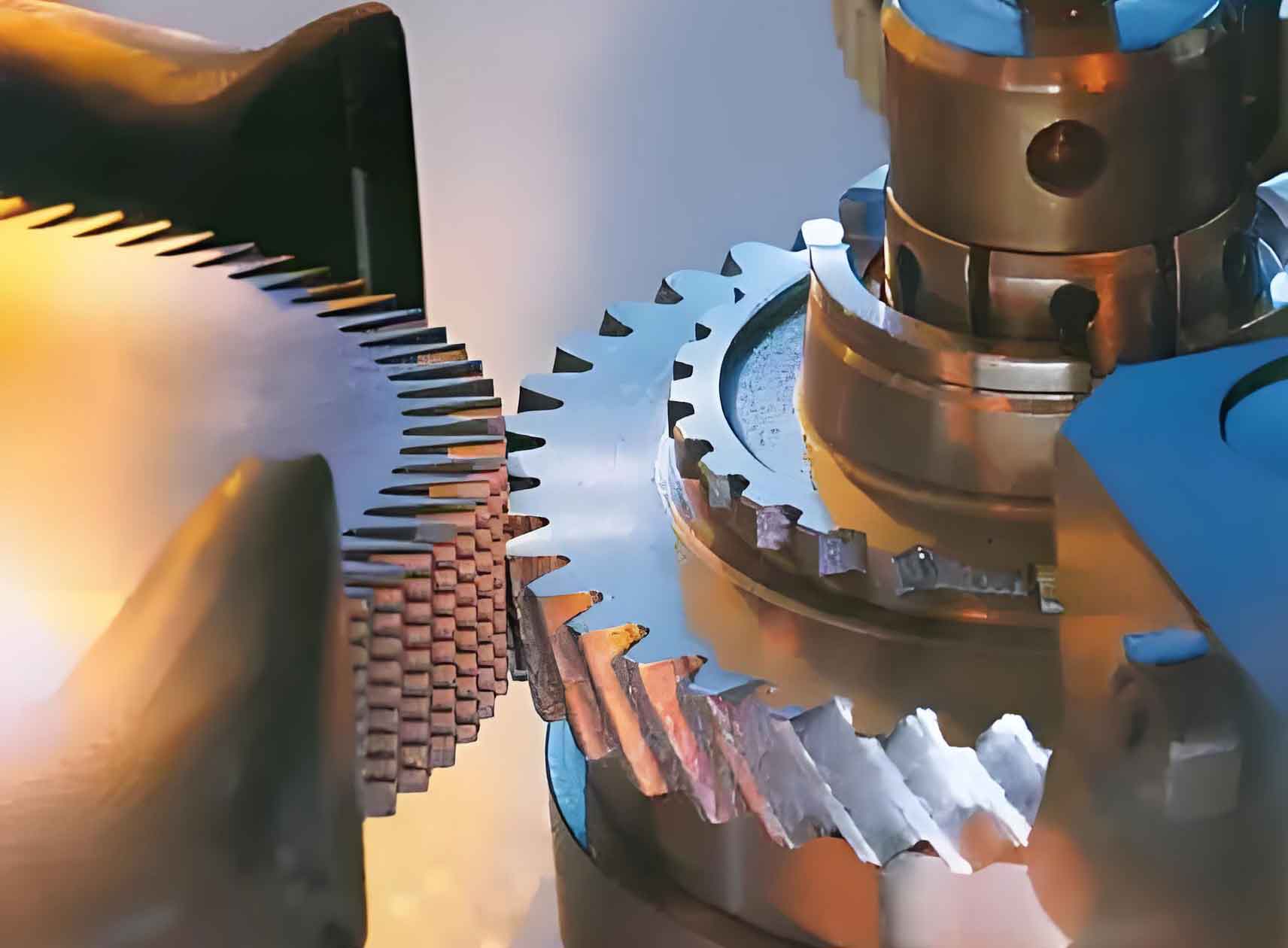
This specific pattern is a textbook manifestation of gear shaving. It is a destructive process where, under high load and due to specific design or material shortcomings, one gear tooth literally scrapes or “shaves” material off the mating tooth, rather than engaging in a smooth rolling and sliding action. The localized nature on the driven gear suggested a dynamic interaction issue related to specific angular positions, while the uniform damage on the pinion indicated a systemic problem affecting all its engagements.
Further investigation into usage patterns revealed that customers frequently used the drill for tasks like screw driving, drilling, and enlarging holes in wood. These applications, especially hole enlargement in wood, often involve intermittent high torque and can cause the tool to operate at or above its rated power, leading to significant temperature rise and mechanical stress.
Comprehensive Root Cause Analysis of Gear Shaving
The investigation into the gear shaving failure was approached from multiple interconnected angles: material science, heat treatment, gear geometry, dynamic system analysis, and stress evaluation.
1. Material and Chemical Composition
Spectrographic analysis was conducted on samples from the failed gears to verify their conformance to specified material grades. The results are shown below:
| Component | Standard | C (%) | Si (%) | Mn (%) | Cr (%) | Mo (%) |
|---|---|---|---|---|---|---|
| Driven Gear | 40Cr | 0.41 | 0.25 | 0.51 | 0.82 | – |
| Pinion | 35CrMo | 0.19 | 0.25 | 0.40 | 1.00 | 0.17 |
The chemical composition of both gears was within acceptable limits for their respective specifications. Therefore, the root cause of gear shaving was not traced to a gross material substitution or impurity.
2. Heat Treatment and Metallurgy
Microstructural analysis (metallography) and hardness testing were performed to assess the quality of heat treatment, which is paramount for wear resistance.
- Driven Gear (40Cr): The target surface hardness was HRC 42-46. Measurements showed values ranging from HRC 41 to 43, which is at the lower specification limit. The microstructure at the tooth surface consisted of fine martensite, and the core showed a sorbitic structure with some ferrite, conforming to the required quenched and tempered + case-hardened structure. However, the lower-than-ideal hardness directly reduced the gear’s resistance to abrasive and adhesive wear, making it more susceptible to the initial stages of gear shaving.
- Pinion (35CrMo): The target surface hardness was HRC 48-52. Actual hardness was measured at HRC 51-51.5. The microstructure showed a fine martensitic case and a sorbitic core, which was satisfactory. The high hardness of the pinion relative to the gear created a significant hardness mismatch. While sometimes designed, an excessive mismatch without proper lubrication or geometry can lead to aggressive wear of the softer component.
The key finding here was the sub-optimal hardness of the driven gear, lowering its pitting and scuffing resistance.
3. Gear Geometry and Design Parameters
The most critical design parameter identified was the module (m). The module defines the size of the gear tooth; a larger module results in a larger, stronger tooth. The original design used a very fine module of 0.6 mm. For a gear train transmitting significant torque (even for a light-duty drill), a fine module has inherent drawbacks:
- Reduced Bending Strength: The tooth root is thinner, leading to higher bending stress. The bending stress at the root can be approximated by the Lewis formula:
$$ \sigma_b = \frac{F_t}{b m Y} $$
where $F_t$ is the tangential tooth load, $b$ is the face width, $m$ is the module, and $Y$ is the Lewis form factor. A smaller $m$ directly increases $\sigma_b$. - Reduced Contact Ratio: The contact ratio ($\epsilon_\gamma$) is a measure of how many tooth pairs are in contact on average during engagement. A higher contact ratio ensures smoother load transfer and reduces the load on any single tooth pair. Fine-module gears tend to have a lower contact ratio, especially with low tooth counts. The original pinion had only 5 teeth, which is an extremely low number, risking undercut and further reducing the effective contact ratio.
- Reduced Resistance to Deformation: Under high load, the slender teeth from a fine module are more prone to elastic deflection. This deflection can momentarily disrupt the correct meshing geometry, causing the teeth to slide against each other rather than roll, initiating the gear shaving process.
The inadequate contact ratio and low tooth stiffness were primary enablers for the localized, high-stress sliding that characterizes gear shaving.
4. Dynamic Load and System Stiffness
Electric drills are subjected to highly dynamic loads. Drilling into wood, especially during hole enlargement or when hitting knots, creates shock loads and torque spikes. The dynamic load factor ($K_v$) accounts for internally generated vibrations from inaccuracies and external shocks. The total load on the tooth is:
$$ F_{total} = K_A \cdot K_v \cdot K_{H\beta} \cdot F_t $$
where $K_A$ is the application factor, $K_v$ is the dynamic factor, and $K_{H\beta}$ is the face load distribution factor.
In a system with low-rigidity gears (fine module) and a high transmission ratio (47:5 creates significant force multiplication on the pinion), these dynamic effects are amplified. The pinion teeth, being few in number, bear a disproportionately high load. During a torque spike, the teeth deflect elastically. If the deflection is large enough, the contact can be lost momentarily. When the teeth snap back into contact, they do so with impact and misalignment, creating perfect conditions for abrasive gear shaving. The repeated sliding over the same few teeth on the driven gear (due to the integer ratio) explains the localized damage pattern.
5. Contact Stress and Lubrication Analysis
The fundamental cause of surface failures like pitting and scuffing (a precursor to severe gear shaving) is excessive contact (Hertzian) stress. The contact stress $\sigma_H$ between two gear teeth is given by:
$$ \sigma_H = Z_E \cdot Z_H \cdot Z_\epsilon \cdot \sqrt{ \frac{F_t}{b \cdot d_1} \cdot \frac{u \pm 1}{u} \cdot K_A \cdot K_v \cdot K_{H\beta} \cdot K_{H\alpha} } $$
where:
- $Z_E$ is the elasticity factor
- $Z_H$ is the zone factor
- $Z_\epsilon$ is the contact ratio factor
- $d_1$ is the pinion pitch diameter
- $u$ is the gear ratio
- $K_{H\alpha}$ is the transverse load factor.
The original design, with its fine module, small pinion diameter ($d_1 = m \cdot z_1 = 0.6 \cdot 5 = 3.0 \text{ mm}$), and low contact ratio ($Z_\epsilon$), would result in a very high calculated $\sigma_H$. This stress, when combined with the dynamic overloads ($K_v$) and the marginally low hardness of the driven gear, exceeded the allowable contact stress limit for the material-condition pair. This led to rapid breakdown of the surface integrity, initiating micropitting and adhesive wear which quickly escalated into macroscopic gear shaving.
Furthermore, the gearbox in such drills is typically lubricated with grease. Under high stress and temperature, the lubricant film can break down, leading to boundary lubrication or dry contact, which dramatically accelerates wear and gear shaving.
Integrated Solution Strategy and Countermeasures
To resolve the gear shaving issue permanently, a multi-pronged improvement strategy was implemented, focusing on increasing gear robustness, optimizing material performance, and mitigating dynamic effects.
1. Redesign of Gear Geometry: Increasing the Module
This was the most impactful change. The goal was to increase tooth strength and contact ratio while maintaining the same overall center distance (to fit the existing housing) and approximately the same output speed (to preserve tool performance). After detailed kinematic and strength calculations, the following new parameters were adopted:
| Component | Original Design | Improved Design | Impact |
|---|---|---|---|
| Module (m) | 0.6 mm | 0.7 mm | +16.7% tooth size |
| Pinion Teeth (z₁) | 5 | 4 | Increases tooth thickness |
| Gear Teeth (z₂) | 47 | 39 | Maintains similar ratio |
| Transmission Ratio (i) | 47/5 = 9.4 | 39/4 = 9.75 | Negligible change in speed |
The bending strength increases with the square of the module ($\sigma_b \propto 1/m$). The contact stress decreases with the square root of the module increase ($\sigma_H$ factor includes $1/\sqrt{m}$). More significantly, the contact ratio increased, leading to smoother operation and lower load per tooth pair. The pinion root diameter increased, drastically improving its bending stiffness and resistance to deflection under load, thereby preventing the loss-of-contact scenario that triggered gear shaving.
2. Enhancement of Material and Heat Treatment Specification
The material specifications were reviewed and the heat treatment process was tightened:
- Driven Gear Hardness: The target hardness range was increased from HRC 42-46 to HRC 45-50. This required stricter control of the high-frequency hardening process parameters (time, temperature, quenching) to achieve a consistently higher surface hardness without compromising the core toughness.
- Case Depth: A minimum effective case depth was specified (e.g., > 0.3 mm) to ensure the hardened layer was sufficient to support the high contact stresses and prevent subsurface yielding.
- Process Control: Statistical process control (SPC) was implemented for batch hardness testing to eliminate parts at the lower end of the specification.
This enhancement directly increased the surface durability and resistance to the initial adhesive wear that leads to gear shaving.
3. Consideration of Profile Modification (Tip and Root Relief)
While the primary fix was the module increase, the analysis also indicated the potential benefit of profile modifications. In future designs or for extreme applications, the following modifications can be applied to further combat gear shaving:
- Tip Relief: Deliberately removing a small amount of material from the tip of the pinion tooth. This prevents the pinion tip from digging into the root of the driven gear, especially under deflection, which is a direct cause of the shaving action.
- Root Relief: Similarly, relieving the root of the driven gear prevents interference with the pinion tip.
These modifications are defined by a relief amount $C_a$ and a relief length. They optimize the load distribution along the tooth flank and prevent edge-loading conditions that precipitate failure.
4. System-Level Improvements: Lubrication and Assembly
To support the mechanical improvements:
- Grease Specification: The lubricating grease was upgraded to a high-pressure, extreme-pressure (EP) grease with solid additives (e.g., MoS₂) to maintain a protective film under high contact stress and temperature, reducing the risk of scuffing.
- Assembly Precision: Tighter controls on gear alignment and bearing preload were enforced to minimize misalignment ($K_{H\beta}$), ensuring even load distribution across the tooth face and preventing localized stress concentrations that could start gear shaving.
Validation and Results
Prototypes incorporating the increased module (0.7 mm) and the enhanced heat treatment were manufactured and subjected to rigorous testing. The testing protocol included:
- Extended Endurance Test: Running the drill under a cyclic load profile simulating heavy wood drilling and screw driving.
- Overload Test: Deliberately stalling the drill repeatedly to generate extreme torque spikes.
- Field Testing: Providing units to users in demanding applications.
The results were unequivocal. The incidence of gear shaving failure was reduced to virtually zero. The gears showed only normal, gradual wear patterns even after significantly extended service life. The bending and contact safety factors, recalculated with the new parameters, showed a substantial increase, confirming the theoretical analysis.
The formula for bending safety factor $S_F$ and contact safety factor $S_H$ illustrate the improvement:
$$ S_F = \frac{\sigma_{FP}}{\sigma_b} \quad \text{and} \quad S_H = \frac{\sigma_{HP}}{\sigma_H} $$
where $\sigma_{FP}$ and $\sigma_{HP}$ are the permissible bending and contact stresses of the material. With a larger module and higher hardness, the calculated operating stresses ($\sigma_b$, $\sigma_H$) decreased, while the permissible stresses ($\sigma_{FP}$, $\sigma_{HP}$) increased, leading to significantly higher $S_F$ and $S_H$, well above the required minimum of 1.0.
Conclusion
The failure of the electric drill gears was a direct consequence of gear shaving, a severe wear mechanism initiated by a combination of factors. The root cause analysis revealed that a design with an excessively fine module (0.6 mm) and a very low pinion tooth count was the primary culprit, leading to high bending and contact stress, low contact ratio, and inadequate tooth stiffness. These design flaws, coupled with dynamic operating loads and a driven gear hardness at the lower specification limit, created a perfect storm for catastrophic adhesive and abrasive wear.
The implemented countermeasure—increasing the gear module to 0.7 mm and adjusting the tooth counts accordingly—was a fundamental and effective solution. This change directly addressed the core weaknesses by strengthening the teeth, increasing stiffness to prevent deflection-induced disengagement, and improving the contact ratio for smoother load sharing. Supplementing this with enhanced heat treatment specifications ensured the material could withstand the revised stress state. This holistic approach to solving gear shaving not only eliminated the immediate failure mode but also robustly extended the service life and reliability of the product, underscoring the critical importance of integrated design, material, and process analysis in mechanical power transmission systems.