
In the pursuit of high-quality, low-noise gear transmissions for automotive and industrial applications, post-heat treatment finishing processes are critical. Among these, gear honing has emerged as a highly efficient and cost-effective method for cylindrical gears, yet its application to spiral bevel gears remains underexplored. This article delves into the feasibility and technical intricacies of implementing gear honing for spiral bevel gears, presenting a comprehensive analysis from theoretical principles to practical manufacturing methods. Gear honing, through its unique abrasive action driven by crossed-axis meshing, offers the potential to correct heat treatment distortions, improve surface finish, and enhance meshing quality. I will explore the fundamental honing principles, detail the design and manufacturing of honing wheels, address challenges such as draft pattern interference, and introduce innovative methods for producing diamond dressing wheels. Throughout this discussion, the term ‘gear honing’ will be frequently emphasized to underscore its centrality to this advanced finishing technology.
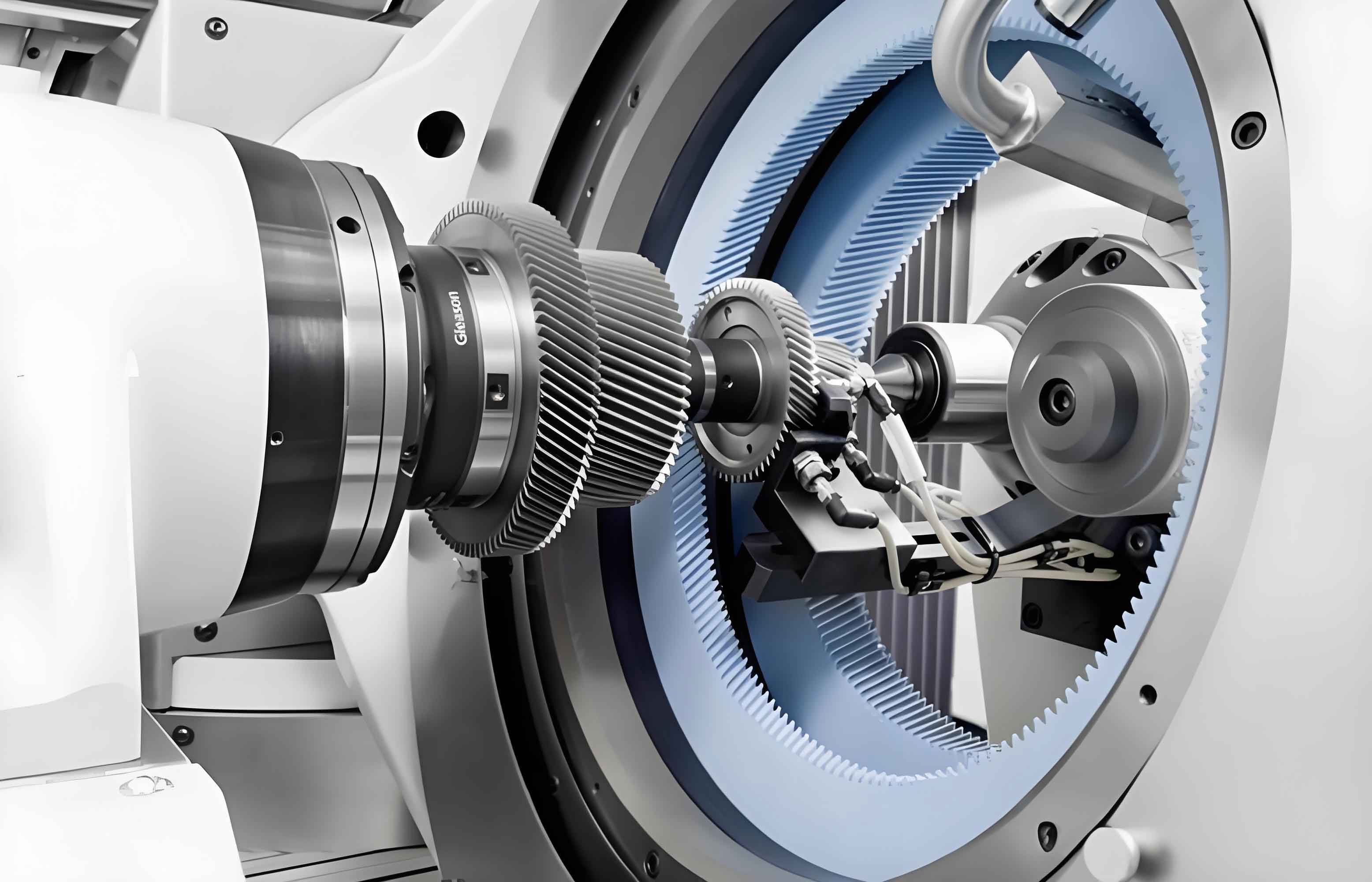
The post-heat treatment finishing of spiral bevel gears is a pivotal step in ensuring their performance, durability, and acoustic characteristics. Traditional methods, while serviceable, often come with significant drawbacks in terms of cost, efficiency, or capability. Gear honing, in contrast, leverages a continuous abrasive process between a honing wheel and the gear workpiece under crossed-axis conditions. This process generates controlled relative sliding across the entire tooth flank, enabling material removal and surface refinement. The core advantage of gear honing lies in its ability to maintain correct pressure angles while imparting a slight crowning along the profile, which is beneficial for load distribution and noise reduction. This article aims to establish a robust framework for adapting gear honing to spiral bevel gears, covering design algorithms, interference avoidance, and manufacturing protocols to meet industrial demands for precision and economy.
Comparative Analysis of Existing Post-Heat Treatment Finishing Technologies
Before delving into gear honing, it is essential to understand the landscape of existing finishing methods for hardened spiral bevel gears. The primary techniques include gear lapping, gear grinding, and hard cutting (skiving). Each has distinct characteristics, as summarized in the table below.
| Finishing Method | Key Principles | Advantages | Disadvantages | Typical Applications |
|---|---|---|---|---|
| Gear Lapping | Abrasive slurry between meshing gears under light load. | High productivity, low cost, improves surface roughness and contact pattern. | Cannot correct major heat treatment errors (e.g., runout, pitch errors); limited shape correction. | Mass production where heat treatment distortion is minimal. |
| Gear Grinding | Precision material removal using shaped SG grinding wheels on CNC machines. | Very high accuracy, excellent surface integrity, corrects most errors. | High initial investment, high operating costs, longer cycle times. | High-end automotive, aerospace, and precision drives. |
| Hard Cutting (Skiving) | Precision cutting of hardened gears with carbide tools. | Higher productivity than grinding, moderate cost increase. | Risk of micro-cracks reducing fatigue life; requires significant investment; surface quality can be inconsistent. | Oerlikon system gears where grinding is not feasible. |
| Gear Honing (Proposed) | Abrasive action via relative sliding in crossed-axis mesh with resin-bonded honing wheel. | High efficiency, low per-part cost, good noise reduction, can correct minor distortions and improve surface finish. | Requires specialized honing wheel design and manufacturing; needs interference-free mold design. | Potentially for mass production of automotive spiral bevel gears seeking cost-effective quality. |
This comparison highlights a gap: the lack of a high-efficiency, low-cost finishing method for spiral bevel gears that balances quality and economy. Gear lapping is insufficient for correction, gear grinding is expensive, and hard cutting has reliability concerns. Therefore, the development of a dedicated gear honing process presents a compelling solution. The gear honing process, by utilizing a continuously abrasive honing wheel, can achieve consistent material removal across the tooth flank, effectively addressing minor heat treatment deformations while enhancing surface characteristics crucial for noise performance.
Fundamental Principles of Gear Honing for Spiral Bevel Gears
The essence of gear honing for spiral bevel gears lies in simulating a crossed-axis gear pair between the honing wheel and the workpiece. Unlike parallel-axis honing for cylindrical gears, this configuration avoids a zero relative sliding velocity at the pitch line, which is essential to prevent tooth profile distortion. The kinematic relationship is derived from hypoid gear theory. Consider a coordinate system where the gear axis is along the z-axis, and the honing wheel axis is skewed. The honing process requires defining a distinct honing pitch cone for the workpiece, different from its original working pitch cone, especially for gear pairs with a high ratio difference. This ensures symmetric sliding velocities at the tooth tip and root for effective honing.
Let the gear’s honing pitch cone have a cone angle $\gamma_{GH}$ and its apex offset from the crossing point by $S_{GH}$. At the mid-point of the tooth face width, designated as the honing pitch point $P$, the common normal vector $\mathbf{n}$ to both the gear and honing wheel pitch surfaces is critical. This vector is given by:
$$ \mathbf{n} = \{ -\cos\gamma_{GH} \sin\theta, -\sin\gamma_{GH}, -\cos\gamma_{GH} \cos\theta \} $$
where $\theta$ is the angle between the common normal and the plane parallel to both gear and honing wheel axes. The position vector of point $P$ in the honing coordinate system is:
$$ \mathbf{r}_{GH} = \{ -A_{GH} \sin\gamma_{GH} \sin\theta, A_{GH} \cos\gamma_{GH} – S_{GH}, -A_{GH} \sin\gamma_{GH} \cos\theta \} $$
Here, $A_{GH}$ is the cone distance at the mid-point of the gear’s honing pitch cone. Assuming the gear rotates with unit angular velocity, its velocity at $P$ is $\mathbf{v}_{GH} = \mathbf{a}_G \times \mathbf{r}_{GH}$, where $\mathbf{a}_G$ is the unit vector along the gear axis. The relative sliding velocity vector $\mathbf{v}_s$ at $P$, which should ideally be along the tooth length direction, is derived from the gear’s spiral angle $\Psi_{GH}$ on the honing pitch cone:
$$ \mathbf{v}_s = (\cos\Psi_{GH} \sin\gamma_{GH} \sin\theta – \sin\Psi_{GH} \cos\theta)\mathbf{i} – \cos\Psi_{GH} \sin\gamma_{GH} \mathbf{j} + (\cos\Psi_{GH} \sin\gamma_{GH} \cos\theta – \sin\Psi_{GH} \sin\theta)\mathbf{k} $$
The honing wheel’s pitch surface is determined by two key parameters: the number of teeth $z_H$ on the honing wheel and the angle $\theta$. A larger $\theta$ increases the crossed-axis angle and relative sliding speed, enhancing honing efficiency. More teeth $z_H$ improve the honing wheel’s durability. The honing wheel’s axis vector $\mathbf{a}_H$ and the distance $l_H$ from $P$ to the intersection of $\mathbf{n}$ with $\mathbf{a}_H$ are solved iteratively to ensure the relative velocity $\mathbf{v}_R = \mathbf{v}_{GH} – \mathbf{v}_H$ is parallel to $\mathbf{v}_s$, where $\mathbf{v}_H$ is the honing wheel’s velocity at $P$. This condition ensures the relative motion is primarily along the tooth length at the pitch point, which is fundamental for effective gear honing.
Comprehensive Design Methodology for the Honing Wheel
The design of the honing wheel for gear honing is a multi-constraint optimization problem. The objective is to maximize honing efficiency and wheel life, which inversely relates to $\theta$ and $z_H$, while satisfying geometric constraints. The primary constraints are: (1) the entire effective tooth surface of the workpiece must lie within the boundary of meshing to ensure continuous contact, and (2) for all points on the workpiece tooth surface, the corresponding contact points on the honing wheel must not lie within its tip or root surfaces to avoid undercutting or interference.
The honing wheel’s tip and root surfaces are not simple cones but are generated as envelopes of the dressing wheel’s tip and root cones during the diamond dressing process. They are surfaces of revolution approximating hyperboloids. For any point on these surfaces, the condition of co-planarity among the surface normal $\mathbf{n}_s$, the position vector $\mathbf{R}_s$ from a fixed point on the axis, and the axis vector $\mathbf{a}_H$ must hold. This leads to a trigonometric equation used to compute the surface coordinates.
A critical step in honing wheel design is the evaluation and avoidance of draft pattern interference, which is essential for molding the resin-bonded wheel. The tooth surface is discretized into a uniformly distributed grid. For each grid point, the limit lead for mold draft is calculated using the normal projection method. Specifically, at a point, a local cylindrical coordinate system aligned with the honing wheel axis is established. The surface normal is projected onto the tangent plane of the cylinder. The ratio of the axial component to the circumferential component, multiplied by the cylinder’s circumference, gives the limit draft lead $L_{draft}$:
$$ L_{draft} = 2\pi R \cdot \frac{n_a}{n_c} $$
where $R$ is the radial distance of the point, $n_a$ is the axial component of the projected normal, and $n_c$ is the circumferential component. For the convex flank, this yields the maximum allowable draft lead; for the concave flank, it gives the minimum required draft lead. Interference is assessed by comparing two values across the entire grid:
- $L_{max,min}$: The maximum among the minimum draft leads on the convex flank.
- $L_{min,max}$: The minimum among the maximum draft leads on the concave flank.
If $L_{max,min} > L_{min,max}$, draft interference exists, meaning no single draft lead can facilitate molding for both flanks simultaneously. To resolve this, an optimal design draft lead $L_{design}$ is chosen, typically as the average:
$$ L_{design} = \frac{L_{max,min} + L_{min,max}}{2} $$
The tooth surface is then modified along theoretical helical paths with this lead, starting from the small end. Points that do not satisfy the draft condition are rotated onto this helical path. Subsequently, a radial smoothing process is applied to ensure the modified surface only adds material, preserving the honing wheel’s strength. This entire procedure ensures the honing wheel can be successfully molded without interference, a cornerstone for practical gear honing implementation.
Manufacturing Processes for the Honing Wheel
The manufacturing of the honing wheel mold is crucial for accurate gear honing. Two main methods exist: traditional generation machining using tapered cutter heads on gear cutting machines with tilt functions, and point-milling using ball-nose end mills on 5-axis CNC machining centers. While generation machining is faster, it produces only approximate surfaces and requires long lead times for custom cutter procurement. Point-milling, though slower, offers high flexibility, short preparation time, and uses standard tools, making it more suitable for prototyping and custom applications in gear honing development.
The process begins with creating a 3D model of the honing wheel tooth space based on the designed surface coordinates. For point-milling, a toolpath is generated to guide the ball-nose cutter along the surface. The key is to maintain cutter contact without gouging. The cutting steps are calculated to achieve the required surface finish. After machining, the metal mold is used to cast the honing wheel from a mixture of abrasives (like silicon carbide or aluminum oxide) and epoxy resin. The draft interference correction applied during design ensures the wheel can be ejected from the mold after curing. Post-curing, the honing wheel may undergo a final precision tuning using a diamond dressing wheel to achieve the exact tooth profile and surface roughness required for effective gear honing.
Innovative Method for Manufacturing Diamond Dressing Wheels
The diamond dressing wheel is essential for truing and profiling the honing wheel in gear honing systems. Its steel core must be precision-ground after heat treatment, which is challenging for spiral bevel gear forms. To address this, I propose a novel universal point-grinding method using a single-angle tapered grinding wheel. This method allows one wheel to grind a range of gear modules, drastically reducing cost and lead time compared to ordering multiple custom-shaped grinding wheels.
The single-angle wheel features one flat side and one conical side, resembling a single-angle milling cutter. The flat side is used for grinding convex flanks, avoiding curvature interference. The cone angle $\alpha_s$ is between 38° and 45°, determined by the sum of the gear’s pressure angles to avoid interference with the opposite flank. The maximum allowable wheel radius $R_{s,max}$ is constrained by curvature interference conditions. For grinding a concave flank originally generated by a cutter with blade angle $\phi_v$ and tip radius $R_v$, the minimum curvature radius on the cutter is $\rho_o = R_v / \cos \phi_v$. On the grinding wheel cone, the maximum curvature is at the outer rim: $\rho_s = R_s / \sin \alpha_s$. To avoid interference, we require $\rho_s \leq \rho_o$, leading to:
$$ R_{s,max} = \frac{R_v \sin \alpha_s}{\cos \phi_v} $$
The wheel position for grinding a point on the tooth surface is determined by aligning the wheel’s conical母线 with the imagined cutter blade’s母线 (generatrix) from the original gear generation. This eliminates one rotational degree of freedom. The distance along this母线 is then set so the wheel’s outer rim coincides with the cutter’s tip circle, fixing the position. This simulated two-parameter enveloping motion ensures the grinding wheel’s volume remains within the imaginary cutter’s volume, guaranteeing no curvature interference. This point-grinding strategy, executed on a 5-axis CNC grinder, enables efficient and accurate production of diamond dressing wheel cores, which are then electroplated with a layer of diamond grit. A final pass with a diamond roller dresser may be used to refine the plated surface, ensuring precision for the subsequent gear honing wheel dressing operations.
Numerical Design Example and Analysis
To validate the gear honing design methodology, I present a numerical example for a spiral bevel gear pair with a 90° shaft angle. The basic design parameters and the calculated honing wheel parameters are summarized in the following table. The goal is to design a honing wheel for the driven gear (pinion) to perform post-heat treatment gear honing.
| Parameter | Drive Gear (Pinion) | Driven Gear (Gear) | Honing Wheel (for Driven Gear) |
|---|---|---|---|
| Number of Teeth, $z$ | 13 | 46 | 39 |
| Pitch Cone Angle, $\gamma$ (°) | 19.37 | 69.17 | 67.88 |
| Face Cone Angle (°) | 23.57 | 71.18 | 68.17 |
| Root Cone Angle (°) | 17.47 | 64.58 | 61.58 |
| Spiral Angle, $\Psi$ (°) | 50.50 | 28.13 | 40.67 |
| Face Width (mm) | 39.024 | 33.020 | 35.886 |
| Apex Offset $S_{GH}$ (mm) | 16.179 | -0.533 | -1.063 |
| Tip Cone Apex Offset (mm) | 10.820 | -2.006 | 0.714 |
| Root Cone Apex Offset (mm) | 17.195 | 0.381 | 2.798 |
| Cone Distance $A_{GH}$ (mm) | 108.432 | 98.755 | 99.566 |
The design process involved optimizing $\theta$ and $z_H$ subject to the meshing boundary and tip/root clearance constraints. For this case, the optimization yielded a honing wheel with 39 teeth and a specific $\theta$ that ensured the entire effective tooth surface of the driven gear was within the meshing zone. The draft interference analysis was performed on the designed honing wheel tooth surface. The computed values were:
- Maximum of minimum draft leads on convex flank ($L_{max,min}$): 142.5 mm.
- Minimum of maximum draft leads on concave flank ($L_{min,max}$): 158.2 mm.
Since $L_{max,min} (142.5) < L_{min,max} (158.2)$, no draft pattern interference exists. Therefore, the honing wheel can be molded without requiring surface modification for draft. This example demonstrates the practical viability of the design algorithms for gear honing applications. Further simulations confirmed that the relative sliding velocity distribution across the tooth flank was favorable, with the pitch line located near the mid-height of the working tooth depth, ensuring symmetric honing action at the tip and root. This is a critical quality indicator for effective gear honing, as it prevents profile deviation and promotes uniform material removal.
Extended Discussion on Process Parameters and Performance
The effectiveness of gear honing depends not only on geometric design but also on process parameters. Key parameters include the honing wheel’s abrasive grit size, bond hardness, honing speed (relative surface speed), crossed-axis angle, and honing pressure or feed rate. For spiral bevel gear honing, the crossed-axis angle, directly influenced by $\theta$, is paramount. A larger angle increases the relative sliding velocity component perpendicular to the tooth traces, enhancing the cutting action but potentially affecting surface finish. An optimal balance must be found. The honing speed $v_h$ can be derived from the kinematic model. At the pitch point $P$, the magnitude of the relative sliding velocity $v_s$ is a function of the gear’s rotational speed $n_G$, the honing wheel’s rotational speed $n_H$, and the geometry. A simplified expression for its tangential component along the tooth length is:
$$ v_{s, tangential} \approx A_{GH} \cdot \omega_G \cdot \sin\gamma_{GH} \cdot \sin\theta \cdot \cos\Psi_{GH} $$
where $\omega_G = 2\pi n_G / 60$. This velocity should be maintained within an optimal range, typically 1-3 m/s for resin-bonded wheels, to ensure efficient material removal without excessive heat generation. The honing pressure, controlled axially, determines the normal force between the wheel and gear, influencing the stock removal rate and final surface roughness. A series of controlled experiments would be needed to establish optimal parameters for specific gear materials and hardening depths, but the geometric foundation provided here is the first critical step in enabling such process optimization for industrial gear honing.
Another consideration is the wear of the honing wheel. During gear honing, the abrasive grains wear, and the wheel profile may change. The diamond dressing wheel must periodically true the honing wheel to maintain profile accuracy. The dressing interval depends on the honing wheel bond, abrasive type, and the amount of material removed from the work gear. A self-sharpening effect is desirable in the wheel formulation. The design of the honing wheel’s basic profile must account for a certain amount of wear while still producing a correct gear tooth form throughout its life. This is an area for further material science research within the context of spiral bevel gear honing.
Conclusion and Future Perspectives
This comprehensive study establishes the theoretical and methodological foundation for applying gear honing technology to the post-heat treatment finishing of spiral bevel gears. By adapting the proven principles of crossed-axis abrasive machining, gear honing offers a promising avenue to achieve high-quality surface finish, noise reduction, and minor error correction in a high-productivity, cost-effective manner. The core contributions include: a detailed kinematic model for honing based on hypoid gear theory; a robust design methodology for the honing wheel incorporating optimization and draft interference analysis; a practical manufacturing approach for both the honing wheel mold and the essential diamond dressing wheel using a novel point-grinding technique.
The numerical example validates the design process, showing that a functional, interference-free honing wheel can be designed for a realistic spiral bevel gear pair. The absence of draft interference in the example case indicates that for many gear designs, the honing wheel can be molded directly from the calculated geometry, simplifying production. The proposed single-angle wheel grinding method for dressing wheel cores has the potential to significantly reduce the cost and lead time associated with this critical component, further enhancing the economic appeal of the gear honing process.
Future work should focus on experimental verification. Building prototype honing wheels and conducting honing trials on hardened spiral bevel gears will be essential to quantify improvements in surface roughness, contact pattern, noise level, and fatigue life compared to traditional methods. Furthermore, research into advanced abrasive composites and bond systems tailored for the specific stresses of spiral bevel gear honing could enhance process efficiency and wheel life. The integration of this gear honing process into automated production lines for automotive differential gears represents a significant opportunity for advancing manufacturing technology. In conclusion, gear honing stands as a viable and highly promising technology for elevating the quality and reducing the cost of spiral bevel gear finishing, potentially revolutionizing this niche of precision gear manufacturing.