
The final precision finishing of hardened gears is often achieved through gear honing, a critical process that directly determines the performance and service life of transmission components. Among the various surface integrity parameters, residual stress induced by the honing process is particularly significant. This residual stress state within the subsurface layer of the gear tooth flank can lead to dimensional instability, affect fatigue strength, promote stress corrosion cracking, and in severe cases, initiate surface cracks. Consequently, the ability to predict and control the residual stress profile resulting from internal gear power honing is of paramount importance for manufacturing high-performance, high-reliability gears. This enables the optimization of process parameters to achieve a favorable stress distribution, thereby reducing trial-and-error in development, shortening research cycles, and lowering costs. This article presents a comprehensive investigation into the residual stress on workpiece surfaces generated by internal gear power honing through dynamic finite element simulation, parameter analysis, and experimental validation.
Traditionally, analyzing residual stress in complex processes like gear honing poses significant challenges due to the intricate interplay of mechanical, thermal, and tribological phenomena. While previous research has established models for simpler 2D operations like grinding or orthogonal cutting, the study of residual stress on spatially complex surfaces like gear flanks remains less explored. The internal gear honing process involves the meshing of a honing wheel (internal gear) with the external helical workpiece gear under a defined crossing angle. The interaction, characterized by both rolling and sliding motions, leads to material removal and plastic deformation of the workpiece surface layer. This deformation, upon unloading, locks in a state of residual stress. This study aims to bridge this gap by developing a finite element model to simulate the dynamic honing process and elucidate the influence of key honing parameters on the resulting residual stress field.
The foundation of any accurate simulation is a precise geometric model. The complex tooth flank geometry of the internal honing wheel necessitates a parametric modeling approach. The mathematical model of the honing wheel tooth surface is derived based on gear meshing theory and coordinate transformation. Starting from the basic equation of the workpiece’s involute helicoid surface in its own coordinate system, the conjugate condition is applied. For a point M on the contacting surfaces, the relative velocity vector must be orthogonal to the common normal vector, expressed as $\vec{v}_{12} \cdot \vec{n} = 0$. This condition, combined with spatial coordinate transformations between the workpiece and honing wheel systems, yields the complete mathematical description of the internal honing wheel’s tooth flank.
The coordinates of any point on the workpiece gear surface can be described by:
$$ x_1 = r_{b1}\cos(\sigma_0 + \theta + \lambda) + r_{b1}\lambda\sin(\sigma_0 + \theta + \lambda) $$
$$ y_1 = r_{b1}\sin(\sigma_0 + \theta + \lambda) – r_{b1}\lambda\cos(\sigma_0 + \theta + \lambda) $$
$$ z_1 = p \theta $$
where $r_{b1}$ is the base radius of the workpiece, $\sigma_0$ is the start angle, $\theta$ is the helical increment angle, $p$ is the lead, and $\lambda$ is the involute increment angle. The parameters $\theta$ and $\lambda$ vary within the ranges defined by the tooth width, root, and tip circles.
Through coordinate transformation and applying the meshing equation $f(\theta, \lambda, \phi_1)=0$, the honing wheel tooth surface coordinates $(x_2, y_2, z_2)$ are obtained as functions of the workpiece parameters and the rotation angles $\phi_1$ and $\phi_2$. This mathematical model is implemented in computational software like MATLAB to generate discrete coordinate points representing the honing wheel tooth flank. The data points are then imported into solid modeling software such as SolidWorks, where they are used to construct lofted surfaces and subsequently generate a complete, accurate 3D solid model of the internal honing wheel, which is essential for the subsequent finite element analysis.
The force interaction during gear honing is a critical factor driving the formation of residual stress. In internal gear honing, the forces can be decomposed into three primary components relative to the workpiece: a tangential force $F_s$, a radial force $F_r$, and an axial force $F_n$. The tangential force is primarily related to the cutting action along the tooth profile, the radial force is the main pressing force applied to achieve material removal, and the axial force arises due to the helical meshing under a crossing angle. These forces are interrelated. If the total honing force vector is denoted as $F_a$, its components can be approximated by:
$$ F_r = F_a \cos \beta \tan \alpha_t $$
$$ F_s = F_a \sin \alpha_n $$
$$ F_n = F_a \cos \beta $$
where $\beta$ is the workpiece helix angle, $\alpha_n$ is the normal pressure angle, and $\alpha_t$ is the transverse pressure angle. In practice, the honing radial force is often the controlled parameter, adjusted by changing the honing allowance, which in turn influences the overall stress state during processing.
The core of this investigation lies in the dynamic finite element simulation of the gear honing process. The primary objective is to compute the residual stress field left on the workpiece tooth surface after the honing tool passes and the load is removed. The simulation is conducted using an explicit dynamics solver, ANSYS/LS-DYNA, which is well-suited for modeling transient contact events with large deformations. The process involves two main computational stages. The first stage is the loading phase, where the dynamic interaction between the honing wheel and the workpiece gear is simulated under applied rotational velocities and radial force. The second stage is the residual stress formation phase, where all external loads and constraints are removed, but the stress field computed from the first stage is imported as the initial condition. The solver then computes the final, self-equilibrating residual stress state within the workpiece.
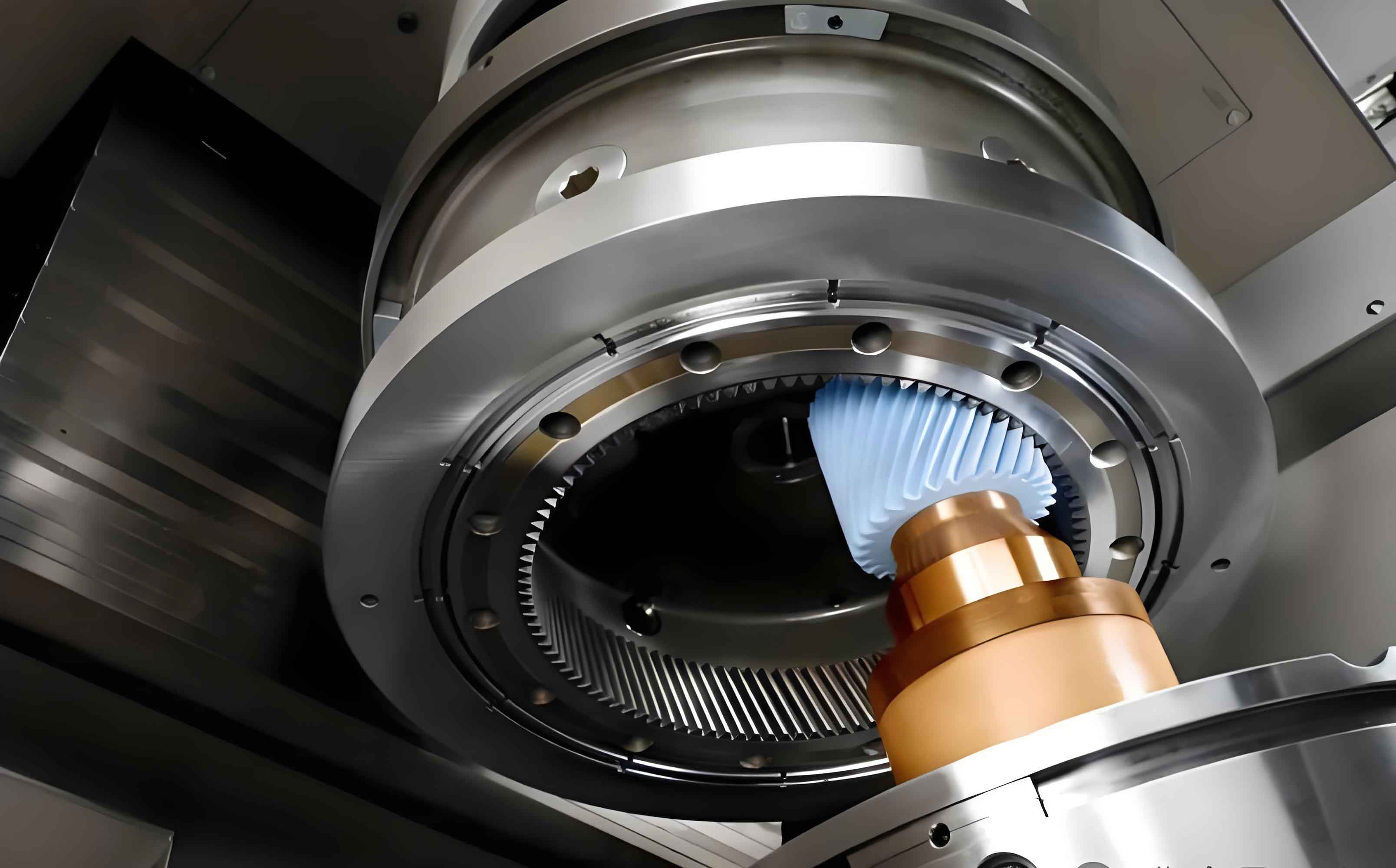
To ensure computational efficiency while maintaining accuracy, the full gear models are simplified. Only a segment containing a few meshing tooth pairs is extracted for analysis. The material properties must be accurately defined. The workpiece material is typically a case-hardened alloy steel such as 20CrMnTi, modeled as an elastic-plastic material. The honing wheel, composed of micro-crystalline alumina abrasive grains held in a bond, is often modeled as a rigid or elastic body since its deformation is minimal compared to the workpiece. Key material properties used in the simulation are summarized in the table below.
| Component | Density (kg/m³) | Young’s Modulus (GPa) | Poisson’s Ratio |
|---|---|---|---|
| Workpiece (20CrMnTi) | 7800 | 207 | 0.25 |
| Honing Wheel | 3120 | 70 | 0.07 |
A critical step is meshing. A finer mesh is applied in the contact regions to capture the high stress gradients accurately, while a coarser mesh is used in the non-critical body areas to reduce the total number of elements. The contact between the honing wheel and gear teeth is defined using an automatic surface-to-surface contact algorithm, incorporating coefficients of static and kinetic friction (typically around 0.35 and 0.40, respectively). Boundary conditions are applied to simulate the actual honing kinematics: the honing wheel and workpiece are assigned their respective rotational speeds about their axes. The axis of the honing wheel is fixed in space, while the workpiece axis is constrained according to the defined crossing angle Σ. A radial force is applied to simulate the honing pressure.
After setting up the model with appropriate constraints, contact definitions, and load curves for rotational velocity, the simulation is executed for a time period sufficient to capture a complete meshing cycle. The output includes the transient stress fields. The von Mises equivalent stress is commonly examined to understand the intensity of the stress during loading. It is calculated using the stress tensor components $\sigma_{ij}$ as:
$$ \sigma_{vm} = \sqrt{ \sigma_{11}^2 + \sigma_{22}^2 + \sigma_{33}^2 – \sigma_{11}\sigma_{22} – \sigma_{22}\sigma_{33} – \sigma_{33}\sigma_{11} + 3\sigma_{12}^2 + 3\sigma_{23}^2 + 3\sigma_{31}^2 } $$
The final residual stress components (e.g., $\sigma_{xx}$, $\sigma_{yy}$ normal stresses) are extracted after the unloading step. To analyze the effect of honing parameters, simulations are run for various combinations of workpiece speed (honinvg speed), applied radial honing force, and shaft crossing angle.
The finite element simulations consistently show that the gear honing process induces compressive residual stresses on the workpiece tooth flanks. This is a favorable outcome as compressive surface stresses generally inhibit crack initiation and propagation, thereby enhancing fatigue life. The magnitude and distribution of this compressive stress, however, are highly dependent on the honing process parameters. The analysis focuses on specific nodes located at characteristic positions on the tooth flank: near the pitch line, the tooth tip (dedendum), and the tooth root (addendum), on both the convex and concave sides of the helical tooth.
The influence of honing speed (primarily controlled by workpiece rotational speed) is significant. Under a constant crossing angle and radial force, increasing the honing speed leads to a decrease in the magnitude of compressive residual stress at all monitored locations. This trend can be attributed to the reduced time of load application (dwell time) at any given point on the tooth surface as the speed increases. With less time for plastic deformation to accumulate, the resulting locked-in compressive stress is lower. The following data illustrates this trend for selected nodes.
| Workpiece Speed (rad/s) | Node 1 Stress (MPa) | Node 2 Stress (MPa) | Node 3 Stress (MPa) |
|---|---|---|---|
| 60.08 | -620 | -410 | -1320 |
| 90.12 | -550 | -362 | -1200 |
| 120.16 | -510 | -335 | -1120 |
| 150.16 | -480 | -310 | -1050 |
| 180.24 | -455 | -290 | -990 |
Conversely, the effect of honing radial force shows an opposing trend. When the honing speed and crossing angle are held constant, an increase in the applied radial force results in a substantial increase in the compressive residual stress. A higher radial force increases the contact pressure and the extent of plastic deformation in the subsurface layer. Upon unloading, the elastic material surrounding this more severely deformed zone forces it into a state of higher compression. The relationship is strongly positive, as seen in the simulation data below.
| Radial Honing Force (N) | Node 1 Stress (MPa) | Node 2 Stress (MPa) | Node 3 Stress (MPa) |
|---|---|---|---|
| 150 | -550 | -362 | -1200 |
| 300 | -720 | -510 | -1550 |
| 450 | -880 | -640 | -1850 |
| 600 | -1020 | -760 | -2120 |
| 750 | -1150 | -870 | -2360 |
| 1000 | -1350 | -1050 | -2750 |
The shaft crossing angle (Σ) is a unique parameter in gear honing, influencing the sliding velocity component and the contact conditions. Within a practical range, the simulation results indicate that increasing the crossing angle leads to a decrease in the resulting compressive residual stress. This can be explained by two combined effects: a potential reduction in the effective normal force component and a significant increase in the relative sliding speed. Both factors—lower force and higher speed—individually contribute to lower residual stress, as previously established. Therefore, their combined effect via an increased crossing angle results in a clear decreasing trend.
| Shaft Crossing Angle Σ (deg) | Node 1 Stress (MPa) | Node 2 Stress (MPa) | Node 3 Stress (MPa) |
|---|---|---|---|
| 8.0 | -580 | -385 | -1260 |
| 10.0 | -540 | -355 | -1180 |
| 12.0 | -505 | -330 | -1100 |
| 14.0 | -475 | -310 | -1040 |
| 16.0 | -450 | -295 | -985 |
Furthermore, the analysis reveals an asymmetry in residual stress between the convex and concave flanks of the helical gear tooth. Typically, the convex flank exhibits a slightly higher magnitude of compressive residual stress compared to the concave flank under identical honing conditions. This asymmetry stems from differences in local contact geometry, effective radius of curvature, and sliding conditions on the two sides of the tooth during the honing process.
To validate the findings from the finite element analysis of gear honing residual stress, experimental measurements were conducted. A gear honed under specific conditions (workpiece speed = 90.12 rad/s, honing wheel speed = 151.67 rad/s, crossing angle Σ = 8.722°, radial force = 150 N) was selected. A single-tooth specimen was carefully sectioned from the gear for measurement. The non-destructive X-ray diffraction (XRD) technique was employed to measure the surface residual stress. Using a Cu Kα X-ray source (λ = 0.15406 nm), the diffraction angles were measured for specific lattice planes, and the stress was calculated based on the shift in these angles using sin²ψ method.
The experimental measurements were taken at locations on the tooth flank corresponding to the nodes analyzed in the simulation. The comparison between the simulated residual stress values and the experimentally measured values is presented in the table below. The agreement is generally good, with the trends correctly predicted by the model. The relative errors between the simulated and measured values for the reported nodes range from approximately 1.4% to 13.6%. These discrepancies are within an acceptable range for such complex simulations and can be attributed to several factors: inherent simplifications in the FE model (e.g., ideal material behavior, simplified abrasive action), measurement uncertainties associated with the XRD technique (e.g., penetration depth, surface preparation effects), and potential variations in the actual honing process conditions compared to the idealized simulation inputs. The fact that the model correctly captures the sign (compressive) and the order of magnitude of the stresses confirms the validity and usefulness of the finite element approach for analyzing residual stress in gear honing.
| Measurement Location (Node ID) | Simulated Stress (MPa) | Measured Stress (MPa) | Relative Error (%) |
|---|---|---|---|
| Pitch (Convex) | -550 | -625 | 13.6 |
| Pitch (Concave) | -362 | -367 | 1.4 |
| Tooth Tip | -1200 | -1152 | 4.2 |
| Tooth Root (Side A) | -950 | -1074 | 13.1 |
| Tooth Root (Side B) | -605 | -684 | 13.1 |
| Tooth Root (Concave) | -510 | -572 | 12.2 |
In conclusion, this integrated study employing finite element simulation and experimental validation provides significant insights into the phenomenon of residual stress generation in internal gear power honing. The key findings are summarized as follows. First, the gear honing process consistently induces a layer of beneficial compressive residual stress on the workpiece tooth surface. Second, the magnitude of this compressive stress is not fixed but is highly sensitive to the honing process parameters. It decreases with increasing honing speed, increases with increasing honing radial force, and decreases with increasing shaft crossing angle within its operational range. Furthermore, an asymmetry exists between the convex and concave flanks of a helical gear tooth. The finite element modeling methodology, encompassing parametric gear generation, dynamic explicit simulation of the meshing process, and sequential loading-unloading analysis, has proven to be an effective tool for predicting residual stress trends. The reasonable correlation with experimental X-ray diffraction measurements validates the model’s predictive capability. This approach provides a valuable virtual platform for optimizing gear honing parameters to achieve desired residual stress profiles, thereby contributing to the manufacture of gears with enhanced fatigue performance and operational reliability without the need for extensive and costly physical trials.