
As a researcher deeply immersed in the field of mechanical transmissions, the dynamic behavior of spur and pinion gears has always been a central focus of my investigations. These components are the unsung heroes of machinery, silently transmitting power in countless applications, from automotive drivetrains to industrial gearboxes. Their performance directly dictates the efficiency, noise, vibration, and longevity of the entire mechanical system. Therefore, developing accurate methods to model, simulate, and experimentally validate their dynamic characteristics is not just an academic exercise but a critical engineering imperative. This article delves into a comprehensive study that contrasts two powerful analytical approaches—lumped-parameter modeling and multi-body dynamics simulation—against experimental data to unravel the complex vibrational narrative of a spur and pinion gear pair.
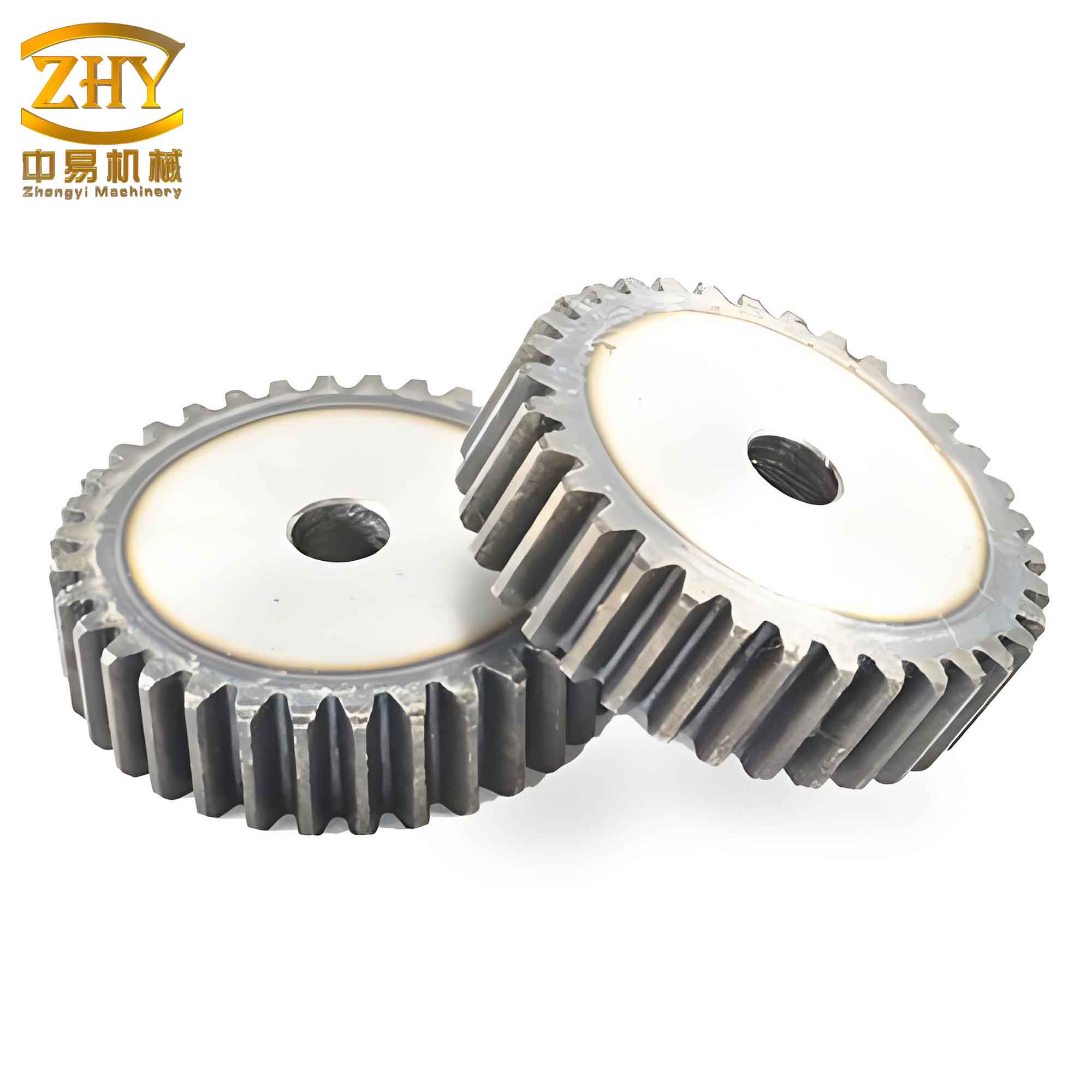
The core challenge in analyzing spur and pinion gear dynamics lies in accurately capturing the system’s nonlinearities. The interaction between meshing teeth is a time-varying dance governed by several key factors. Primarily, the meshing stiffness is not constant; it fluctuates as the number of tooth pairs in contact changes during the roll of the spur and pinion gears, leading to parametric excitation. Furthermore, damping at the tooth interface, friction forces that alternate direction at the pitch point, and manufacturing errors all introduce additional layers of complexity. To study this, I began by constructing a fundamental mathematical model that incorporates these essential phenomena.
Lumped-Parameter Model: The Mathematical Foundation
I employed the lumped-parameter method to create a translational-rotational coupled dynamic model for a single-stage spur and pinion gear transmission system. This model simplifies the physical components into discrete masses, inertias, springs, and dampers, focusing on the dominant degrees of freedom. For this analysis, I considered a system with six degrees of freedom: translational motion in the x (axial) and y (line-of-action) directions for both the pinion and the gear, plus rotational motion for each. The shafts and supporting bearings are not modeled explicitly; instead, their stiffness and damping effects are represented by equivalent values in the translational coordinates. The model schematic conceptualizes the pinion and gear as rigid bodies connected by a nonlinear spring-damper element representing the tooth mesh, along with supporting springs and dampers.
The generalized displacement vector for the system is defined as:
$$ \boldsymbol{\theta} = \{ x_p, y_p, \theta_p, x_g, y_g, \theta_g \}^T $$
where the subscripts \(p\) and \(g\) denote the pinion and gear, respectively. The dynamic meshing force \(F_m\) is the heart of the interaction, expressed as a function of the relative displacement and velocity along the line of action, incorporating the time-varying mesh stiffness \(k_m(t)\) and damping \(c_m\):
$$ F_m = k_m(t) (y_p + R_p\theta_p – y_g – R_g\theta_g) + c_m (\dot{y}_p + R_p\dot{\theta}_p – \dot{y}_g – R_g\dot{\theta}_g) $$
Here, \(R\) denotes the base circle radius. The friction force \(F_f\) on the tooth flanks is approximated as proportional to the dynamic meshing force, with a coefficient \(\lambda f\), where \(f\) is an equivalent friction coefficient and \(\lambda\) indicates the direction (\(\pm1\)) based on the contact point relative to the pitch point.
Applying Newton’s second law, the equations of motion for the six-degree-of-freedom system are derived. For conciseness, the full derivation is summarized into the matrix form of the system, which is canonical for dynamic analysis:
$$ \mathbf{M}\ddot{\boldsymbol{\delta}} + \mathbf{C}\dot{\boldsymbol{\delta}} + \mathbf{K}\boldsymbol{\delta} = \mathbf{P} $$
In this equation, \(\boldsymbol{\delta}\) is the transformed displacement vector (combining linear and angular displacements), \(\mathbf{M}\) is the mass/inertia matrix, \(\mathbf{C}\) is the damping matrix, \(\mathbf{K}\) is the stiffness matrix, and \(\mathbf{P}\) is the force vector containing the input torque and load torque. The stiffness matrix \(\mathbf{K}\) is particularly interesting as it contains the time-varying mesh stiffness \(k_m(t)\), making the system parametrically excited. For this study, the mesh stiffness was approximated as a simplified sinusoidal function around a mean value \(\bar{k}_m\), calculated according to established standards:
$$ k_m(t) = \bar{k}_m + \Delta k \cos(\omega_m t) $$
where \(\omega_m\) is the gear meshing frequency. The system parameters used for both the mathematical model and subsequent simulations are detailed in Table 1.
| Parameter | Symbol | Pinion Value | Gear Value |
|---|---|---|---|
| Module | m | 2 mm | 2 mm |
| Number of Teeth | z | 55 | 75 |
| Pressure Angle | \(\alpha\) | 20° | 20° |
| Face Width | B | 20 mm | 20 mm |
| Mass | m | Calculated | Calculated |
| Moment of Inertia | I | Calculated | Calculated |
| Equivalent Bearing Stiffness (x,y) | \(k_{px}, k_{py}, k_{gx}, k_{gy}\) | Assumed based on system design | |
| Input Speed | \(n_p\) | 800 rpm | – |
| Load Torque | \(T_g\) | – | 165 Nm |
Before solving for the dynamic response, it is insightful to examine the system’s inherent natural characteristics by performing a modal analysis. Setting the damping and excitation terms to zero, the eigenvalue problem \( (\mathbf{K} – \omega^2 \mathbf{M})\mathbf{X} = 0 \) is solved. The calculated natural frequencies for the first six modes are presented in Table 2. The presence of a rigid-body mode (0 Hz) is expected in the rotational direction without a torsional restraint; applying a small torsional stiffness to the output eliminates this for response analysis.
| Mode Number | 1 | 2 | 3 | 4 | 5 | 6 |
|---|---|---|---|---|---|---|
| Natural Frequency (Hz) | 0 | 477 | 614 | 750 | 912 | 2025 |
To obtain the dynamic response, I solved the system of differential equations (Equation 3) numerically using the Runge-Kutta method under the specified operating conditions (800 rpm, 165 Nm). The solutions provided time histories for all displacements. From these, the dynamic meshing force was reconstructed using Equation 2. The results showed periodic oscillations in the displacements and forces, as expected. The mean dynamic meshing force calculated from the lumped-parameter model served as a key benchmark for later comparison.
Multi-Body Dynamics Simulation: A Virtual Prototype
While the lumped-parameter model is powerful, I sought to complement it with a more visually intuitive and geometrically precise method. This led to the development of a multi-body dynamics model using a commercial software, ADAMS. Here, the spur and pinion gears, shafts, and housing are modeled as three-dimensional rigid bodies with accurate geometry imported from a CAD model. The connections (joints) are defined: revolute joints for the shafts and a fixed joint between each gear and its shaft.
The most critical aspect is defining the contact force between the teeth of the spur and pinion gears. Instead of a predefined kinematic constraint, a force-based contact algorithm was used. The software employs an impact function that calculates normal contact force \(F_n\) based on a spring-damper model:
$$ F_n =
\begin{cases}
k \, g^e + \text{step}(g, 0, 0, d_{\text{max}}, c_{\text{max}}) \cdot \dot{g}, & \text{if } g < 0 \\
0, & \text{if } g \geq 0
\end{cases} $$
where \(g\) is the penetration depth between the contacting geometries, \(k\) is the contact stiffness, \(e\) is the force exponent (typically 1.5 for metals), and the damping term is a function of penetration and a maximum damping coefficient \(c_{\text{max}}\). The contact stiffness \(k\) itself is derived from the material properties and local geometry using Hertzsian contact theory:
$$ k = \frac{4}{3} R^{1/2} E^* $$
with \( \frac{1}{R} = \frac{1}{R_1} + \frac{1}{R_2} \) and \( \frac{1}{E^*} = \frac{1-\nu_1^2}{E_1} + \frac{1-\nu_2^2}{E_2} \). For simplicity and computational efficiency, the radii \(R_1\) and \(R_2\) were approximated at the pitch circles of the spur and pinion gears. A Coulomb friction model was also included in the tangential direction. The simulation was run with identical input conditions: a constant rotational velocity on the pinion shaft and a constant resistive torque on the gear shaft. The software solved the system’s equations of motion, which in a multi-body framework are differential-algebraic equations (DAEs) of the form:
$$ \frac{d}{dt}\left( \frac{\partial L}{\partial \dot{\mathbf{q}}} \right) – \frac{\partial L}{\partial \mathbf{q}} + \mathbf{\Phi}_{\mathbf{q}}^T \mathbf{\lambda} – \mathbf{Q} = 0 $$
$$ \mathbf{\Phi}(\mathbf{q}, t) = 0 $$
where \(L\) is the Lagrangian, \(\mathbf{q}\) are the generalized coordinates, \(\mathbf{\Phi}\) are the constraint equations, \(\mathbf{\lambda}\) are the Lagrange multipliers, and \(\mathbf{Q}\) are the generalized forces. The results provided rich data, including the three-dimensional contact force components (radial, tangential, axial) between the spur and pinion gears, as well as the vibration velocities and displacements of the gear bodies.
Experimental Validation: Ground Truth from the Test Bench
No modeling or simulation effort is complete without validation against physical reality. To this end, I conducted an experimental investigation on a gearbox test rig. The test setup involved the same spur and pinion gear pair housed in a gearbox. Tri-axial accelerometers were mounted on the bearing housings to measure vibration. Data was acquired using a high-speed data acquisition system at a sampling frequency of 8192 Hz. The test was run at the same operational point: 800 rpm input speed and an approximate load of 165 Nm.
The raw acceleration signals in the tangential (x) and radial (y) directions were processed. Spectral analysis confirmed the dominant frequency components, with the gear mesh frequency (\(f_m = \frac{n_p \times z_p}{60}\)) being clearly identifiable and matching the theoretical value closely, providing confidence in the test setup. To enable direct comparison with the displacement and velocity outputs from the models, I performed numerical integration (with proper high-pass filtering to remove drift) on the measured acceleration time history to obtain velocity and displacement signals.
Synthesis and Comparative Analysis
With results from the lumped-parameter model (LPM), the multi-body dynamics simulation (MBS), and the experiment (EXP), a comprehensive comparative analysis was undertaken. The objective was to evaluate the fidelity and practicality of each analytical method.
1. Dynamic Meshing Force: The primary force driving the system’s vibration is the dynamic meshing force. A comparison of the mean meshing force magnitude obtained from the three sources is highly instructive. The theoretical static force, calculated from the input torque and base circle radius, served as the baseline reference.
| Method / Component | Tangential Force (N) | Radial Force (N) | Axial Force (N) | Resultant Force (N) |
|---|---|---|---|---|
| Theoretical (Static) | ~2200 | ~801 | 0 | ~2340 |
| Lumped-Parameter Model | ~2172 | ~791 | 0 | ~2310 |
| Multi-Body Simulation | ~2389 | ~807 | ~2.2 | ~2308 |
The results show excellent agreement in the magnitude of the resultant dynamic meshing force among all three columns. Both the LPM and MBS methods yielded values within 2% of the theoretical static force, validating their core accuracy in predicting load transmission. A key observation is the presence of a small axial force in the MBS results, which is absent in the LPM and theoretical calculations. This arises because the MBS model exists in a 3D space where minor misalignments and vibrations can generate axial components, whereas the LPM is a constrained 2D plane model. This highlights a nuanced advantage of the multi-body approach in capturing all spatial force components.
2. Vibration Response (Displacement & Velocity): Comparing the kinematic outputs—specifically, the tangential vibration displacement and velocity of the pinion—reveals further insights into model performance relative to experimental data.
- Displacement: The vibration displacement time history from the LPM showed a much closer match in amplitude and trend to the experimentally derived displacement (obtained via double integration of acceleration). The MBS-predicted displacement, while showing similar periodic behavior, was an order of magnitude smaller. This discrepancy may be attributed to the idealized rigid-body contact and damping parameters in the MBS model, which might not fully capture the energy dissipation and structural flexibilities of the real system that influence absolute displacement.
- Velocity: The comparison of vibration velocity was more favorable. Both the LPM and MBS predicted velocity amplitudes that were of the same order of magnitude as the experimentally derived velocity (from single integration of acceleration). The LPM results again aligned more closely in waveform detail, but the MBS provided a qualitatively correct and quantitatively reasonable estimate of vibration severity.
3. Practical Methodological Assessment: Beyond numerical results, a practical evaluation of the two modeling approaches is crucial for guiding future research and engineering practice.
| Aspect | Lumped-Parameter Model (LPM) | Multi-Body Simulation (MBS) |
|---|---|---|
| Model Fidelity & Insight | Excellent for understanding fundamental physics (parametric excitation, modal properties). Provides direct access to equations. High accuracy in predicting key dynamic forces and vibration trends. | Excellent for visualizing complex 3D interactions, contact patterns, and spatial force components. Captures geometric effects naturally. |
| Computational Efficiency | Very high. Solving 6 ODEs is computationally inexpensive, allowing for rapid parametric studies and long-duration simulations. | Moderate to low. Solving large DAEs with contact detection is computationally demanding, limiting simulation speed and scope for extensive parameter sweeps. |
| Ease of Setup | Requires deep analytical derivation and coding. Parameter identification (stiffness, damping) is critical and non-trivial. | Relatively easier initial setup via GUI and CAD import. However, tuning contact parameters (stiffness, damping, friction) is equally critical and challenging. |
| Primary Strength | Precision in dynamic analysis and speed for iterative design. | Realism in system representation and ability to model complex assemblies. |
| Best Use Case | Initial design stage, thorough dynamic analysis, root-cause vibration studies, control system design. | Detailed design validation, study of misalignment effects, noise analysis (NVH), and creating realistic virtual prototypes for system integration. |
Conclusion
Through this integrated investigation into the dynamics of a spur and pinion gear pair, several important conclusions have been crystallized. First, both the lumped-parameter modeling and multi-body dynamics simulation approaches are fundamentally capable of predicting the dynamic meshing forces with high accuracy when compared to theoretical expectations. Second, for predicting vibration kinematic responses, the lumped-parameter model demonstrated superior correlation with experimental data, particularly for displacement, likely due to its tailored incorporation of system-specific dynamic parameters. The multi-body simulation, while slightly less accurate in absolute displacement magnitude, provided valuable 3D force data and a qualitatively correct dynamic picture with greater geometric realism.
Therefore, the most effective strategy for researching spur and pinion gear dynamics is not to choose one method over the other, but to employ them synergistically. The lumped-parameter model serves as an efficient and insightful tool for rapid dynamic analysis and understanding core phenomena. Its results can then inform and validate the setup of a more detailed multi-body dynamics model, which in turn can explore secondary effects and full-system interactions that are difficult to encapsulate in a simplified analytical model. Finally, targeted experimental validation remains the indispensable cornerstone for calibrating model parameters and confirming findings. This combined methodological framework provides a robust foundation for advancing the design of quieter, more efficient, and more reliable spur and pinion gear transmissions, ultimately contributing to the enhancement of mechanical systems across countless industries.