
Throughout my years of analyzing and improving gear manufacturing processes, I have consistently observed that the pursuit of higher quality at a reasonable cost hinges on a deep understanding of error sources. For gears produced to standards like JB179-83 Class 8 or 7, the common process chain of hobbing, shaving, and finishing is standard. However, the final accuracy is not merely a sum of individual operations; it is a complex interaction of errors that propagate, transform, and sometimes cancel out. The most significant challenges to kinematic accuracy—the smoothness of rotational transmission—are invariably tied to two fundamental types of eccentricity: geometric eccentricity and kinematic (or motion) eccentricity. This analysis delves into their behavior across the hobbing, shaving, and gear honing stages, providing a clear roadmap for their control.
The core of the problem lies in how a gear’s teeth are positioned relative to its theoretical perfect form. Geometric eccentricity ($e_j$) arises from misalignment between the gear blank’s reference bore and the machine tool’s arbor or fixture axis. This is predominantly caused by clearance in fits. Kinematic eccentricity ($e_k$), on the other hand, is induced by the cumulative pitch error of the machine tool’s indexing train (e.g., worn worm and worm wheel). It causes the gear’s base circle to be offset from its axis of rotation during cutting, creating a form of “phantom” eccentricity related to motion, not physical misplacement. The combined effect of these eccentricities is quantified through two critical inspection parameters: the radial runout ($F_r$) and the variation in base tangent length (or adjacent pitch error, often analogous to $F_w$).
Theoretical Foundation of Eccentricity Effects
The influence of these eccentricities on the meshing line increment, which directly affects tooth engagement, follows a sinusoidal pattern. For a gear rotating through an angle $\phi$, with a pressure angle $\alpha$, and a phase difference $\psi$ between the two eccentricity vectors, the contributions are:
$$ \Delta F_{geom} = \pm e_j \cdot \sin(\phi) $$
$$ \Delta F_{kin} = \pm e_k \cdot \sin(\phi \pm \psi) $$
Integrating these effects over a full revolution reveals their impact on the standard measurement parameters. For hobbing, the relationships are well-established:
$$ F_{r(hob)} = 2 \cdot e_{j(hob)} $$
$$ F_{w(hob)} = 4 \cdot e_{k(hob)} \cdot \sin(\alpha) $$
Here, $F_{r(hob)}$ is directly proportional to the geometric eccentricity present during hobbing, while $F_{w(hob)}$ is a direct indicator of the kinematic eccentricity from the hobbing machine’s indexing system. These initial errors set the stage for all subsequent finishing operations.
Error Propagation and Transformation in Shaving
Shaving, as a free-meshing, gear-type finishing process, has a unique effect on these errors. It does not simply replicate them. The mechanics of the shaving cut tend to average out certain error components. A critical principle is that the shaving process tends to convert pre-existing geometric eccentricity ($e_j$) from the hobbed gear into a form of kinematic error in the shaved gear, while the original kinematic eccentricity ($e_k$) largely remains. Furthermore, any *new* geometric eccentricity introduced by the shaving fixture itself ($e_{j(shave)}$) adds directly to the radial runout.
Therefore, the error state after shaving can be described as a transformation of the hobbed state. Ignoring for a moment the specific clamping method, the expected errors post-shaving are a combination of the transformed hob errors and new clamping errors:
$$ F_{r(shave)} \approx 2 \cdot e_{j(hob)} \cdot \cos(\alpha) + 2 \cdot e_{j(shave)} $$
$$ F_{w(shave)} \approx 4 \cdot e_{k(hob)} \cdot \sin(\alpha) – 2 \cdot e_{j(hob)} \cdot \sin(2\alpha) \cdot \cos(\psi) $$
This reveals a key insight: poor shaving fixture design, typically using a simple solid arbor with clearance fit, is a major source of new geometric eccentricity ($e_{j(shave)}$). This directly degrades $F_r$ and can also influence tooth alignment and profile. The common fixture shown in many workshops, with its inevitable clearance, is a fundamental bottleneck to achieving higher accuracy.
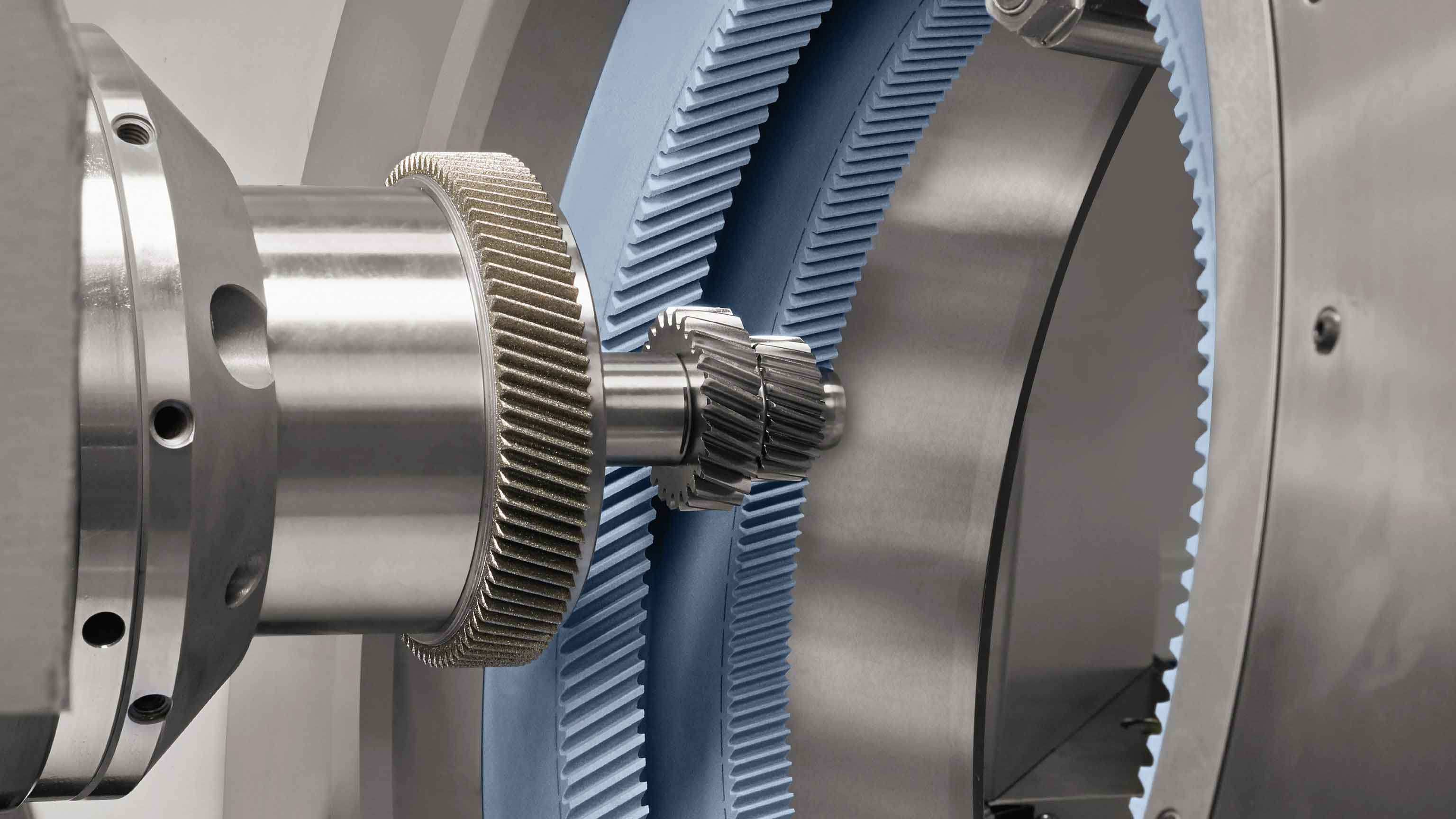
The Role of Gear Honing in Final Error Correction
Following shaving, the process of gear honing serves as a final abrasive finishing operation. While gear honing is most renowned for dramatically improving surface finish and inducing favorable compressive residual stresses, it also plays a subtle but important role in the final error landscape. Similar to shaving, gear honing is a free-meshing process. It has a mild corrective action on tooth flank geometry. The abrasive action of the honing gear can slightly average out minor pitch errors and reduce noise-exciting irregularities. However, it is crucial to understand that gear honing is not primarily a size or concentricity correction process. The eccentricities largely locked in after shaving—both the residual kinematic eccentricity and the fixture-induced geometric eccentricity—will largely persist through a conventional gear honing operation. Therefore, the foundation for excellent kinematic accuracy must be laid before the gear honing stage. A high-quality pre-honed gear with minimal $F_r$ and $F_w$ will yield a superior final product after gear honing, with exceptional smoothness and quietness. The fixture used for gear honing is equally critical; a floating, non-quick-change design that minimizes clamping distortion is essential to preserve the accuracy achieved in prior stages and allow the gear honing abrasives to work uniformly across all teeth.
Practical Solutions for Error Suppression
The analysis clearly points to specific leverage points for improvement. The goal is to drive both $e_j$ and $e_k$ as close to zero as possible at each stage.
1. Eliminating Geometric Eccentricity at the Source: Zero-Clearance Fixturing
The single most effective action is to eliminate clearance in all critical fixturing. For hobbing, this means employing a non-quick-change, expanding mandrel (e.g., hydraulic, plastic, or mechanically expanding collet) that grips the bore with uniform pressure and truly centers the blank. This makes $e_{j(hob)} \approx 0$, so $F_{r(hob)} \approx 0$.
For shaving and gear honing, the same principle applies. The traditional quick-change arbor must be abandoned in favor of a precision expanding fixture. A well-designed floating mandrel for shaving, which centers the gear on its bore without axial clamping force that can induce wobble, is vital. This makes $e_{j(shave)} \approx 0$.
2. Minimizing Kinematic Eccentricity: Machine Tool Discipline
Controlling $e_k$ requires disciplined maintenance of the gear cutting machine. The indexing train, especially the worm and worm gear pair in a hobbing machine, is the primary culprit. Regular inspection, timely replacement of worn components, and precise adjustment are non-negotiable. Furthermore, the selection of change gears for indexing and differential should use gear tooth counts that minimize known cyclic error frequencies.
3. The Impact of Implemented Solutions
Implementing zero-clearance hobbing and shaving fixturing has a dramatic effect on the error equations. With $e_{j(hob)} = 0$ and $e_{j(shave)} = 0$, the post-shaving errors simplify radically:
$$ F_{r} \approx 0 $$
$$ F_{w} \approx 4 \cdot e_{k(hob)} \cdot \sin(\alpha) $$
For a standard pressure angle $\alpha = 20^\circ$, $ \sin(20^\circ) \approx 0.342 $. Thus, $ F_{w} \approx 1.368 \cdot e_{k(hob)} $. The remaining error is solely a function of the hobbing machine’s kinematic quality, which is now the isolated and primary target for further improvement. This clear separation of error sources is the hallmark of a controlled process.
| Process Stage | Primary Error Introduced | Key Control Parameter Affected | Critical Control Method |
|---|---|---|---|
| Hobbing | Geometric Eccentricity ($e_j$), Kinematic Eccentricity ($e_k$) | $F_r$, $F_w$ | Zero-clearance expanding mandrel; Machine index train maintenance |
| Shaving | New Geometric Eccentricity ($e_{j(shave)}$); Transforms prior $e_j$ into $F_w$ | $F_r$, $F_w$ (transformed) | Precision floating/expanding fixture; Minimize axial clamping force |
| Gear Honing | Minimal new eccentricity; Can average minor flank errors | Surface finish, minor profile/pitch correction | Non-quick-change, low-distortion floating fixture; Correct honing gear design |
Comprehensive Recommendations for Precision Gear Manufacturing
Based on this integrated analysis, I offer the following strategic recommendations for any shop serious about improving gear quality:
- Universal Adoption of Precision Fixturing: Invest in and standardize the use of zero-clearance, expanding mandrels for hobbing, shaving, and gear honing. The upfront cost is rapidly offset by reduced scrap, less rework, and the ability to consistently hit tighter tolerances. The fixture is not just a holder; it is a primary determinant of quality.
- Proactive Machine Tool Management: Establish a rigorous preventive maintenance schedule focused on the indexing and drive systems of hobbing machines. Treat kinematic accuracy as a key performance indicator to be monitored and preserved.
- Design for Manufacturability: Whenever possible, advocate for the design of shaft gears over separate gears mounted on a shaft. A shaft gear, manufactured between centers, inherently eliminates the runout error associated with bore-to-arbor fits. Its final accuracy then depends primarily on the machine tool’s kinematic fidelity and the uniformity of the cutting process, which are often easier to control than compounded fixture errors.
- Understand the Role of Each Process: Recognize that gear honing is a superb finishing operation for noise reduction and surface integrity, but it is not a cure for poor concentricity. The goal must be to deliver a shaved gear with excellent $F_r$ and $F_w$ to the gear honing operation. The honing fixture must be of equal quality to preserve this accuracy during the final abrasive finishing process.
In conclusion, the path to mastering gear accuracy is a systematic one. It requires moving from a vague understanding of “machine error” to a precise quantification of geometric and kinematic eccentricities. By attacking these specific error sources with targeted solutions—primarily superior fixturing and machine discipline—the seemingly complex challenge of producing high-precision, quiet, and durable gears becomes a manageable and predictable engineering task. The process chain, from hobbing through shaving to final gear honing, then works in harmony to refine the gear, rather than inadvertently amplifying inherent flaws.