
In the rapidly evolving fields of electric vehicles and robotics, gears remain indispensable mechanical components, driving continuous advancements in gear cutting technologies. Traditional gear cutting methods, such as hobbing and shaping, rely on specialized tools like hobs or shaper cutters, which are designed for specific gear parameters like module, pressure angle, and number of teeth. This inherently limits their flexibility, making them cost-effective only for mass production. For customized small-batch production or prototyping, where unique gear specifications are often required, these conventional approaches fall short due to high tooling costs and lead times. Alternative methods, like form milling with dedicated cutters or computer-aided manufacturing (CAM) on multi-axis machining centers, offer some solutions but come with their own constraints. Form tools are expensive and gear-specific, while high-end CAM systems may be inaccessible to small workshops or laboratories. To address these challenges, I propose a novel gear cutting method that utilizes a standard tapered end mill as the sole cutting tool. This approach enables the machining of gears with various parameters—including module, pressure angle, number of teeth, and even complex tooth geometries—on both advanced 5-axis machining centers and universal milling machines. By leveraging simple kinematic adjustments, this method promises to democratize gear cutting for定制化生产, offering a low-cost, versatile solution for research, development, and small-scale manufacturing. In this article, I will detail the principles, adjustments, and practical applications of this innovative gear cutting technique, supported by experimental validations that underscore its precision and feasibility.
The core of the proposed gear cutting method lies in the use of a tapered end mill, whose cutting edges form a conical surface. Unlike dedicated gear cutters, this tool is widely available and inexpensive. The fundamental concept involves two synchronized motions: the tool reciprocates linearly along the tooth width direction (i.e., parallel to the gear axis), while simultaneously feeding alternately along the tangent direction to the pitch circle. This generates the involute tooth profile incrementally. For a single tooth slot, the tool follows a zigzag path, with each feed step corresponding to a slight rotation of the gear blank. The relationship between the tool feed length and the blank rotation is critical for accurate involute generation. Mathematically, this synchronization is expressed as:
$$ \theta_w = \frac{f_t}{r_0} = \frac{2f_t}{mz} $$
Here, $\theta_w$ represents the rotation angle of the gear blank (in radians), $f_t$ is the linear feed length of the tool along the pitch circle tangent, $r_0$ is the pitch circle radius, $m$ is the module, and $z$ is the number of teeth. This equation ensures that the tool’s movement relative to the blank precisely traces the involute curve. After completing one tooth slot, the tool retracts to the starting point, and the gear blank is indexed by one pitch angle—a process called分度—to begin cutting the next slot. This cycle repeats $z$ times to produce all teeth. The beauty of this gear cutting approach is that it does not require a tool shaped like the tooth space; instead, the involute profile emerges from the coordinated motion of a simple conical tool. This principle forms the basis for adapting the method to various gear parameters, as discussed next.
One of the key advantages of this gear cutting method is the ability to adjust gear parameters on the fly by modifying machining parameters. For standard gears, the module $m$ is directly related to the tooth depth. Specifically, the full depth of a standard tooth slot $h$ is typically given by:
$$ h = 2.25m $$
Thus, by simply changing the cutting depth $h$ during the gear cutting process, gears of different modules can be produced using the same tapered end mill. For instance, if a module of 2 mm is desired, the slot depth is set to 4.5 mm; for a module of 3 mm, it becomes 6.75 mm. This flexibility is unprecedented in traditional gear cutting methods, which require separate tools for each module. Similarly, the number of teeth $z$ is controlled by the indexing angle $\theta_i$ after each tooth slot is completed. The indexing angle is calculated as:
$$ \theta_i = \frac{2\pi}{z} $$
By adjusting the indexing mechanism—whether electronically on a CNC machine or mechanically via a dividing head—the gear cutting process can accommodate any tooth count. Lastly, the pressure angle $\alpha$, which defines the inclination of the tooth flanks, is inherently linked to the half-cone angle of the tapered end mill. If the tool’s half-cone angle matches the desired pressure angle, the tool path remains parallel to the gear axis. However, if a different pressure angle is needed, the tool path plane can be tilted by an angle $\Delta \alpha$, which is the difference between the desired pressure angle and the tool’s half-cone angle. This tilt adjusts the effective cutting angle, allowing for the generation of various pressure angles without changing the tool. In summary, the gear cutting parameters are decoupled from the tool geometry, enabling remarkable adaptability.
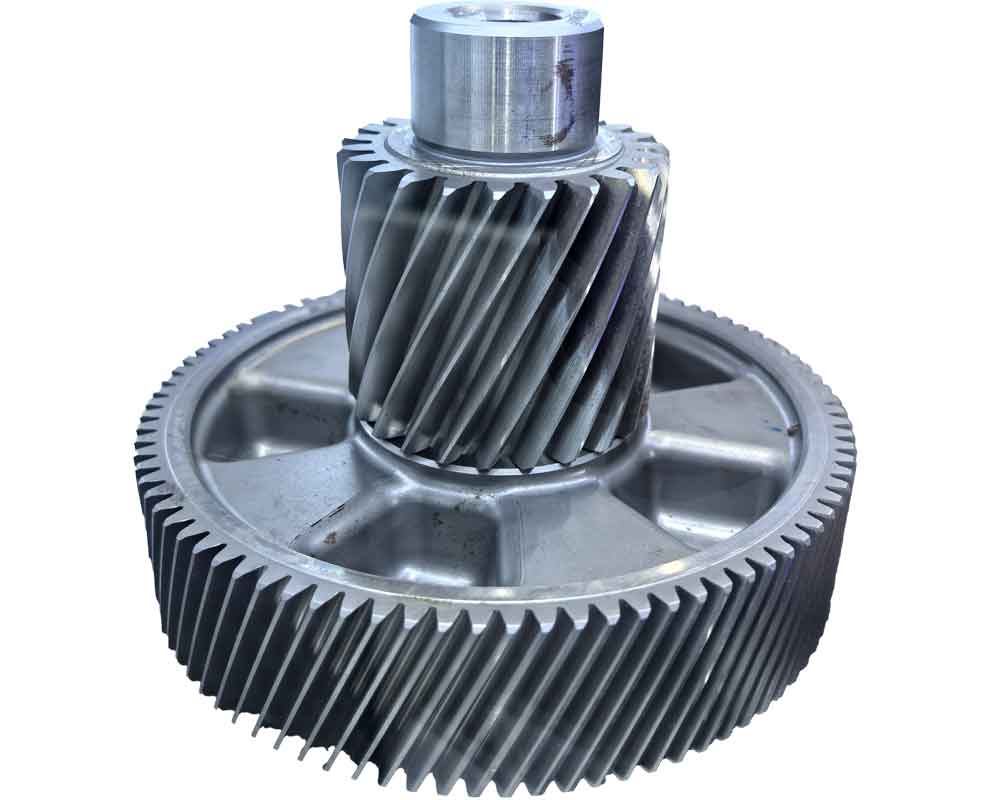
The proposed gear cutting method seamlessly extends to helical gears, which have teeth twisted along the gear axis. For helical gear cutting, the tool still reciprocates along the tooth width direction, but now the gear blank rotates synchronously with an additional axial movement of the tool. Specifically, as the tool moves axially by a distance $l_a$, the gear blank must rotate by an angle $\theta_a$ to account for the helix angle $\beta$. The relationship is derived from the geometry of the helical tooth line on the pitch cylinder. The axial displacement $l_a$ corresponds to a tangential displacement $f_a$ on the pitch surface, given by:
$$ f_a = l_a \tan \beta $$
Consequently, the required rotation angle is:
$$ \theta_a = \frac{f_a}{r_0} = \frac{2f_a}{mz} = \frac{2l_a \tan \beta}{mz} $$
This synchronization ensures that the tool cuts along the helical path, generating the correct tooth geometry. In practice, on a 5-axis machining center, this is achieved by programming simultaneous axial and rotational motions. On a universal mill with a mechanical synchronizing device, the axial feed can be coupled to the blank rotation via gearing or cams. This capability highlights the versatility of the gear cutting method, as it can produce both spur and helical gears with the same tapered end mill.
Beyond standard helical gears, the method can also generate gears with non-linear tooth lines, such as arc tooth line gears (also known as crowned or profile-modified gears). These gears have tooth traces that follow a curved path along the face width, often used to reduce edge contact and improve load distribution. The principle is similar to helical gear cutting, but instead of a constant helix angle, the tooth line shape is defined by a function $f(x)$, where $x$ is the axial position. During gear cutting, as the tool moves axially, the gear blank rotates by an angle $\theta_x$ that varies according to the desired curve. The relationship is:
$$ \theta_x = \frac{f(x)}{r_0} = \frac{2f(x)}{mz} $$
By programming or mechanically linking the axial motion to the rotation via this equation, any tooth line shape can be produced. For example, a sinusoidal or circular arc profile can be implemented, enabling定制化 gear designs for specialized applications. This flexibility further underscores the power of this gear cutting approach in meeting diverse engineering needs.
To validate the proposed gear cutting method, I conducted trials on a 5-axis machining center, which offers high precision and dynamic control. The setup involved mounting the gear blank on a rotary table (C-axis) and tilting the spindle or table (A or B-axis) to orient the tool correctly. The tool—a tapered end mill—was programmed to move in a zigzag pattern along the tooth width while synchronously rotating the blank according to the equations earlier. This environment allows for direct implementation of the gear cutting kinematics without additional hardware. The trials focused on spur and helical gears made from engineering plastic, with specifications as shown in the table below.
| Parameter | Value |
|---|---|
| Module, $m$ (mm) | 2.5 |
| Number of teeth, $z$ | 34 |
| Pressure angle, $\alpha$ (degrees) | 20 |
| Helix angle, $\beta$ (degrees) | 0 (spur) and 20 (helical) |
The cutting conditions were selected to balance efficiency and surface quality, as summarized in the following table.
| Parameter | Value |
|---|---|
| Spindle speed (rpm) | 3000 |
| Feed rate (mm/min) | 300 |
| Feed per tooth (mm/rev) | 0.1 |
The tapered end mill had the following geometry, which is typical for such tools:
| Parameter | Value |
|---|---|
| Cutting edge diameter (mm) | 1.5 |
| Cutting edge length (mm) | 5 |
| Half-cone angle (degrees) | 20 |
| Shank diameter (mm) | 6 |
The gear cutting process proceeded smoothly, taking approximately one hour per gear. The resulting gears exhibited clean tooth profiles with minimal burrs. To quantify accuracy, I measured the common normal length (over pins) for the spur gears, as this is a sensitive indicator of tooth spacing and profile errors. The deviations from the theoretical values are plotted below, showing that most were within 10 μm. This level of precision is remarkable for a method using a non-dedicated tool, and it demonstrates the effectiveness of the synchronized kinematics in gear cutting. The helical gears were also visually inspected and showed consistent helix angles, confirming the proper implementation of the axial-rotation coupling.
While 5-axis machining centers are ideal for this gear cutting method, they are not always accessible. To make the technique available in smaller workshops, I developed a feed synchronization device that can be mounted on a universal milling machine. This device mechanically links the longitudinal feed of the milling table (Y-direction) to the rotation of the gear blank, thereby implementing the fundamental equation $\theta_w = 2f_t / (mz)$. The setup includes a rack-and-pinion mechanism that translates linear table movement into blank rotation. Additionally, a separate indexing mechanism allows for分度 after each tooth slot. The indexing uses a lever principle: a pivot point is adjusted based on the ratio of a reference gear’s teeth to the desired gear’s teeth, ensuring precise pitch division. The indexing angle $\theta_i$ is achieved as:
$$ \theta_i = \frac{\pi m \cdot (z_R / z)}{D_R / 2} = \frac{2\pi}{z} $$
where $z_R$ and $D_R$ are the tooth count and diameter of the reference gear. This mechanical design enables variable tooth counts by simply repositioning the pivot. With this attachment, I performed gear cutting trials on a standard horizontal milling machine. The workpiece was again engineering plastic, and the gear parameters were: module $m = 2.5$ mm, pressure angle $\alpha = 20^\circ$, and number of teeth $z = 31$. The cutting conditions are listed in the table.
| Parameter | Value |
|---|---|
| Spindle speed (rpm) | 1000 |
| Feed rate (mm/min) | 200 |
| Feed per tooth (mm/rev) | 0.2 |
The gear cutting process was manual but straightforward, taking about two hours due to slower feeds and manual interventions. To assess the quality, I compared a gear produced by this method with one made on a conventional gear hobbing machine. The tooth profiles were scanned and superimposed, revealing a maximum profile error of 0.05 mm. This is acceptable for many prototyping and repair applications, especially considering the low cost and flexibility of the setup. Furthermore, to demonstrate the module adjustability, I machined multiple gear segments on the same blank by varying only the cutting depth. The results, with modules of 1, 1.5, 2, and 2.5 mm, all showed correct tooth proportions. Lastly, I tested arc tooth line gear cutting by programming the feed synchronization device to follow a sinusoidal curve. The resulting tooth trace clearly exhibited the desired wave pattern, proving the method’s capability for complex geometries. These trials collectively validate that the proposed gear cutting method is not only feasible on high-end machines but also adaptable to humble workshop equipment.
In conclusion, the gear cutting method using a tapered end mill presents a paradigm shift in gear manufacturing, particularly for定制化小批量生产. By decoupling gear parameters from tool geometry, it allows a single, inexpensive tool to produce gears of various modules, pressure angles, tooth counts, and tooth line shapes. The experiments on a 5-axis machining center demonstrated high precision, with common normal length deviations within 10 μm for spur gears. On a universal milling machine equipped with a mechanical synchronizer, the gear cutting achieved satisfactory accuracy, with profile errors up to 0.05 mm compared to hobbing. While the method may not match the productivity of dedicated gear cutters for mass production, its flexibility and low tooling cost make it ideal for research, development, maintenance, and small-batch production. Future work could focus on optimizing cutting parameters for different materials, extending the method to bevel or worm gears, and integrating real-time monitoring to further improve accuracy. Nevertheless, this gear cutting approach already offers a powerful solution for engineers and machinists seeking to overcome the limitations of traditional gear cutting techniques.