
In the field of gear transmission systems, face gear drives represent a unique configuration where a cylindrical gear meshes with a conical gear, enabling orthogonal and non-orthogonal applications. However, a less explored variant is the offset face gear drive, where the pinion is positioned with a lateral displacement relative to the face gear axis. This offset configuration significantly broadens the application scope of face gear transmissions, offering designers greater flexibility in mechanical engineering layouts. In this article, I will delve into the geometric design, theoretical analysis, and practical implementation of offset orthogonal face gears, with a particular emphasis on gear shaping as the primary manufacturing method. The discussion will encompass mathematical modeling, limitation analysis for undercutting and tooth tip sharpening, and experimental validation through gear shaping trials. Throughout, I will integrate numerous formulas and tables to summarize key concepts, ensuring a comprehensive understanding of this advanced gear type.
Face gear drives are known for their ability to transmit motion between intersecting or offset shafts, but the offset variant introduces a lateral displacement between the axes of the cylindrical pinion and the face gear. This offset, denoted as E, allows for more compact and versatile designs in applications such as aerospace, automotive differentials, and industrial machinery. The design of offset face gears requires precise geometric calculations to avoid common issues like undercutting and tooth tip sharpening, which can compromise gear strength and meshing performance. In my approach, I base the analysis on gear meshing theory, starting with the mathematical model for generating the face gear tooth surface using a gear shaping process. Gear shaping, a formative manufacturing technique, is ideal for producing complex gear geometries like face gears, as it involves a reciprocating cutter that mimics the meshing action of a gear pair. This method ensures accurate tooth profiles and is central to my experimental work.
To begin, I derive the tooth surface equations for the offset orthogonal face gear. The process starts with the tool geometry—a standard involute gear cutter used in gear shaping. Let the tool coordinate system be Σs, with parameters (us, θs) defining the tool surface. The position vector for the tool tooth surface, representing both sides of the tooth槽, is given by:
$$ \vec{r}_s(\theta_s, u_s) = \begin{bmatrix} \pm r_{bs}[\sin(\theta_{os} + \theta_s) – \theta_s \cos(\theta_{os} + \theta_s)] \\ -r_{bs}[\cos(\theta_{os} + \theta_s) + \theta_s \sin(\theta_{os} + \theta_s)] \\ u_s \end{bmatrix}, $$
where rbs is the base circle radius of the tool, θos is a parameter accounting for the tool tooth space, calculated as θos = π/(2Ns) – inv(αo), with Ns as the number of tool teeth and αo as the pressure angle. The unit normal vector of the tool surface is:
$$ \vec{n}_s = \begin{bmatrix} -\cos(\theta_s + \theta_{os}) \\ \pm \sin(\theta_s + \theta_{os}) \\ 0 \end{bmatrix}. $$
Next, I establish the coordinate transformation from the tool system to the face gear system Σ2, incorporating the offset E. The transformation matrix M2s is:
$$ M_{2s} = \begin{bmatrix} \cos \phi_2 \cos \phi_s & -\cos \phi_2 \sin \phi_s & -\sin \phi_2 & E \cos \phi_2 \\ -\sin \phi_2 \cos \phi_s & \sin \phi_2 \sin \phi_s & -\cos \phi_2 & -E \sin \phi_2 \\ \sin \phi_s & \cos \phi_s & 0 & 0 \\ 0 & 0 & 0 & 1 \end{bmatrix}, $$
where φs and φ2 are rotational angles of the tool and face gear, respectively. The face gear tooth surface Σ2 is generated by enveloping the tool surface, leading to the equation:
$$ \vec{r}_2(\theta_s, \phi_s, u_s) = M_{2s}(\phi_s) \vec{r}_s(\theta_s, u_s), $$
subject to the meshing condition f(θs, φs, us) = 0. The meshing equation is derived from the relative velocity between the tool and gear at contact points. In the tool coordinate system, the relative velocity vector is:
$$ \vec{v}^{(s,2)} = \omega_s \begin{bmatrix} -y_s – m_{2s} z_s \cos \phi_s \\ x_s + m_{2s} z_s \sin \phi_s \\ m_{2s} (x_s \cos \phi_s – y_s \sin \phi_s + E) \end{bmatrix}, $$
where m2s is the gear ratio. The meshing condition requires that the tool normal vector is orthogonal to the relative velocity, yielding:
$$ f(\theta_s, \phi_s, u_s) = \vec{n}_s \cdot \vec{v}^{(s,2)} = 0. $$
Solving this, I obtain us = rbs / (m2s} \cos \phi), where φ = φs ± (θs + θos). Substituting back, the face gear tooth surface equation becomes:
$$ \vec{r}_2(\theta_s, \phi_s) = \begin{bmatrix} r_{bs}[\cos \phi_2 (\sin \varphi \mp \theta_s \cos \varphi) – \frac{\sin \phi_2}{m_{2s} \cos \varphi}] + E \cos \phi_2 \\ -r_{bs}[\sin \phi_2 (\sin \varphi \mp \theta_s \cos \varphi) + \frac{\cos \phi_2}{m_{2s} \cos \varphi}] – E \sin \phi_2 \\ -r_{bs} (\cos \varphi \pm \theta_s \sin \varphi) \end{bmatrix}. $$
This equation describes the complete tooth geometry of the offset face gear, accounting for the lateral displacement E. To ensure practical manufacturability via gear shaping, I next analyze limitations related to undercutting and tooth tip sharpening.
Undercutting occurs when the tool removes excessive material from the gear root, weakening the tooth. It can be avoided by eliminating singular points on the tooth surface, where the relative velocity and tool surface velocity cancel out. Mathematically, this condition is expressed as:
$$ \vec{v}_{rs} + \vec{v}^{(s,2)} = 0, $$
leading to a system of equations that define the limit for undercutting. By differentiating the meshing equation and combining with the tooth surface equations, I derive the condition F(θs, φs, us) = Δ12 + Δ22 + Δ32 = 0, where Δ1, Δ2, and Δ3 are determinants involving partial derivatives. At the tool tip, parameter θs* is given by θs* = √(ras2 – rbs2)/rbs, with ras as the tool tip radius. Solving for φs* and substituting into the tooth surface equation yields the undercut limit point (x2*, y2*, z2*). The minimum inner radius R1 to prevent undercutting is:
$$ R_1 = \sqrt{(x_2^*)^2 + (y_2^*)^2}. $$
Due to asymmetry in offset face gears, this calculation must be performed for both tooth sides, and the maximum value is selected: R1 = max(R1a, R1b). This ensures that the gear design avoids root interference during the gear shaping process.
Tooth tip sharpening refers to the thinning of the gear tooth tip until it becomes a point, which reduces load capacity. To analyze this, I transform the tooth surface equation to a coordinate system Sg aligned with the gear tip. The condition for tip sharpening is that the coordinates of opposite tooth surfaces coincide at the tip, expressed as:
$$ x_g^a(\theta_s^a, \phi_s^a) – x_g^b(\theta_s^b, \phi_s^b) = 0, \quad z_g^a(\theta_s^a, \phi_s^a) – z_g^b(\theta_s^b, \phi_s^b) = 0, \quad y_g^a = y_g^b = 0. $$
Solving these equations provides the limit point (xg*, yg*, zg*), and the maximum outer radius R2 to prevent sharpening is:
$$ R_2 = \sqrt{(x_g^*)^2 + (z_g^*)^2}. $$
These geometric constraints are crucial for designing offset face gears that are both functional and durable. To summarize the design parameters and limits, I present the following table:
| Parameter | Symbol | Typical Value | Constraint |
|---|---|---|---|
| Offset Distance | E | 15 mm | Based on application |
| Tool Teeth Number | Ns | 25 | Standard gear shaping cutter |
| Face Gear Teeth Number | N2 | 88 | For desired gear ratio |
| Pressure Angle | αo | 20° | Common in gear systems |
| Module | m | 3 mm | Tooth size specification |
| Minimum Inner Radius | R1 | Calculated from undercut analysis | Avoids root interference |
| Maximum Outer Radius | R2 | Calculated from tip sharpening analysis | Prevents tooth tip failure |
With the theoretical foundation established, I now turn to the practical aspect of manufacturing offset face gears through gear shaping. Gear shaping is a versatile machining process that uses a reciprocating cutter to generate gear teeth by simulating meshing action. For offset face gears, the key challenge is aligning the tool axis with the required offset relative to the gear axis. In my setup, I employ a modified gear shaping machine, where the tool axis is positioned laterally to achieve the offset E. The principle involves mounting the face gear blank on a rotary table, with the tool axis oriented perpendicular to the gear axis but displaced by distance E. This configuration ensures that the tool cuts teeth along an inclined path, resulting in the desired offset geometry.
The gear shaping process for offset face gears requires precise coordination between the tool reciprocation, gear rotation, and feed motions. The mathematical relationship for the offset angle γ, which adjusts the tool position, is derived from the offset distance E and the distance L from the rotation center to the gear blank edge: tan γ = E / L. This angle is set on the machine to orient the tool correctly. During gear shaping, the tool, with its involute profile, engages with the gear blank, removing material to form the tooth spaces. The process parameters, such as cutting speed, feed rate, and depth of cut, are optimized based on the gear material and size. Gear shaping offers advantages like high accuracy and the ability to produce complex profiles, making it ideal for offset face gears. To illustrate the setup, I include an image of the gear shaping process:
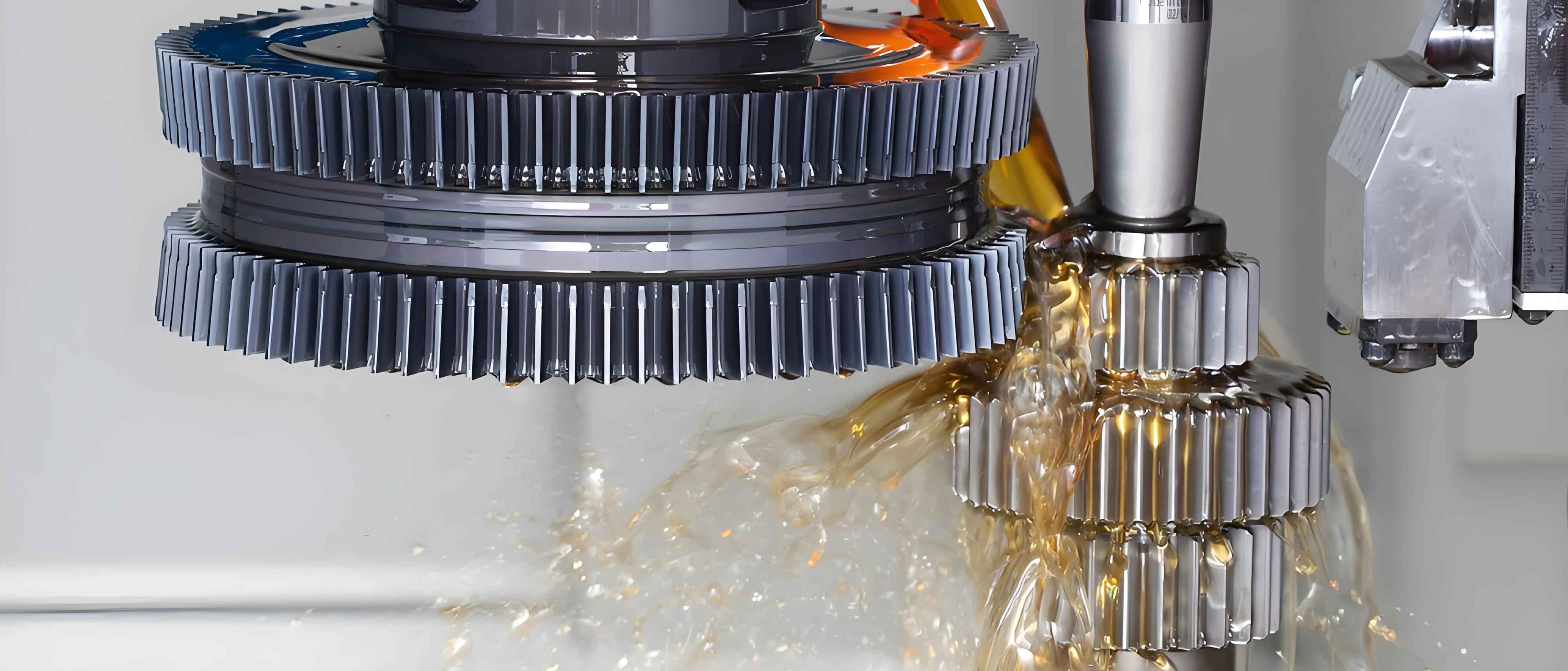
This image depicts a typical gear shaping operation, highlighting the interaction between the cutter and gear blank. In my experiments, I used a Y514 type gear shaping machine, equipped with a custom fixture to achieve the offset. The tool had Ns = 25 teeth, αo = 20°, and m = 3 mm, while the face gear blank had N2 = 88 teeth and E = 15 mm. The gear shaping process involved setting γ according to the calculation, followed by successive passes to cut the teeth to full depth. I monitored the process for vibrations and tool wear, ensuring consistent tooth geometry. After machining, I inspected the gear for surface finish and dimensional accuracy, confirming that the tooth profiles matched the theoretical equations.
To validate the meshing performance of the manufactured offset face gear, I conducted a rolling contact test on a Y9550 type gear rolling tester. This test involves mating the face gear with a cylindrical pinion and running them under light load to observe the contact pattern. The contact pattern indicates the quality of tooth engagement and any alignment issues. In my test, the gear pair exhibited a longitudinal倾斜 contact pattern, which is characteristic of offset face gears due to the inclined tooth geometry. The pattern was continuous along the tooth face, with no signs of edge loading or discontinuity, demonstrating that the gear shaping process successfully produced a functional mesh. However, minor imperfections in the contact pattern were noted, likely due to surface roughness or fixture errors during gear shaping. These can be mitigated by refining the machining parameters or post-processing techniques like grinding.
The experimental results confirm the feasibility of producing offset face gears via gear shaping. The gear teeth showed no undercutting or tip sharpening, with the tooth width within the calculated limits from R1 and R2. This validates the theoretical design constraints derived earlier. Moreover, the contact pattern alignment supports the correctness of the tooth surface equations and the offset configuration. For a comprehensive overview, I summarize the gear shaping test conditions and outcomes in the table below:
| Aspect | Details | Observation |
|---|---|---|
| Machine Used | Y514 gear shaping machine | Modified for offset setup |
| Tool Specifications | Ns=25, αo=20°, m=3 mm | Standard involute cutter |
| Gear Blank | N2=88, E=15 mm, material: steel | Pre-machined for shaping |
| Shaping Parameters | Cutting speed: 20 m/min, feed: 0.1 mm/stroke | Achieved smooth tooth surfaces |
| Offset Angle γ | Calculated as tan γ = E / L | Accurately set on fixture |
| Test Equipment | Y9550 gear rolling tester | For contact pattern analysis |
| Contact Pattern | Longitudinal倾斜, continuous | Indicates proper meshing |
| Issues Noted | Minor surface roughness | Could be improved with finer gear shaping |
Reflecting on the overall process, gear shaping proves to be a robust method for manufacturing offset face gears. The ability to control tool kinematics and offset alignment allows for precise tooth generation, even with asymmetric geometries. In practice, gear shaping can be extended to produce helical or crowned face gears by modifying the tool path, further enhancing application versatility. However, challenges such as tool wear and setup complexity must be addressed through advanced tool materials and computer numerical control (CNC) integration. Future work could explore optimizing gear shaping parameters for higher efficiency or combining it with finishing processes like honing for superior surface quality.
In conclusion, the design and manufacturing of offset orthogonal face gears involve a blend of theoretical analysis and practical gear shaping techniques. I have derived the tooth surface equations using meshing theory, established limits for undercutting and tooth tip sharpening, and demonstrated successful production through gear shaping experiments. The key formulas, such as the tooth surface equation and constraint conditions, provide a foundation for custom gear designs. The experimental validation via gear shaping and rolling tests confirms the practicality of this approach. As gear shaping continues to evolve with automation and precision engineering, offset face gears will find broader use in advanced transmission systems, offering compact and efficient solutions for modern machinery. This comprehensive study highlights the importance of gear shaping in realizing complex gear geometries and paves the way for further innovations in gear technology.