
The pursuit of dimensional stability in carburized gears is a paramount concern in precision manufacturing. Distortion arising from heat treatment directly compromises the longevity, load-bearing capacity, and operational accuracy of gear components. Even with subsequent grinding operations, the inherent warpage, size change, or shape alteration from heat treatment can limit the achievable precision grade and increase production costs. Extensive research and practical experience have shown that heat treatment defects related to distortion are multifactorial, stemming from a complex interplay of material characteristics, process parameters, and part geometry. Effective control, therefore, necessitates a holistic view of the entire manufacturing chain, from steelmaking to final quenching. This analysis delves into the fundamental mechanisms of distortion, systematically examines contributing factors across the production process, and proposes a comprehensive strategy for mitigation.
Fundamental Mechanisms of Distortion
In industrial practice, heat treatment distortion manifests in various forms: uniform scaling or growth, warping, twisting, bending, and ovality. Fundamentally, these can be categorized into two primary types, often occurring simultaneously:
- Volumetric (or Specific Volume) Change: This is a consequence of phase transformations. Different metallurgical phases (e.g., austenite, martensite, bainite) possess distinct atomic packing densities, quantified by their specific volume. The transformation from one phase to another during heating and cooling inevitably causes a change in the part’s dimensions.
- Plastic Deformation from Internal Stresses: This type of distortion results from the yielding of the material under internal stresses generated during non-uniform heating or cooling. The root cause is the temperature gradient and the associated differential thermal expansion/contraction (thermal stress) and the non-simultaneous phase transformation across the part section (transformation stress).
The characteristics of these two mechanisms are distinct and are summarized in the table below.
| Distortion Type | Primary Cause | Key Characteristics | Governing Factors |
|---|---|---|---|
| Volumetric Change | Phase transformation (change in specific volume). | Generally isotropic (uniform in all directions). Cumulative with repeated heat treatment cycles. Changes the overall volume of the part. | Carbon content, hardenability, volume fraction of phases like martensite, retained austenite, and carbides. |
| Plastic Deformation | Internal stresses exceeding material’s yield strength. | Anisotropic (has a clear direction, e.g., bending, warping). Does not change the overall volume. Each stress cycle adds to the total distortion. | Part geometry, heating/cooling rate uniformity, material yield strength at temperature, and淬火烈度 (quench severity). |
The volumetric change associated with the martensitic transformation is a major contributor. The transformation strain, \(\varepsilon_{tr}\), can be related to the volume fraction of martensite, \(V_m\), and the transformation’s eigenstrain, \(\varepsilon_0\):
$$
\varepsilon_{tr} = V_m \cdot \varepsilon_0
$$
where \(\varepsilon_0\) is positive (expansion) for the austenite-to-martensite transformation. This expansion, if not uniform, directly contributes to heat treatment defects like dimensional growth.
The internal stress leading to plastic deformation arises from thermal gradients (thermal stress, \(\sigma_{th}\)) and transformation gradients (transformation stress, \(\sigma_{tr}\)). The total stress, \(\sigma_{total}\), at any point is the sum:
$$
\sigma_{total} = \sigma_{th} + \sigma_{tr}
$$
Thermal stress, \(\sigma_{th}\), is proportional to the thermal gradient \(\nabla T\), the coefficient of thermal expansion \(\alpha\), and Young’s modulus \(E\): \(\sigma_{th} \propto -E \alpha \nabla T\). Transformation stress arises when one region transforms and expands (e.g., to martensite) while adjacent material is still austenitic, creating a localized strain mismatch. When \(\sigma_{total}\) exceeds the temperature-dependent yield strength \(\sigma_y(T)\), plastic deformation occurs, leading to permanent shape change—a critical category of heat treatment defects.
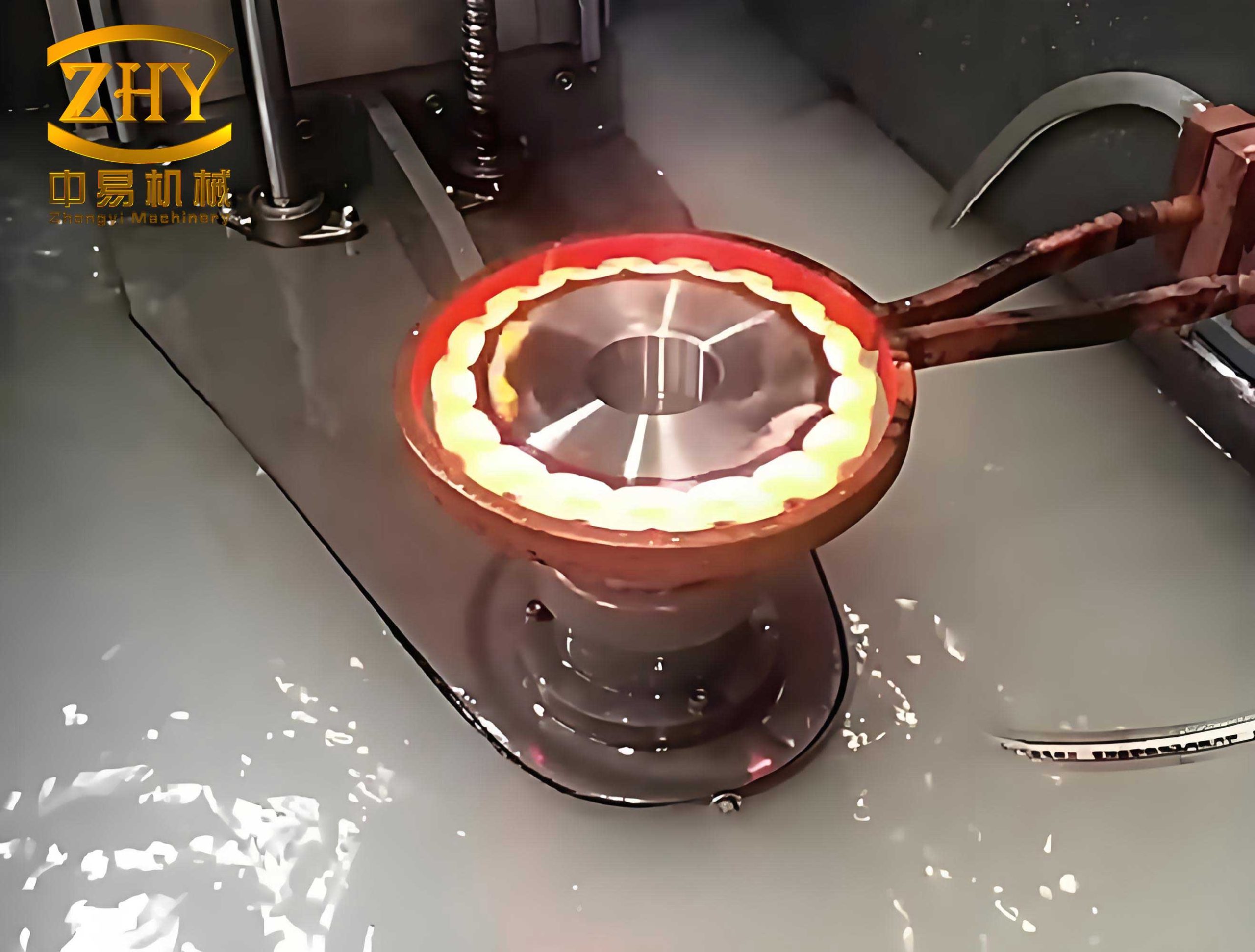
Comprehensive Analysis of Influencing Factors and Countermeasures
Controlling distortion requires addressing factors across the entire manufacturing workflow. The following sections detail these factors and propose targeted countermeasures.
1. Material and Metallurgical Factors
The inherent properties of the steel are the first determinant of distortion behavior.
- Hardenability (Jominy Profile): Steels with high and widely varying hardenability (a wide Jominy band) tend to exhibit greater and less predictable distortion. A narrow hardenability band ensures more consistent response. Core hardness above approximately 40 HRC often leads to increased distortion due to higher transformation stresses.
- Chemical Composition & Grain Structure: Elements like Al and N are critical. A controlled Al/N ratio (typically between 1.0 and 2.5) helps achieve fine, stable austenite grains, reducing distortion susceptibility. Banded structures, segregation (e.g., “square” segregation pattern), and non-uniform prior microstructure lead to uneven response to carburizing and quenching, causing distortion asymmetry.
Countermeasures: Specify steels with narrow hardenability bands (e.g., “H”-grade steels with guaranteed Jominy limits). Source material from suppliers specializing in low-distortion grades. Implement strict incoming material inspection for microstructure (grain size, banding) and chemical homogeneity.
2. The Critical Role of Preliminary Heat Treatment
The state of the material before carburizing sets the stage. An improper preliminary treatment is a primary source of subsequent heat treatment defects.
- Normalizing & Annealing: Incomplete normalization leaving a mixed grain size (coarse and fine), Widmanstätten or bainitic structures, or excessively high hardness (>~200 HB) creates a non-uniform starting condition. This heterogeneity amplifies distortion during final quenching.
Countermeasures: Replace simple normalization with controlled-temperature normalizing or isothermal annealing (e.g., pearlitic anneal). This ensures a uniform, fine-grained ferrite-pearlite structure with consistent and moderate hardness (~160-180 HB), providing a stable and homogeneous base for carburizing.
3. Carburizing Process Parameters
The carburizing cycle itself introduces thermal and chemical gradients.
- Temperature: Higher carburizing temperatures (e.g., 950°C vs. 920°C) accelerate carbon diffusion but increase thermal gradients, grain growth, and residual stress before quenching, all exacerbating distortion.
- Uniformity: Non-uniform temperature or carbon potential within the furnace leads to varying case depths and transformation behavior across a single gear or batch, causing unpredictable warping.
Countermeasures: Optimize the process to the lowest effective temperature (e.g., 880-930°C range). Use modern furnaces with advanced circulation fans and control systems to ensure ±5°C temperature uniformity and ±0.05% carbon potential control. Regular furnace surveys (TUS and CUS) are mandatory.
4. Quenching: The Most Critical Phase
The quenching operation is the single most influential step regarding heat treatment defects from distortion. It governs both the volumetric change (via phase selection) and the internal stress development.
- Quenchant Selection & Temperature: The cooling power (quench severity, or “H-value”) must be carefully matched to the gear’s hardenability and geometry. Hot oil quenching (e.g., 120°C ± 20°C) generates lower thermal gradients than cold oil (40-60°C), reducing thermal stress. However, it may increase the risk of non-martensitic transformations.
- Agitation: Uniform, controlled agitation is crucial. Non-uniform flow over the gear surfaces creates varying cooling rates, leading to bending or ovality. Agitation must be optimized, not maximized.
- Press Quenching (Die Quenching): For critical components like thin-rimmed gears, press quenching is essential. The gear is clamped between dies during quenching, physically restraining distortion. The key parameters—die pressure, timing, internal mandrel expansion pressure, and oil spray patterns—must be meticulously tuned for each part geometry.
The Grossmann Quench Severity Factor \(H\) relates the heat transfer coefficient \(h\) to the thermal conductivity \(k\) of the steel:
$$
H = \frac{h}{2k}
$$
Selecting a quenchant and agitation to achieve an optimal \(H\)-value for the specific gear cross-section is vital. The cooling curve must avoid the pearlite “nose” of the CCT diagram but not be so severe as to create excessive thermal stress.
5. Fixturing and Loading Techniques
How parts are loaded into the furnace and quench fixture significantly impacts uniformity.
- Purpose: Fixturing promotes uniform exposure to the furnace atmosphere and, more importantly, uniform cooling during quench. It supports parts in their optimal orientation to minimize gravity-induced sagging.
- Methods: Use dedicated carburizing trays and baskets. For long shafts, use vertical hanging. For gears with bores, use compensating washers, stack gears with spacers, or employ expansion mandrels that fit keyways/splines to control bore size. The goal is to create symmetrical thermal and transformational conditions.
6. Integration with Machining Processes
Distortion control is a partnership between heat treatment and machining.
- Predictive Compensation: Based on known distortion patterns (e.g., bore shrinkage, OD growth, tooth helix angle change), machining dimensions can be pre-adjusted. This “reverse distortion” or “pre-correction” method involves machining the part to a non-nominal dimension so that it distorts into the correct specification.
- Sequencing: For asymmetric or thin-web gears, rough machining, then heat treatment, followed by final machining is often best. This removes the distorted layer post-heat treatment.
- Stress Relieving: A sub-critical stress relief (e.g., 350-400°C for 4-6 hours) after rough machining and before final machining or after carburizing but before quenching (for some processes) can stabilize the microstructure and relieve machining stresses, reducing the driving force for distortion during final quench.
The efficacy of stress relieving can be modeled using the Larson-Miller parameter \(P_{LM}\) for thermal activation:
$$
P_{LM} = T \cdot (C + \log t)
$$
where \(T\) is temperature in Kelvin, \(t\) is time in hours, and \(C\) is a constant (often ~20). This helps optimize the stress relief cycle.
A Systematic Strategy for Distortion Minimization
Based on the above factors, a successful strategy must be integrated and sequential. The table below outlines a phased approach.
| Phase | Key Actions | Target Outcome |
|---|---|---|
| 1. Design & Material Selection | Design for symmetry. Select steel with narrow hardenability. Specify fine-grained, homogeneous microstructure. | A geometry and material with inherently low distortion potential. |
| 2. Preliminary Processing | Apply controlled normalizing/isothermal annealing. Perform stress relief after rough machining. | A uniform, stress-free, and stable starting microstructure. |
| 3. Carburizing Process Control | Use lowest effective temperature. Ensure furnace uniformity (TUS/CUS). Optimize carbon profile. | A uniform, predictable case with minimal thermal stress before quench. |
| 4. Optimized Quenching | Select quenchant (hot oil, martempering oil). Design fixtures for uniform cooling/press quenching. Precisely control agitation and temperature. | Controlled phase transformation with minimized thermal and transformation stress gradients. |
| 5. Post-Quench & Machining | Implement cryogenic treatment if needed for retained austenite. Apply final machining with distortion compensation. Use statistical process control (SPC). | Stabilized dimensions meeting final specification with high consistency. |
Conclusion: From Art to Controlled Science
Mitigating carburizing heat treatment distortion is no longer a black art reliant solely on operator experience. It is a manageable engineering challenge that demands a systematic, data-driven approach. By understanding the fundamental duel between volumetric change and stress-induced plasticity, manufacturers can deconstruct the root causes. A holistic strategy that encompasses material science, precise thermal process control, advanced quenching technology, intelligent fixturing, and close collaboration with machining is essential. The consistent production of high-precision, durable gears with minimal heat treatment defects hinges on this comprehensive mastery of the entire process chain, transforming a historical source of variability into a pillar of manufacturing reliability and quality.