
As an engineer specializing in materials science and heat treatment processes, I have observed the critical role that heat treatment plays in the performance and longevity of gears across various industries. With the continuous advancement of mechanical engineering, gears are subjected to increasingly demanding conditions, such as high power, high speed, low noise, and long-term operational reliability. These requirements necessitate enhanced load-bearing capacity and manufacturing precision, which directly depend on material strength, toughness, and the minimization of heat treatment defects. In this article, I will delve into the prominent issues related to heat treatment defects in gears, drawing from experiences in automotive, machine tool, high-speed, and heavy-duty applications. I will use tables and formulas to summarize key points, and emphasize the term “heat treatment defects” throughout to highlight its significance.
Heat treatment defects are a major concern in gear manufacturing, as they can lead to dimensional inaccuracies, reduced mechanical properties, and premature failure. These defects often arise from improper process parameters, material inconsistencies, or cooling irregularities. For instance, in carburizing and quenching processes, distortions and residual stresses are common heat treatment defects that compromise gear accuracy. Similarly, in induction hardening, uneven hardening layers represent another form of heat treatment defects that affect fatigue resistance. The control of these heat treatment defects is paramount to achieving high-performance gears.
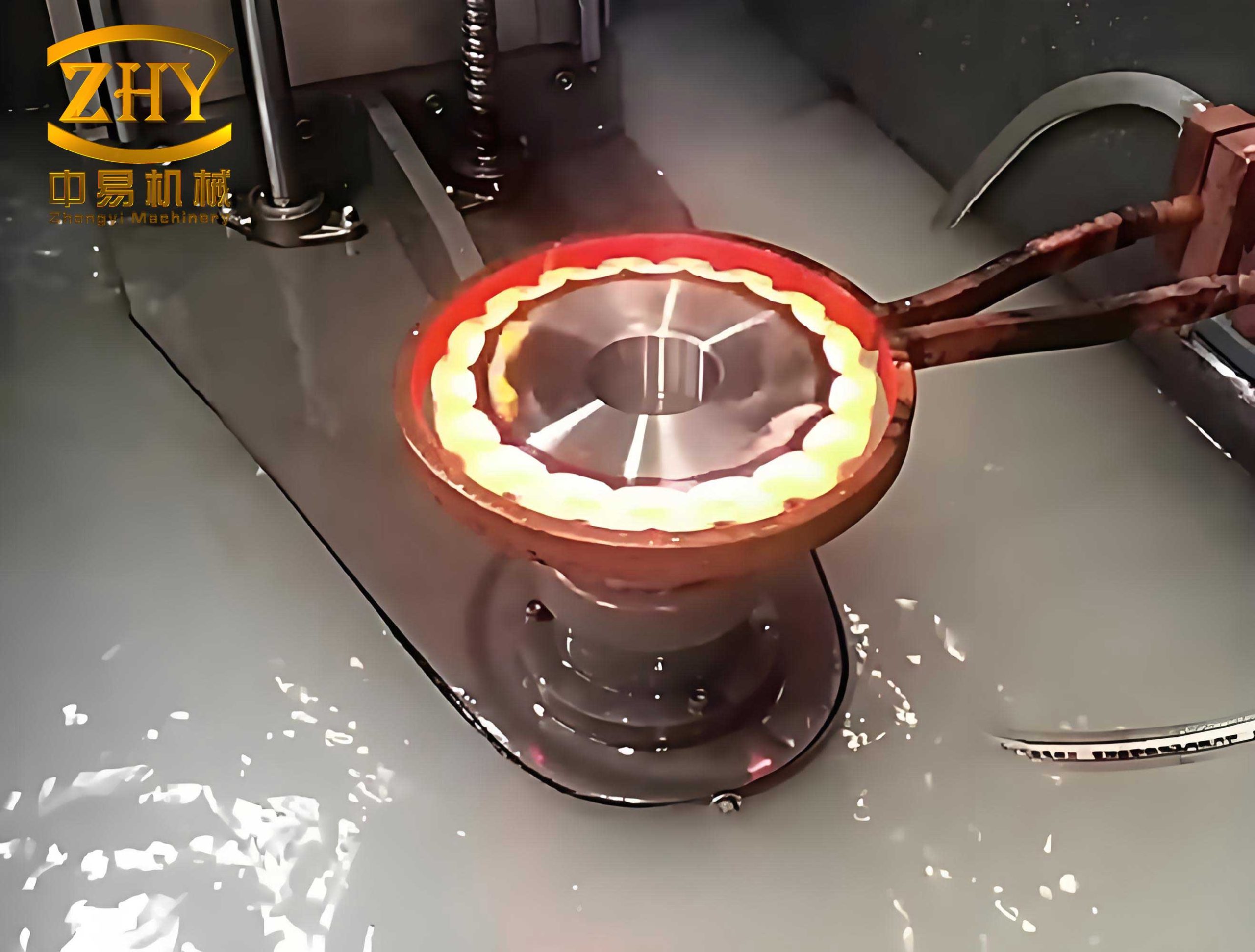
In the automotive and tractor industry, gears in transmission boxes and rear axles primarily undergo carburizing and carbonitriding processes. While continuous furnaces are used in large plants, pit-type furnaces are common elsewhere. The lifespan of these gears lags behind international standards, largely due to heat treatment defects like deformation and inadequate case depth. Precision is crucial; studies show that improving gear accuracy from grade 8 to higher levels can increase load capacity by up to 20%, reduce noise by 3-5 decibels, and enhance transmission efficiency. However, heat treatment defects such as quenching distortion can degrade accuracy by 1-2 grades, making them a bottleneck in quality control. To address this, systematic research is needed on how material冶金 quality and heat treatment parameters influence heat treatment defects. For example, the relationship between cooling rate and distortion can be expressed using the following formula for thermal stress-induced deformation: $$ \Delta L = \alpha \cdot L \cdot \Delta T + \beta \cdot \sigma_y / E $$ where $\Delta L$ is the dimensional change, $\alpha$ is the thermal expansion coefficient, $L$ is the initial length, $\Delta T$ is the temperature gradient, $\beta$ is a geometric factor, $\sigma_y$ is yield strength, and $E$ is Young’s modulus. This highlights how heat treatment defects like distortion are tied to material properties and process conditions.
Table 1 summarizes common heat treatment defects in automotive gears and their impacts:
| Heat Treatment Process | Common Heat Treatment Defects | Impact on Gear Performance |
|---|---|---|
| Carburizing and Quenching | Distortion, cracking, soft spots | Reduced accuracy, lower fatigue strength |
| Carbonitriding | Residual stresses, uneven case depth | Increased noise, premature wear |
| Induction Hardening | Overheating, inadequate hardening depth | Tooth breakage, reduced load capacity |
Moving to machine tool gears, which are often made from 45Cr or 40Cr steel with high-frequency induction hardening, heat treatment defects contribute to poor quality. Gears may lose precision within 10 years, with gearboxes requiring overhaul in 3 years compared to 10 years abroad. Noise levels are high due to heat treatment defects like improper hardening profiles. In developed countries, carburized gears are standard for critical applications, as they offer better wear resistance and longevity. Therefore, improving high-frequency hardening quality is essential to mitigate heat treatment defects. For gears with modulus greater than 5 mm, low-hardenability steel with super-audio frequency induction hardening can reduce heat treatment defects by providing more controlled heating. Additionally, carburizing or carbonitriding for important machine tool gears requires attention to heat treatment defects such as deformation, which is more challenging to control. Nitriding, especially ion nitriding, is advantageous for minimizing heat treatment defects due to lower processing temperatures, but process stability must be ensured. The hardness after nitriding can be modeled as: $$ H = H_0 + k \cdot \sqrt{t} $$ where $H$ is the surface hardness, $H_0$ is the base hardness, $k$ is a material constant, and $t$ is the nitriding time. This formula helps in optimizing parameters to avoid heat treatment defects like excessive brittleness.
High-speed gears used in petroleum, chemical, and electrical machinery operate at line speeds exceeding 50 m/s with precision grades of 4-5. These gears demand long-term stability, and heat treatment defects can lead to catastrophic failures. Imported equipment often uses carburized and ground gears, while some employ nitrided gears. Heat treatment defects in these applications include distortion during carburizing and quenching, which is critical since subsequent grinding is required. For nitrided gears, which are not ground post-treatment, minimizing heat treatment defects like distortion is even more vital. To enhance load capacity, precipitation hardening nitriding and deep nitriding techniques are being researched. The contact fatigue strength of nitrided gears can be estimated using: $$ \sigma_H = C \cdot H^2 \cdot \sqrt{b/d} $$ where $\sigma_H$ is the contact stress, $C$ is a constant, $H$ is hardness, $b$ is face width, and $d$ is pitch diameter. This underscores how heat treatment defects that affect hardness directly impact performance.
Table 2 compares heat treatment defects in high-speed gears for different processes:
| Gear Type | Heat Treatment Method | Typical Heat Treatment Defects | Mitigation Strategies |
|---|---|---|---|
| Carburized Gears | Carburizing and quenching | Distortion, cracking, residual stresses | Controlled cooling, stress relieving |
| Nitrided Gears | Ion nitriding | Brittle layer, uneven compound zone | Optimized temperature and time |
| Induction Hardened Gears | High-frequency hardening | Shallow case depth, overheating | Precise frequency control |
In heavy-duty mining and machinery, low-speed heavy-load gears transmit high torques at line speeds below 5 m/s. Heat treatment defects here are prevalent due to low hardness in tempered gears, typically below 250 HB, which limits contact strength. According to the relationship, contact strength is proportional to the square of hardness: $$ \sigma_c \propto H^2 $$ Thus, heat treatment defects that result in insufficient hardness drastically reduce load capacity. For hard-faced gears, induction and flame hardening often lead to heat treatment defects like non-uniform hardening layers, rarely following the tooth profile. This affects both contact and bending strength. To address these heat treatment defects, improving existing processes is crucial. Developing medium-hard gear surfaces with tempered hardness raised to 300-350 HB can alleviate heat treatment defects associated with soft cores. Additionally, advancing carburizing and quenching for large-modulus gears requires tackling heat treatment defects such as distortion and case depth variations. The bending stress at the tooth root can be expressed as: $$ \sigma_b = \frac{F_t \cdot K_a \cdot K_v \cdot K_s}{b \cdot m \cdot Y} $$ where $F_t$ is tangential load, $K_a$, $K_v$, $K_s$ are application factors, $b$ is face width, $m$ is module, and $Y$ is the form factor. Heat treatment defects that alter material properties influence these factors, leading to failures.
To summarize the overarching challenges, heat treatment defects across all gear types hinder progress in mechanical industries. Key tasks include transitioning from soft to medium-hard gear surfaces, improving induction and flame hardening to reduce heat treatment defects, and developing carburized hard-faced gears with controlled distortion. Carbonitriding and ion nitriding offer benefits but require stabilization to minimize heat treatment defects. Research on heat treatment defects related to deformation is critical, especially for precision gears. The following formula models distortion during quenching: $$ \epsilon = \int_{T_0}^{T_f} \alpha(T) \, dT + \frac{\sigma_{th}}{E} $$ where $\epsilon$ is strain, $\alpha(T)$ is temperature-dependent expansion coefficient, $T_0$ and $T_f$ are initial and final temperatures, and $\sigma_{th}$ is thermal stress. This highlights the complexity of managing heat treatment defects.
In conclusion, as an engineer, I emphasize that heat treatment defects are a central issue in gear manufacturing, affecting accuracy, noise, and lifespan. By systematically addressing these heat treatment defects through optimized processes, material selection, and advanced modeling, we can enhance gear performance. Tables and formulas provided here offer a framework for understanding and mitigating heat treatment defects. Future efforts should focus on real-time monitoring and adaptive control to minimize heat treatment defects, ensuring gears meet the demands of modern machinery. The continuous evolution of heat treatment technologies will play a pivotal role in overcoming these heat treatment defects, driving innovation in industries reliant on precision gearing.