
The pursuit of dimensional stability in hardened components represents one of the most persistent challenges in industrial heat treatment. Among these, heat treatment defects manifested as distortion in gears following carburizing and quenching are particularly complex and critical. Distortion is an irreversible plastic deformation that directly impacts manufacturing cost, assembly precision, and ultimately, the performance, noise, and longevity of gear-driven systems. My analysis, drawing from both theoretical frameworks and practical observations, positions these heat treatment defects as the result of a complex interplay between transient stresses, phase transformations, and material characteristics during thermal processing.
1. The Fundamental Nature of Heat Treatment Defects: Stress and Strain
At its core, heat treatment defects like distortion originate when internal stresses generated during heating and cooling exceed the material’s yield strength at temperature. To understand this, we must begin with the fundamental stress-strain relationship. In the elastic region, stress ($\sigma$) and strain ($\varepsilon$) are related linearly by Hooke’s Law: $\sigma = E \cdot \varepsilon$, where $E$ is Young’s modulus. However, during quenching, conditions often push the material into the plastic region, where deformation becomes permanent. The primary drivers of these internal stresses are:
- Thermal Stress ($\sigma_{th}$): Generated by temperature gradients within a part during heating or cooling. When the surface cools faster than the core, it contracts more, creating a state where the surface is initially in tension and the core in compression. As cooling proceeds, this stress state can reverse.
- Transformational (Phase) Stress ($\sigma_{tr}$): Generated by volumetric changes associated with phase transformations (e.g., austenite to martensite), especially when these transformations occur non-simultaneously in different sections of the part.
The final heat treatment defects—whether dimensional change, warpage, or cracking—are the visible result of the residual stress state, which is the superposition of thermal and transformational stresses: $\sigma_{res} = \sigma_{th} + \sigma_{tr}$.
The progression of thermal stress in a simple cylinder during rapid cooling can be conceptualized in distinct stages, as summarized in the analysis below. It highlights the transition from surface tension to final surface compression in a non-transforming material.
| Cooling Stage | Surface Stress State | Core Stress State | Driving Mechanism |
|---|---|---|---|
| Initial (W): Max. temp gradient | Tensile ($\sigma > 0$) | Compressive ($\sigma < 0$) | Surface contracts faster than core. |
| Mid-stage (U): Stress reversal | Zero ($\sigma \approx 0$) | Zero ($\sigma \approx 0$) | Core cooling rate now exceeds surface. |
| Final (V): Low temperature | Compressive ($\sigma < 0$) | Tensile ($\sigma > 0$) | Stress state is “frozen in” due to high yield strength. |
When phase transformations are introduced, the picture becomes more complex. For a through-hardening steel, the sequence of martensitic transformation (starting at the Ms temperature) often leads to a final residual stress state opposite to that of pure thermal stress: surface in tension and core in compression. This tensile surface stress is a key contributor to quench cracking, one of the most severe heat treatment defects. The risk is highest at an intermediate cooling rate where core transformation significantly lags behind the surface, maximizing stress.
2. Unique Aspects of Carburizing Quenching Defects
Gear carburizing and quenching introduces additional layers of complexity to the genesis of heat treatment defects. The process creates a part with a high-carbon case and a lower-carbon core, fundamentally altering its transformational behavior.
- Altered Transformation Kinetics: The high carbon content in the case lowers its martensite start (Ms) temperature. Consequently, the lower-carbon core may begin its martensitic transformation before the case. This can invert the transformational stress pattern, potentially placing the case in compression from the outset of transformation.
- Chemical Gradient-Induced Stress: The infusion of carbon atoms into the lattice itself creates a “chemical” or “carburizing” stress, independent of cooling, which typically contributes a compressive component to the case stress.
As a result, the final residual stress profile in a carburized and quenched gear is a composite of multiple factors. The surface and immediate sub-surface often exhibit high compressive stresses (beneficial for fatigue resistance), which result from the summation of negative thermal stress, chemical stress, and a potentially compressive transformational stress component. This beneficial stress state, however, does not eliminate other forms of heat treatment defects like shape distortion (warpage, out-of-roundness) or size change, which are governed by the integrated stress distribution and part geometry.
3. Theoretical and Computational Approaches to Modeling Defects
Predicting and quantifying heat treatment defects requires modeling a tightly coupled multi-physics problem. A forward simulation must sequentially or concurrently solve for:
- Carbon Diffusion: Governed by Fick’s laws. For a one-dimensional case:
$$\frac{\partial C}{\partial t} = D(T) \frac{\partial^2 C}{\partial x^2}$$
where $C$ is carbon concentration, $t$ is time, $D$ is temperature-dependent diffusivity, and $x$ is depth. - Heat Transfer: Solving the transient heat conduction equation with boundary conditions for convection and radiation during quenching:
$$\rho c_p \frac{\partial T}{\partial t} = \nabla \cdot (k \nabla T)$$
where $\rho$ is density, $c_p$ is specific heat, $k$ is thermal conductivity, and $T$ is temperature. - Phase Transformation Kinetics: Using models like the Johnson-Mehl-Avrami-Kolmogorov (JMAK) equation for diffusional transformations or the Koistinen-Marburger relationship for martensite:
$$V_m = 1 – \exp[-\alpha (M_s – T)]$$
where $V_m$ is martensite volume fraction and $\alpha$ is a material constant. - Stress-Strain Analysis: Solving for stress ($\sigma$) and strain ($\varepsilon$) considering thermal strain ($\varepsilon_{th}$), transformational strain ($\varepsilon_{tr}$), and plastic strain ($\varepsilon_{pl}$):
$$\varepsilon_{total} = \varepsilon_{el} + \varepsilon_{th} + \varepsilon_{tr} + \varepsilon_{pl}$$
The total strain is linked to stress via the material’s constitutive model (elastic-plastic).
Commercial software packages (e.g., SYSWELD, DEFORM-HT, DANTE) attempt this coupling. The core challenge lies in the accuracy of material property databases, the definition of boundary conditions (especially heat transfer coefficients during quenching), and the inherent simplifications in material models. While predictions for case depth and hardness profiles are reliable, precise quantitative prediction of heat treatment defects like distortion magnitude remains an area of active research and requires empirical calibration. The following table outlines the key interconnected models required for a comprehensive simulation.
| Process Input | Physical Model | Output/Field Variable | Primary Challenge |
|---|---|---|---|
| Temperature, Time, Carbon Potential | Thermochemical (Diffusion) | Carbon Concentration Profile C(x,t) | Gas-surface reaction kinetics, multi-component diffusion. |
| Furnace/Quench Media Conditions | Heat Transfer (Conduction, Convection) | Temperature Field T(x,y,z,t) | Defining accurate heat transfer coefficients (HTCs) for complex parts and agitated quenchant. |
| Temperature History, Carbon Content | Metallurgical (Phase Transformation) | Phase Fractions (Austenite, Martensite, etc.) | Modeling transformation plasticity and its effect on stress. |
| Temperature, Phase, & Property Fields | Mechanical (Stress-Strain) | Residual Stress Field, Distortion | Coupled thermo-metallo-mechanical analysis; accurate high-temperature yield data. |
4. Practical Methodology for Investigating Distortion in Production
Given the current limitations of purely predictive simulation, a systematic experimental approach remains indispensable for managing heat treatment defects in industrial settings. The goal is not to eliminate distortion but to control its mean and variation within acceptable statistical limits for subsequent manufacturing steps.
For gears, critical distortion parameters include:
- Geometric: Bore diameter, outer diameter, face flatness, run-out.
- Involute-Specific: Profile deviation (tooth form), lead deviation (tooth alignment), pitch error.
A structured methodology involves:
- Characterization: Comprehensive measurement of pre- and post-heat treatment dimensions on statistically significant sample sizes to establish baselines.
- Root Cause Analysis: Correlating distortion patterns with potential factors. This is where theoretical understanding guides practice. For example, non-uniform cooling often leads to predictable warpage patterns.
- Design of Experiments (DOE): Systematically varying key process factors (e.g., preheat temperature, carburizing temperature/time, quenching medium temperature, agitation) to quantify their individual and interactive effects on specific heat treatment defects.
- Process Optimization: Using DOE results to find a robust process window that minimizes distortion variation while meeting all metallurgical requirements (hardness, case depth, microstructure).
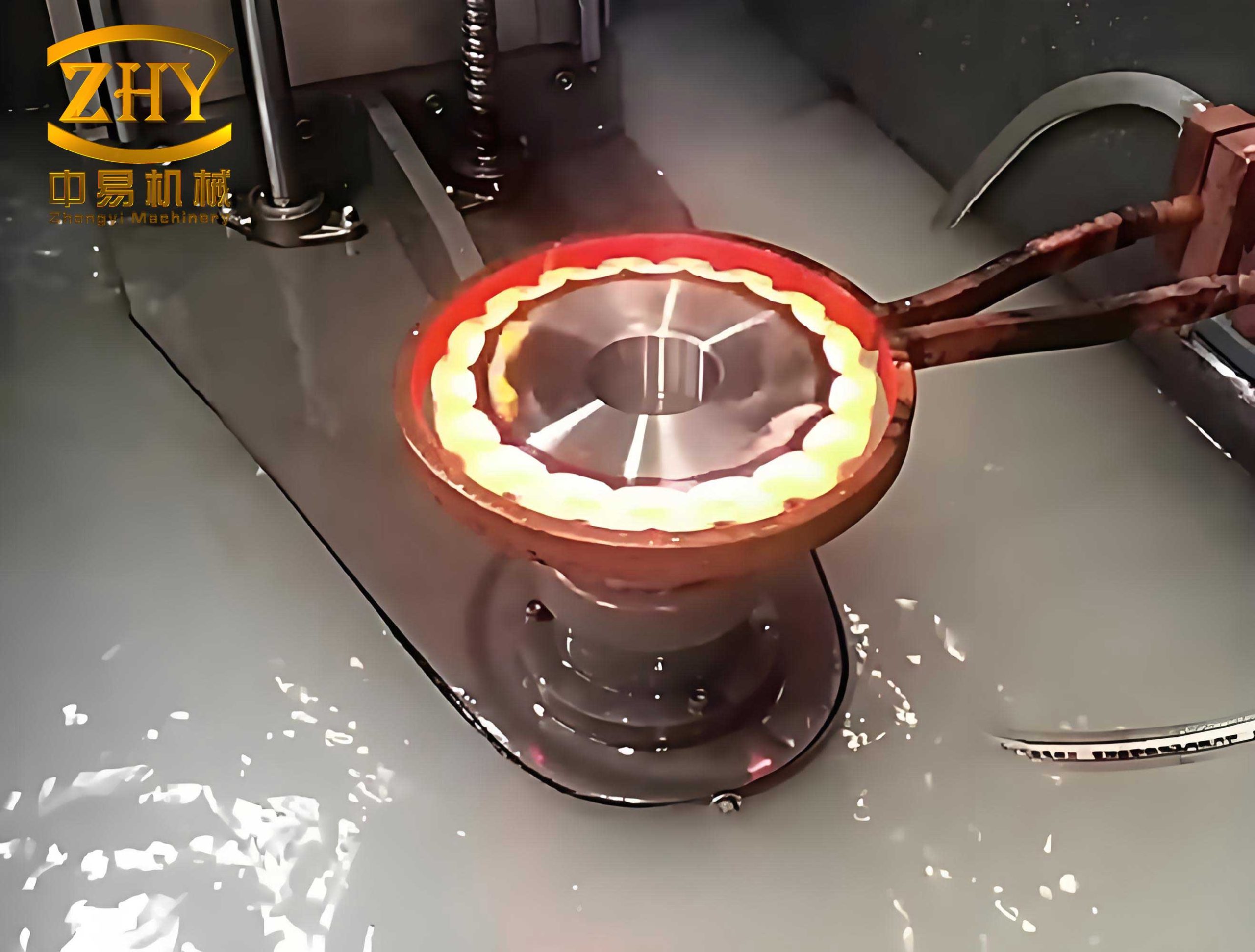
Common practical strategies informed by theory include reducing heating/cooling rate gradients, using interrupted or “hot” quenching to minimize thermal shock, and employing press quenching or fixture quenching to physically restrain parts during the critical martensitic transformation. The complexity of these interacting factors is visually represented in the following diagram, which illustrates how material, process, and geometry converge to cause heat treatment defects.
5. An Integrated Perspective on Controlling Heat Treatment Defects
Ultimately, managing heat treatment defects in gears is not solely a post-forging or post-machining concern. It requires an integrated “Design for Heat Treatment” philosophy that spans the entire product lifecycle.
| Stage | Consideration | Impact on Distortion |
|---|---|---|
| Material & Design | Steel grade (hardenability), cleanliness, part symmetry, section thickness transitions. | Defines fundamental susceptibility to thermal/transformational stresses. Asymmetry promotes non-uniform cooling. |
| Pre-H/T Processing | Forging practice, soft machining stock allowance, residual stress from cutting. | Unbalanced residual stresses from machining can be released or amplified during heating, leading to unpredictable warpage. |
| Heat Treatment Process | Fixturing, furnace atmosphere uniformity, quenchant flow control, process model-based control. | Directly controls the thermal and transformational gradients that drive distortion. Uniformity is paramount. |
| Post-H/T & Integration | Matching distortion data with gear finishing capabilities (e.g., grinding, honing). | The goal is a stable, predictable distortion pattern that can be efficiently compensated for in final machining. |
Looking forward, the path to mastering heat treatment defects lies in the convergence of advanced sensing, high-fidelity multi-scale modeling, and adaptive process control. “Soft sensors” that use real-time process data (temperature, carbon potential) to infer core state variables (phase fraction, stress) are a promising development. The integration of CAD, CAE (Computer-Aided Engineering), and CAM (Computer-Aided Manufacturing) into a holistic digital twin of the heat treatment process will allow for virtual prototyping and optimization, significantly reducing the trial-and-error burden.
In conclusion, while the fundamental theories of thermal and transformational stress provide a robust framework for understanding the root causes of heat treatment defects, the precise prediction and control of distortion in complex components like carburized gears remain a formidable challenge. A synergistic approach combining deepening theoretical insight, advancing computational power, and structured empirical investigation is essential. For the foreseeable future, a science-guided experimental methodology, leveraging tools like DOE and statistical process control, will continue to be the most effective weapon in the engineer’s arsenal for combating these costly and complex heat treatment defects.