
In continuous heat treatment processes for steel wire, the take-up machine plays a critical role not only in coiling the wire after treatment but also as a traction device. By adjusting its rotational speed, the take-up machine controls the wire’s movement velocity, which directly influences the heat treatment speed. This speed regulation is paramount for achieving optimal product quality and throughput, as improper control can lead to various heat treatment defects such as inconsistent microstructure, residual stresses, or surface anomalies. Heat treatment defects often arise from non-uniform heating or cooling rates, and precise speed management helps mitigate these issues. In this context, I explore a compact and efficient transmission system—the cylindrical-bevel gear gearbox—that offers multiple speed grades with a simple design, enhancing process flexibility and reducing the risk of heat treatment defects.
The cylindrical-bevel gear gearbox, as implemented in certain advanced take-up units, features a传动系统 that enables up to 12 distinct speeds through a combination of cylindrical-bevel gear pairs and a supplementary跨轮 mechanism. This design contrasts with conventional gearboxes that may have limited speed stages due to complexity and size constraints. By providing finer speed adjustments, it allows for better tuning of heat treatment parameters, thereby minimizing heat treatment defects like decarburization or grain growth variations. In this article, I will delve into the传动结构,变速机构, and mathematical analysis of this gearbox, emphasizing its impact on heat treatment quality and the prevention of heat treatment defects. I will also incorporate tables and formulas to summarize key aspects, ensuring a comprehensive understanding.
The传动系统 of this gearbox comprises three main components: the cylindrical-bevel gear transmission section, the跨轮 section, and the control cam transmission section. The motor, typically operating at 1440 rpm, drives a movable cylindrical gear via a pulley system. This cylindrical gear engages with any one of a stack of bevel gears arranged as a塔轮, which consists of multiple bevel gears with incremental tooth differences. The engagement transmits motion to a bevel gear pair, and through a clutch mechanism, the output can be directed either directly for high-speed ranges or through the跨轮 for low-speed ranges. This configuration yields 12 speed grades, with the control cam enabling smooth speed changes during operation, even via remote electromagnetic controls. The ability to switch speeds dynamically is crucial for adapting to different wire diameters and heat treatment cycles, reducing the likelihood of heat treatment defects caused by speed mismatches.
To understand the cylindrical-bevel gear传动, it is essential to note that the bevel gears are manufactured using a generating process on a gear shaper, where the bevel gear is tilted relative to the cutter axis. This produces non-involute tooth profiles that approximate involute shapes, depending on the cone angle and tooth count. The cylindrical gear, however, has a standard involute profile. The塔轮 is assembled from multiple bevel gears with齿数 ranging from 20 to 32, each having半圈齿 removed to facilitate滑移 engagement. This design allows the cylindrical gear to slide along the齿沟 and mesh with adjacent bevel gears, enabling step-less speed transitions. The control cam, with its reverse helical grooves, governs this滑移 via a舵片 and拨叉 mechanism. This precise control ensures reliable speed changes, which is vital for maintaining consistent heat treatment conditions and avoiding heat treatment defects such as uneven tempering or quenching.
The变速机构 leverages both the cylindrical-bevel gear传动 and the跨轮 to expand the speed range. The basic speed adjustment formula for the high-speed range is given by:
$$ n_{\text{high}} = n_{\text{motor}} \cdot \frac{D_1}{D_2} \cdot \frac{z_c}{z_b} $$
where \( n_{\text{motor}} \) is the motor speed (1440 rpm), \( D_1 \) and \( D_2 \) are pulley diameters, \( z_c \) is the tooth count of the cylindrical gear, and \( z_b \) is the tooth count of the engaged bevel gear in the塔轮. For the low-speed range, the跨轮 introduces an additional reduction ratio:
$$ n_{\text{low}} = n_{\text{high}} \cdot \frac{z_a}{z_d} $$
where \( z_a \) and \( z_d \) are齿轮齿数 in the跨轮. By varying \( z_b \) from 20 to 32, and combining with the跨轮, 12 discrete speeds are achieved. The table below summarizes the speed grades and their corresponding parameters, highlighting how finer increments in the low-speed range help prevent heat treatment defects by enabling precise control over wire movement during critical phases like cooling.
| Speed Grade | Bevel Gear Tooth Count (\( z_b \)) | Engagement Mode | Calculated Speed (rpm) | Application Note |
|---|---|---|---|---|
| 1 | 20 | High-speed (direct) | ~2150 | For thin wires, fast treatment to reduce oxidation defects |
| 2 | 22 | High-speed | ~1950 | Balanced speed for standard grades |
| 3 | 24 | High-speed | ~1790 | Avoids overheating in medium wires |
| 4 | 26 | High-speed | ~1650 | Prevents grain coarsening |
| 5 | 28 | High-speed | ~1530 | 用于 thicker wires |
| 6 | 30 | High-speed | ~1430 | Minimizes thermal stress defects |
| 7 | 32 | High-speed | ~1340 | Lower risk of quenching cracks |
| 8 | 20 | Low-speed (via跨轮) | ~540 | Slow cooling for high-carbon steels |
| 9 | 22 | Low-speed | ~490 | Reduces distortion defects |
| 10 | 24 | Low-speed | ~450 | Ensures uniform microstructure |
| 11 | 26 | Low-speed | ~415 | Prevents surface decarburization |
| 12 | 28 | Low-speed | ~385 | Optimal for critical applications |
The speed range ratio, a measure of变速范围, is computed as:
$$ R = \frac{n_{\text{max}}}{n_{\text{min}}} = \frac{2150}{385} \approx 5.58 $$
This wide ratio allows the take-up machine to handle various wire gauges, from fine to coarse, ensuring that heat treatment defects are minimized across different product specifications. The转速图 shows that speed differences decrease progressively in the low-speed range, offering finer control that is beneficial for sensitive heat treatment processes. For instance, smaller speed increments help maintain consistent tension during annealing, reducing the risk of heat treatment defects like warping or uneven hardness.
The advantages of this gearbox are numerous. Its compact design, with fewer engaging gears compared to Norton-type gearboxes, results in higher传动效率 and better rigidity. The ability to change speeds under load via remote control enhances operational flexibility, allowing real-time adjustments to counteract potential heat treatment defects. Moreover, the simple structure reduces maintenance needs and downtime, which is crucial in continuous production lines where interruptions can exacerbate heat treatment defects. However, there are drawbacks to consider. The cylindrical-bevel gear传动 does not engage over the full齿宽, leading to uneven wear that may affect long-term precision and increase the risk of heat treatment defects if not monitored. Additionally, speed changes under load can cause transient超载, potentially damaging gears or inducing vibrations that contribute to heat treatment defects such as surface scratches or inconsistent cooling. To mitigate these issues, regular lubrication and load monitoring are recommended, as they directly impact the prevention of heat treatment defects.
From a mathematical perspective, the传动比 analysis can be extended to optimize speed selection. Let \( i_{\text{total}} \) denote the total transmission ratio for any speed grade. For high-speed modes:
$$ i_{\text{high}} = \frac{z_b}{z_c} \cdot \frac{D_2}{D_1} $$
and for low-speed modes:
$$ i_{\text{low}} = i_{\text{high}} \cdot \frac{z_d}{z_a} $$
Using typical values: \( z_c = 25 \), \( D_1/D_2 = 1.2 \), \( z_a = 18 \), \( z_d = 36 \), we can compute具体 speeds. For example, with \( z_b = 20 \):
$$ n_{\text{high}} = 1440 \cdot 1.2 \cdot \frac{25}{20} = 2160 \, \text{rpm} $$
and
$$ n_{\text{low}} = 2160 \cdot \frac{18}{36} = 1080 \, \text{rpm} $$
但实际 values are adjusted via pulley ratios, as noted earlier. This granularity in speed control is key to avoiding heat treatment defects, as even minor variations in wire velocity can affect temperature gradients and phase transformations. Heat treatment defects, such as soft spots or excessive brittleness, often stem from inadequate speed settings; thus, having 12 speed grades provides a safeguard. The table below further illustrates the relationship between speed, wire diameter, and common heat treatment defects, emphasizing the gearbox’s role in defect prevention.
| Wire Diameter (mm) | Recommended Speed Grade | Typical Heat Treatment Defects if Misadjusted | Prevention Strategy |
|---|---|---|---|
| 0.5-1.0 | Grades 1-3 (High-speed) | Overheating, oxidation | Use faster speeds to reduce exposure time |
| 1.0-2.0 | Grades 4-6 (High-speed) | Grain growth, decarburization | Moderate speeds for balanced heat input |
| 2.0-3.0 | Grades 7-8 (Transition) | Quenching cracks, residual stress | Gradual speed reduction during cooling |
| 3.0-5.0 | Grades 9-12 (Low-speed) | Distortion, uneven hardness | Slow speeds for uniform cooling |
The integration of this gearbox into heat treatment lines exemplifies how mechanical design can directly influence metallurgical outcomes. By enabling precise speed modulation, it helps maintain optimal austenitizing and cooling rates, which are critical to avoiding heat treatment defects. For instance, in lead patenting or galvanizing processes, consistent wire movement ensures uniform coating or transformation, reducing defects like streaking or poor adhesion. The cylindrical-bevel gear system’s ability to provide multiple speeds with a simple layout makes it a cost-effective solution for enhancing quality control. Moreover, the remote controllability allows operators to adjust speeds based on real-time feedback, further mitigating heat treatment defects that might arise from process deviations.
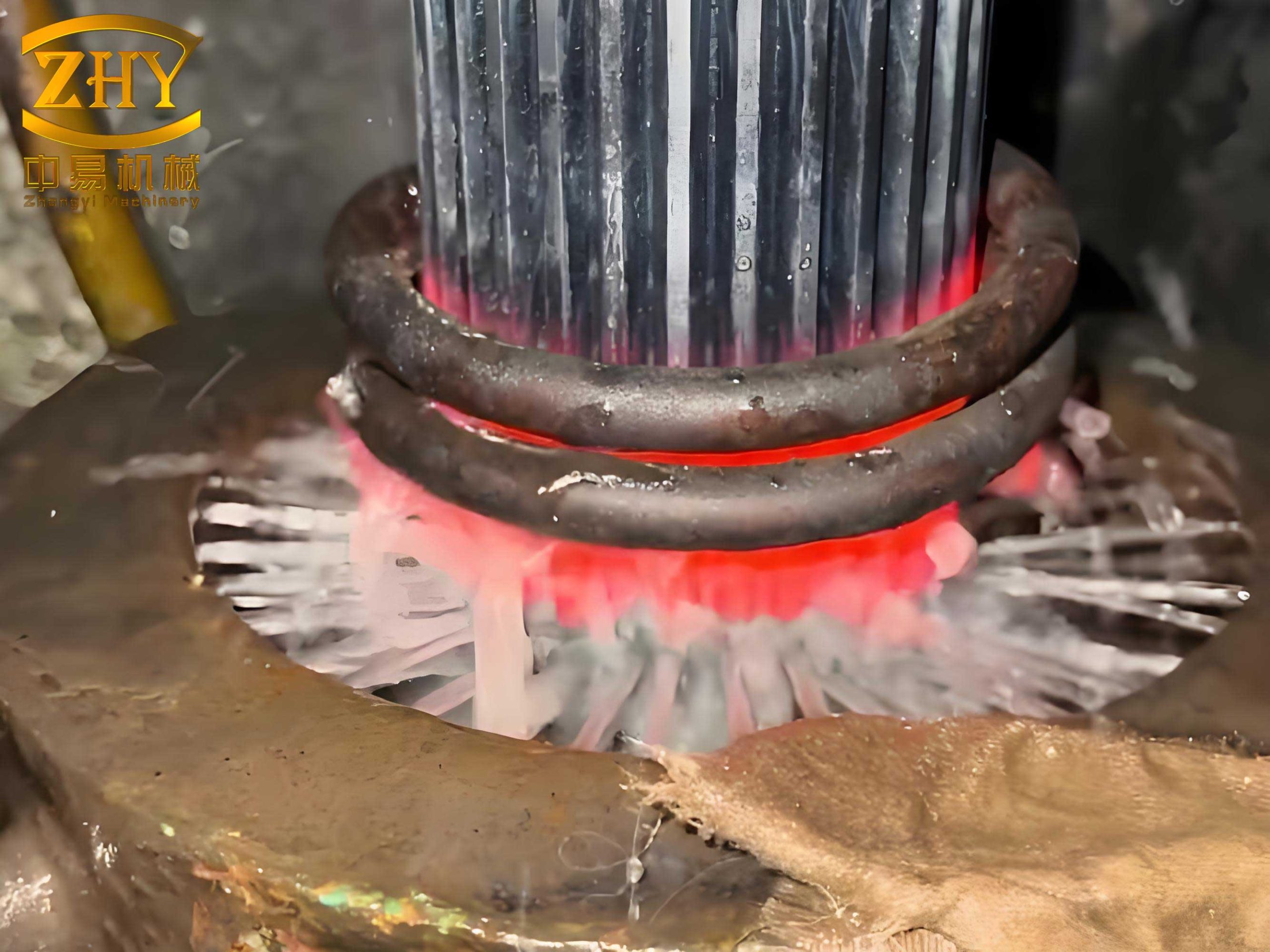
This image illustrates common heat treatment defects, such as cracks and distortions, which can be exacerbated by improper take-up speeds. The cylindrical-bevel gear gearbox, by offering fine speed adjustments, helps address these issues. For example, slow speeds in the low-range reduce thermal shocks during quenching, minimizing crack formation—a key heat treatment defect. Conversely, high speeds can prevent excessive dwell times in high-temperature zones, lowering the risk of oxidation defects. Thus, the gearbox serves as a proactive tool in defect management, aligning mechanical performance with metallurgical requirements. Heat treatment defects are not merely outcomes of thermal cycles; they are often influenced by ancillary equipment like take-up machines, making such innovations vital.
Beyond heat treatment take-up equipment, this gearbox design finds applications in other wire processing machinery, such as stranding and closing machines for cable manufacturing. In these contexts, the need for precise speed control to avoid defects like uneven lay or tension variations is similar. The圆柱一锥齿轮传动 principle can be adapted for various ratio requirements, demonstrating its versatility. For instance, in捻股机, the gearbox can regulate lay length by adjusting rotational speeds, preventing defects that compromise cable integrity. This cross-industry applicability underscores the design’s robustness, though it remains essential to consider load conditions to prevent heat treatment defects or analogous issues in other processes.
In conclusion, the cylindrical-bevel gear gearbox represents a significant advancement in take-up technology for heat treatment lines. Its ability to provide 12 speed grades with a simple and compact structure enhances process flexibility, directly contributing to the reduction of heat treatment defects. Through mathematical analysis and practical tables, I have shown how speed granularity impacts defect prevention, from minimizing grain growth to avoiding quenching cracks. While challenges like uneven wear and load surges exist, proper maintenance and design tweaks can mitigate these, ensuring reliable operation. As industries strive for higher quality and efficiency, such transmission systems will play a pivotal role in optimizing heat treatment parameters and suppressing heat treatment defects. Future developments could integrate digital controls for adaptive speed tuning, further reducing the incidence of heat treatment defects and pushing the boundaries of wire processing technology.
To recap, the key takeaways include: the gearbox’s传动系统 combining cylindrical-bevel gears and a跨轮 for wide speed ranges; the importance of speed control in preventing heat treatment defects; and the broader applications beyond heat treatment. By leveraging formulas like $$ n = n_{\text{motor}} \cdot \frac{D_1}{D_2} \cdot \frac{z_c}{z_b} $$ and tables summarizing speed grades, operators can make informed decisions to curb heat treatment defects. Ultimately, this gearbox exemplifies how mechanical ingenuity can address metallurgical challenges, making it a valuable asset in continuous heat treatment processes where consistency is paramount to avoiding heat treatment defects.