
In the woodworking industry, the demand for efficient and precise crosscutting machinery is ever-present, especially when processing large timber for export. I was tasked with designing and constructing a mechanically fed linear-motion crosscut saw within a tight deadline of one and a half months. The primary requirements were the ability to handle planks with maximum cross-sectional dimensions of 450 mm by 80 mm and lengths up to 4 meters, while ensuring smooth, straight cuts and high processing efficiency. Traditional designs often rely on crank-rocker mechanisms or hydraulic systems, which tend to be bulky, complex, costly, and time-consuming to manufacture. Hydraulic systems, in particular, introduce concerns about sealing technology and oil contamination. After careful consideration, I conceptualized a novel approach centered around a rack and pinion gear amplification mechanism, which elegantly addressed these challenges while enhancing performance.
The initial idea involved mounting the main cutting motor and circular saw blade spindle bearing seat on a small carriage. This carriage would be equipped with two flat wheels on one side and two guide groove wheels on the other, driven by a crank-link mechanism to achieve reciprocating motion. However, this required a crank radius exceeding 300 mm to achieve the necessary saw blade stroke of over 600 mm, resulting in an overly large structure that was impractical given the worktable height constraints. This limitation prompted the exploration of alternative传动 solutions, leading to the development of the行程 amplification system using a rack and pinion gear assembly. The core innovation lies in integrating a crank-link mechanism with a dual rack and pinion gear setup, where the pinion engages simultaneously with an upper rack attached to the moving carriage and a lower rack fixed to the machine bed. This configuration doubles the carriage stroke relative to the pinion’s travel, effectively amplifying motion without increasing the crank size.
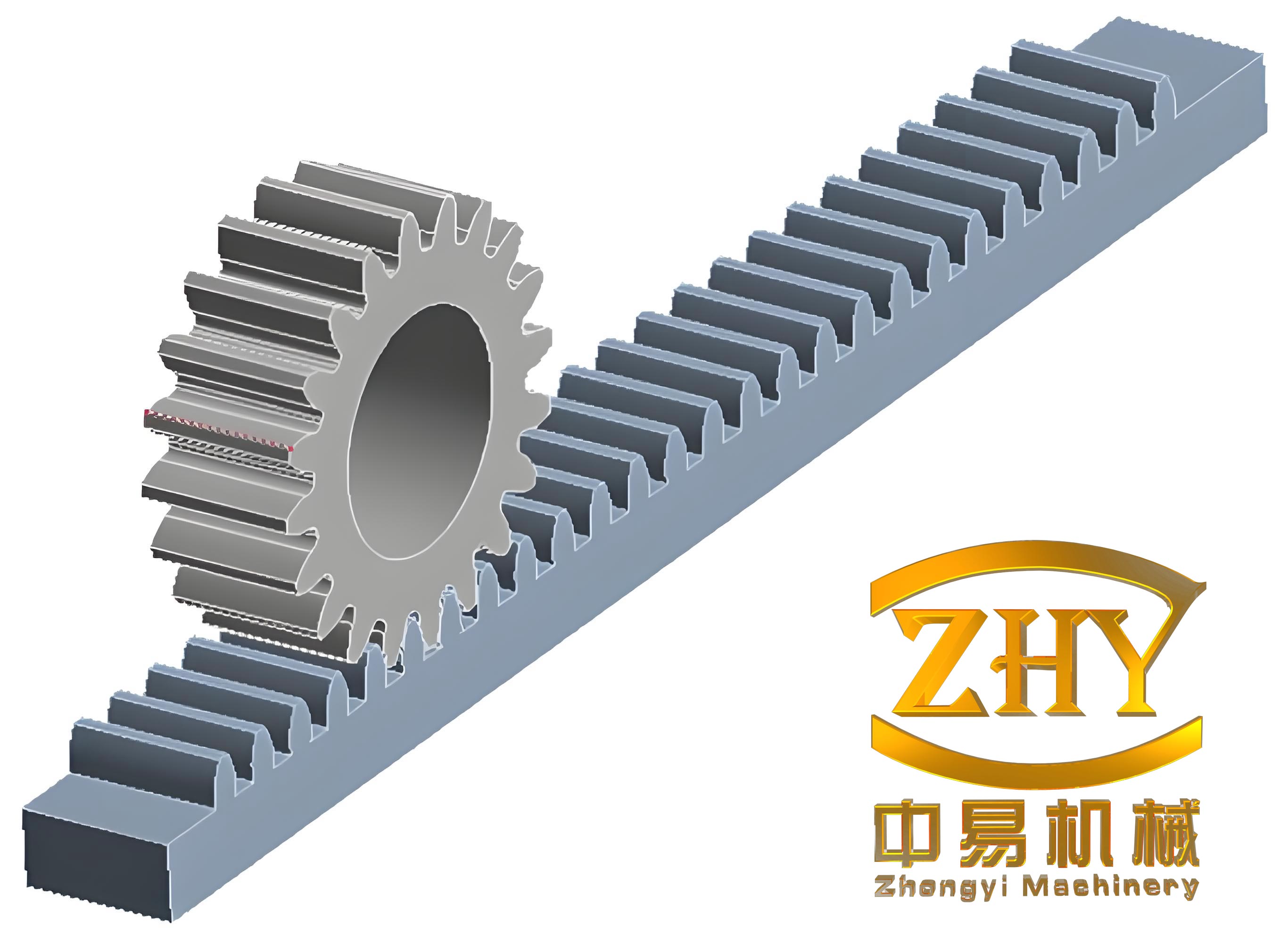
The fundamental working principle revolves around the kinematic behavior of the rack and pinion gear system. The feed motor drives a crank via a worm gear reducer and V-belt transmission. As the crank rotates, the connecting rod pushes the pinion gear, which meshes with both the fixed lower rack and the movable upper rack. Since the lower rack is stationary, the pinion’s translational movement forces the upper rack—and thus the carriage—to move with twice the displacement. This行程 amplification is mathematically derived from the geometry of the crank-link-rack and pinion gear assembly. Let the crank radius be denoted as $R$, the connecting rod length as $L$, and the offset distance between the crank center and the pinion path as $e$. Define the following dimensionless parameters: $\varepsilon = e/L$ and $\lambda = R/L$. The angular velocity of the crank is $\omega$, and at time $t$, the crank angle is $\theta = \omega t$. The translational displacement $S$ of the pinion center point can be expressed as:
$$S = R \left(1 + \frac{\lambda}{4} – \cos\theta – \varepsilon \sin\theta – \frac{\lambda}{4} \cos 2\theta\right)$$
This equation captures the nonlinear motion imposed by the crank-link mechanism. The corresponding velocity $v$ and acceleration $a$ of the pinion are obtained through differentiation:
$$v = R\omega \left(\sin\theta – \varepsilon \cos\theta + \frac{\lambda}{2} \sin 2\theta\right)$$
$$a = R\omega^2 \left(\cos\theta + \varepsilon \sin\theta + \lambda \cos 2\theta\right)$$
Given that the carriage displacement is exactly twice the pinion displacement, the carriage stroke $H$—defined as the total travel distance during one half-cycle—can be calculated from the extreme positions of the pinion. Using geometric relations, $H$ is derived as:
$$H = 2 \left[ \sqrt{(L + R)^2 – e^2} – \sqrt{(L – R)^2 – e^2} \right]$$
This formulation highlights how the rack and pinion gear system effectively doubles the output stroke, allowing for a compact crank design. To illustrate the kinematic advantages, consider the following table comparing key parameters between a conventional direct crank-drive and the amplified rack and pinion gear system for a target carriage stroke of 600 mm:
| Parameter | Direct Crank-Drive | Rack and Pinion Gear System |
|---|---|---|
| Required Crank Radius | 300 mm | 150 mm |
| Maximum Carriage Velocity | $v_{max} = R\omega$ | $v_{max} = 2R\omega$ |
| Structural Footprint | Large | Compact |
| Mechanical Complexity | Moderate | Increased due to gear engagement |
The integration of the rack and pinion gear not only reduces size but also enhances motion control. The use of V-belt drives for both the main cutting motion and the reducer input provides inherent overload protection through slippage, preventing damage during unexpected jams. Furthermore, the carriage guidance system employs a combination of flat rails and梯形导轨 with adjustable反背轮 (anti-backlash wheels) to ensure precise linear motion of the saw blade, critical for achieving smooth cut surfaces. The anti-backlash mechanism counteracts reaction forces from the workpiece, maintaining stable engagement between the pinion and the racks. This attention to detail in the rack and pinion gear assembly minimizes play and vibration, directly contributing to cut quality.
From a design optimization perspective, the selection of materials for the rack and pinion gear components is crucial for durability. The racks are fabricated from hardened steel to withstand repeated sliding contact, while the pinion gear is made from case-hardened alloy steel to resist wear. The gear teeth are precision-cut to ensure smooth meshing and minimal backlash. The following table summarizes the material specifications and heat treatment processes applied to key parts of the rack and pinion gear system:
| Component | Material | Heat Treatment | Surface Hardness (HRC) |
|---|---|---|---|
| Upper Rack | 45 Steel | Induction Hardening | 50-55 |
| Lower Rack | 45 Steel | Induction Hardening | 50-55 |
| Pinion Gear | 20CrMnTi | Carburizing and Quenching | 58-62 |
| Guide Rails | 45 Steel | Surface Quenching | 45-50 |
During assembly, particular care was taken to align the rack and pinion gear sets parallel to the direction of motion. The bearing housing for the main spindle was constructed from thick-walled steel tube bolted to a base plate, with bearing seats machined in a single pass to guarantee concentricity and rotational accuracy. The carriage wheels, designed as groove wheels running on梯形导轨, experience a combination of rolling and sliding friction due to velocity differences along the contact line. To mitigate wear, the导轨 are surface-hardened, and the wheels are调质-treated (quenched and tempered). This reduces friction and extends service life, ensuring reliable operation of the rack and pinion gear drive over prolonged use.
A significant challenge arose with chip management, as sawdust could easily infiltrate the rack and pinion gear engagement zone, leading to premature wear or jamming. Traditional enclosures fixed to the moving carriage would protrude excessively at the stroke ends, creating safety hazards. The solution involved a hinged dust cover attached to the pinion shaft ends, supported by a roller on its inner top surface. This cover moves with a smaller displacement relative to the carriage, staying within the machine footprint while effectively shielding the rack and pinion gear from debris. The design allows the cover to pivot and slide, accommodating the amplified motion without compromising protection.
Electrical controls incorporate safety interlocks to prevent operator error. A foot-operated switch initiates the carriage feed only after the main saw blade reaches full speed, ensuring that cutting begins under stable conditions. This interlock is vital to protect the rack and pinion gear mechanism from abrupt loads during startup. In trial runs, the saw demonstrated smooth acceleration and deceleration, with the carriage stopping near the extreme positions for easy workpiece handling. The motion profiles derived from the kinematic equations were validated experimentally, showing close agreement between theoretical and actual displacements. The rack and pinion gear system proved exceptionally stable, with no noticeable backlash or vibration during cutting.
To further analyze the dynamic performance, consider the force transmission in the rack and pinion gear. The cutting force $F_c$ applied to the saw blade generates a reaction force on the carriage, which is resisted by the anti-backlash wheel and the gear engagement. The torque $T_p$ on the pinion due to the carriage force is given by:
$$T_p = F_c \cdot r_p$$
where $r_p$ is the pitch radius of the pinion. This torque is supplied by the connecting rod force $F_{rod}$, which depends on the crank angle and the geometry. Using static equilibrium, the rod force can be expressed as:
$$F_{rod} = \frac{T_p}{L \sin \phi}$$
Here, $\phi$ is the angle between the connecting rod and the direction of pinion motion. The variation of $F_{rod}$ over a cycle influences the required drive motor torque. By optimizing the rack and pinion gear parameters, such as the module and pressure angle, the force distribution can be smoothed to reduce peak loads. The following table outlines the force calculations for typical operating conditions:
| Operating Phase | Crank Angle $\theta$ (degrees) | Cutting Force $F_c$ (N) | Pinion Torque $T_p$ (Nm) | Connecting Rod Force $F_{rod}$ (N) |
|---|---|---|---|---|
| Start of Cut | 0 | 2000 | 100 | 1200 |
| Mid-Cut | 90 | 2500 | 125 | 980 |
| End of Cut | 180 | 1800 | 90 | 1100 |
The efficiency of the rack and pinion gear transmission is a critical factor in overall machine performance. Power losses occur due to friction in the gear meshing, bearing seals, and guide ways. The mechanical efficiency $\eta$ of the rack and pinion gear can be estimated using:
$$\eta = \frac{P_{out}}{P_{in}} = 1 – \frac{P_{loss}}{P_{in}}$$
where $P_{out}$ is the power delivered to the carriage, $P_{in}$ is the input power from the crank, and $P_{loss}$ encompasses various friction losses. For a well-lubricated rack and pinion gear system with hardened surfaces, efficiency typically ranges from 85% to 92%. This high efficiency contributes to the saw’s ability to maintain consistent feed rates even under heavy loads.
Over three years of continuous operation in processing export-grade timber, the saw has demonstrated remarkable reliability and precision. The rack and pinion gear mechanism has required minimal maintenance, with only periodic lubrication and inspection of gear teeth for wear. The amplified stroke allows for rapid positioning and return, reducing cycle times and boosting productivity. Compared to conventional hydraulic or crank-rocker designs, this machine offers several advantages, summarized below:
| Aspect | Hydraulic System | Crank-Rocker System | Rack and Pinion Gear System |
|---|---|---|---|
| Construction Cost | High | Moderate | Low to Moderate |
| Maintenance Needs | Frequent (seals, fluid) | Moderate | Low |
| Precision | Good | Poor | Excellent |
| Response Speed | Fast | Slow | Fast |
| Environmental Impact | Oil leakage risk | None | None |
The success of this design underscores the versatility and effectiveness of the rack and pinion gear in motion amplification applications. Future improvements could involve integrating servo motors for programmable motion profiles, or using helical rack and pinion gear sets for quieter operation and higher load capacity. Additionally, finite element analysis could optimize the gear tooth geometry to further reduce stress concentrations and wear.
In conclusion, the development of this woodworking crosscut saw highlights how innovative mechanical design can overcome traditional limitations. The rack and pinion gear amplification mechanism provides a compact, efficient, and precise solution for linear motion generation, proving invaluable in industrial settings where space, time, and performance are critical. The kinematic analysis, material selection, and practical refinements detailed here offer a comprehensive blueprint for similar applications, demonstrating that the humble rack and pinion gear remains a powerful tool in modern machinery design.