
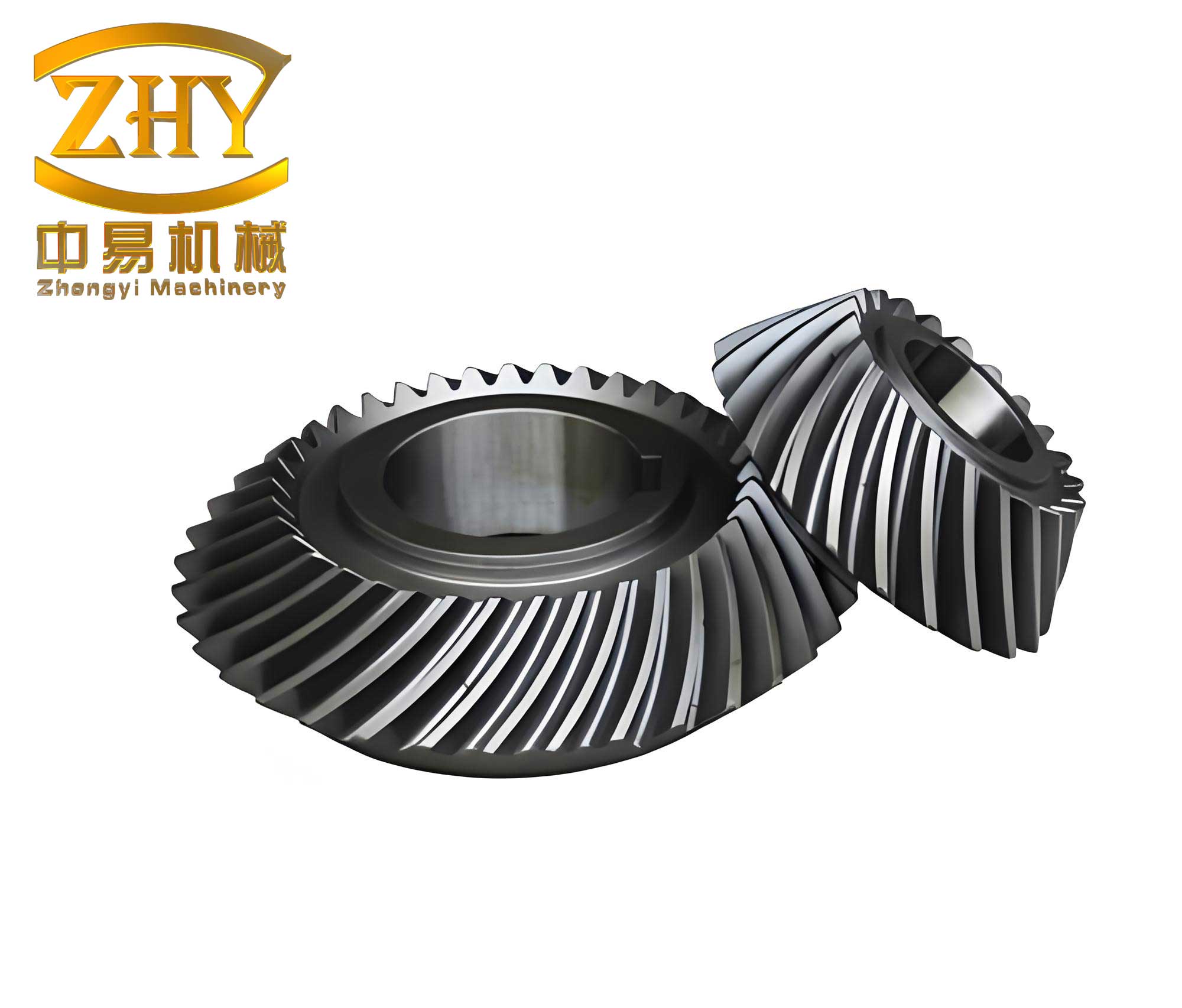
In my experience with mechanical transmission design, particularly in applications like roll straightening equipment for bar-shaped components, I encountered a challenging problem involving the transmission of motion between two axes that are neither parallel nor intersecting. This scenario is commonly addressed using spiral gears, which are essentially helical gears adapted for skew axes. While spiral gear transmissions are less common in general machinery, they offer a practical solution for low-speed rotary motion transfer between non-parallel, non-intersecting axes. Typically, when spiral gears are positioned at the shortest distance between the skew axes—i.e., along the common perpendicular—the design is straightforward, with the center distance equal to the length of the common perpendicular. However, in my specific design, the gears could not be placed at this location; instead, they had to be installed at points offset from the common perpendicular, complicating the geometric parameter relationships. This necessitated a thorough theoretical derivation to establish the connections between parameters such as center distance, axis separation, spiral angles, number of teeth, and module. Here, I present a detailed first-person account of this derivation and calculation, providing a theoretical foundation for spiral gear design in such configurations.
The core issue revolves around determining the effective center distance when the spiral gears are not on the common perpendicular of the skew axes. Consider two skew axes with a separation distance \( L \) and an angle \( \beta \) between them. The gears are installed at points on each axis that are both at a distance \( l \) from the common perpendicular line. Let the gears have a normal module \( m_n \), normal pressure angle \( \alpha_n \), number of teeth \( z_1 \) and \( z_2 \), and spiral angles \( \beta_1 \) and \( \beta_2 \), respectively. Note that for spiral gears on skew axes, the spiral angles are not necessarily equal or opposite; they depend on the axis orientation and desired motion. The center distance \( a \) in this setup is not simply \( L \); instead, it must be calculated based on the spatial geometry.
To derive the relationship, I established a right-handed Cartesian coordinate system. Let the \( x \)-axis coincide with one of the skew axes, with the origin at the midpoint of the common perpendicular. The other axis intersects the \( x \)-axis at point \( O \) and makes an angle \( \beta \) with it. The gears are installed at points \( A \) and \( B \) on the two axes, each offset by distance \( l \) from the common perpendicular. Specifically, point \( A \) lies on the \( x \)-axis at coordinates \( (l, 0, 0) \), while point \( B \) lies on the other axis. The coordinates of \( B \) can be expressed as \( (L \cos \beta, L \sin \beta, l) \), considering the geometry. The vector \( \overrightarrow{AB} \) is then \( (L \cos \beta – l, L \sin \beta, l) \).
The end face of gear 1 (at point \( A \)) is perpendicular to its axis (the \( x \)-axis), so its plane equation is given by \( x = l \). For gear 2 (at point \( B \)), the end face is perpendicular to its axis, which has direction vector related to the axis orientation. The plane equation for gear 2’s end face can be derived as passing through point \( B \) and perpendicular to the axis direction. After mathematical manipulation, the intersection line of these two planes represents the potential contact line for the spiral gears. The meshing point \( P \) must lie on this line.
By defining the meshing point coordinates and relating them to the pitch diameters of the spiral gears, I derived the fundamental relationship. The pitch diameter \( d \) for a spiral gear is given by \( d = \frac{m_n z}{\cos \beta} \), where \( \beta \) is the spiral angle. For the two spiral gears, we have \( d_1 = \frac{m_n z_1}{\cos \beta_1} \) and \( d_2 = \frac{m_n z_2}{\cos \beta_2} \). The center distance \( a \) is the distance between the axes along the line perpendicular to both gears’ planes at the meshing point. Through geometric and algebraic steps, the relationship among the parameters is expressed as:
$$ a = \sqrt{ L^2 + l^2 \sin^2 \beta + \frac{1}{4} \left( \frac{m_n z_1}{\cos \beta_1} \right)^2 + \frac{1}{4} \left( \frac{m_n z_2}{\cos \beta_2} \right)^2 – \frac{m_n^2 z_1 z_2 \cos(\beta_1 – \beta_2)}{2 \cos \beta_1 \cos \beta_2} } $$
This formula encapsulates the complex interplay between the axis geometry and spiral gear parameters. To clarify, here’s a table summarizing the key symbols and their meanings in the context of spiral gear design for skew axes:
| Symbol | Meaning | Typical Units |
|---|---|---|
| \( a \) | Center distance between spiral gears | mm |
| \( L \) | Distance between the two skew axes along common perpendicular | mm |
| \( l \) | Offset distance of gear installation from common perpendicular | mm |
| \( \beta \) | Angle between the two skew axes | degrees or radians |
| \( \beta_1, \beta_2 \) | Spiral angles of gear 1 and gear 2 | degrees or radians |
| \( m_n \) | Normal module of the spiral gears | mm |
| \( z_1, z_2 \) | Number of teeth on gear 1 and gear 2 | dimensionless |
| \( d_1, d_2 \) | Pitch diameters of gear 1 and gear 2 | mm |
| \( \alpha_n \) | Normal pressure angle | degrees or radians |
In practical spiral gear design, once the axis configuration ( \( L \) and \( \beta \) ) and installation constraints ( \( l \) ) are known, this formula allows for the determination of appropriate spiral angles and tooth numbers to achieve a desired center distance. Conversely, if the spiral gear parameters are specified, the required axis separation can be calculated. This flexibility is crucial for custom applications like the roll straightening machine I worked on, where space constraints dictated the gear placement.
To further illustrate, consider special cases that simplify the general formula. When the spiral gears are installed on the common perpendicular ( \( l = 0 \) ), the formula reduces to:
$$ a = \sqrt{ L^2 + \frac{1}{4} \left( \frac{m_n z_1}{\cos \beta_1} \right)^2 + \frac{1}{4} \left( \frac{m_n z_2}{\cos \beta_2} \right)^2 – \frac{m_n^2 z_1 z_2 \cos(\beta_1 – \beta_2)}{2 \cos \beta_1 \cos \beta_2} } $$
If the axes are parallel ( \( \beta = 0 \) ), the spiral gear transmission becomes a standard helical gear transmission for parallel axes. In this case, the formula simplifies significantly. Assuming \( \beta_1 = -\beta_2 \) (opposite spiral angles for parallel axes) and \( \beta = 0 \), we get:
$$ a = \frac{1}{2} \left( \frac{m_n z_1}{\cos \beta_1} + \frac{m_n z_2}{\cos \beta_2} \right) = \frac{d_1 + d_2}{2} $$
This is the familiar center distance formula for parallel helical gears. Moreover, if the spiral angles are zero ( \( \beta_1 = \beta_2 = 0 \) ), the spiral gears become spur gears, and the formula further reduces to \( a = \frac{m_n (z_1 + z_2)}{2} \), which is the standard for parallel spur gears. These simplifications demonstrate that the general spiral gear formula encompasses common gear transmissions as subsets, highlighting its versatility.
Another important aspect is the calculation of the effective spiral angles relative to the axis orientation. For proper meshing of spiral gears on skew axes, the spiral angles must satisfy the condition that the sum of the projection angles aligns with the axis angle. Specifically, the relationship between the axis angle \( \beta \) and the spiral angles \( \beta_1 \) and \( \beta_2 \) is given by:
$$ \beta = \beta_1 + \beta_2 $$
This ensures that the gears mesh correctly without interference. In practice, this condition is used to select or compute the spiral angles during the design phase. For instance, if the axis angle is fixed, one can choose \( \beta_1 \) and \( \beta_2 \) such that their sum equals \( \beta \), then use the center distance formula to check for compatibility with other parameters.
To aid in design decisions, I often use tabulated calculations. Below is a sample table showing how variations in spiral angles affect the center distance for a given set of parameters ( \( L = 100 \, \text{mm} \), \( l = 20 \, \text{mm} \), \( m_n = 2 \, \text{mm} \), \( z_1 = 30 \), \( z_2 = 45 \), \( \beta = 30^\circ \) ):
| \( \beta_1 \) (degrees) | \( \beta_2 \) (degrees) | Calculated \( a \) (mm) | Notes |
|---|---|---|---|
| 10 | 20 | 112.5 | Valid since \( \beta_1 + \beta_2 = 30^\circ \) |
| 15 | 15 | 110.8 | Symmetric spiral angles |
| 5 | 25 | 114.3 | Wider spread in angles |
| 0 | 30 | 118.7 | Gear 1 is effectively spur-like |
| 30 | 0 | 118.7 | Gear 2 is effectively spur-like |
This table illustrates that the center distance varies with the choice of spiral angles, allowing designers to optimize for space or performance. The spiral gear design thus offers a high degree of flexibility, but it requires careful calculation to avoid undercutting or excessive sliding velocities.
In addition to geometric parameters, the performance of spiral gears depends on factors like sliding velocity and contact ratio. The sliding velocity \( v_s \) at the meshing point can be estimated using the formula:
$$ v_s = \omega_1 \rho_1 \sin \beta_1 + \omega_2 \rho_2 \sin \beta_2 $$
where \( \omega_1 \) and \( \omega_2 \) are the angular velocities, and \( \rho_1 \) and \( \rho_2 \) are the pitch radii. For spiral gears on skew axes, sliding is more pronounced than in parallel helical gears, which can lead to higher wear. Therefore, these gears are typically used for low-speed applications. The contact ratio \( \varepsilon \) for spiral gears is also lower due to the point contact nature, but it can be approximated by considering the effective tooth action along the line of contact. A simplified formula is:
$$ \varepsilon \approx \frac{\sqrt{ \left( \frac{d_{a1}}{2} \right)^2 – \left( \frac{d_{b1}}{2} \right)^2 } + \sqrt{ \left( \frac{d_{a2}}{2} \right)^2 – \left( \frac{d_{b2}}{2} \right)^2 } – a \sin \alpha_t }{p_t \cos \alpha_t } $$
Here, \( d_a \) is the addendum diameter, \( d_b \) is the base diameter, \( \alpha_t \) is the transverse pressure angle, and \( p_t \) is the transverse pitch. These parameters must be derived from the normal module and spiral angles. For spiral gears, the transverse module \( m_t \) is related to the normal module by \( m_t = \frac{m_n}{\cos \beta} \), and the transverse pressure angle \( \alpha_t \) is given by \( \tan \alpha_t = \frac{\tan \alpha_n}{\cos \beta} \). These relationships are essential for strength and durability calculations.
To summarize the design process for spiral gears on skew axes, I propose a step-by-step methodology:
- Determine the axis configuration: measure or specify the axis separation \( L \) and angle \( \beta \).
- Identify installation constraints: decide the offset distance \( l \) from the common perpendicular, if any.
- Select initial spiral gear parameters: choose a normal module \( m_n \) based on load requirements, and tentative tooth numbers \( z_1 \) and \( z_2 \).
- Compute spiral angles: use the condition \( \beta = \beta_1 + \beta_2 \) and the center distance formula to solve for \( \beta_1 \) and \( \beta_2 \) iteratively, ensuring the center distance fits the design space.
- Verify geometric compatibility: check for interference, calculate pitch diameters, and ensure adequate clearance.
- Evaluate performance: estimate sliding velocity, contact ratio, and efficiency to confirm suitability for the application.
- Iterate as needed: adjust parameters to optimize the design.
This methodology was applied in the roll straightening machine design, where the spiral gears successfully transmitted motion between skew axes with an offset installation. The calculated center distance using the derived formula matched the physical assembly, validating the approach.
For broader context, spiral gears are also used in other applications such as old automotive differentials or certain types of pumps. However, their design often relies on empirical rules or specialized software. The theoretical derivation provided here offers a clear mathematical foundation that can be implemented in spreadsheets or custom codes for quick calculations. To facilitate this, I include below a consolidated formula set for spiral gear design on skew axes:
$$ d_1 = \frac{m_n z_1}{\cos \beta_1}, \quad d_2 = \frac{m_n z_2}{\cos \beta_2} $$
$$ \beta = \beta_1 + \beta_2 $$
$$ a = \sqrt{ L^2 + l^2 \sin^2 \beta + \frac{d_1^2}{4} + \frac{d_2^2}{4} – \frac{d_1 d_2 \cos(\beta_1 – \beta_2)}{2} } $$
$$ v_s = \frac{\pi n_1 d_1 \sin \beta_1}{60} + \frac{\pi n_2 d_2 \sin \beta_2}{60} \quad \text{(for rotational speeds \( n_1 \) and \( n_2 \) in rpm)} $$
These formulas assume the gears are standard involute profiles with normal pressure angle \( \alpha_n \). For non-standard designs, additional corrections may be needed.
In conclusion, the design of spiral gears for non-parallel, non-intersecting axes requires careful attention to geometric parameters, especially when the gears are not positioned on the common perpendicular. The derived relationship between center distance, axis separation, offset distance, spiral angles, and tooth numbers provides a robust theoretical basis for such designs. Through this work, I have demonstrated that spiral gear transmissions, while complex, are manageable with proper mathematical tools. The formulas and tables presented here can guide engineers in tackling similar challenges, ensuring reliable and efficient motion transfer in skew axis applications. Future work could explore the integration of these calculations with CAD software for automated spiral gear modeling, further enhancing design accessibility.
To reinforce the practicality, I recall that in the roll straightening machine, the spiral gears operated smoothly at low speeds, with minimal backlash, thanks to the precise parameter matching achieved through these calculations. This experience underscores the value of theoretical rigor in mechanical design, particularly for specialized components like spiral gears. As machinery evolves, such foundational knowledge remains essential for innovation and problem-solving in transmission systems.