
In modern coke production, the Coke Dry Quenching (CDQ) process stands as a pivotal technology for energy conservation, emission reduction, and pollution control. A critical component within this material handling chain is the traverse traction equipment, responsible for moving the hot coke containers, or “coke cars,” from the coke oven to the position beneath the hoist. This article details the in-house development of a highly reliable and efficient traverse traction system based on the rack and pinion gear drive principle. The discussion will encompass the structural design of two primary variants, their comparative technical characteristics, and a foundational methodology for motor sizing and selection.
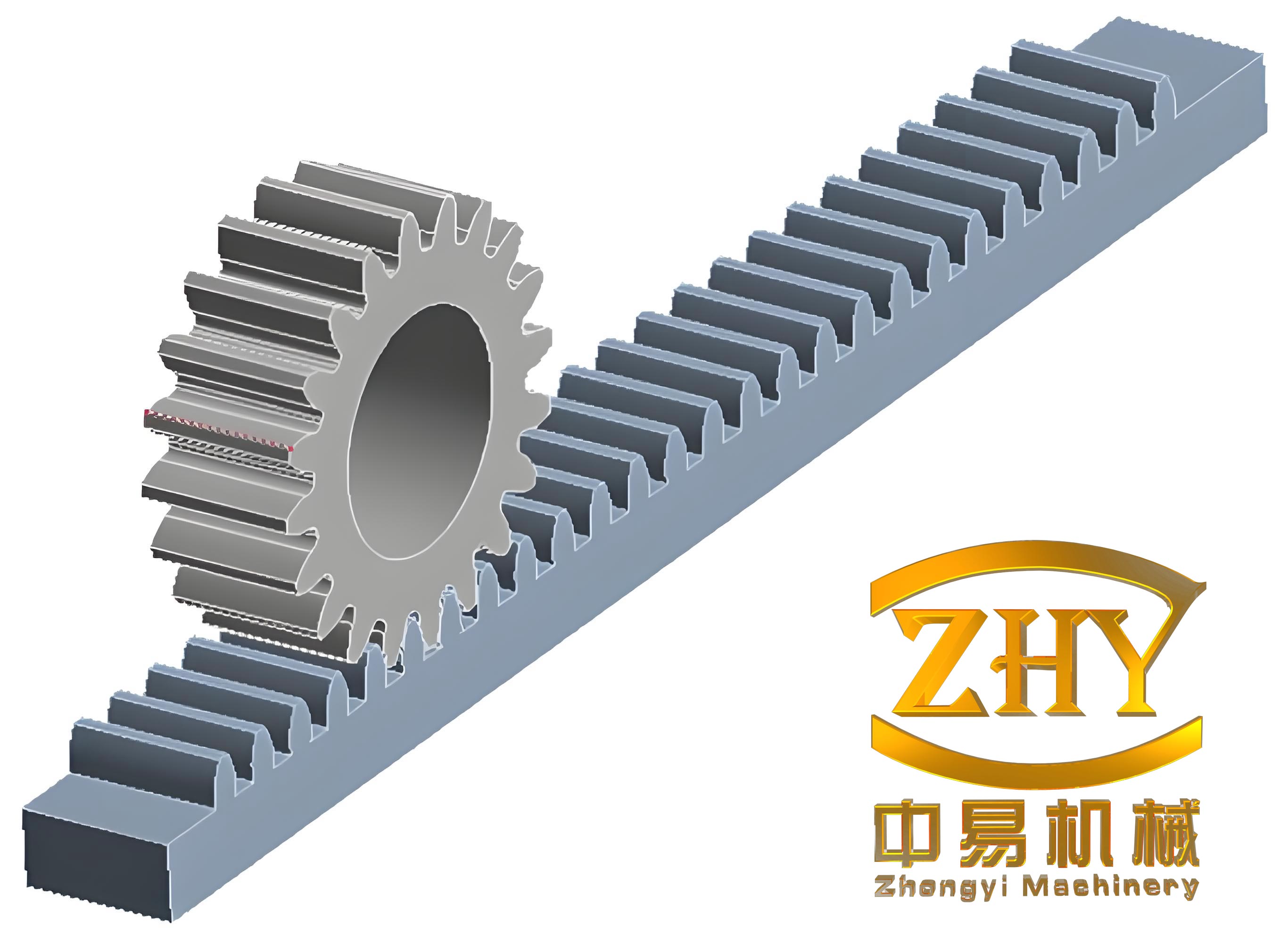
The core of our developed system revolves around the rack and pinion gear mechanism. This choice is paramount for achieving precise positioning and smooth, controlled movement under heavy loads and in demanding industrial environments. Unlike other traction methods, the positive engagement of the rack and pinion gear ensures no slippage, leading to highly reliable stop positions—a non-negotiable requirement for automated material handling. We have engineered two main configurations to suit different logistical layouts and throughput requirements: the Rack-Fixed Type and the Pinion-Fixed Type.
Structural Configuration of Traction Systems
The design of each system is tailored to its operational philosophy, with the rack and pinion gear serving as the central driving element in both.
Rack-Fixed Type Traction System
This system is engineered for high-efficiency operations, featuring a dual-hook mechanism capable of simultaneously transferring two coke cars. Its primary components are integrated onto a traveling cart that moves along a fixed track.
| Component Group | Key Elements & Description |
|---|---|
| Hook Mechanism | A welded assembly linked to the traveling cart via pins. Its lifting and lowering action is powered by an electro-hydraulic push rod mounted on the cart. |
| Traveling Cart | Comprises a welded frame, wheel assemblies, and the electric drive unit. The drive unit includes a motor, reducer, coupling, and the essential pinion gear shaft. This pinion engages with the fixed rack and pinion gear assembly installed along the track, propelling the cart. |
| Anti-Tipping Device | Consists of a keeper frame and rollers that interact with the track base to ensure stable travel and prevent derailment or tipping. |
| Manual Traction Unit (Backup) | An emergency system with a hand crank, planetary reducer, drum, and wire rope, activated if the primary electric drive fails. |
Pinion-Fixed Type Traction System
This configuration is a single-hook system designed for standard CDQ traverse processes. Here, the drive unit is stationary, and the moving assembly carries the rack and pinion gear component.
| Component Group | Key Elements & Description |
|---|---|
| Hook Mechanism | A four-bar linkage system comprising the hook, pull arm, rotating frame, and walking frame. It is connected to the sliding bar mechanism. |
| Swing Device | Utilizes a hydraulic cylinder to rotate a swing track, which in turn actuates the hook’s lifting and lowering via the linkage. |
| Sliding Bar Mechanism | The core moving assembly. It incorporates the rack gear attached to a rack frame. Driven by the stationary pinion, this entire mechanism slides along its dedicated轨道. |
| Drive Unit (Transmission) | Houses the fixed pinion gear shaft, driven by a variable-frequency motor and reducer. It also includes a backup manual drive (planetary reducer) with a clutch for emergency engagement. |
| Hold-Down Roller Assembly | Presses down on the sliding bar mechanism during travel to prevent uplift and ensure continuous engagement of the rack and pinion gear. |
Technical Characteristics and Comparative Analysis
The adoption of the rack and pinion gear transmission imparts several key advantages. The motion is inherently stable and jerk-free, which is critical for protecting the heavy, pendulum-like coke car. Positional accuracy upon stopping is exceptionally high due to the non-slip nature of gear engagement. Economically, both systems prioritize electric drive for normal operation, with a simpler manual system as a fail-safe backup, optimizing both reliability and cost.
The selection between the two types, or alternative winch-based systems, depends heavily on the specific plant layout and process requirements. The following table summarizes the primary decision factors:
| Traction System Type | Key Application Scenario | Space Requirement | Relative Cost |
|---|---|---|---|
| Rack-Fixed Type | Short traverse distance, high throughput (dual-car movement). | Moderate (fixed rack along track). | Highest |
| Pinion-Fixed Type | Standard single-car traverse processes. | Larger (moving rack requires travel path plus rack length). Can be optimized with a hinged rack design for tight spaces. | Medium |
| Winch (Cable) Drive | Long traverse distances, lighter牵引 loads. | Minimal at traverse path, but requires winch station. | Lowest |
For the pinion-fixed type, a significant design innovation involves making the rack frame in two hinged sections. This allows the trailing section to fold or pivot away when the mechanism is at one end of its travel, dramatically reducing the system’s footprint in space-constrained installations—a practical solution that maintains the benefits of the rack and pinion gear drive.
Traction speed is determined by process cycles and is typically controlled within a range of 0 to 0.73 m/s using variable-frequency drives (VFDs) and proximity switches for soft starts and precise stops.
Motor Sizing and Selection Methodology
Proper motor selection is critical for reliable operation. The sizing process involves calculating the torque required to overcome static and dynamic resistances during both steady-state running and startup acceleration. The following methodology outlines the key steps and formulas.
1. Resistances During Steady-State Traverse
The motor must overcome several static resistances while moving at constant velocity.
a) Friction Resistance Moment ($M_m$)
This includes rolling friction and wheel bearing friction, with an additional factor ($\beta$) for flange contact and track imperfections.
$$M_m = \beta (G + Q)\left(k + \mu \frac{d}{2}\right)$$
Where:
$G$ = Weight of the traveling cart/traverse frame (N)
$Q$ = Weight of the coke car and load (N)
$k$ = Coefficient of rolling friction (m)
$\mu$ = Coefficient of bearing friction
$d$ = Bearing inner diameter (m)
$\beta$ = Additional resistance coefficient (typically 1.5 – 2.5 for wheel-on-rail systems)
The corresponding friction force ($P_m$) at the wheel tread is:
$$P_m = \frac{M_m}{D_c / 2}$$
Where $D_c$ is the wheel diameter (m).
b) Wind Pressure Resistance ($P_f$)
For large-volume coke cars, wind resistance is significant, even indoors due to air displacement.
$$P_f = q \cdot \sum F$$
Where:
$q$ = Design wind pressure (N/m²). A typical value for indoor/calcified areas is 98 N/m².
$\sum F$ = Total frontal area of the cart and coke car (m²).
c) Grade Resistance ($P_p$)
Even slightly inclined tracks contribute to resistance.
$$P_p = (G + Q) k_p$$
Where $k_p$ is the grade resistance coefficient. For tracks level on a concrete foundation, $k_p \approx 0.001$.
The total static force to be overcome during steady running is:
$$P_j = P_m + P_f + P_p$$
This translates to the static torque ($M_j$) on the motor shaft:
$$M_j = \frac{P_j \cdot D_c}{2 \cdot i \cdot \eta}$$
Where:
$i$ = Total gear reduction ratio of the reducer.
$\eta$ = Overall mechanical efficiency of the drive train (gears, bearings).
2. Resistances During Startup Acceleration
During startup, the motor must also provide torque to accelerate all rotating and translating masses.
a) Dynamic Torque for Rotating Masses ($M_{d1}$)
This accelerates the motor rotor, couplings, and other parts on the high-speed shaft.
$$M_{d1} = \frac{C \cdot (GD^2)_1 \cdot n_1}{375 \cdot t_q}$$
Where:
$(GD^2)_1$ = Flywheel moment of all parts on the motor shaft (N·m²).
$n_1$ = Motor rated speed (rpm).
$t_q$ = Desired startup time (s).
$C$ = Coefficient accounting for inertia of other rotating parts (gears, wheels) referred to the motor shaft ($C > 1$).
b) Dynamic Torque for Translating Masses ($M_{d2}$)
This accelerates the linear motion of the total weight ($G+Q$).
$$M_{d2} = \frac{(G+Q)}{g} \cdot \frac{v}{t_q} \cdot \frac{D_c}{2} \cdot \frac{1}{i \cdot \eta}$$
Where:
$v$ = Final traverse speed (m/s).
$g$ = Acceleration due to gravity (9.81 m/s²).
3. Motor Torque and Power Calculation
The total torque required at the motor shaft during startup is the sum of all components:
$$M_q = M_j + M_{d1} + M_{d2}$$
Applying an overload factor ($\lambda$, typically 1.2-1.3 for AC motors) gives the required motor rated torque:
$$M_c \ge \frac{M_q}{\lambda}$$
Finally, the required motor rated power ($P_c$) in kW is:
$$P_c = \frac{M_c \cdot n_1}{9550}$$
The motor selection process begins by assuming a standard motor speed ($n_1$) and the operational speed ($v$). The required wheel speed ($n_c$) is $ n_c = \frac{60 \cdot v}{\pi D_c} $. A preliminary gear ratio is then $ i = \frac{n_1}{n_c} $. After performing the calculations above, a standard motor with a rated power equal to or greater than $P_c$ is selected from manufacturer catalogs, often a variable-frequency drive (VFD) motor for speed control.
Conclusion
The developed rack and pinion gear-based traverse traction systems represent a robust and optimized solution for material handling in Coke Dry Quenching plants. The rack and pinion gear drive is the cornerstone of this design, providing unmatched positional accuracy and smooth force transmission. By offering two principal configurations—the Rack-Fixed and Pinion-Fixed types—the design can be adapted to a wide range of layout constraints and productivity requirements, from high-throughput dual-car transfer to standard single-car operations. The systematic approach to motor sizing ensures reliable performance under both steady-state and transient startup conditions. These systems, emphasizing economy, reliability, and practical innovation—such as the hinged rack frame for space saving—have proven their long-term operational value in numerous industrial applications, solidifying the rack and pinion gear mechanism as the preferred choice for heavy-duty, precise traverse motion in harsh metallurgical environments.