
The design of the final drive hypoid gear set is a critical aspect of automotive drivetrain development. Traditionally, the determination of its fundamental geometric parameters relies heavily on empirical knowledge and iterative refinement. While this approach can yield functional designs, it often fails to achieve an optimal balance between compactness, performance, and manufacturability. Mathematical optimization techniques offer a path to more systematic design, typically aiming to minimize mass or volume while satisfying a set of strength and geometric constraints. However, conventional optimization often treats design parameters as deterministic values, neglecting the inevitable variations that occur during manufacturing and assembly. These variations can cause significant deviations in the final performance, leading to designs that are optimal only on paper but fragile in practice. This article presents a robust design optimization methodology for the hypoid gear pair in an automotive final drive, aiming to minimize its overall installed volume while ensuring the design is insensitive to parameter fluctuations.
The core objective of this design is to minimize the combined volume of the drive (pinion) and driven (ring) hypoid gear. The total volume \( V_{total} \) is defined as:
$$ V_{total} = V_{pinion} + V_{ring} $$
The individual volumes are functions of the key geometric parameters. The primary design variables influencing the volume and performance are:
- \( z_1 \): Number of pinion teeth.
- \( z_2 \): Number of ring gear teeth (often defined by the final drive ratio \( i_0 \)).
- \( m_t \): Transverse module at the pinion.
- \( b \): Face width of the gears.
- \( E \): Offset distance (the defining feature of a hypoid gear).
- \( \beta_1 \): Spiral angle of the pinion.
- \( D_2 \): Reference diameter of the ring gear.
These parameters must be chosen to provide sufficient gear tooth strength, ensure adequate ground clearance, maintain proper contact patterns, and avoid interference, all while pursuing the minimal volume goal.
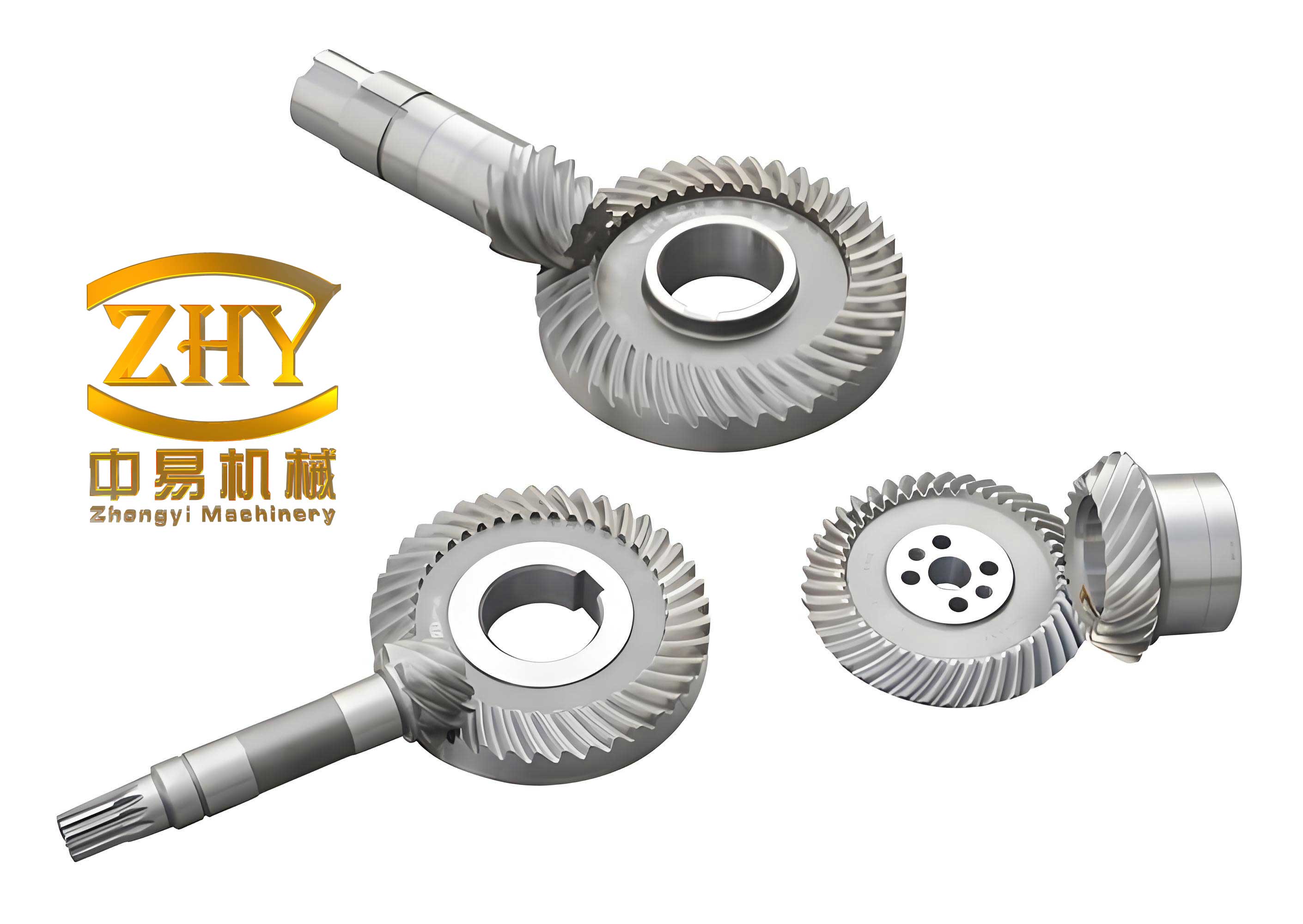
The robust optimization process is structured in three distinct stages: System Design, Parameter Design, and Tolerance Design. This case study is based on the data for a越野车 (off-road vehicle) with the following specifications:
- Engine max torque, \( T_{emax} = 172 \, \text{N·m} \)
- Transmission max ratio, \( i_g = 3.115 \)
- Fully laden mass, \( m_a = 3205 \, \text{kg} \)
- Final drive ratio, \( i_0 = 4.5 \)
- Tire rolling radius, \( r = 0.375 \, \text{m} \)
System and Parameter Design
The first step, System Design, defines the problem’s objective and constraints. Following that, Parameter Design seeks the optimal nominal values for the design parameters. Instead of using gradient-based methods initially, a direct search method employing orthogonal arrays is used to efficiently explore the design space and identify promising regions. The most influential parameters—\( z_1 \), \( m_t \), \( b \), \( E \), and \( \beta_1 \)—are selected as control factors. A seven-level orthogonal array \( L_{18}(7^8) \) is utilized. The levels for the initial screening are shown in Table 1.
| Level | \( X_1 (z_1) \) | \( X_2 (D_2) \) | \( X_3 (E) \) | \( X_4 (m_t) \) | \( X_5 (b) \) | \( X_6 (\beta_1) \) | \( X_7 \) |
|---|---|---|---|---|---|---|---|
| 1 | 7 | 35 | 17 | 5 | 24 | 17.0 | 0.80 |
| 2 | 8 | 37 | 18 | 6 | 26 | 20.0 | 0.81 |
| 3 | 8 | 39 | 19 | 7 | 28 | 23.0 | 0.82 |
| 4 | 9 | 41 | 20 | 7 | 30 | 26.0 | 0.84 |
| 5 | 9 | 41 | 21 | 7 | 29 | 29.0 | 0.86 |
| 6 | 10 | 43 | 22 | 8 | 34 | 32.0 | 0.88 |
| 7 | 10 | 45 | 23 | 9 | 36 | 35.0 | 0.90 |
After several rounds of direct search and analysis, a promising candidate design point is identified. The focus then shifts to Parameter Design for Stability. The goal is to find the nominal parameter combination that not only minimizes volume but also makes the performance (volume) least sensitive to noise factors (manufacturing variations). From the previous screening, factors \( X_3 \) (Offset \( E \)), \( X_4 \) (Module \( m_t \)), and \( X_6 \) (Spiral Angle \( \beta_1 \)) are chosen for further refinement. A three-level orthogonal array \( L_9(3^4) \) is used as the inner array for this stage. The levels are centered around the promising values from the initial search.
| Level | \( X_3 (E) \) | \( X_4 (m_t) \) | \( X_6 (\beta_1) \) |
|---|---|---|---|
| 1 | 190 | 6 | 24 |
| 2 | 195 | 7 | 28 |
| 3 | 200 | 8 | 32 |
For each of the 9 experimental runs in the inner array, an outer array is constructed to simulate the effect of noise. The control factors themselves, now treated as noise factors \( X’_3, X’_4, X’_6 \) for the outer array, are varied around their nominal levels according to assumed tolerances (e.g., ±1% for \( E \), ±5% for \( m_t \), ±6% for \( \beta_1 \)). The output characteristic, total volume \( Y \), is calculated for each combination in the outer array. This generates a distribution of \( Y \) for each inner array condition.
The robustness of each design is quantified using the Signal-to-Noise (S/N) ratio. For a “smaller-the-better” characteristic like volume, the S/N ratio \( \eta \) is calculated as:
$$ \eta = -10 \log_{10} \left( \frac{1}{n} \sum_{i=1}^{n} Y_i^2 \right) $$
where \( n \) is the number of runs in the outer array (e.g., \( n=9 \) for an \( L_9 \) outer array), and \( Y_i \) are the calculated volume values. A higher S/N ratio indicates lower sensitivity to noise, meaning a more robust design.
Analysis of the inner array results, based on the calculated S/N ratios, reveals that factor \( X_3 \) (Offset \( E \)) has a highly significant effect on robustness, followed by \( X_6 \) (Spiral Angle \( \beta_1 \)). The optimal levels are chosen to maximize the S/N ratio while considering the absolute value of the output. This process yields the best nominal parameter set from the Parameter Design stage, as shown in Table 3.
| Parameter | Symbol | Optimal Nominal Value |
|---|---|---|
| Pinion Teeth | \( z_1 \) | 9 |
| Ring Gear Ref. Diameter (mm) | \( D_2 \) | 41 |
| Offset (mm) | \( E \) | 190 |
| Transverse Module (mm) | \( m_t \) | 6 |
| Face Width (mm) | \( b \) | 29 |
| Spiral Angle (deg) | \( \beta_1 \) | 32 |
| Calculated Volume (unit³) | \( Y \) | 857,369.5 |
Tolerance Design
The final stage, Tolerance Design, determines the permissible variations (tolerances) for the parameters. Starting with the optimal nominal values from Table 3, an error factors table is built. The noise factors \( X’_3, X’_4, X’_6, X’_7 \) are assigned three levels: the nominal value (level 2), and levels corresponding to their proposed machining tolerances. For instance, based on standard gear machining precision grades, tolerances might be set as shown in Table 4.
| Level | \( X’_3 (E) \) | \( X’_4 (m_t) \) | \( X’_6 (\beta_1) \) | \( X’_7 \) |
|---|---|---|---|---|
| 1 | 189.9 | 5.97 | 28.9 | 0.868 |
| 2 (Nominal) | 190.0 | 6.00 | 32.0 | 0.872 |
| 3 | 190.1 | 6.03 | 32.1 | 0.876 |
An outer array experiment (e.g., using \( L_9(3^4) \)) is conducted with these error factors. The resulting variance in the output volume \( Y \) is analyzed using Analysis of Variance (ANOVA). The contribution of each error factor to the total variance is calculated. For this case, the analysis showed that variation in the offset \( E \) (\( X’_3 \)) contributed approximately 54.8% to the total variance, making it the most critical parameter.
To decide whether to tighten tolerances, an economic assessment is made using a quadratic loss function. The loss \( L(y) \) due to deviation from the target volume \( m \) (here, \( m = 857,369.5 \)) is modeled as:
$$ L(y) = k (y – m)^2 $$
where \( k = \frac{A_0}{\Delta_0^2} \). \( A_0 \) is the loss when the functional limit \( \Delta_0 \) is exceeded.
The expected loss for the current design with its assumed tolerances is proportional to the variance \( \sigma^2 \). The potential reduction in loss from tightening the tolerance on the most influential factor (Offset \( E \)) is evaluated. In this specific study, halving the tolerance on \( E \) was found to reduce the expected loss only marginally. However, this tightening would require a substantial increase in machining precision and cost. Therefore, the decision was made to maintain the originally assumed, economically viable tolerances. The final design specifications, including tolerances, are summarized in Table 5.
| Design Parameter | Symbol | Nominal Value | Tolerance |
|---|---|---|---|
| Pinion Teeth | \( z_1 \) | 9 | – |
| Ring Gear Ref. Diameter (mm) | \( D_2 \) | 41 | – |
| Offset (mm) | \( E \) | 190.0 | ±0.1 |
| Transverse Module (mm) | \( m_t \) | 6.00 | ±0.03 |
| Face Width (mm) | \( b \) | 29.0 | ±0.1 |
| Spiral Angle (deg) | \( \beta_1 \) | 32.00 | ±0.10 |
Conclusion
The robust design optimization methodology successfully addresses the limitations of both traditional and conventional optimization approaches for automotive hypoid gear design. By systematically integrating Parameter Design (using orthogonal arrays and S/N ratio) and Tolerance Design (using loss functions and ANOVA), the method achieves a dual objective: finding the nominal parameter set that minimizes the overall volume of the final drive hypoid gear set, and determining the economic tolerances that make this minimum-volume design resistant to manufacturing variations. The resulting design is not merely a theoretical optimum but a practical, producible solution. The parameters obtained do not require subsequent rounding or standardization, making them directly applicable for detailed engineering. This framework demonstrates significant value for automotive component design, particularly in enhancing quality and supporting localization efforts by providing a scientifically rigorous yet practical design pathway for complex drivetrain components like the hypoid gear pair.