
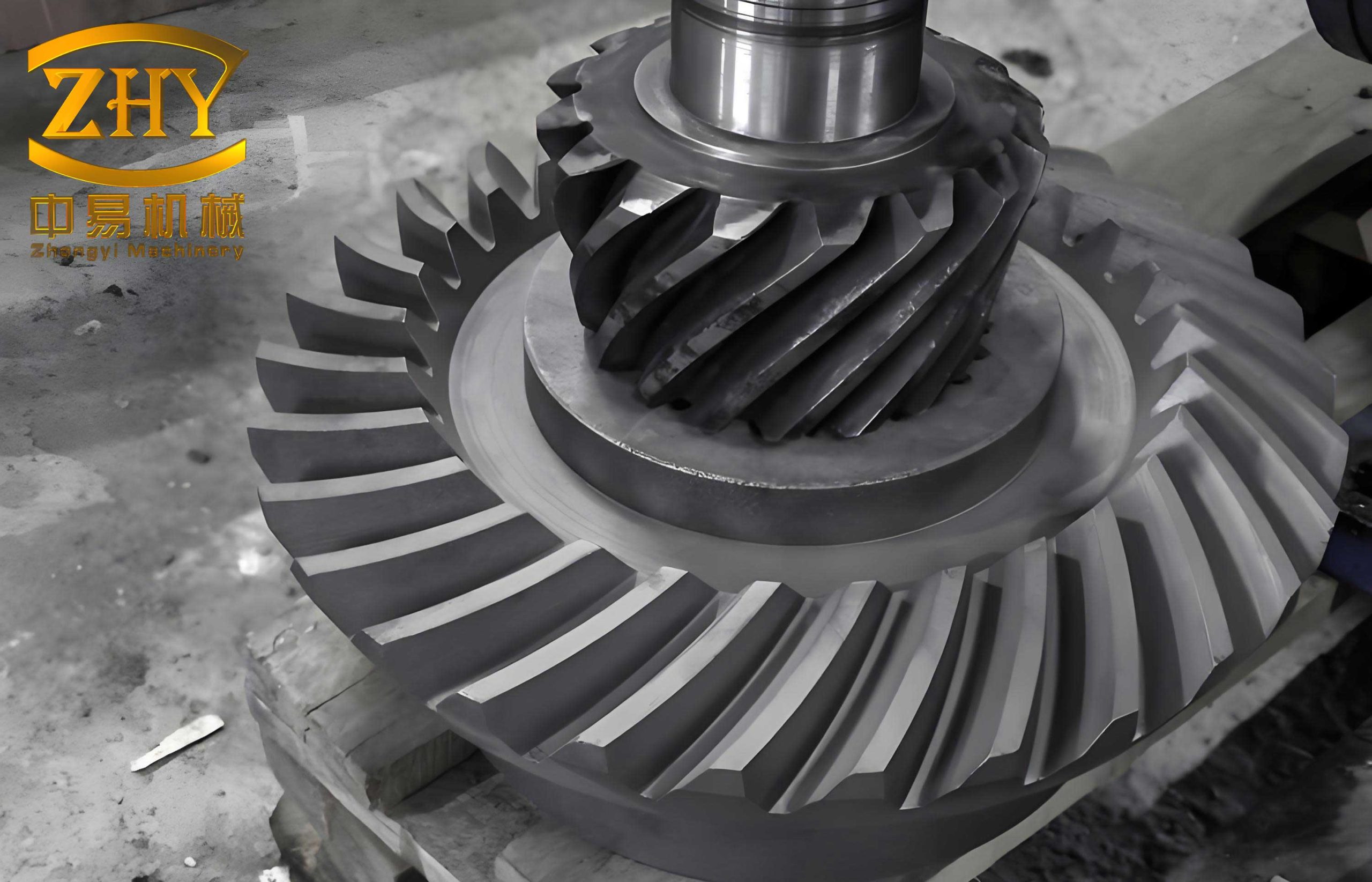
The quest for high-performance, durable power transmission components in automotive and heavy machinery has consistently driven innovation in manufacturing processes. Among these components, the helical bevel gear is critical for final drive axles, where it transmits torque at a right angle with high contact ratio and smooth engagement. While the precision forging of driven helical bevel gears has achieved notable industrial success, the plastic forming of its mating counterpart—the smaller, driving helical bevel gear with a low pinion angle—presents a more formidable challenge. This article delves into the intricate forming mechanics, experimental validation, and advanced numerical simulation of driving helical bevel gears produced through the closed-die extrusion process, offering a comprehensive analysis of this complex forging operation.
Introduction and Process Rationale
The driving helical bevel gear in an automobile’s final drive assembly is a key determinant of the system’s overall longevity. Failure of this pinion gear inevitably leads to the premature failure of the larger driven gear. Traditional machining of these gears from solid blanks is not only material-inefficient but also severs the natural grain flow, potentially creating stress concentration sites. Precision forging, in contrast, offers the promise of superior mechanical properties through continuous grain flow, material savings, and higher production rates. The primary obstacle in forging the driving helical bevel gear lies in its geometry: a pinion angle typically less than 50° and a complex, spiraled tooth form with significant axial overlap. Conventional axial forging, where metal is forced straight into the tooth cavity, results in excessively long, curved flow paths and immense resistance, making complete die filling practically impossible.
The closed-die extrusion process emerges as the most viable solution. In this method, a preformed billet is confined within a sealed die cavity containing the negative impression of the gear teeth. The application of force through upper and lower punches compresses the billet axially. This compression does not aim to push metal directly into the teeth from the ends. Instead, it strategically reduces the volume within the central core region bounded by the gear’s root cone. The hydrostatic pressure generated within this confined volume forces the material to flow radially outward into the intricate spiral tooth cavities. This radial flow path is significantly shorter and more energy-efficient than axial filling. The successful implementation of this process hinges on the intelligent design of the preform billet, the precise control of metal flow, and a deep understanding of the deformation mechanics, all of which are explored herein.
Mechanisms of Metal Flow and Preform Design
The core principle of forming a helical bevel gear via closed-die extrusion is the controlled radial flow of material. The design of the initial billet, or preform, is paramount to guiding this flow and ensuring complete die filling without defects. The optimal preform shape must be entirely contained within the “enveloping body” defined by the gear’s root cone surface and two coaxial cylinders at the major and minor end root diameters. This ensures that during compression, every element of the preform has a direct, unobstructed path to a portion of the tooth cavity.
A simplified preform for experimental and simulation studies can be represented as a truncated cone whose dimensions are derived from the gear’s root geometry. The volume of the preform must precisely match the final volume of the forged gear tooth section to prevent flash formation or underfilling. The governing equation for volume constancy is:
$$ V_{preform} = V_{gear\_body} = \int_{z_1}^{z_2} A_{root}(z) \, dz $$
where $A_{root}(z)$ is the cross-sectional area of the gear body at height $z$, defined by the root cone. The design must also consider the positioning of the neutral plane—the plane of zero axial velocity—to promote balanced flow towards both the major and minor ends of the helical bevel gear. An improperly positioned neutral plane can lead to incomplete filling at one end and excessive pressure at the other.
Experimental Investigation with Physical Modeling
To visualize the deformation mechanics, physical modeling using lead as a workpiece material was conducted. Lead, at room temperature, exhibits flow stress characteristics similar to hot steel, making it an excellent analog for modeling metal flow patterns. A specialized die set was constructed for a universal testing machine to simulate the closed-die extrusion process.
Process Sequence and Observations: The lead preform was placed in the die cavity, and the upper punch was driven downward. Specimens were extracted at various intermediate stroke positions (e.g., 10mm, 20mm, 30mm, 40mm). The sequence revealed a distinct metal filling pattern: the tooth cavities at the minor end (the small-diameter tip) filled first. As axial compression continued, the plastic deformation zone propagated towards the major end (the large-diameter flange), with these teeth filling last. This is attributed to the smaller cross-sectional area and shorter flow path at the minor end offering less resistance.
Grid Pattern Analysis: A fundamental technique in physical modeling involves etching a square grid pattern on the meridional plane of the preform. After deformation, analysis of this distorted grid provides direct insight into strain distribution and material flow.
| Deformation Stage (Axial Reduction) | Grid Pattern Observation on Meridional Plane | Interpretation of Metal Flow |
|---|---|---|
| 10 mm | Squares begin to elongate horizontally near the outer surface. | Initial radial outward flow commences at the outer diameter, compressing the central core. |
| 20 mm | Elongation becomes pronounced; grid lines curve, following the contour of the root cone. | Active radial flow into the tooth cavities is established. The central core acts as a pressure vessel. |
| 30-40 mm | Grid lines are highly distorted and densified near the tooth root fillet regions. Lines remain continuous. | Intense localized deformation occurs as material packs into the final corners of the die. The continuity confirms the absence of internal shearing defects. |
The examination of transverse (cross-sectional) slices showed the circular initial section deforming into a polygonal “star” shape, with the lobes corresponding perfectly to the tips of the forming helical bevel gear teeth. This visualization confirms the dominant radial flow mechanism.
Significance of Flow Lines: The continuous and smoothly curved flow lines revealed by the grid study are not merely academic observations. They represent the physical manifestation of unbroken grain flow. In the finished forged helical bevel gear, this translates to aligned microstructures along tooth profiles, enhanced fatigue strength, superior impact resistance, and ultimately, a longer service life compared to a machined gear with cut fibers.
Material Properties and Process Parameters
The experimental work and subsequent numerical simulation rely on accurate material models. For the physical modeling, lead’s properties were characterized. The flow stress $\sigma_f$ of lead at room temperature (20°C) can be represented by a simple constant yield stress model for the strain rates involved in this process:
$$ \sigma_f = 29.5 \, \text{MPa} $$
For simulating the hot forging of steel, a more complex model, such as the Hansel-Spittel equation, is typically used:
$$ \sigma_f = A \cdot e^{m_1 T} \cdot \phi^{m_2} \cdot \dot{\phi}^{m_3} \cdot e^{m_4/\phi} \cdot (1 + \phi)^{m_5 T} \cdot e^{m_7 \phi} \cdot \dot{\phi}^{m_8} \cdot T^{m_9} $$
where $A$, $m_1$…$m_9$ are material constants, $T$ is temperature, $\phi$ is strain, and $\dot{\phi}$ is strain rate. Friction at the die-workpiece interface is critical. A constant shear friction model is often employed:
$$ \tau = m \cdot k $$
where $\tau$ is the frictional shear stress, $m$ is the friction factor (ranging from 0 for perfect lubrication to 1 for perfect sticking), and $k$ is the shear yield strength of the material ($k = \sigma_f / \sqrt{3}$). For the lead experiments with lubricant, a friction factor of $m \approx 0.2$ was applicable.
| Parameter Category | Symbol / Name | Value / Description (Example) |
|---|---|---|
| Material (Lead) | Flow Stress ($\sigma_f$) | 29.5 MPa |
| Temperature | 20 °C (Room Temp) | |
| Friction Factor ($m$) | 0.2 (Lubricated) | |
| Process | Machine Type | Hydraulic Press (Constant Velocity) |
| Punch Speed ($v$) | 10 mm/s | |
| Process Type | Closed-Die (Occluded) Extrusion | |
| Geometry | Number of Teeth ($z$) | 7 |
| Pinion Angle ($\delta$) | < 30° |
Numerical Simulation using Rigid-Plastic Finite Element Method
To complement physical testing and gain a more detailed, three-dimensional understanding of the process, a rigid-plastic Finite Element Method (FEM) simulation was performed. This method is highly effective for large plastic deformation analysis, as it neglects elastic effects, reducing computational cost. The commercial software DEFORM-3D was utilized.
Model Setup: The simplified preform geometry was meshed with tetrahedral elements. The die components (upper punch, lower punch, and the spiral tooth cavity insert) were modeled as rigid bodies. The material model for lead ($\sigma_f = 29.5$ MPa) and the shear friction model ($m=0.2$) were applied. A constant punch velocity of 10 mm/s was prescribed.
Simulation Results and Validation:
1. Deformation Progression: The FEM simulation successfully animated the entire forming sequence. The results visually confirmed the experimental observation: sequential filling from the minor end to the major end of the helical bevel gear. The software tracked the evolution of the workpiece shape at hundreds of time steps, providing a complete digital twin of the process.
2. Strain Distribution: The effective strain ($\bar{\phi}$) contour plot is a powerful output. It revealed that the highest strain values (exceeding 5.0 or 500%) were localized in the tooth root fillets and the tips of the teeth. This indicates severe working in these regions, which is beneficial for refining the microstructure but also highlights areas of highest tool wear and potential for defect initiation if process conditions are extreme.
$$ \bar{\phi} = \int d\bar{\phi} = \int \sqrt{\frac{2}{3} d\epsilon_{ij} d\epsilon_{ij}} \, dt $$
3. Load-Stroke Curve: The simulation calculated the forming force required throughout the punch stroke. The resulting curve exhibited characteristic stages: a sharp rise during initial yielding and contact establishment, a steady but non-linear increase as the projected contact area of the deforming helical bevel gear grows, and a final steep ascent as the last, most difficult-to-fill sections (the major end tooth corners) are consolidated.
Comparison with Experiment: A critical step was validating the FEM model. The simulated final gear shape matched the experimental lead specimen accurately. The metal flow pattern shown in the simulated mid-plane cross-section closely mirrored the distorted grid from the physical test. Most importantly, the simulated load-stroke curve fell well within the envelope of scatter from multiple physical tests, with a deviation of less than 15% during the stable deformation phase. The discrepancies in the initial and final stages are attributable to idealized contact initialization and the extreme sensitivity of force to complete die filling in the simulation. This agreement confirms the validity and predictive capability of the FEM model for the closed-die extrusion of helical bevel gears.
| Aspect | Physical Experiment Result | FEM Simulation Result | Conclusion |
|---|---|---|---|
| Final Gear Geometry | Full, well-defined spiral teeth. | Full, well-defined spiral teeth. | Excellent agreement. Model accurately predicts fill. |
| Filling Sequence | Minor end first, major end last. | Minor end first, major end last. | Perfect agreement on metal flow mechanism. |
| Internal Flow Pattern | Continuous, curved grid lines densifying at roots. | Continuous, distorted mesh lines densifying at roots. | Model correctly captures strain localization and flow continuity. |
| Forming Load | Measured load-stroke curve (with scatter band). | Calculated load-stroke curve. | Good agreement (<15% error in stable phase). Model is quantitatively predictive. |
Discussion: Process Optimization and Industrial Implications
The combined experimental and numerical analysis provides a robust foundation for optimizing the closed-die extrusion process for helical bevel gears and designing the necessary tooling.
1. Tooling and Machine Requirements: The process imposes extreme pressures on the central punch(es). To mitigate this and potentially improve filling balance, the use of a double-action press is highly advantageous. Such a press can actuate both the upper and lower punches simultaneously and independently. By controlling the relative speeds of the two punches, the neutral plane can be precisely positioned, ensuring equal flow resistance towards both ends of the gear. On a conventional single-action press, a specialized die structure with a hydraulically or spring-actuated lower punch can be designed to achieve a similar counter-pressure effect.
2. Preform Design Optimization: The FEM model becomes an invaluable tool here. By parametrically varying the preform geometry (cone angle, volume distribution, presence of initial protrusions), simulations can quickly identify designs that minimize forming load, ensure complete fill, and reduce localized excessive strain. The goal is to achieve a more hydrostatic stress state to facilitate material flow into the most difficult cavities of the helical bevel gear.
3. Prediction of Defects and Tool Stresses: Advanced FEM analysis can be extended to predict potential forging defects such as laps or incomplete filling under non-optimal conditions. Furthermore, by coupling the deformation analysis with an elastic analysis of the die tools (using simulated pressure as boundary conditions), critical stresses in the punch and the fragile tooth-forming inserts can be predicted. This enables proactive design of tooling with adequate safety factors, optimal use of high-grade tool steels, and consideration of pre-stressed die rings to combat fatigue failure.
The formula for estimating the maximum punch pressure $P_{max}$ can be derived from the slab method for complex shapes and is related to the flow stress and geometry:
$$ P_{max} \approx \sigma_f \cdot \left(1 + \frac{\mu \cdot D}{h}\right) \cdot Q $$
where $\mu$ is the Coulomb friction coefficient, $D$ is a characteristic diameter, $h$ is the instantaneous height of the deforming section, and $Q$ is a complex shape factor (>1) that accounts for the additional pressure required to force metal into the intricate spiral teeth of the helical bevel gear. FEM provides a direct numerical solution for $P_{max}$ without the need for simplifying assumptions inherent in analytical $Q$ factors.
Conclusion
The closed-die extrusion process presents a technically sound and economically promising route for the net-shape forging of high-strength driving helical bevel gears. This analysis has systematically deconstructed its forming mechanics:
- The process is fundamentally driven by radial material flow from a compressed central core, not axial flow, making it essential for gears with low pinion angles and overlapping teeth.
- Physical modeling with grid analysis visually confirmed this flow pattern, demonstrating sequential die filling from the minor to the major end and revealing the continuous, beneficial grain flow achieved in the forged component.
- The development and validation of a 3D rigid-plastic Finite Element Model has provided a powerful digital tool. The model accurately replicates the forming sequence, strain distribution, and force requirements, with results showing strong agreement with experimental data.
- The insights gained directly inform critical practical aspects: the necessity for double-action presses or equivalent tooling to manage loads, the methodology for optimizing preform design, and the feasibility of using simulation for predictive tool life and defect analysis.
Therefore, the integration of fundamental metal flow principles, physical experimentation, and advanced numerical simulation forms a comprehensive framework for the development and industrialization of the closed-die extrusion process for helical bevel gears. This approach not only demystifies the complex deformation involved but also provides a clear engineering pathway to manufacture stronger, more durable gears that can meet the escalating demands of modern automotive and mechanical transmission systems.