
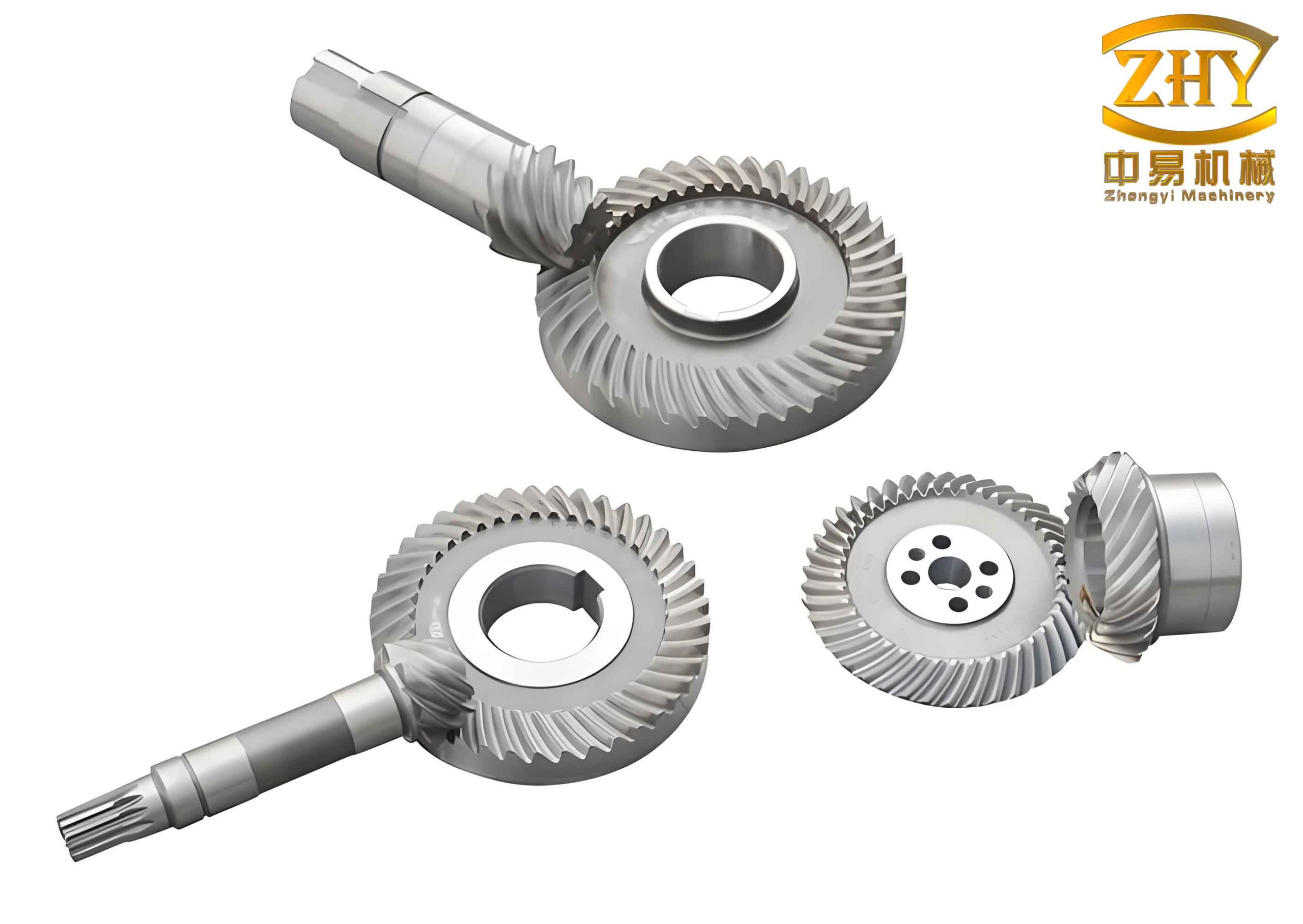
In the field of mechanical transmission, hyperboloid gears play a critical role due to their excellent dynamic performance. However, the design and manufacturing processes for hyperboloid gears are notoriously complex, involving intricate machine adjustments, trial-and-error cutting, and heavy reliance on operator experience. Traditional methods are time-consuming and costly, often requiring multiple iterations to achieve desired gear quality. With advancements in numerical control (NC) technology and computer-aided design (CAD), it is now possible to revolutionize hyperboloid gear manufacturing. In this paper, I present a comprehensive approach integrating CAD into the NC-based machining of hyperboloid gears, focusing on computer graphics simulation and tooth contact analysis (TCA) for fitted tooth surfaces. This integration aims to eliminate physical trial cutting, reduce dependency on empirical adjustments, and shorten design cycles, thereby enhancing efficiency and precision in hyperboloid gear production.
The application of CAD in hyperboloid gear manufacturing begins with a structured system that leverages virtual environments to simulate and optimize the entire process. Figure 1 illustrates the system architecture, which replaces traditional iterative machining with computer-based simulations. Initially, basic design dimensions are used to calculate cutting parameters, similar to conventional methods. These parameters are then transformed into NC tool paths through motion transformations. Subsequently, computer graphics simulation visualizes the machining process, allowing for interference detection and program validation without physical cutting. Finally, fitted tooth surface contact analysis predicts gear meshing behavior, including contact patterns and transmission errors, enabling parameter adjustments before actual machining. A feedback loop ensures that unsatisfactory results from TCA are used to refine cutting parameters iteratively until optimal performance is achieved. This system underscores the pivotal role of CAD in streamlining hyperboloid gear manufacturing.
At the core of this system is the NC motion transformation, which converts machine adjustment parameters into tool position data for simulation and NC code generation. Consider a hyperboloid gear machining setup with key parameters: tool tilt angle \(i\), tool rotation angle \(j\), workpiece axis \(P\), root cone mounting angle \(\delta_m\), offset distance \(E\), axial correction \(x\),床位 \(x_b\), angular tool position \(q\), and radial tool position \(S\). To derive tool paths, coordinate systems are established: \(\Sigma_m = \{O – \mathbf{i}_m, \mathbf{j}_m, \mathbf{k}_m\}\) fixed to the machine bed, and \(\Sigma_w = \{O_o – \mathbf{i}_w, \mathbf{j}_w, \mathbf{k}_w\}\) fixed to the workpiece. An intermediate system \(\Sigma’_m = \{O_o – \mathbf{i}’_m, \mathbf{j}’_m, \mathbf{k}’_m\}\) is also defined, with \(\mathbf{i}’_m\) aligned with the workpiece axis \(P\) and \(\mathbf{j}’_m\) parallel to \(\mathbf{j}_m\). The homogeneous transformation matrix from \(\Sigma_m\) to \(\Sigma’_m\) is given by:
$$M_{mm’} = \begin{bmatrix} \cos \delta_m & 0 & \sin \delta_m & -x – x_b \sin \delta_m \\ 0 & 1 & 0 & E \\ -\sin \delta_m & 0 & \cos \delta_m & -x_b \cos \delta_m \\ 0 & 0 & 0 & 1 \end{bmatrix}.$$
Similarly, the transformation from \(\Sigma’_m\) to \(\Sigma_w\) involves a rotation about the workpiece axis by an angle \(\varphi\):
$$M_{m’w} = \begin{bmatrix} 1 & 0 & 0 & 0 \\ 0 & \cos \varphi & -\sin \varphi & 0 \\ 0 & \sin \varphi & \cos \varphi & 0 \\ 0 & 0 & 0 & 1 \end{bmatrix}.$$
The tool center position \(O_c\) and tool axis vector \(\mathbf{c}\) in \(\Sigma_m\) are expressed as:
$$\mathbf{R}_m = [S \cos q, 0, S \sin q, 1]^T,$$
$$\mathbf{c}_m = [\sin i \sin (q – j), \sin i \cos (q – j), -\cos i, 0]^T.$$
Thus, the tool position relative to the workpiece, essential for NC programming and simulation, is computed as:
$$\mathbf{R}_w = M_{m’w} M_{mm’} \mathbf{R}_m,$$
$$\mathbf{c}_w = M_{m’w} M_{mm’} \mathbf{c}_m.$$
These equations form the basis for generating tool paths, with the relationship between \(q\) and \(\varphi\) determined by the machining method (e.g., tool tilting or modification). The derived tool positions are then used to drive computer graphics simulation, a crucial step in validating the machining process for hyperboloid gears.
Computer graphics simulation of hyperboloid gear machining involves modeling the cutting process as a Boolean subtraction between the workpiece and the tool’s swept volume. This approach relies on algorithms such as Z-buffer modeling and Boolean operations to create realistic visualizations. The Z-buffer structure represents entities by storing depth information along viewing rays, enabling efficient hidden surface removal and solid modeling. For hyperboloid gear simulation, the tool’s swept volume is constructed based on its motion path, derived from NC transformations. As the tool engages the workpiece, the Boolean subtraction updates the workpiece’s Z-buffer data, effectively “carving out” material. This process is illustrated in Figure 3, where a ray from point \((x_i, y_j)\) intersects both the tool and workpiece, splitting the workpiece’s Z-buffer into segments upon tool entry. To enhance realism, Phong’s illumination model is applied to compute shading and colors, resulting in photorealistic renderings of the gear teeth. For instance, Figure 4 showcases a simulated hyperboloid gear after machining, demonstrating the capability to inspect tooth profiles and detect potential errors virtually. This simulation not only replaces costly physical trial cuts but also allows for rapid design iterations, significantly benefiting hyperboloid gear manufacturing.
Beyond graphics simulation, fitted tooth surface contact analysis (TCA) is employed to predict the meshing behavior of hyperboloid gears without physical assembly. Traditional TCA relies on conjugate theory and analytical surface equations, but fitted TCA uses sampled points from actual gear surfaces, making it versatile for various data sources (e.g., simulation outputs or coordinate measuring machines). For hyperboloid gears, tooth surface points are sampled uniformly—typically 9 points along the tooth length (u-direction) and 5 points along the tooth width (v-direction), as shown in Figure 6. To mitigate boundary effects, additional points are included, resulting in 11×7 samples. These points are fitted using cubic B-spline functions, yielding a surface representation:
$$S_i = [U_i] [m_s] [CP_i] [m_t] [V_i],$$
where \([U_i]\) and \([V_i]\) are parameter vectors, \([m_s]\) and \([m_t]\) are basis matrices, and \([CP_i]\) is a 4×4 control point matrix derived from the sampled data. The surface normal at any point \((u_i, v_i)\) is computed as:
$$\mathbf{N}_i = \frac{\mathbf{S}’_{ui} \times \mathbf{S}’_{vi}}{|\mathbf{S}’_{ui} \times \mathbf{S}’_{vi}|},$$
with partial derivatives \(\mathbf{S}’_{ui} = [\dot{U}_i] [m_s] [CP_i] [m_t] [V_i]\) and \(\mathbf{S}’_{vi} = [U_i] [m_s] [CP_i] [m_t] [\dot{V}_i]\). This fitted surface enables efficient coordinate transformations and contact analysis for hyperboloid gears.
Contact point determination in fitted TCA involves solving for points where two gear surfaces mate under rotation. Let \(C_1\) and \(C_2\) be points on the pinion and gear surfaces, respectively, with position vectors \(\mathbf{R}_1\) and \(\mathbf{R}_2\) and unit normals \(\mathbf{N}_1\) and \(\mathbf{N}_2\) in their local coordinates. Assuming the pinion is fixed, the gear rotates by an angle \(\varphi_2\) around its axis \(P_2\) to achieve contact at point \(C\). The conditions for contact are:
$$\mathbf{R}_1 = M(\varphi_2 P_2) \otimes \mathbf{R}_2,$$
$$\mathbf{N}_1 = M(\varphi_2 P_2) \otimes \mathbf{N}_2,$$
where \(M(\varphi_2 P_2) \otimes\) denotes rotation by \(\varphi_2\). This system has five unknowns and requires iterative solving. To ensure convergence, initial guesses are taken from previous contact points or adjustment parameters. Once contact points are identified, the contact zone is analyzed using differential geometry. For a contact point \(C’\) on rotated surfaces \(S’_1\) and \(S’_2\), the first fundamental forms provide coefficients \(E_i, F_i, G_i\), and the second fundamental forms yield \(L_i, M_i, N_i\). The normal curvatures \(K_{ui}, K_{vi}\) and geodesic torsions \(\tau_{ui}, \tau_{vi}\) are calculated as:
$$K_{ui} = \frac{L_i}{E_i}, \quad K_{vi} = \frac{N_i}{G_i},$$
$$\tau_{ui} = \frac{E_i M_i – F_i L_i}{E_i \sqrt{G_i^2 – E_i F_i}}, \quad \tau_{vi} = \frac{F_i N_i – G_i M_i}{G_i \sqrt{G_i^2 – E_i F_i}}.$$
Relative curvatures between the surfaces are then derived to determine the contact ellipse. Let \(\theta_1\) and \(\theta_2\) be angles between directional vectors on the surfaces. Using Euler-Bertrand formulas, the relative normal curvatures \(\bar{K}_{nu}, \bar{K}_{nv}\) and relative torsion \(\bar{\tau}_{gu}\) are obtained. The principal relative curvatures \(\bar{K}_1, \bar{K}_2\) and their directions \(\alpha_1, \alpha_2\) are found from:
$$\tan 2\alpha_i = \frac{2\bar{\tau}_{gu}}{\bar{K}_{nu} – \bar{K}_{nv}},$$
$$\bar{K}_i = \frac{\bar{K}_{nu} – \bar{K}_{nv}}{2} \pm \frac{\sqrt{(\bar{K}_{nu} – \bar{K}_{nv})^2 + 4\bar{\tau}_{gu}^2}}{2}.$$
The semi-axes of the contact ellipse (assuming \(|\bar{K}_1| > |\bar{K}_2|\)) are:
$$L’_1 = \sqrt{\frac{0.0127}{|\bar{K}_1|}}, \quad L’_2 = \sqrt{\frac{0.0127}{|\bar{K}_2|}}.$$
These axes are projected onto the gear’s axial plane to visualize the contact pattern, critical for assessing hyperboloid gear performance.
Transmission error curves, which indicate deviations from ideal motion transfer, are derived from contact point data. For each contact point, angular increments \(\Delta \varepsilon_1\) and \(\Delta \varepsilon_2\) are computed for the pinion and gear, respectively. If the pinion is the driver, the expected gear rotation is \(\Delta I = \frac{Z_1}{Z_2} \Delta \varepsilon_1\), so the transmission error is \(\Delta \varepsilon = \Delta \varepsilon_2 – \Delta I\). Plotting \(\Delta \varepsilon\) against \(\Delta \varepsilon_2\) yields the error curve, essential for evaluating hyperboloid gear dynamics and noise characteristics.
To summarize the key parameters and steps in this CAD approach, the following tables provide structured overviews. Table 1 lists common machining parameters for hyperboloid gears, while Table 2 outlines the sampled point distribution for surface fitting. Table 3 presents typical results from contact analysis, including ellipse dimensions and transmission errors.
| Parameter | Symbol | Typical Range | Description |
|---|---|---|---|
| Tool Tilt Angle | \(i\) | 0°–30° | Inclination of tool axis relative to workpiece |
| Tool Rotation Angle | \(j\) | 0°–360° | Orientation of tool around its axis |
| Root Cone Mounting Angle | \(\delta_m\) | 10°–50° | Angle of workpiece mounting on machine |
| Offset Distance | \(E\) | 0–100 mm | Lateral displacement between tool and workpiece |
| Axial Correction | \(x\) | -5 to 5 mm | Adjustment along workpiece axis |
| 床位 | \(x_b\) | -10 to 10 mm | Bed position correction |
| Angular Tool Position | \(q\) | 0°–360° | Angular setting of tool in radial plane |
| Radial Tool Position | \(S\) | 50–200 mm | Distance from tool center to workpiece axis |
| Direction | Number of Points | Parameter Range | Purpose |
|---|---|---|---|
| Tooth Length (u) | 11 | \(u \in [0, 1]\) | Capture profile curvature |
| Tooth Width (v) | 7 | \(v \in [0, 1]\) | Capture flank topography |
| Total Samples | 77 | — | Ensure accurate B-spline fitting |
| Contact Point | Pinion Angle \(\Delta \varepsilon_1\) (rad) | Gear Angle \(\Delta \varepsilon_2\) (rad) | Ellipse Major Axis \(L’_1\) (mm) | Ellipse Minor Axis \(L’_2\) (mm) | Transmission Error \(\Delta \varepsilon\) (arcsec) |
|---|---|---|---|---|---|
| 1 | 0.000 | 0.000 | 3.2 | 1.5 | 0.0 |
| 2 | 0.025 | 0.012 | 3.1 | 1.6 | -0.5 |
| 3 | 0.050 | 0.024 | 3.0 | 1.7 | -0.8 |
| 4 | 0.075 | 0.036 | 2.9 | 1.8 | -1.2 |
| 5 | 0.100 | 0.048 | 2.8 | 1.9 | -1.5 |
The integration of CAD into hyperboloid gear manufacturing offers profound benefits. By simulating the machining process graphically, potential errors such as collisions or overcutting can be detected early, reducing scrap and rework. The use of fitted TCA enables predictive analysis of gear meshing, allowing engineers to optimize tooth contact patterns and minimize transmission errors before physical production. This is particularly valuable for hyperboloid gears, where precise contact is crucial for smooth operation and longevity. Moreover, the method accommodates data from various sources, including NC simulations and coordinate measurements, making it adaptable to different manufacturing environments. For instance, in mass production of hyperboloid gears, CAD tools can standardize parameter settings, diminishing the need for skilled operators and accelerating time-to-market.
In conclusion, the application of computer-aided design in hyperboloid gear numerical control manufacturing represents a significant leap forward. Through detailed motion transformations, realistic graphics simulations, and advanced tooth contact analysis, this approach mitigates the drawbacks of traditional methods. It not only enhances accuracy and efficiency but also fosters innovation in gear design. Future work could explore real-time simulation interfaces or AI-driven parameter optimization for hyperboloid gears. As industries demand higher-performance transmissions, the synergy of CAD and NC technology will continue to propel hyperboloid gear manufacturing into new eras of precision and reliability.
The mathematical foundations discussed here are encapsulated in key formulas. For NC motion, the tool position is central:
$$\mathbf{R}_w = M_{m’w} M_{mm’} \mathbf{R}_m.$$
For surface fitting, the B-spline representation is:
$$S_i = \sum_{k=0}^{3} \sum_{l=0}^{3} B_k(u) B_l(v) \mathbf{CP}_{kl},$$
where \(B_k\) and \(B_l\) are basis functions. In contact analysis, the relative curvature calculation is vital for hyperboloid gears:
$$\bar{K}_1 = \frac{\bar{K}_{nu} + \bar{K}_{nv}}{2} + \frac{1}{2} \sqrt{(\bar{K}_{nu} – \bar{K}_{nv})^2 + 4\bar{\tau}_{gu}^2}.$$
These equations, combined with the tabulated data, provide a comprehensive toolkit for implementing CAD in hyperboloid gear production. By embracing these techniques, manufacturers can achieve superior gear quality while reducing costs and lead times, ultimately advancing the field of mechanical engineering.